Go Back   Home > Forums > Blogs
Home Forums Rules Articles Store Gallery Blogs Register Donations FAQ Calendar Search Today's Posts Mark Forums Read

Please consider donating to help us continue to serve you.

Ads on/off / Custom Title / More PMs / More album space / Advanced printing & mass image saving
Old
Rating: 2 votes, 5.00 average.

Tech note: Balanced lines-1

Posted 13th January 2010 at 06:54 PM by janneman
Updated 13th January 2010 at 06:57 PM by janneman

Why would one use balanced interconnects, and how can we make them work well?

Balanced lines came about at a time where very long signal lines were coming in use for telephone and later for large audio performance venues. If you use a single screened line for your signal, and the line is long, the ground current through the screen causes a voltage between the ground points of the cable ends. Since the signal send out (and received) is the difference between the voltage on the signal wire and the ground wire, the unwanted signal (noise, hum) is effectively added to the wanted (music) signal. We don’t want that.

The trick is to use TWO signal lines in parallel. You send the signal over the two lines in such a way that the signal you want to transmit is the difference between the signals on these two wires, and then at the receiving end you have an amp that reacts to the difference between the two lines, so your signal at the far end is the difference between...
Attached Thumbnails
Click image for larger version

Name:	balanced lines-1.jpg
Views:	2501
Size:	71.9 KB
ID:	90  
janneman's Avatar
diyAudio Member
Posted in Uncategorized
Views 2041 Comments 1 janneman is offline
Old
Rating: 4 votes, 5.00 average.

PSU for High end audio without electrolytic capacitors

Posted 13th February 2010 at 06:18 PM by Nazar_lv (Creative High end audio)
Updated 18th March 2010 at 03:52 PM by Nazar_lv

From article http://overture.org.ua/?p=238
----------------------------------------------

Electrolytic capacitors are constant part of power supply of audio devices, but in terms of sound he does not bring anything good, dispersion of sound quality-type of electrolytic capacitor is very large. Sonically the best types of electrolytic caps are Nichicon KZ, FG, Panasonic Pureism, Black Gate FK, NX, Elna Cerafine, Silmic II, Silmic,but the attempt to eliminate from PSU electrolytic capacitors was very successful, instead is used "electronic capacitor" (right side of the circuit).
It is global negative feedback free electronic substitutes, that has a low and stable impedance 0,1...0,2Ohm (equivalent to cap 40000u) in the band to megahertz shunting NP0 0,1 microfarads Murata GRM31 in close to chips, it completely detach regulator (317\337) from load, therefore we have the ideal transient response when load "changes", and dont have noise and output...
Attached Thumbnails
Click image for larger version

Name:	capacitorless.GIF
Views:	3636
Size:	24.8 KB
ID:	113  
Nazar_lv's Avatar
diyAudio Member
Posted in Uncategorized
Views 5969 Comments 11 Nazar_lv is offline
Old
Rating: 2 votes, 5.00 average.

Synergy "Active" Crossover

Posted 6th April 2010 at 01:38 PM by wintermute (Wintermutes Rantings)
Updated 5th January 2011 at 03:18 AM by wintermute (fixed a couple of typos, and added a small amount of clarification.)

Following on from YARPS I thought I would post the design I have been working on for my active crossover (which is in fact is what the YARPS power supply was designed to drive).

So here I present the Synergy "Active" Crossover. Please note I have only simmed it at this stage (and when I started I knew nothing about active filter design) so there is no guarantee it will work.

Why have I put "Active" in quotes? Because whilst this filter uses active components, for all intents and purposes it behaves like a passive filter. It basically emulates either an LC or a CL passive 2nd order filter.

Why the name Synergy? Well I though it was the best word to describe the differing technologies working together to give the end result

The design goal is to have an active crossover that for all intents and purposes is transparent. That is it does nothing other than split the frequencies at the desired crossover point....
Attached Thumbnails
Click image for larger version

Name:	synergy.png
Views:	2731
Size:	19.8 KB
ID:	142   Click image for larger version

Name:	synergy_freq_resp.png
Views:	1775
Size:	18.5 KB
ID:	143  
Attached Files
File Type: zip synergy.zip (9.6 KB, 251 views)
wintermute's Avatar
diyAudio Moderator
Views 4000 Comments 12 wintermute is offline
Old
Rating: 3 votes, 5.00 average.

Salas DCB1 "BLUE EDITION"

Posted 15th June 2010 at 04:56 PM by Tea-Bag
Updated 7th September 2011 at 09:10 PM by Tea-Bag (added BOM)

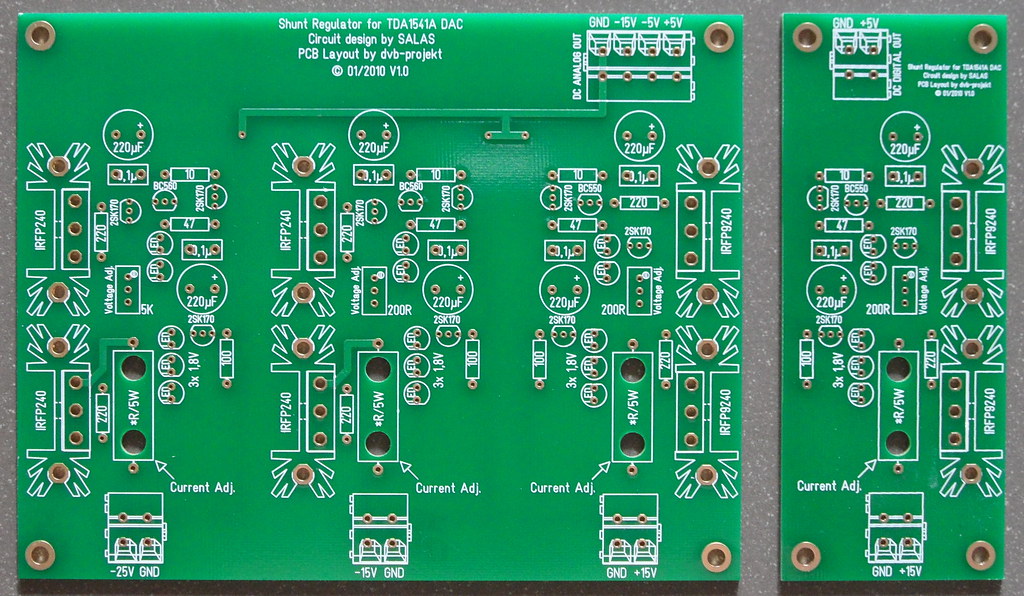
So I am going to write some details down about the DCB1 Blue Edition Buffer. This is the best I can tell, the third or fourth iteration of this buffer/Power supply. The GB will certainly represent the third run of the buffer.

Salas added some tweaks to the design which CRT implemented. I will be offering these boards for sale.

Click the image to open in full size.

Here are some things that make it different,
It's a larger board.
More room for filter caps.
They can handle 10mm pitch snap-in capacitors 25mm width capacitors.

Click the image to open in full size.


There are positions for smaller MUR120 type diodes or MUR820 style TO-220 style diodes.

The vRef LEDS can now be bypassed with a 25mm Film cap or a 100uf electrolytic.

Click the image to open in full size....
Attached Files
File Type: pdf Blue DCB1 v1.0.4.pdf (42.5 KB, 2382 views)
File Type: pdf SalasDCB1shuntreg build guide v4.1.pdf (50.7 KB, 1634 views)
File Type: pdf BOM DCB1 Oenboek.pdf (168.7 KB, 825 views)
Tea-Bag's Avatar
diyAudio Member
Posted in Uncategorized
Views 6993 Comments 3 Tea-Bag is offline
Old
Rating: 2 votes, 5.00 average.

Don't be such a scientist!

Posted 15th June 2010 at 05:21 PM by janneman
Updated 15th June 2010 at 05:25 PM by janneman

I didn't get it. There are gifted design engineers on this forum. They get involved in threads. BUT, in most cases, eventually an 'issue' develops and the engineering guy gets binned or banned or asks to be banned. Why why why? Happened to me a few times. Not that I got banned, thank Ohm, but I got close to leaving because I too got enough of it.
Of what?
Let me explain. Most engineering types like to explain things, to tell others with less experience and knowledge what they are doing wrong and how they can do it better. They inundate you with facts, figures, links to engineering papers etc, and expect that the other guy flows over with gratitude. But, funny enough, it doesn't happen that way. The 'other guy' gets pissed off from being corrected all the time. Hell, he didn't come here for that, he came to have fun, discuss his hobby and his latest creation.

[flashback] At the time Al Gore's An inconvenient Truth came out, the same director (!) also made Too...
janneman's Avatar
diyAudio Member
Posted in Uncategorized
Views 3000 Comments 27 janneman is offline
Old
Rating: 2 votes, 5.00 average.

Basic common emitter amplifier design

Posted 28th August 2010 at 09:43 PM by wakibaki

The amplifier is probably the single most important composite circuit element in electronics. Certainly such familiar devices as radios and music systems would be impossible without amplifiers. The very large majority of amplifiers these days are solid state, that is, they use transistors. While there are many types of transistors, the first mass-produced transistors were BJTs, or bipolar junction transistors, and understanding transistor amplifiers, for most people, begins with these.

The transistor has three terminals and can be arranged in three basic amplifier configurations, the common emitter, common base (or grounded base) and common collector or emitter follower amplifiers.

Common base amplifiers are not commonly employed at lower frequencies as, amongst other reasons, they have a low input impedance, although they can be found in amplifiers for e.g. moving coil microphones. They are sometimes employed as current buffers, having a current gain of 1,...
Attached Thumbnails
Click image for larger version

Name:	common_emitter_3.jpg
Views:	1196
Size:	12.9 KB
ID:	237   Click image for larger version

Name:	common_emitter.jpg
Views:	1045
Size:	8.9 KB
ID:	238  
Attached Files
Banned
Posted in Uncategorized
Views 3991 Comments 0 wakibaki is offline
Old
Rating: 2 votes, 5.00 average.

PCBs for Dummies

Posted 19th February 2011 at 12:49 AM by NYCOne

WARNING:


The following method uses deadly, strong chemicals. Do not proceed as you could die, or lose a part of your body you value (eyes, face, hands, other). The following is for entertainment purposes ONLY. Following this method is taking extraordinary risk and you could get gravely injured, or die.

Yes, I was a dummy when it came to PCBs. In fact, I was a dummy when I came to anything DIY Audio a few months ago. Of course, now I’m an expert in all things.

All the information you could ever want is in the forum – “Just search the forum…”

It really irks me when people post that. “Hey, I already searched the forum, and now I’m asking…” As a newbie, I knew NOTHING about circuits, PCBs, soldering, resistors, you name it. I always wonder if the “experts” realize that new people enter the hobby now and again.

After trying lots of things, buying lots things, and running some experiments, I know a little bit about...
diyAudio Member
Posted in Uncategorized
Views 1911 Comments 5 NYCOne is offline
Old
Rating: 3 votes, 4.67 average.

GB F5 Guide (pcb version 2)

Posted 3rd February 2010 at 02:17 AM by cviller
Updated 28th July 2011 at 07:49 AM by cviller

As promised, I would make a guide to the boards and in particular to the additions I have made to the F5. I decided to do this in the blog, because then you can give me comments which I can use for improving the doc. However I'm not done at all, but I thought it would be nice to give you access to the BOM I have made.

IMPORTANT: Before you start stuffing your boards, you must read the manual/article written by Nelson Pass – available for download on the First Watt website (First Watt: Products: F5).

PCB
Here is a picture of the pcb.
Click image for larger version

Name:	f5_v2_front.jpg
Views:	8682
Size:	150.5 KB
ID:	99
There are no more boards available, but you can order F5 boards on the diyAudio store.


Schematics
Click image for larger version

Name:	f5_cascode_forguide.png
Views:	8631
Size:	67.7 KB
ID:	98
Optionality
With the addition of optional extra output mosfets and cascoding, there are many possible ways to build the amp. Here I'll try to explain some of them.

Stock F5 example
Greens are populated and...
Attached Thumbnails
Click image for larger version

Name:	f5_v2_front_two_output_pairs.jpg
Views:	6755
Size:	155.5 KB
ID:	102   Click image for larger version

Name:	f5_v2_front_two_output_pairs_cascode.jpg
Views:	6475
Size:	155.5 KB
ID:	103   Click image for larger version

Name:	f5_v2_front_stock_f5_rev2.jpg
Views:	5207
Size:	155.7 KB
ID:	151  
Attached Files
File Type: pdf bom.pdf (50.9 KB, 2892 views)
cviller's Avatar
diyAudio Member
Posted in Uncategorized
Views 30560 Comments 74 cviller is offline
Old
Rating: 3 votes, 4.67 average.

Feedback, or how to be late and be on time the same time, all the time.

Posted 3rd November 2010 at 06:19 AM by janneman
Updated 3rd November 2010 at 11:20 AM by janneman

Just a couple of days ago I posted something to try to debunk that tired old myth that 'feedback always comes too late and therefor can't work'. Apart from the fact that obviously it does work, which makes the first statement pretty stupid to begin with, here's my take on it.

The myth may result from an often repeated misconception that feedback comes 'after the fact' and therefore always comes too late.
This has been shown to not be the case over and over again but if you have no engineering background it may be difficult to grasp the concept. Let me try to help.

Obviously, there is a signal delay in an amp from input to output and back to the input through the feedback loop. Since the feedback loop is generally a pair of resistors, the bulk of the delay is in the amp. That is the case both in non-feedback as well as in feedback amps. Such delays are very small, often fractions of a microsecond, and in this context can be ignored.

What...
janneman's Avatar
diyAudio Member
Posted in Uncategorized
Views 1102 Comments 3 janneman is offline
Old
Rating: 7 votes, 4.43 average.

Tech note: voltage regulators-1

Posted 7th January 2010 at 06:10 PM by janneman
Updated 11th February 2010 at 04:31 AM by Jason

There are lots of types of voltage regulators, but in this installment I’ll talk about series regulators.

What’s a regulator? It’s all in the name: it REGULATES the voltage to the circuit to be powered to keep it constant and as free of noise and ripple as practical. The ‘regulation’ means that there is some circuitry that compares a reference voltage, like from a zener diode, to the regulated output voltage, and then uses the difference between the two to adjust another element to null that difference. The ‘compare-and-correct’ is crucial for a regulator, and is done by negative feedback….

Look at Fig 1: is there a regulator in there? No, they are all circuits that try to give a constant, ripple free voltage, but if you start to draw varying currents from them, the output will vary with that current and there is no mechanism that somehow tries to null out that variation. Fig 1c is better than 1b, because Q1 buffers the voltage from the zener reference, so...
Attached Thumbnails
Click image for larger version

Name:	reg-1-1.jpg
Views:	4066
Size:	8.0 KB
ID:	87   Click image for larger version

Name:	reg-1-2.jpg
Views:	3946
Size:	13.0 KB
ID:	88  
Attached Files
janneman's Avatar
diyAudio Member
Posted in Uncategorized
Views 4944 Comments 5 janneman is offline
Hide this!Advertise here!

New To Site? Need Help?

All times are GMT. The time now is 06:01 PM.

Page generated in 0.13143 seconds (90.28% PHP - 9.72% MySQL) with 13 queries

Copyright ©1999-2012 diyAudio