

Dear All
I have used LED cathode bias on a number of valves, but only recently tried it on some ecc83. I am pleasantly surprised with the improvement.
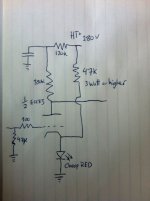
The problem with LED bias on ecc83 is that the current draw of this valve is too meager to induce any standard LED to conduct. I therefore bring the LED to continuously conduct by an additional connection, bypassing the valve (and annode resistor) entirely with a separate sufficient wattage higher value resistor directly to the HT.
The value of this resistor is chosen to drop almost all the HT and deliver approx. 6mA current to the cheap red LED. For my test circuit I am using HT of 280 Volts so chose a 5 watt 47K ohm resistor that I had handy. I pre-selected the red LED's and chose two that elevate the cathode by 1.67 volts on each channel.
My method of testing for linearity is a crude point-based method. Nevertheless, I measure distinct improvments that I believe can be heard with my own ears...
The by-passed LED bias on e83cc also seems to remove any last vestiges of power supply noise. Perhaps there is a bit of aikido-stype ps noise injection in this method. Since I by-pass the LED to make it continuously conduct, the effect is electrically similar to filament bias.
When I have used LED bias on other valves the change is distinct and subtle, but the changes I am getting with this method on e83cc seem even more significant. Maybe it is just my own biased hearing though. Has anyone else done this before?
Ian
I have used LED cathode bias on a number of valves, but only recently tried it on some ecc83. I am pleasantly surprised with the improvement.
The problem with LED bias on ecc83 is that the current draw of this valve is too meager to induce any standard LED to conduct. I therefore bring the LED to continuously conduct by an additional connection, bypassing the valve (and annode resistor) entirely with a separate sufficient wattage higher value resistor directly to the HT.
The value of this resistor is chosen to drop almost all the HT and deliver approx. 6mA current to the cheap red LED. For my test circuit I am using HT of 280 Volts so chose a 5 watt 47K ohm resistor that I had handy. I pre-selected the red LED's and chose two that elevate the cathode by 1.67 volts on each channel.
My method of testing for linearity is a crude point-based method. Nevertheless, I measure distinct improvments that I believe can be heard with my own ears...
The by-passed LED bias on e83cc also seems to remove any last vestiges of power supply noise. Perhaps there is a bit of aikido-stype ps noise injection in this method. Since I by-pass the LED to make it continuously conduct, the effect is electrically similar to filament bias.
When I have used LED bias on other valves the change is distinct and subtle, but the changes I am getting with this method on e83cc seem even more significant. Maybe it is just my own biased hearing though. Has anyone else done this before?
Ian
Attachments
Last edited:

The dynamic resistance of a red LED is ~5 ohm and the resistor connected to the PS is 47000 ohm. This gives an injection ratio of ~5/47000 or 0.01%.The by-passed LED bias on e83cc also seems to remove any last vestiges of power supply noise. Perhaps there is a bit of aikido ps noise injection in this method.
The PSRR of a commond catode stage is rp/(rp+Ra). Devide that ratio by the gain of the stage and you'll find what to inject to cancel out PS rippel..

Done exactly what? Do you mean injecting more current via additional resistor in series with LED? It must be done to set operating point for an LED dynamic resistance to be (more) linear and low(er).
Last edited:

Yes, I've posted on this several times and the resistor "trick" was added to the components chapter of "Valve Amplifiers" 4th edition. It's a great way to run ECC83, a tube which is rarely used correctly. If you use a CCS on the plate, then buffer the output, the linearity is stunningly good.
Looking at your schematic: the injection point is in phase with the ripple. No ripple cancellation in other words..
Voltage ripple is also at the plate, so you in general subtract those injected at the cathode. Yet, you should calculate if it is significant with the values from the schamatic. See: Lowering SE Amplifier Noise (page 4)
Thanks Sy, I always buffer the output on ecc83 - the output impedance for the above circuit is otherwise far too high... 😉 I only have the 3rd edition of MJ's book - my wife finally gave it to me for christmas 2011 so can't really justify buying the 4th.
For some of my testing I also used an annode choke instead of a resistor - which sounds fine, but the effect was at all so startling as that of the LED. I only wish I had tried this earlier.
Thanks for your input jane - it must just be my ears then. I have to push the circuit quite hard to get any audible ps noise anyway. Strange things is also this... it does seem to have greater amplification factor as well (at least to my ears). But I haven't yet bothered to try and measure this yet...
What I find is that this way of bias appears much better than standard LED bias - although it might only be possible on certain valves.
For some of my testing I also used an annode choke instead of a resistor - which sounds fine, but the effect was at all so startling as that of the LED. I only wish I had tried this earlier.
Thanks for your input jane - it must just be my ears then. I have to push the circuit quite hard to get any audible ps noise anyway. Strange things is also this... it does seem to have greater amplification factor as well (at least to my ears). But I haven't yet bothered to try and measure this yet...
What I find is that this way of bias appears much better than standard LED bias - although it might only be possible on certain valves.
Last edited:


Thanks Sy, I always buffer the output on ecc83 - the output impedance for the above circuit is otherwise far too high... 😉 I only have the 3rd edition of MJ's book - my wife finally gave it to me for christmas 2011 so can't really justify buying the 4th.
<snip>
I have the first, third and fourth editions, there is sufficient new material in the fourth edition that I felt justified in getting a copy. (Well actually my wife ordered me a copy for last Christmas, which I finally got a couple of months ago.)
I use and like LED bias, but these days am also using battery powered grid bias. Lithium alkaline (1.8 - 1.9V new) and alkaline (1.6V new typically) have proven quite worthwhile in my recent designs. I've also used A23 12V types in certain applications. (See my Muscovite thread in analog sources for an example)
That only works for transformer coupling. For RC coupling the ripples add, as 'jane' said.yagoolar said:Voltage ripple is also at the plate, so you in general subtract those injected at the cathode. Yet, you should calculate if it is significant with the values from the schamatic.
See: Lowering SE Amplifier Noise (page 4)
Hi Kevin
I actually use battery grid bias on the next stage in this circuit. Its similar to the ear 834p schematic... I was going to tear it apart but decided to tinker with it instead 😉
I agree that battery grid bias is very good. Since the batteries only reference the grid they seem to last a VERY LONG time...
Ian
I actually use battery grid bias on the next stage in this circuit. Its similar to the ear 834p schematic... I was going to tear it apart but decided to tinker with it instead 😉
I agree that battery grid bias is very good. Since the batteries only reference the grid they seem to last a VERY LONG time...
Ian
Theoretically they should last the rated shelf life of the battery and perhaps beyond. The batteries I purchase generally have shelf lives of 5yrs or more and the alkaline lithium cells much longer than that. I think the main concern would be the rising internal impedance, and I will just monitor the battery voltage periodically, they're cheap enough to replace.. 😀
In one application where I need about 1V of bias I am running them through a resistive divider with a standing current of about 1uA - even these should not need replacement for at least most of the rated shelf life of the battery. (8.76mAH per annum)
In one application where I need about 1V of bias I am running them through a resistive divider with a standing current of about 1uA - even these should not need replacement for at least most of the rated shelf life of the battery. (8.76mAH per annum)
That only works for transformer coupling. For RC coupling the ripples add, as 'jane' said.
If we assume there is no signal on grid, and part of ripple voltage is applied to cathode, than positive voltage change results in lower anode current and lower voltage drop across anode resistor. Then anode voltage rises. Rrrrright. Absent minded I was.
The problem with LED bias on ecc83 is that the current draw of this valve is too meager to induce any standard LED to conduct.
its possible to mount a small SMD voltage doubler directly on the LED (seen on AMZ blog)
but would that be any good at all for LED biasing

Member
Joined 2009
Paid Member
[...] I therefore bring the LED to continuously conduct by an additional connection, bypassing the valve (and annode resistor) entirely with a separate sufficient wattage higher value resistor directly to the HT.
Why don't you move the LED bias resistor from the B+ to the smoothed B+ at the top of the anode load resistor. This may buy you further improvement:
a) the B+ is smoother so marginally less noise
b) you will create a shunt, a constant current draw that will improve the regulation of the B+ at the top of the anode resistor.
You will need to lower the value of the 120k B+ dropper resistor of course.
You will need to lower the value of the 120k B+ dropper resistor of course.
If you put the resistor downstream then you have to be certain that any other resistors upstream can carry the additional current load.
I didn't want to create an incendiary device... (the schematic as drawn is of course not complete)
Also, my HT is well fitered with chokes so I didn't have any extra noise (in fact I experienced less noise). Otherwise I see no problem with what you suggest.
Last edited:
I have used LED cathode bias on a number of valves, but only recently tried it on some ecc83. I am pleasantly surprised with the improvement. <snip>
I've been doing it this way for about 8 years now.... I do it no other way...
-g
I found these low power LEDs from Vishay and used them on a cv4004/12ax7 stage with local feedback, just as is, led conducts and it sounds good. A bit better than resistor bias did, I think, but the difference was rather subtle. B+ is 300V and plate resistor 220k.
http://www.datasheetcatalog.org/datasheet2/a/0a4d5856wkg3pgjx3s4ia79lqgwy.pdf
Tried all three colours, I settled for the green one, partly because it sounded better, and possibly because it looked better on the datasheet.
As far as suppliers go, I only know of this page where I ordered them (swedish company).
LED grön 3mm lågström 2mA TLLG4401 | Electrokit
(there's a little english flag to the upper right on the page, click it for english version of the page)
Try them out and see what you think! They cost about $0.50/piece, so they're rather cheap.
http://www.datasheetcatalog.org/datasheet2/a/0a4d5856wkg3pgjx3s4ia79lqgwy.pdf
Tried all three colours, I settled for the green one, partly because it sounded better, and possibly because it looked better on the datasheet.
As far as suppliers go, I only know of this page where I ordered them (swedish company).
LED grön 3mm lågström 2mA TLLG4401 | Electrokit
(there's a little english flag to the upper right on the page, click it for english version of the page)
Try them out and see what you think! They cost about $0.50/piece, so they're rather cheap.

Would using a separate low voltage power supply and lower resistance resistor to feed the 6ma thru the LED work just as well as pulling the 6ma via the bigger resistor off the B+ supply? Assume a regulated say 12VDC supply feeding a 1666 ohm resistor to the say a red LED. Idea is to avoid heavy loads on the B+ supply.
- Home
- Amplifiers
- Tubes / Valves
- Cheap Red LED bias on ecc83/12ax7