

To tweak or not to tweak...That is my question. I am wondering how much DC offset (at the output terminals of my amplifier) is "acceptable", normal, or too much?
My amp in question is a Hafler 9180
After idling for about an hour...no load... no input; nothing connected; I checked the outputs for DC offset: R= 25.1mv L= 50.9 mv
If I'm biamping w/ this amp is the DC too much to stick directly on to a (midrange) driver ?
My amp in question is a Hafler 9180
After idling for about an hour...no load... no input; nothing connected; I checked the outputs for DC offset: R= 25.1mv L= 50.9 mv
If I'm biamping w/ this amp is the DC too much to stick directly on to a (midrange) driver ?

i think 50 mV and less is alright
it is not easy to get lower, as there will be a drift in most power amplifiers
as you play music and temperatures changes in amplifier components
mainly semiconductors, transistors and diodes are effected
at what level should we begin to be concerned?
I have noticed some say that 100 mV is beginning to be uncomfortable
---------
Should be noted here, that there were in past some amplifiers
that had loudspeaker as the bias component,
to feed the amplifier a small current for start up.
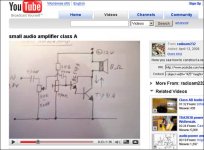
radioam232 Simple Class A.
This amplifier defintely will have some dc-offset!
Now, he is only using very small Class A current. And it works.
As can be seen from his videos.
He has got 203 youtube videos - most related to electronics
it is not easy to get lower, as there will be a drift in most power amplifiers
as you play music and temperatures changes in amplifier components
mainly semiconductors, transistors and diodes are effected
at what level should we begin to be concerned?
I have noticed some say that 100 mV is beginning to be uncomfortable
---------
Should be noted here, that there were in past some amplifiers
that had loudspeaker as the bias component,
to feed the amplifier a small current for start up.
radioam232 Simple Class A.
This amplifier defintely will have some dc-offset!
Now, he is only using very small Class A current. And it works.
As can be seen from his videos.
He has got 203 youtube videos - most related to electronics
small audio amplifier class A
http://www.youtube.com/watch?v=waK38uzRgBw
small audio amplifier class A tested
http://www.youtube.com/watch?v=TfpOIH7k7lQ
Attachments

50mV or Less ?
That's somewhat reassuring BUT...I'm planning on using an active crossover (Marchand) so the speakers will not have a passive XO (with its caps) in line between amp and speakers. I worry about sticking my speakers right into the amp outputs IF the offset is "excessive". Hense my question...what is excessive ?
That's somewhat reassuring BUT...I'm planning on using an active crossover (Marchand) so the speakers will not have a passive XO (with its caps) in line between amp and speakers. I worry about sticking my speakers right into the amp outputs IF the offset is "excessive". Hense my question...what is excessive ?
too much offset?
I don't think this is a problem. If you calculate the power, V^2/R,
assuming R is 4 Ohms, you get a power of 0.625 milliWatts. This shouldn't be an issue.
One might argue that the slight offset from zero of the mechanical suspension would cause a bit more 2nd harmonic distortion. Still,
we're talking about 50 mV compared to 14 V peak, if you assume a
25 watt driver rating...that is a displacement of 0.36% of the maximum. Surely purely mechanical issues could cause this much displacement.
In summary...I don't think 50 mV will cause any problems.
I don't think this is a problem. If you calculate the power, V^2/R,
assuming R is 4 Ohms, you get a power of 0.625 milliWatts. This shouldn't be an issue.
One might argue that the slight offset from zero of the mechanical suspension would cause a bit more 2nd harmonic distortion. Still,
we're talking about 50 mV compared to 14 V peak, if you assume a
25 watt driver rating...that is a displacement of 0.36% of the maximum. Surely purely mechanical issues could cause this much displacement.
In summary...I don't think 50 mV will cause any problems.
From the safety there is no problem
even 1 Volt offset or even 4 V for one larger 8 Ohm speaker
Power = UxU / R
Power = Volt x Volt / Ohm
4x4 /8 = 2 Watt .. which corresponds to a 4 Watt rated Woofer. (ACwatt = DCwatt x 2)
The question is more what djoffe said:
slight offset from zero of the mechanical suspension
'Max output' level may decrease a bit, as at one swing of the cone
it will sooner reach the limit of travel.
But how many play their speakers to the limit Only a few fools.
How much an 1.0 Volt offset, for example, will increase distortion
is something that needs to be investigated.
Personally, I think this is much less than what we might imagine.
And very much different from Woofer to Woofer.
However, keeping the DC-offset not to high is a good thing.
Where the limit will be, is most a question of your personality,
how afraid you are of things, Ghosts.
Your self-confidence
even 1 Volt offset or even 4 V for one larger 8 Ohm speaker
Power = UxU / R
Power = Volt x Volt / Ohm
4x4 /8 = 2 Watt .. which corresponds to a 4 Watt rated Woofer. (ACwatt = DCwatt x 2)
The question is more what djoffe said:
slight offset from zero of the mechanical suspension
'Max output' level may decrease a bit, as at one swing of the cone
it will sooner reach the limit of travel.
But how many play their speakers to the limit
Only a few fools.How much an 1.0 Volt offset, for example, will increase distortion
is something that needs to be investigated.
Personally, I think this is much less than what we might imagine.
And very much different from Woofer to Woofer.
However, keeping the DC-offset not to high is a good thing.
Where the limit will be, is most a question of your personality,
how afraid you are of things, Ghosts.
Your self-confidence
Re: 50mV or Less ?
50mV is not much for a woofer, even though you may be able to see a slight displacement.
However, 50mV is not so little for a treble unit. So it would probably be safest to use a high quality coupling capacitor for the treble unit.
Just my .02
Regards
ronzeman said:That's somewhat reassuring BUT...I'm planning on using an active crossover (Marchand) so the speakers will not have a passive XO (with its caps) in line between amp and speakers. I worry about sticking my speakers right into the amp outputs IF the offset is "excessive". Hense my question...what is excessive ?
50mV is not much for a woofer, even though you may be able to see a slight displacement.
However, 50mV is not so little for a treble unit. So it would probably be safest to use a high quality coupling capacitor for the treble unit.
Just my .02
Regards

This depends how much neurotic you are
If you measure 1 milivolts when cold... then you may start to have concerns..... when hot it may jump to higher values!... then you gonna loose your peace because of that.
Off set does not sound.... big or lower, it is just a perfectionist care...if possible to remove..why not to remove? make it zero or the minimum possible...will make academic folks smile... as they have enormous calculations to avoid that and the dam off set is always there..ahahahahah!.... match transistors...will make your off set zeroed.
Many amplifiers (thousands of them) ask you to adjust to less than 25 milivolts...and this is not to loose from others that are asking the same.... because you may think they are second class amplifier because not bothering about off set...more politically accepted thing than real technical worries.
Let's say you will have a huge off set (referenced to the standards) of 150 milivolts... this will move the speaker upwards or backwards a tenth of milimeter into a high power speaker and more to a low powered speaker..... but the speaker, by itself, is already non perfectly centered..means..it can move more milimeters into one direction when compared to the other direction of movement...the opposite related the first one.....so.... you will not bother the speaker...he is already out from all kind of precision.
If you are neurotic..then the first movement must be upwards and them the second must be backwards... and be carefull!...not the opposite, because electrons will be confused!..will enter a hard strike, they will not work anymore!
When the amplifier goes on (switched on...power on!)...if a good amplifier..will not have "power on" thump...but big offset will make a "power on" "tic"...not a "tac!" and not a "thump!".... so... having off set, you gonna have "tic"... and will need delayed insertion circuits and relays..because of the "tic" sound.
Waste of power.... well folks..... 150 milivolts... may be 2 miliwatts... i do not think you are wasting too much ... each Led you may have into the frontal panel will waste 10 miliamperes.
Some people thinks because this error... that can be positive or negative, will result in different size into the waveform... negative!... will not produce that...no misterious distortions will be produced too..also you will not attract the Devil to your home...your cake will not burn into the fire...your steak will not have too much salt...your wife will not move to another town with your gardener...your automobile will not spend more gasoline and your dog will not spell the yellow liquid into your shoes.
But if you are neurotic...well..... better to remove the off set.... maybe the Global heating will be caused by you...please!... adjust that thing please!.... it is hot here man!.... hurry up!
But if you are reasonable stable inside your mind... in other words, not too much neurotic, paranoid, schizophrenic, hysterical, psychotic... then you can send the off set to hell, then you may go listening and enjoying music, you may kick your wife's dog because the idiot barks too much and before that will toast your barbecue without be thinking if what the dog means while barking, .... well.... enjoying your good life without such a kind of nonsense worries other folks, less happy than you are, can have.
regards,
Carlos
If you measure 1 milivolts when cold... then you may start to have concerns..... when hot it may jump to higher values!... then you gonna loose your peace because of that.
Off set does not sound.... big or lower, it is just a perfectionist care...if possible to remove..why not to remove? make it zero or the minimum possible...will make academic folks smile... as they have enormous calculations to avoid that and the dam off set is always there..ahahahahah!.... match transistors...will make your off set zeroed.
Many amplifiers (thousands of them) ask you to adjust to less than 25 milivolts...and this is not to loose from others that are asking the same.... because you may think they are second class amplifier because not bothering about off set...more politically accepted thing than real technical worries.
Let's say you will have a huge off set (referenced to the standards) of 150 milivolts... this will move the speaker upwards or backwards a tenth of milimeter into a high power speaker and more to a low powered speaker..... but the speaker, by itself, is already non perfectly centered..means..it can move more milimeters into one direction when compared to the other direction of movement...the opposite related the first one.....so.... you will not bother the speaker...he is already out from all kind of precision.
If you are neurotic..then the first movement must be upwards and them the second must be backwards... and be carefull!...not the opposite, because electrons will be confused!..will enter a hard strike, they will not work anymore!
When the amplifier goes on (switched on...power on!)...if a good amplifier..will not have "power on" thump...but big offset will make a "power on" "tic"...not a "tac!" and not a "thump!".... so... having off set, you gonna have "tic"... and will need delayed insertion circuits and relays..because of the "tic" sound.
Waste of power.... well folks..... 150 milivolts... may be 2 miliwatts... i do not think you are wasting too much ... each Led you may have into the frontal panel will waste 10 miliamperes.
Some people thinks because this error... that can be positive or negative, will result in different size into the waveform... negative!... will not produce that...no misterious distortions will be produced too..also you will not attract the Devil to your home...your cake will not burn into the fire...your steak will not have too much salt...your wife will not move to another town with your gardener...your automobile will not spend more gasoline and your dog will not spell the yellow liquid into your shoes.
But if you are neurotic...well..... better to remove the off set.... maybe the Global heating will be caused by you...please!... adjust that thing please!.... it is hot here man!.... hurry up!
But if you are reasonable stable inside your mind... in other words, not too much neurotic, paranoid, schizophrenic, hysterical, psychotic... then you can send the off set to hell, then you may go listening and enjoying music, you may kick your wife's dog because the idiot barks too much and before that will toast your barbecue without be thinking if what the dog means while barking, .... well.... enjoying your good life without such a kind of nonsense worries other folks, less happy than you are, can have.
regards,
Carlos


offsets... without passive XO
If you use a passive crossover in your speaker, then the caps in the XO will take care of much of the offending DC; NOW..if you are bi- or tri amping a speaker, each driver is directly attached to the amps output. A midrange or tweeter would not be happy with any "large" DC offset. ? greater than 25mv?
Offset is less of an issue with woofers; and passive crossovers. IMO
If you use a passive crossover in your speaker, then the caps in the XO will take care of much of the offending DC; NOW..if you are bi- or tri amping a speaker, each driver is directly attached to the amps output. A midrange or tweeter would not be happy with any "large" DC offset. ? greater than 25mv?
Offset is less of an issue with woofers; and passive crossovers. IMO
Solution Found ?
Today I got to change out a few parts in my DH200 Hafler. My LEFT channel was in need of a tweak. Changed out Q1,2,5,and 6 with a matched set of 2N5401's and 2N5551's. The DC offset plummeted from 300mV to 1.2mV...thats correct 1.2 mV!
Right channel was OK at 4.8mV
I love it when things turn out right.
Now for my other Hafler 9180
30 mV seems to be a number a few have offered as OK. Perhaps I will order another set of Beta Matched Xistors for this amp and see what happens.
Today I got to change out a few parts in my DH200 Hafler. My LEFT channel was in need of a tweak. Changed out Q1,2,5,and 6 with a matched set of 2N5401's and 2N5551's. The DC offset plummeted from 300mV to 1.2mV...thats correct 1.2 mV!
Right channel was OK at 4.8mV
I love it when things turn out right.
Now for my other Hafler 9180
30 mV seems to be a number a few have offered as OK. Perhaps I will order another set of Beta Matched Xistors for this amp and see what happens.

if you are really worried about it, you could just use an output coupling cap and then your DC offset would be a big fat goose egg at the spkr terminals. thats assuming your not one of those types that finds indirect output coupling repugnant. 470uF or so in series with + speaker line should do nicely.

That's very possible. DC offset means current is pumped into the load. If the offset is high enough that PSU loading will be audible in some cases. It's just the same as adding a load across the PSU.darkfenriz said:How about tranformer buzzing mechanically?
There seems to be a direct dependancy on offset voltage...
Needs more than a few millivolts though !
will result in severely rolled off bass and some loss of mid as well.gain said:.......... use an output coupling cap ..................470uF or so in series with + speaker line should do nicely.
AndrewT said:will result in severely rolled off bass and some loss of mid as well.
humm, thats interesting to know. what value would you recommend? i have a vintage RCA that uses one 470uF output coupler on each channel and i can assure you production of copious amounts of bass is NOT one of its problems
EDIT: did some math and did find that at 20Hz Xc~16 ohm with 470uF, so yeah i can see how that would attenuate a deep base note. but, was thinking that perhaps since a speaker (especially a woofer) is a somewhat inductive, you end up with the coupling cap in series with an inductive load (during bass notes) which would tune out (reduce) some, or maybe even most, of that 16 ohm reactance you get from the cap. thoughts?
regarding dc offset, i remember seeing one of quasi's designs that incorporated a trimmer between the legs of the LTP. by adjusting this trimmer you could set DC offset to minimum. i believe it was his 'brother of quasi' but cant be sure. do a search and check out the schematic if you are interested.

Preamps are different. Any small offsets make pots and switches noisy when operated. If your power amp is DC coupled ( not many are as the gain at DC usually reverts to unity ) and if there is no coupling cap at the power amp input then any DC applied to the input will be passed to the output. Depending on the offset of the power amp this could increase or decrease any offset present.
Sorry "how much" When it comes to preamps 0.000 is fine
Sorry "how much" When it comes to preamps 0.000 is fine
- Status
- This old topic is closed. If you want to reopen this topic, contact a moderator using the "Report Post" button.
- Home
- Amplifiers
- Solid State
- Amplifier DC Offset - How Much is OK?