
Is it true that some speaker manufacturers deliberately provide for what is known as "BBC dip" in their speakers' frequency response. What is the purpose of providing a "BBC dip" in a loud-speaker? Whether any research has been done on its effect on musicality of the speakers? Since fidelity is the acurate reproduction of the original recorded sound, is it not against the tenets of high-end audio to design speakers with a "BBC dip". Isn't the sound coloured this way?
Yes, this increase in midrange brightness is what the BBC dip removes making the speaker less forward sounding, more 'polite' as it is said.sreten said:The "dip" is a compensation for the sudden increase in off axis
response when the tweeter comes in above the usually large
midrange units in the BBC's case, nearly all are 8" or larger.
Its not needed and doesn't work well with small midranges.
sreten.
markp said:Yes, this increase in midrange brightness is what the BBC dip removes making the speaker less forward sounding, more 'polite' as it is said.
The point is for "BBC" speakers it is more accurate.
sreten.The BBC dip is a falicy.
Take alook at the response graphs...
http://www.harbeth.co.uk/images/35acurve1b.jpg
The problem arose from the Bextrene cone used in the LS3/5a, it had a pronounced breakup at around 1k due to either cone material or suspension.
My guess is the 'dip' was introduced to correct this, and the result was a flat response.
Note: one of the reasons why the 3/5a sounded polite was a very smooth 30deg off-axis response, something often over looked (or heard) in the majority of speakers around at the time.
Take alook at the response graphs...
http://www.harbeth.co.uk/images/35acurve1b.jpg
The problem arose from the Bextrene cone used in the LS3/5a, it had a pronounced breakup at around 1k due to either cone material or suspension.
My guess is the 'dip' was introduced to correct this, and the result was a flat response.
Note: one of the reasons why the 3/5a sounded polite was a very smooth 30deg off-axis response, something often over looked (or heard) in the majority of speakers around at the time.
Originally posted by sreten
The "dip" is a compensation for the sudden increase in off axis
The idea was it seems, that even flat response @1,5-~3kHz is annoying to the ear, shrill and fatiguing, especially on classical. The solution was to introduce a small attenuation, dipping (1-2db) b/ween 300-3kHz -- better still, 2-3db between 100-10kHz.
I don't mind the idea, in fact I'd like it IF I could get a flatish extension thereafter...
Ap said:The BBC dip is a falicy.
Gregm said:
The idea was it seems, that even flat response @1,5-~3kHz is annoying to the ear, shrill and fatiguing, especially on classical. The solution was to introduce a small attenuation, dipping (1-2db) b/ween 300-3kHz -- better still, 2-3db between 100-10kHz.
Hmm.......
AP, the LS3/5A doesn't need or have the compensation, as stated
it was used in BBC speakers with 8" or larger midrange units.
I'm sorry GregM but that is not the the classic "BBC dip" by any
definition, the dip is around the c/o point and very local to that
frequency range.
BBC speaker voicing on the other hand does prefer basically
a gently falling response, 2dB/3dB over the range, but this is
not the "BBC dip" phenomena, its just overall voicing.
This "voicing" is must less pronounced than the differences
in response of MM cartridges, and suits the brighter more
accurate examples of cartridges.
Budget cartridges often fall ~ 6dB across the frequency range.
Edit :
I'll just note that the dip was copied by some manafacturers
without apparently understanding its purpose, however the
technique is still in use today, reducing axial output if there
is a peak in off axis response, to give a balanced result.
sreten.
Member
Joined 2009
Paid Member

well I have read enough references to a 1-3kHz dip giving an enhanced sense of depth, from Broskie to Linkwitz that suggests the illusion it gives is real. However Sreten is probably right that in some designs its there for other reasons. Certainly my apogees have the dip in the crossover.
Of course it could be an old wives tale that has become accepted ignorance!
Of course it could be an old wives tale that has become accepted ignorance!

Sreten likes to make up stories based on his POV. On another occasion he claimed the so called BBC dip was in fact a peak at the upper HF end, I tried to wrestle with him on this claimed story and he said he knows it b/c he's British. You can study the LS3/5A history and all the different driver suppliers and then look at its xover schematics early revisions (note all the level taps), I figure depending on which years production sample an audio reviewer had their mits on, every version likely had their own sonic signature (maybe like a 'vintage' series). It's probably just another Myth still making the rounds via the internets.

BBC speaker voicing on the other hand does prefer basically a gently falling response,
2dB/3dB over the range, but this is not the "BBC dip" phenomena, its just overall voicing.
Acoustic Research also provided this response at the "normal" setting of their mid/high controls.
When turned to maximum, the controls gave a "flat" response.

@ infinia.
I must admit I thought the BBC Dip was a gentle 4dB frequency response rolloff across the band as exemplified by Troels Gravesen's voicing with the LR2 ScanSpeak-3W-Discovery.
It apparently reduces sibilance and fatigue. FWIW, the BBC employed BW3 filters which have increased power response at crossover compared to LR2 and LR4. Maybe that is where the dip at crossover idea might come from, but it's news to me, and I prefer BW3 flat on frequency response.
Earl Geddes says that a (slope) dip is particularly applicable to high dispersion tweeters. The more I learn about speakers, the more I learn that EVERYTHING is a compromise.
I must admit I thought the BBC Dip was a gentle 4dB frequency response rolloff across the band as exemplified by Troels Gravesen's voicing with the LR2 ScanSpeak-3W-Discovery.
It apparently reduces sibilance and fatigue. FWIW, the BBC employed BW3 filters which have increased power response at crossover compared to LR2 and LR4. Maybe that is where the dip at crossover idea might come from, but it's news to me, and I prefer BW3 flat on frequency response.
Earl Geddes says that a (slope) dip is particularly applicable to high dispersion tweeters. The more I learn about speakers, the more I learn that EVERYTHING is a compromise.
Attachments
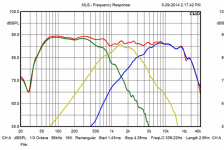
I must admit I thought the BBC Dip was a gentle 4dB frequency response rolloff across the band as exemplified by Troels Gravesen's voicing..
There were 3 "major" compensation curves used by the BBC - Troels design was one of them. I believe that the dip you are describing was actually in use the most for far-field near-field adjustment.
Engineer Keith Gundry developed the presence region compensation curve.
You can read more about that here:
http://www.diyaudio.com/forums/multi-way/83755-what-meant-bbc-rise-8.html#post972549
There were 3 "major" compensation curves used by the BBC - Troels design was one of them.
Troels did work for the beeb?
only 3 ? I get there was one for every speaker design. I fear giving them "labels", counting them, or deciding what was major and minor is a big problem bud!
from all Ive read (a lot) in the final analysis I say its all myth building from the clinger-ons.
Last edited:
Is it true that some speaker manufacturers deliberately provide for what is known as "BBC dip" in their speakers' frequency response.
You can see for yourself in Stereophile's measurements of their reccomended 2.5 or 3 way speakers for 2014. The common trend I see is a dip ~100hz to 1khz except for the YG Acoustics.
Vivid G1 Giya
An externally hosted image should be here but it was not working when we last tested it.

Wilson Audio Alexandria XLF
An externally hosted image should be here but it was not working when we last tested it.

YG Acoustics Sonja 1.3
An externally hosted image should be here but it was not working when we last tested it.

Joseph Audio Perspective
An externally hosted image should be here but it was not working when we last tested it.

Sonus Faber Venere 2.5
An externally hosted image should be here but it was not working when we last tested it.

Revel Performa3 F208
An externally hosted image should be here but it was not working when we last tested it.

Goldenear Aon2
An externally hosted image should be here but it was not working when we last tested it.

Troels did work for the beeb?
only 3 ? I get there was one for every speaker design. I fear giving them "labels", counting them, or deciding what was major and minor is a big problem bud!
from all Ive read (a lot) in the final analysis I say its all myth building from the clinger-ons.
Ok, poorly said.
Troels design utilized one of the major compensation curves used by the BBC.
Yes, the "BBC dip" was probably "coined" by an audio reviewer.
In the BBC probably the 1-3.5/4 kHz would have been called the Gundry dip, or Harwood's presence curve/dip.
I think Harwood (BBC Engineer) was researching this around the time Blauert (Academic Doctoral) was. It could be that one influenced the other.
Factorising the product of two prime numbers efficiently looks interesting.
How hard can it be really?
Hi,
Well good look with that. You don't seem to understand the problem.
If it was easy cryptography would be fatally fundamentally flawed.
There is no efficient "crack" to the problem, that is the point.
rgds, sreten.
Last edited:
- Status
- This old topic is closed. If you want to reopen this topic, contact a moderator using the "Report Post" button.
- Home
- Loudspeakers
- Multi-Way
- BBC Dip