
let me start with a quote from our fellow member:
indeed the way most people stuff their enclosures it doesn't. and that's the problem.
oftentimes i will look at a manual of some car audio subwoofer ( from a reputable company like JBL ! ) and in the box instructions it will say something like "line the sides of the box with 1" fiberglass".
well what is that going to do ? one inch of fiberglass will be lucky to absorb 5 khz. what effect will it have on 200 hz ?
most subwoofers are helped by the fact that their dimensions don't allow very low frequency modes and at the same time they do not produce much high frequency energy so there is not much need for attenuation to begin with.
and then there are companies like B&W who will make funky looking enclosures ( transmission line / labyrinth ) to absorb the back wave. WHY ?
why not just use a normal box with SUFFICIENT AMOUNT OF DAMPING MATERIAL ?
when i say sufficient amount of damping material i mean something like:
30 of box volume in direct vicinity of the driver left open. the sides of the box lined with high density acoustical foam such as auralex such that maybe 20% of the total box volume is foam. and the remaining 50% of the box volume stuffed with something like acousta stuff ( or if you don't care about your health - fiberglass ).
and when i say stuffed i mean STUFFED. none of that 1.5 pounds per cubic feet nonsense. i mean stuff as much as will go in !
yes that means a significant amount of money will be spent on foam and stuffing. but that doesn't seem to stop the Transmission Line folks ? and what about the dipole folks who cry all the time about regular speakers sounding "boxy" ?
it seems people are willing to do almost anything to get away from the boxy sound EXCEPT the only thing they should be doing - stuffing the box properly.
ps: i am not saying that using elements of a transmission line ( the way B&W does in Nautilus ) is not a reasonable approach. i am saying that what makes TLs not sound too obnoxious is the stuffing, not the cabinet. cabinet geometry can only ENHANCE the effectiveness of stuffing by allowing it to work optimally. an unstuffed pipe will sound WORSE than an unstuffed box.
it seems that in their quest to solve the problem people feel the urge to exacerbate it first so that there would not be any way of ignoring the problem before actually solving it. to fight boxy sound first they turn the box into a tube which sounds even worse and then they finally stuff the tube to fix the problem. well why not just stuff the box to begin with ?
Stuffing does not do anything much at LF to attenuate the rear wave inside the enclosure.
indeed the way most people stuff their enclosures it doesn't. and that's the problem.
oftentimes i will look at a manual of some car audio subwoofer ( from a reputable company like JBL ! ) and in the box instructions it will say something like "line the sides of the box with 1" fiberglass".
well what is that going to do ? one inch of fiberglass will be lucky to absorb 5 khz. what effect will it have on 200 hz ?
most subwoofers are helped by the fact that their dimensions don't allow very low frequency modes and at the same time they do not produce much high frequency energy so there is not much need for attenuation to begin with.
and then there are companies like B&W who will make funky looking enclosures ( transmission line / labyrinth ) to absorb the back wave. WHY ?
why not just use a normal box with SUFFICIENT AMOUNT OF DAMPING MATERIAL ?
when i say sufficient amount of damping material i mean something like:
30 of box volume in direct vicinity of the driver left open. the sides of the box lined with high density acoustical foam such as auralex such that maybe 20% of the total box volume is foam. and the remaining 50% of the box volume stuffed with something like acousta stuff ( or if you don't care about your health - fiberglass ).
and when i say stuffed i mean STUFFED. none of that 1.5 pounds per cubic feet nonsense. i mean stuff as much as will go in !
yes that means a significant amount of money will be spent on foam and stuffing. but that doesn't seem to stop the Transmission Line folks ? and what about the dipole folks who cry all the time about regular speakers sounding "boxy" ?
it seems people are willing to do almost anything to get away from the boxy sound EXCEPT the only thing they should be doing - stuffing the box properly.
ps: i am not saying that using elements of a transmission line ( the way B&W does in Nautilus ) is not a reasonable approach. i am saying that what makes TLs not sound too obnoxious is the stuffing, not the cabinet. cabinet geometry can only ENHANCE the effectiveness of stuffing by allowing it to work optimally. an unstuffed pipe will sound WORSE than an unstuffed box.
it seems that in their quest to solve the problem people feel the urge to exacerbate it first so that there would not be any way of ignoring the problem before actually solving it. to fight boxy sound first they turn the box into a tube which sounds even worse and then they finally stuff the tube to fix the problem. well why not just stuff the box to begin with ?
Last edited:
... and then there are companies like B&W who will make funky looking enclosures ( transmission line / labyrinth ) to absorb the back wave.
At least in their highly rated Matrix 802 series, B&W used no stuffing at all (maybe also in others, but I have only opened the 802). As far as I know, the tapered shape of the housings for the high and mid frequency drivers is chosen to prevent standing waves and resonances. For the low frequencies, I don't think you get much (if any) benefits from stuffing, even if you fully stuff the whole box.
Kurt
stuffing also causes attenuation, no? I believe the goal with the fancy box designs is to eliminate standing waves without the reduction in efficiency. Could be wrong

Borat, perhaps first learn about the properties of the various stuffing materials. Here is a good resource.
http://www.bobgolds.com/AbsorptionCoefficients.htm
As to massively stuffing, I don't believe it will have any major effect. People such as Tom Nousaine have already tested various stuffing densities and found there are limits.
http://www.bobgolds.com/AbsorptionCoefficients.htm
As to massively stuffing, I don't believe it will have any major effect. People such as Tom Nousaine have already tested various stuffing densities and found there are limits.

Borat,
I may be one of the fringe "TL people". 🙄 I believe a bigger case is a fair trade-off for fidelity...
I say that "proper" cabinet geometry can greatly decrease the need for stuffing.
I have run hours of sim's using MLK's worksheets with the intent of minimizing the need for stuffing. My weapon of choice is the MLQW alignment, which looks to the world to be a bass reflex...
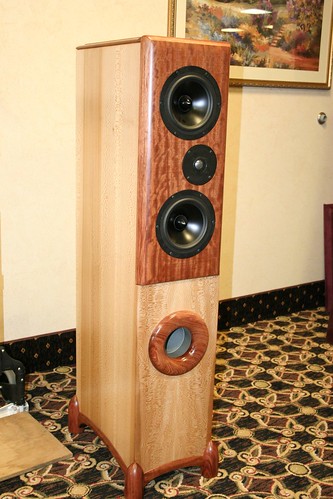
The stuffing is ~1/4 pound of polyfil. The lining is 5/8" spun fiberglass over 1/4" ceramic tile backer board (the idea provided by Bob Brines) 😉
The design is successful through choosing the combination of dimensions and positions for the case elements to minimize resonances. It was chosen this year as "Best in Show" @ diyAtlanta.
For a subwoofer the same approach is successful.
I may be one of the fringe "TL people". 🙄 I believe a bigger case is a fair trade-off for fidelity...
I say that "proper" cabinet geometry can greatly decrease the need for stuffing.
I have run hours of sim's using MLK's worksheets with the intent of minimizing the need for stuffing. My weapon of choice is the MLQW alignment, which looks to the world to be a bass reflex...
The stuffing is ~1/4 pound of polyfil. The lining is 5/8" spun fiberglass over 1/4" ceramic tile backer board (the idea provided by Bob Brines) 😉
The design is successful through choosing the combination of dimensions and positions for the case elements to minimize resonances. It was chosen this year as "Best in Show" @ diyAtlanta.
For a subwoofer the same approach is successful.
hey ed and everybody else,
can't contribute to this topic very much, but ed, you speaker looks stunning 😱 . where can i read more about it? do you have an own thread where you talk about the designe and also show a few more photos?
sincerely,
mike
can't contribute to this topic very much, but ed, you speaker looks stunning 😱 . where can i read more about it? do you have an own thread where you talk about the designe and also show a few more photos?
sincerely,
mike

I did a substantial study of box stuffing some 20+ years ago that was an AES publication. AT very LF the stuffing does little to absorb the sound waves, but does add an apparent volume increase that is a very good thing in a closed box. The material matters a lot and "stuffing" has an optimum. We found that "lightly filled" was best and that once you got to the point where you had to start compressing the material the effectiveness begain to decline. We found the best material to be shreaded cotton clothing (used in automotive for noise control). I now find that blocks of open cell polyurethane works very well, but that stuf is very expensive. All round fiberglas was a good choice from a cost and availability point of view, but I hate working with that stuff. As is well known, I am a big fan of simple closed boxes mostly filled with foam. These are easy to design and make, very repeatable, no noise leaks (like ported), pure monopoles, a lot of advantages. LF extension is of course NOT one of them, but I always suggest subs.
Stuufing a ported enclosure does esult in a lot loss at the tuning frequency kind of defeating the point of using a port.
Stuufing a ported enclosure does esult in a lot loss at the tuning frequency kind of defeating the point of using a port.

We found the best material to be shreaded cotton clothing
Similar stuff, different application: http://www.bondedlogic.com/
dave
When it comes to subwoofers, I've found that no stuffing at all gives the result I like best. If the cabinet dimensions are quite small, we wont get any standing wave modes in the passband of the subwoofer, so there's really no use for stuffing. A serious problem with stuffing woofer cabinets is that the cone motion will make the stuffing move as well. I tried to totally fill up some 100 liter cabinets... it sounded awful. No stuffing was a lot better in my opinion.

Borat.
The degree of stuffing depends on type type of enclosure being stuffed.
Acoustic suspension, yes stuff quite a bit - much beyond just lining the walls. I have found a rough rule of thumb is 1 lb/cu ft fiberglass works well.
OTOH, a vented alignment does not do well with AS type stuffing. Just line 3 of the 4 walls on a vented speaker.
The degree of stuffing depends on type type of enclosure being stuffed.
Acoustic suspension, yes stuff quite a bit - much beyond just lining the walls. I have found a rough rule of thumb is 1 lb/cu ft fiberglass works well.
OTOH, a vented alignment does not do well with AS type stuffing. Just line 3 of the 4 walls on a vented speaker.

Interesting thread.
I am building a sealed box with an 8" woofer to play up to 820Hz (24dB LR). I have behind the woofer thick acoustic foam. The rest of the box I plan to fill entirely with BAF and a bit with lambswool which I already have.
Is this a good idea? It seems it in theory, to reduce internal reflections and standing waves, but will I "suffocate" the sound? StigEric just mentioned that low bass will disturb the material and possibly be detrimental to the sound; my stuffing will be packed between shelf braces so shouldn't move much, should I be concerned? Perhaps it's more relevant with ported designs.
I am building a sealed box with an 8" woofer to play up to 820Hz (24dB LR). I have behind the woofer thick acoustic foam. The rest of the box I plan to fill entirely with BAF and a bit with lambswool which I already have.
Is this a good idea? It seems it in theory, to reduce internal reflections and standing waves, but will I "suffocate" the sound? StigEric just mentioned that low bass will disturb the material and possibly be detrimental to the sound; my stuffing will be packed between shelf braces so shouldn't move much, should I be concerned? Perhaps it's more relevant with ported designs.
Dr. EM. The most important function of closed box stuffing is to make the box volume behave like it's bigger than it really is. That will give more bass. An optimized amount of stuffing can effectively 'increase' the volume 15-20%.
I think your acoustic foam behind the woofer is okay. Just make sure you use some fibrous stuffing as well. The thinner the fiber you use the better.
At one point, US speaker maker Advent used five 1 foot square by 2 inch thick blocks of open cell foam as the stuffing in their New Large Advent model. It worked, but not as well as fiberglass. When I upgrade a NLA xover I usually replace the foam with FG. It lowers the box Fc up to 5 hz.
I think your acoustic foam behind the woofer is okay. Just make sure you use some fibrous stuffing as well. The thinner the fiber you use the better.
At one point, US speaker maker Advent used five 1 foot square by 2 inch thick blocks of open cell foam as the stuffing in their New Large Advent model. It worked, but not as well as fiberglass. When I upgrade a NLA xover I usually replace the foam with FG. It lowers the box Fc up to 5 hz.

I only have annecdotal evidence (I didn't take measurements, actually I probably did but I couldn't lay my hands on them readily) But I found that adding stuffing seemed to make my prototype MTM sound somewhat muffled.. Not sure how to describe it really but I didn't like it. I think maybe it did help to reduce the back wall reflections, but at the cost of making the speakers sound terrible 😉
what I am using is this stuff (32mm) on the back wall and the bottom of the cabinet. I've yet to experiment with adding more than that. It far exceeds anything else I tried for reducing back wall reflections. It doesn't completely eliminate them but it tames them pretty well 🙂 certainly worked much better than stuffing without the detrimental effect on the sound.
Tony.
what I am using is this stuff (32mm) on the back wall and the bottom of the cabinet. I've yet to experiment with adding more than that. It far exceeds anything else I tried for reducing back wall reflections. It doesn't completely eliminate them but it tames them pretty well 🙂 certainly worked much better than stuffing without the detrimental effect on the sound.
Tony.
Last edited:
I only have annecdotal evidence (I didn't take measurements, actually I probably did but I couldn't lay my hands on them readily) But I found that adding stuffing seemed to make my prototype MTM sound somewhat muffled.. Not sure how to describe it really but I didn't like it. I think maybe it did help to reduce the back wall reflections, but at the cost of making the speakers sound terrible 😉
what I am using is this stuff (32mm) on the back wall and the bottom of the cabinet. I've yet to experiment with adding more than that. It far exceeds anything else I tried for reducing back wall reflections. It doesn't completely eliminate them but it tames them pretty well 🙂 certainly worked much better than stuffing without the detrimental effect on the sound.
Tony.
Neat stuff Tony. doesn't look like it's available here in the US. 🙁

I like rockwool. Positioning one stiff piece of it to bisect the internal box area seems to give excellent results.
Generally noise barriers do not have the same properties that one would want in a box filling material. They would tend to be closed cell, which would decrease the box virtual volume not increase it. One wants an open structure with many small fibers, like FG, but foam does work too. FG is hard to beat for the money, its just such a mess to work with.

There's a sort of magic in that...The most important function of closed box stuffing is to make the box volume behave like it's bigger than it really is
I thought stuffing was for mechanically damping the driver ,ie when the signal stops suddendly , the cone continues to vibrate to its resonance frequency.
Adding stuffing internally obviously alters some electrical and mechanical parameters , which depend also by others like cables,crossover components and amplifier's damping factor . It lowers the cabinet Q , stops stationary waves but not the very LF ones , though the behavior of the driver as a EMF is strange.

Generally noise barriers do not have the same properties that one would want in a box filling material. They would tend to be closed cell, which would decrease the box virtual volume not increase it. One wants an open structure with many small fibers, like FG, but foam does work too. FG is hard to beat for the money, its just such a mess to work with.
Could you please give me your opinion on this:
Isolant laine de coton - Isoa
Is it similar to the shreadded coton stuff you were talking about in your previous post?
(sorry, the linked page is in french...)
- Status
- Not open for further replies.
- Home
- Loudspeakers
- Multi-Way
- Enclosure Stuffing