


Hello Everyone,
I've read almost whole thread and found it very inspiring. Unfortunately plenty of links in posts are now dead. I would be grateful if one can confirm my reasoning of balance equation.
Let's assume circut as in original Hawksford paper (attached, T2 collector connection is wrong, right?).
Considering just an upper half of the circut.
Vin = V(T3emitter | T5base)
and let assume Vout= 0
Then:
V(T1base) = Vin * [R4 / (R3 + R4)]
R2 - can be seen as emitter degeneration resistor, so T1 gain in G(T1) = ~ R1 / R2
let [R4 / (R3 + R4)] = k,
if balance is for G = 1, then V(R1) = Vin, and V(T1emitter) = Vin
-(Vin * k - Vin) * R1 / R2 = Vin
-Vin * (k - 1) * R1 / R2 = Vin
-(k - 1) * R1 / R2 = 1
(1 - k) * R1 = R2
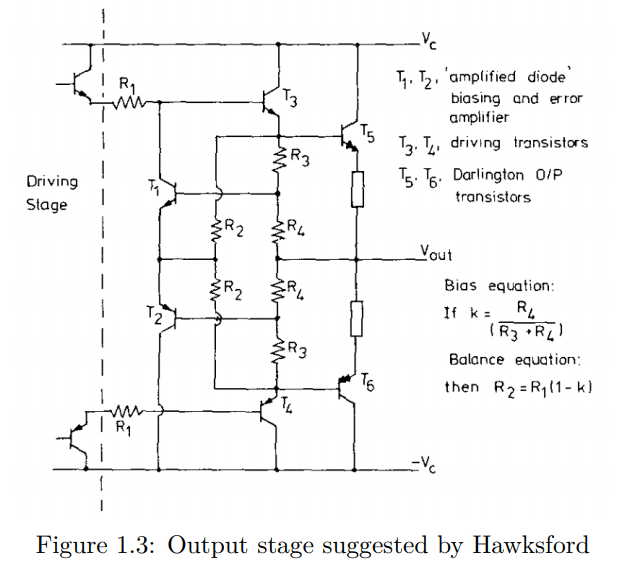
Thanks to anyone, who can review my analysis, and point if I miss something, or even whole point.
I've read almost whole thread and found it very inspiring. Unfortunately plenty of links in posts are now dead. I would be grateful if one can confirm my reasoning of balance equation.
Let's assume circut as in original Hawksford paper (attached, T2 collector connection is wrong, right?).
Considering just an upper half of the circut.
Vin = V(T3emitter | T5base)
and let assume Vout= 0
Then:
V(T1base) = Vin * [R4 / (R3 + R4)]
R2 - can be seen as emitter degeneration resistor, so T1 gain in G(T1) = ~ R1 / R2
let [R4 / (R3 + R4)] = k,
if balance is for G = 1, then V(R1) = Vin, and V(T1emitter) = Vin
-(Vin * k - Vin) * R1 / R2 = Vin
-Vin * (k - 1) * R1 / R2 = Vin
-(k - 1) * R1 / R2 = 1
(1 - k) * R1 = R2
Thanks to anyone, who can review my analysis, and point if I miss something, or even whole point.

for this cases dead URLs goes open in many cases here:Hello Everyone,
I've read almost whole thread and found it very inspiring. Unfortunately plenty of links in posts are now dead. I would be grateful if one can confirm my reasoning of balance equation.
https://web.archive.org

Thank you!for this cases dead URLs goes open in many cases here:
I knew this tool, but never suspect I will be able to find posts which I was looking for.
Posts #774 and #1169 in this thread.
output error...
Here, the assumed input is current linear at load. It would have been a great advantage if the input was at a constant current load.
Here, the assumed input is current linear at load. It would have been a great advantage if the input was at a constant current load.
The diagram is in error. The original concept was in error too. T1 & T2 just add some negative feedback to the output stage. There are alternative ways to do this, too.Let's assume circut as in original Hawksford paper (attached, T2 collector connection is wrong, right?).
post #1169 is on page 59 and post #774 on page 39 in this thread, but there a no URL's to find.Thank you!
I knew this tool, but never suspect I will be able to find posts which I was looking for.
Posts #774 and #1169 in this thread.

#1169
https://www.diyaudio.com/community/threads/bob-cordell-interview-error-correction.89023/post-1071658
#774
https://www.diyaudio.com/community/threads/bob-cordell-interview-error-correction.89023/post-1063948
https://www.diyaudio.com/community/threads/bob-cordell-interview-error-correction.89023/post-1071658
#774
https://www.diyaudio.com/community/threads/bob-cordell-interview-error-correction.89023/post-1063948
post #1169 is on page 59 and post #774 on page 39 in this thread, but there a no URL's to find.
- Home
- Amplifiers
- Solid State
- Bob Cordell Interview: Error Correction