
In the late 70s, my friends and I assembled 3 "Universal Tiger" amplifiers degigned by Dan Mayer and sold by SWTPC.
After a couple months of operation, they all blew their output transisters. Recently I was browsing Dr. Leach's site and read his comments regarding the design."These amplifiers were very unstable, causing them to oscillate, overheat, and blow tweeters."
I find all this strange as, at the time, the Hirsch-Houck Labs gave the amplifier very high marks for sound quality and stability
Have you experts ever looked at the schematic to determine what could have caused the problem and how it can be resolved?
I would appreciate your comments.
I attach a copy of the schematic.
After a couple months of operation, they all blew their output transisters. Recently I was browsing Dr. Leach's site and read his comments regarding the design."These amplifiers were very unstable, causing them to oscillate, overheat, and blow tweeters."
I find all this strange as, at the time, the Hirsch-Houck Labs gave the amplifier very high marks for sound quality and stability
Have you experts ever looked at the schematic to determine what could have caused the problem and how it can be resolved?
I would appreciate your comments.
I attach a copy of the schematic.
Attachments
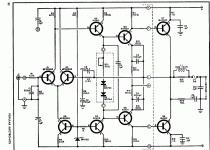

Put small ceramic capacitors in each input transistor and also in the second stage.
Your oscilation will stop.
Now, go removing and testing if it will oscilate.... try to remove the differential input first.
The one that likes to oscilate, normally is the second stage, considering both differential transistors as "input", and first stage.
If not stopped with that capacitors, try to put in the other transistors too.
Hehe, will stop.
regards,
Carlos
Your oscilation will stop.
Now, go removing and testing if it will oscilate.... try to remove the differential input first.
The one that likes to oscilate, normally is the second stage, considering both differential transistors as "input", and first stage.
If not stopped with that capacitors, try to put in the other transistors too.
Hehe, will stop.
regards,
Carlos
From base to colector, and soldered very close the transistor.
Will stop oscilate.
regards
Carlos
Will stop oscilate.
regards
Carlos
Re: Put small ceramic capacitors in each input transistor and also in the second stage.
Why ceramic capacitors and not polystyrene?
Carlos
Why ceramic capacitors and not polystyrene?
Carlos
Sorry, use from 10 pf (better ) to 47 picofarads
The lower the value, the better the highs you will reproduce.
The higher the values, you will triangulate your sinusoidal waveform starting from audibles frequencies.
In practice, i never go up than 21 picofarads, as a rule for me, as i found problems in some circuits using higher values.
regards,
Carlos
The lower the value, the better the highs you will reproduce.
The higher the values, you will triangulate your sinusoidal waveform starting from audibles frequencies.
In practice, i never go up than 21 picofarads, as a rule for me, as i found problems in some circuits using higher values.
regards,
Carlos

The Tiger amps had all sorts of failure modes, not just oscillation. Thermal runaway transmuted many a silicon chip into carbon, taking much of the rest of the amp with it. Audio Amateur had an article some years back (late '80s, early '90s?) on a rebuild that claimed to address the issues- I think it was by Poehland.

the Hirsch-Houck Labs gave the amplifier very high marks for sound quality
Did they ever bother to listen?

Ouch, c8=220pF, and no cdoms ? It's a wonder that it does not
oscillate permanently...
I would reduce c8 to 22pF, and add cdoms (B-C) of ~68pF to
Q3 and Q4. But these modifications will definitely change sounding.
Also, it's very likely that the amp selfdestruct with heavy clipping.
No care has been taken, that the cfp-output breaks down when
overdriven by clipping.
And what the hell does c10/c11/c12 ? Has oscillation been stopped by
applying a permanent capacitive load ?
At least c11/c12 guarantee that this amp does not oscillate very long.
And biasing a cfp-output with 2 diodes+pot ? Big nono !
If the pot get's dust, the amp will blow.
My recommendation: Do NOT build this one !
It might sound good, but at least a bit of reliability is a must.
You can redesign it, but then it's some standard ClassAB.
Mike
oscillate permanently...
I would reduce c8 to 22pF, and add cdoms (B-C) of ~68pF to
Q3 and Q4. But these modifications will definitely change sounding.
Also, it's very likely that the amp selfdestruct with heavy clipping.
No care has been taken, that the cfp-output breaks down when
overdriven by clipping.
And what the hell does c10/c11/c12 ? Has oscillation been stopped by
applying a permanent capacitive load ?
At least c11/c12 guarantee that this amp does not oscillate very long.
And biasing a cfp-output with 2 diodes+pot ? Big nono !
If the pot get's dust, the amp will blow.
My recommendation: Do NOT build this one !
It might sound good, but at least a bit of reliability is a must.
You can redesign it, but then it's some standard ClassAB.
Mike

MikeB said:Ouch, c8=220pF, and no cdoms ? It's a wonder that it does not
oscillate permanently...
I would reduce c8 to 22pF, and add cdoms (B-C) of ~68pF to
Q3 and Q4. But these modifications will definitely change sounding.
Also, it's very likely that the amp selfdestruct with heavy clipping.
No care has been taken, that the cfp-output breaks down when
overdriven by clipping.
And what the hell does c10/c11/c12 ? Has oscillation been stopped by
applying a permanent capacitive load ?
At least c11/c12 guarantee that this amp does not oscillate very long.
And biasing a cfp-output with 2 diodes+pot ? Big nono !
If the pot get's dust, the amp will blow.
My recommendation: Do NOT build this one !
It might sound good, but at least a bit of reliability is a must.
You can redesign it, but then it's some standard ClassAB.
Mike
MikeB,
this amplifier use same output stage configuration as the ETI466/480. The output stage has voltage gain too. This is about 2. The C3/C4 make some phase compensation, and the C11/C12 do same at the highest frequencies.
The planner not use Cdom, because of the large local feedback at the VAS, which is reduce the open loop gain. This combination has some advantages, such as the peak output voltage is very close to the rail voltage.
The bias is not so critical, because of the CFP output stage, but there must be better to make some local DC feedback...
sajti

I built these amplifiers as a young kid and yes they did blow up often. They seemed to go unstable with no output load, sometimes with the input unplugged, perhaps picking up RF, perhaps if clipped too hard. Not always sure what did it. What I did notice is that often C3 and C4 (polystrene) were melted, hmm caps are not supposed to dissipate energy but also R12, R14, R15, and R16 were badly burnt and being physically close might have caused them to melt. Eventually, I did the analysis and these resistors should be over 1W each, 2W to be safe, they were 1/2 W in the original design. Higher wattage resistors here helped very much. The design has an output stage gain of 2 which means the output can be driven into saturation and "stick" before the voltage gain stage clips which is not a good thing.
Feedback from the voltage gain stage to the neg diff amp input, might help compensate the amp, but really some analysis should be done first. I would not just go tacking caps in here and there to try to stabilize the amp. I'd be really curious to hear if anyone has looked at this design in SPICE.
I doubt the designers ever did stability analysis of this design just trying to "tune" it in their prototype which did not seem to work out very well.
This design brings back memories and was advanced for its day with a fully complementary output stage using fast (for the times) very high power devices when many were doing the RCA (and Citation 12) quasi complementary design.
Feedback from the voltage gain stage to the neg diff amp input, might help compensate the amp, but really some analysis should be done first. I would not just go tacking caps in here and there to try to stabilize the amp. I'd be really curious to hear if anyone has looked at this design in SPICE.
I doubt the designers ever did stability analysis of this design just trying to "tune" it in their prototype which did not seem to work out very well.
This design brings back memories and was advanced for its day with a fully complementary output stage using fast (for the times) very high power devices when many were doing the RCA (and Citation 12) quasi complementary design.

I have the 1973 popular electronics magazine this article was in originally and i have that audio amature article on the rebuild of a tiger, a flaming oddesy i think it was called. i will see if i can find it.
My Father built one of these years ago and it suffered badly from crossover distortion at low volumes...
The article delt mainly with 2 factors, one being that in one of the amps he rebuilt, it had half the output devices were pecor brand and the other half motorola. the pecor units are/were infieriour and would cause the amp to osccilate and blow up.
secondly there is a problem with the bias resistor stack wattage rating in the original schematic. The article calculates the load and resizes the bias resistor wattages much larger and this seemed to fix the problem.
I even remember the author talking about how he had miswired the amp accdentally during testing and the output was shorted and the amp still produced 4V across a dead short (according to the author) before it blew a supply fuse.
I remember reading all kinds of articles on these amps and it seems the designed was plagued with problems, very hard to build but way ahead of its time, for the time!
I still have a pair of brand new power supply transformers that i purchased ohhh...20 years ago with the intent of building one of these and just never got around to it....
Anybuddy want them??? i think there 56Vct but i have to look again. i have a spec sheet on them.
My Father built one of these years ago and it suffered badly from crossover distortion at low volumes...
The article delt mainly with 2 factors, one being that in one of the amps he rebuilt, it had half the output devices were pecor brand and the other half motorola. the pecor units are/were infieriour and would cause the amp to osccilate and blow up.
secondly there is a problem with the bias resistor stack wattage rating in the original schematic. The article calculates the load and resizes the bias resistor wattages much larger and this seemed to fix the problem.
I even remember the author talking about how he had miswired the amp accdentally during testing and the output was shorted and the amp still produced 4V across a dead short (according to the author) before it blew a supply fuse.
I remember reading all kinds of articles on these amps and it seems the designed was plagued with problems, very hard to build but way ahead of its time, for the time!
I still have a pair of brand new power supply transformers that i purchased ohhh...20 years ago with the intent of building one of these and just never got around to it....
Anybuddy want them??? i think there 56Vct but i have to look again. i have a spec sheet on them.

1973????
Gee, that's funny. My copy says 1970. There were later versions. They all did the same thing.
Yes, for its day, it was a jump forward. After building amps now for around 35 years, I'm not so sure that the non-complimentary approach for output stages isn't so bad after all. I have heard good examples of it. True, most of them are lower power than many would prefer.
Jocko
Gee, that's funny. My copy says 1970. There were later versions. They all did the same thing.
Yes, for its day, it was a jump forward. After building amps now for around 35 years, I'm not so sure that the non-complimentary approach for output stages isn't so bad after all. I have heard good examples of it. True, most of them are lower power than many would prefer.
Jocko
The apocaliptic, the end of the world amplifier
My God, as you telling me this is not one amplifier, this is a terrorism bomb!
regards,
Carlos
My God, as you telling me this is not one amplifier, this is a terrorism bomb!
regards,
Carlos
Could be either....
What does the input stage look like?? A single diff amp pair, or a complimentary diff amp pair. The former is the Universal Tiger, 1970, the latter.......I forget what it was called, but '73 sounds right.
Jocko
What does the input stage look like?? A single diff amp pair, or a complimentary diff amp pair. The former is the Universal Tiger, 1970, the latter.......I forget what it was called, but '73 sounds right.
Jocko
Tiger Burnout
As has been noted by many individuals the old Tiger amps had a very bad habit of self destruction. I had built a number of these in the past and all never made it past infancy. I my opinion the Tiger amps are not worth messing with. I would not waste my time with making modifications. Perhaps some of the power supply parts are worth saving.
Johannes
As has been noted by many individuals the old Tiger amps had a very bad habit of self destruction. I had built a number of these in the past and all never made it past infancy. I my opinion the Tiger amps are not worth messing with. I would not waste my time with making modifications. Perhaps some of the power supply parts are worth saving.
Johannes

Zero Cool said:I still have a pair of brand new power supply transformers that i purchased ohhh...20 years ago with the intent of building one of these and just never got around to it....
Anybuddy want them??? i think there 56Vct but i have to look again. i have a spec sheet on them.
Email me through my diyAudio account.
Hummm...
I built 4 of the Universal Tigers around 1973 from kits I bought from SWTPC. My brother also built 4 (we were both bi-amping). All 8 worked great. I used mine for about 20 years. They still worked fine when I retired them. They never gave a hint of trouble. SWTPC updated them in a later version, and called them the 'Tiger .01'. I have no experience with this version. Is this the one you guys are talking about? Also, I think the 200W amp had some problems (It was called the Tigersaurous). I think I still have the amps somewhere in the garage. Switched to tubes, and retired them, but have nothing but fond memories of the UT's.
I built 4 of the Universal Tigers around 1973 from kits I bought from SWTPC. My brother also built 4 (we were both bi-amping). All 8 worked great. I used mine for about 20 years. They still worked fine when I retired them. They never gave a hint of trouble. SWTPC updated them in a later version, and called them the 'Tiger .01'. I have no experience with this version. Is this the one you guys are talking about? Also, I think the 200W amp had some problems (It was called the Tigersaurous). I think I still have the amps somewhere in the garage. Switched to tubes, and retired them, but have nothing but fond memories of the UT's.
- Home
- Amplifiers
- Solid State
- Universal Tiger