

Wahab,
I always use the complement of this device, the 2SC3423, very low Cob of 1.8pF and 200MHz. I find it to be an outstanding choice.
Hugh
Hi hugh
Undoubtly one of the best BJT for VAS purpose.
I found that theses transistors are in fact TO126 repackaged versions
of the 2SA1145/2SC2705 pair that was ubiquitous in japanese amps...
Generaly they were associated with 2SA968/2SC2238 drivers as well
as with a 2SA1302/2SC3281 OPS.
That say it all about these manufacturers seriousness since they
use top of the art semis even with high GNFB designs that are less
sensitive to components quality than minimalist designs as the one
that is discussed in this thread.
Since we are, as amateurs, poorly supplied with good devices, i still retained
the BD139 as current source in my sims..


Sort of like cooking again.
For some things it's regular refined salt and sugar, for others it's sea salt flakes and hand-rolled palm sugar (gula djawa for the Asia orientated in Oz).
A1145/C2705 are/were also nice Vas devices for MOSFET amps.
Jacco , you are just insane....


. . . . how to test amplifier stability with spice
greg
square waves are the best way to test amp stability in spice just as in real life at 10 or 20Khz, but you can also do an AC sweep and watch out for a "peak". the more pronounced the peak the more is the sign of instability. I think Lineup mentioned this earlier but I to do not know where
mike
Test with BJT VAS
Hi Wahab,
What is your modification?
I happened to have the Toshiba 2SA1145 so I swapped that in. I did a few changes to get some healthy current thru the JFET.
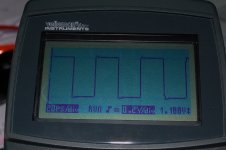
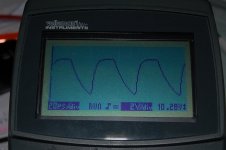
Rise time is much better than the fall time.
The test square wave is 20kHz.
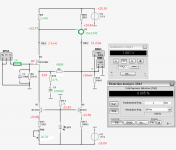
Pic.1 - My changes are in Green; Actual voltages are in Red
Pic.2 - Input waveform at the gate of the JFET
Pic.3 - Output waveform
BTW, I bought my 2SA1145/C2705 from RS-components, the price is very reasonable & they do free delivery in Australia.
Cheers, Stanley
Step responses...
Hi Wahab,
What is your modification?
I happened to have the Toshiba 2SA1145 so I swapped that in. I did a few changes to get some healthy current thru the JFET.
Rise time is much better than the fall time.
The test square wave is 20kHz.
Pic.1 - My changes are in Green; Actual voltages are in Red
Pic.2 - Input waveform at the gate of the JFET
Pic.3 - Output waveform
BTW, I bought my 2SA1145/C2705 from RS-components, the price is very reasonable & they do free delivery in Australia.
Cheers, Stanley
Attachments
Hi Wahab,
What is your modification?
Stanley
Hi , Stanley...
Hugh spotted it right...
Stanley,
I would suggest you try 15pF silver mica lag compensation between base and collector of the VAS. This will straighten out the square wave and bring more stability.
Good work!
Hugh
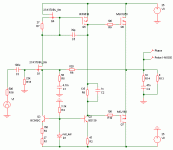
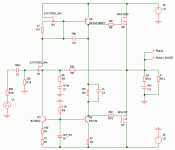
The schematics in my sims :
Attachments
Stanley,
Wahab's mod increases loop gain by around 6dB by replacing the VAS gate to rail resistor with a CCS, in this case another jfet. This is also a very good way to bring additional offset control, and may even reduce the switch-on transient.
With increased loop gain, THD will be lower, but correspondingly, Bode stability will require more lag compensation. The sonic effect is still the big unknown, but this is an excellent way to secure more loop gain in an amplifier whose transconductance in that vital first stage is very low, typically around 20 millisiemens, almost two orders of magnitude behind a bipolar device in the same position.
Nice mod, Wahab, wow, I almost agree with you, what is the world coming to??
Hugh
Wahab's mod increases loop gain by around 6dB by replacing the VAS gate to rail resistor with a CCS, in this case another jfet. This is also a very good way to bring additional offset control, and may even reduce the switch-on transient.
With increased loop gain, THD will be lower, but correspondingly, Bode stability will require more lag compensation. The sonic effect is still the big unknown, but this is an excellent way to secure more loop gain in an amplifier whose transconductance in that vital first stage is very low, typically around 20 millisiemens, almost two orders of magnitude behind a bipolar device in the same position.
Nice mod, Wahab, wow, I almost agree with you, what is the world coming to??
Hugh
Stanley,
I would suggest you try 15pF silver mica lag compensation between base and collector of the VAS. This will straighten out the square wave and bring more stability.
Good work!
Hugh
Thanks Hugh,
I will try that with a 15pF ceramic cap as I don't think I have the 15pF silver mica.
Cheers, Stanley
Hi , Stanley...
Hugh spotted it right...
The schematics in my sims :
Hi Wahab,
I will try your mod. Can I use 2SK117GR for Q4?
I only have a few K170BL but I have got a bunch of cheaper Toshiba 2SK117GR with Idss ~ 6mA.
Cheers, Stanley
Wahab's mod increases loop gain by around 6dB by replacing the VAS gate to rail resistor with a CCS.
Nice mod, Wahab, wow, I almost agree with you, what is the world coming to??
Hugh
Well , that s in fact one of Lineup s version of his fetzilla that
can be found somewhere in this populated thread...
He did more or less test all possible variations with and without lag cap.
The only mods i made was to increase the values of the feedback
resistors, as their original values were too low for some obvious reasons,
that allow to get rid of an eventual ugly lead comp. cap and replacing it by
a well more stability enhancing lag cap compensation.
Using lateral power fets from Hitachi is mandatory for good performances,
i wouldnt expect other models to behave well be it in sims or in real life..
- Status
- This old topic is closed. If you want to reopen this topic, contact a moderator using the "Report Post" button.
- Home
- Amplifiers
- Solid State
- JFET input, MOSFET VAS, LATERAL output = Perfect!!