
Bob, whatever you do, don't waste your time covering the deeply excreble so-called "CFAs". There are no reasons that can be advanced for their use in audio.
Hi Mike,
As indicated in my response to Bonsai, I'd need to educate myself more on the CFA in a power amplifier context, and to find that it brought some value to the table in order to devote much if any text to it.
Cheers,
Bob

BTW, I have designed and simmed a quad comp input stage. Results look interesting with full power THD at ~6ppm 20 kHz. This is a VFA design, but features 'current on demand' architecture so its fast (See ADI's Walt Kester op-amp app note for a brief description - although in that implementation they seem to use diode biasing of the input devices). If you apply conventional TMC, the distortion is about 30ppm. This design might also benefit from MIC, but I have not tried that yet, and the slew rates in any event probably ok as is. If you drop the RHS of the input stage off, you get a classic 2 stage CFA topology -similar to nx-Amp).
🙂
🙂
Attachments

Last edited:
Thanks for your very kind words, Bonsai. . . . For example, the 50-watt MOSFET power amplifier with error correction that I reported on in 1983 achieved 300 V/us, which I think is more than adequate for audio.
Cheers,
Bob
Thanks Bob - whatever you decide, I will look forward to your views.
🙂
Writing down one's knowledge alongside measurements/evidence is different from simply writing down one's knowledge even if the person is right. It is sort of like the open-source software community. Anyone can check the analysis.
...
Keantoken,
You maybe correct (and really well written) but I'd like to offer an opposing view. Namely, this forum is a hobby, and doesn't have the burden of rigor. Many (including myself) seem to enjoy the more relaxed and possibly opinionated, and often even incorrect views brought forward. There is still a lot of information being passed and people feel a bit more at ease posting a thought without having to provide proof.
One never knows where the final bit of inspiration comes from, especially if you ignore post that start with: No ...
Thanks
-Antonio
BTW, I have designed and simmed a quad comp input stage. Results look interesting with full power THD at ~6ppm 20 kHz. This is a VFA design...
If you drop the RHS of the input stage off, you get a classic 2 stage CFA topology -similar to nx-Amp).
Bonsai,
Neat work, and by my personal definition its a cfa.
Thanks
-Antonio
Seems the editor got the better of me about the amp I posted above . . .
Straight MC comp: 30ppm at full power 20 kHz
TMC comp: 6ppm at full power
Rails set to 85V and peak output swing is 76V delivering 350W RMS into 8 Ohms.
Rounding the output pair complement to 10 each side will drp THD to about 5ppm, and AFEC will take it to 500ppb. Of course, getting these levels on a practical amplifier really requires good layout and wiring skills - this a big challenge
Straight MC comp: 30ppm at full power 20 kHz
TMC comp: 6ppm at full power
Rails set to 85V and peak output swing is 76V delivering 350W RMS into 8 Ohms.
Rounding the output pair complement to 10 each side will drp THD to about 5ppm, and AFEC will take it to 500ppb. Of course, getting these levels on a practical amplifier really requires good layout and wiring skills - this a big challenge

Keantoken,
You maybe correct (and really well written) but I'd like to offer an opposing view. Namely, this forum is a hobby, and doesn't have the burden of rigor. Many (including myself) seem to enjoy the more relaxed and possibly opinionated, and often even incorrect views brought forward. There is still a lot of information being passed and people feel a bit more at ease posting a thought without having to provide proof.
One never knows where the final bit of inspiration comes from, especially if you ignore post that start with: No ...
Thanks
-Antonio
As you say there is always a place for casual talk. But when the good is mixed with the bad, it's hard for many to tell the difference. At times we feel the need for a deeply rigorous investigation, to cut through all the noise. There should be a place for this that's separate from casual talk, that puts in place a framework that streamlines rigor.
When one person posts an unverified statement, each person reading that statement has to verify it themselves. But when the person posting a statement provides the proof, it saves us collectively a lot of work. This is a group dynamic we miss out on when everyone is on battery saver mode. Collaboration requires a bit of unconditional sacrifice - which seems a lot worse than it actually is to someone with anxiety. It is like investment. You have to spend money to make money, and hoarding is ultimately more risky than making wise, if uncertain, investments.
The reason casual talk can be so helpful in solving problems is because there is a degree of unconditional acceptance that alleviates fear and anxiety. An unconditionally free mind is not good at working within restrictions, so the instinct of fear is a fallback which leads to linear, outcome-based thought - this crushes creativity and nonlinear problem-solving. Therefore the alleviation of fear allows a person to express their full creativity.
On the other hand, due perhaps at large to the public schooling system and intellectual bigotry, rigor is a subject of anxiety and fear. Anyone who performs their research under the influence of anxiety will produce work of limited usefulness.
Considering all this it seems to me that the most progress will not come necessarily from brilliant minds, but from the places where unconditional acceptance prevails and people are given their mental freedom. So a place like the wiki I described could only be supplemental to a community such as this forum. Without the energizing force of a collaborative community, such a project would experience a slow, miserable death.
Last edited:
BTW, I have designed and simmed a quad comp input stage. Results look interesting with full power THD at ~6ppm 20 kHz. This is a VFA design, but features 'current on demand' architecture so its fast (See ADI's Walt Kester op-amp app note for a brief description - although in that implementation they seem to use diode biasing of the input devices). If you apply conventional TMC, the distortion is about 30ppm. This design might also benefit from MIC, but I have not tried that yet, and the slew rates in any event probably ok as is. If you drop the RHS of the input stage off, you get a classic 2 stage CFA topology -similar to nx-Amp).
🙂
Thats a very good topology, there are three audio companies using it at the moment, the most famous one is Marantz.
This however is not the quad core topology but its called H bridge.
BTW, I have designed and simmed a quad comp input stage. Results look interesting with full power THD at ~6ppm 20 kHz.
🙂
What is this amp's ULGF?
For 8 pairs of output devices, due to physical constraints, it is not realistic to rely on ULGFs higher than 7-800KHz.
This is an interesting trade-off. Increasing the number of output pairs allows less current per device, hence less (open loop) distortions. But increasing the number of output pairs decreases the practical (not in simulation) ULGF, so less feedback to linearize. So where is the optimum?
EVEN order harmonic cancellation, if you please, and, NO, Bonsai's nx amplifier's input stage is incapable of cancelling even order harmonics like a current-mirror loaded diff. pair.
It doesnt need to cancel even order harmonics as these are at levels already lower than with the use of LTP as the stage is much more linear. I have already pointed it out, provided an analyses and Edmond has proved the point with simulation. 3RD harmonics are even more improved as well. Didnt you follow the thread ?? 🙁
Thats a very good topology, there are three audio companies using it at the moment, the most famous one is Marantz.
This however is not the quad core topology but its called H bridge.
Yes, that's why I just called a quad complimentary. I guess H bridge is probably more accurate, but quad balanced might help differentiate it from H bridge which is primarily associated with power output stages in motor drives and amplifiers.
I have not checked yet, but I don't think the PSRR is as good as a standard balanced or Lin VFA. Some more work needed in this area no doubt.
The naming by Analog Devices had me confused I have to agree. National which was probably the first to use it in their lm6171 didnt assign any particular name to it. PSRR is a little worse off, however slewrate can be increased by feedforward as is used with the lm49713 but its really not necessary for a audio amp and your design as is makes for a very good amp. Ive used a amp with this topology for the last three years and it is very difficult to discern it from CFA amps I have. PSRR is not such a big problem as some make it out to be although cascode as youve used helps. Why didnt you apply the cascode for the other CFA arm BTW ??.
I highly doubt the veracity of this; I fail to appreciate how a "CFA" input stage that operates in class-AB can be inherently more linear than a current-mirror loaded LTP which operates in class-A.It doesnt need to cancel even order harmonics as these are at levels already lower than with the use of LTP as the stage is much more linear.

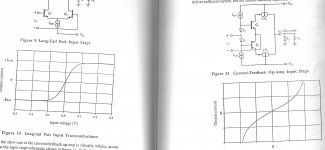
I highly doubt the veracity of this; I fail to appreciate how a "CFA" input stage that operates in class-AB can be inherently more linear than a current-mirror loaded LTP which operates in class-A.
Michael
Why would anyone operate such an input stage in class A/B ?
Thanks
-Antonio
Michael
Why would anyone operate such an input stage in class A/B ?
Thanks
-Antonio
The complementary common emitter input stage of a so-called "CFA" operates in class AB.
I would expect the cfa input stage to operate in class A for applications of which we speak. Just because it can operate in class ab doesnt mean it should (I do agree that quoting the high slew rate benefit is in fact meaningless and misleading because of the above).
Thanks
-Antonio
Thanks
-Antonio
This class AB thing wrt the CFA front end has been raised as an objection quite a few times. This may be the case with IC opamps, where a few hundred micro amps is a useful power saving. In a discrete design you do not have these limitations.
- Home
- Amplifiers
- Solid State
- Bob Cordell's Power amplifier book