

We actually test amps this way. Amps that seem like they will take it anyway and wondered if anyone has a valuable opinion for this test.
Take channel 1 of a stereo amp and hook it to channel 2 of the same amp with a resistor. This would be red to red binding post with the resistor in between. We start with a 4 ohm power resistor. Drive channel 1 and read all your favorite measurements on channel 1. Next look at the signal on channel 2 which is used as the virtual ground when driving channel 1 with your favorite test signals. This residual signal seems to speak volumes about the amplifier or in many cases the ampli-fire. Many amps do not like this test but the amps that do well here seem to usually sound pretty good in general and are often the most reliable. Of course this is if all normal testing goes well also.
I like this test as driving a speaker is kind of like pulling a trailer with a truck, robust is better.
Anyone have a thought about this? I really like this test!
Take channel 1 of a stereo amp and hook it to channel 2 of the same amp with a resistor. This would be red to red binding post with the resistor in between. We start with a 4 ohm power resistor. Drive channel 1 and read all your favorite measurements on channel 1. Next look at the signal on channel 2 which is used as the virtual ground when driving channel 1 with your favorite test signals. This residual signal seems to speak volumes about the amplifier or in many cases the ampli-fire. Many amps do not like this test but the amps that do well here seem to usually sound pretty good in general and are often the most reliable. Of course this is if all normal testing goes well also.
I like this test as driving a speaker is kind of like pulling a trailer with a truck, robust is better.
Anyone have a thought about this? I really like this test!

This test doesn't say anything about how the amp handles inductive and capacative loads like real speakers though.....
This test doesn't say anything about how the amp handles inductive and capacative loads like real speakers though.....
Yes you are correct.
We go on to add complex circuits there and resonators- L C in series with various resistors as a standard test method using a repeatable procedure. It is a virtual ground so in theory if it were perfect there would be no signal on channel 2. Always far from that in reality.
The straight resistor is very useful and valid for determining real damping factor at any frequency.
Speakers may be placed where the resistor goes. Does not get any more real than that.
For horrible load simulation a brush type low voltage AC motor is placed where the resistor goes.
I hope some of you try this with your favorite amps!😀 Let us know what you find. This is also a great way to hook two amps together and learn which is the master... I mean for testing.- tug-o-war.
Sounds similar to a method explained by Nelson Pass back in the early '80s. He used it in the Citation 12 mod. article for Audio Amateur. Go to PassDIY and find the Citation article.
Craig
Craig

actually this is a good way to measure output impedance (or inversely damping factor). if the output of amp A is 10Vpeak (20Vp-p), and the resistor is 10 ohms, then you are feeding 1Apeak into amp B's output. so a measurement with an oscope on amp B's output will show a relationship of 1mV/milliohm. this will also reveal if the amp is underbiased, because you will see spikes at the zero crossing due to the changes in output impedance as the transistors move through the crossover region. this may be an effective way to correctly set the bias on an amp without a distortion analyzer (i really need to experiment with this a bit more before i recommend it). i'm not yet sure what the effects of amp A being underbiased or overbiased would be, which is another reason i need to explore this a bit more

Good idea, change the resistor with real loudspeaker too they are reactive.
My test is little different, using sweep AC current source connected to amp output.
My test is little different, using sweep AC current source connected to amp output.
this will also reveal if the amp is underbiased, because you will see spikes at the zero crossing due to the changes in output impedance as the transistors move through the crossover region. this may be an effective way to correctly set the bias on an amp without a distortion analyzer (i really need to experiment with this a bit more before i recommend it). i'm not yet sure what the effects of amp A being underbiased or overbiased would be, which is another reason i need to explore this a bit more
Not only underbiased, but bad combination of output filter and feedback loop in classB or small bias classAB creates some noise when crossing, while most classA is free.
i have done some investigation of this. the best method is to use a "power" version of a Howland current source instead of an amp and resistor. if the amp output impedance is more than 100 milliohms, the measurement begins to show a bit of error. about 1% per 100 milliohm. a howland current source would also be useful for charting the impedance vs frequency curves of speakers, crossover networks, etc... and the current is set with a simple scaling resistor. the one i built to test the idea has switchable scaling for 1A, 100mA, 10mA, 1mA.... i just have to experiment with it more to find out if there are other sources of error i'm overlooking. i also want to try using it as an ESR meter (or even better a curve tracer for in-circuit testing of components).
Last edited:
It's an old idea. IIRC Tim De Paravicini described this method for testing damping factor many years ago.

I've mentioned from time to time Cherry's formulation of this test - put 2 different frequency signals at each end of the resistor between amp channels and you sweep the output over a large region of the I,V plane
same frequency, differing phase simulates manyaspects of complex impedance load
same frequency, differing phase simulates manyaspects of complex impedance load
How about some more gain?
Graham’s Class A Imagineering articles spend considerable space discussing amplifier output impedance and interaction with “back EMF” from the complex loudspeaker load, with the possibility of nonlinear back EMF components tossed in as well
Suspicion over feedback control of the output impedance with standard dominant pole miller compensation is suggested as a source of poor performance with the complex/nonlinear speaker load
Cherry has addressed the same issues in “Feedback Sensitivity and Stability of Audio Power Amplifiers” and “ Output Resistance and Intermodulation Distortion of Feedback Amplifiers” JAES V30 #5 May, April 1982
Cherry’s prescription is more gain, specifically more hfe in the VAS and more loop gain to address output stage current and voltage nonlinearities respectively
The JLH output stage Graham uses naturally provides voltage gain, borrowing another of Hood’s ideas (“Gain Stage Investigations” Electronics World july 1998) I changed the Q2 driver transistor (~= VAS transistor) to a small signal mosfet for increased “hfe” at audio frequencies
2-Pole compensation that includes the output stage is implemented with Graham’s component values, slightly rearranged, (Cherry’s nested feedback around the output stage)
I’ve put my thread opening sim of Graham’s circuit together with my modded circuit in the following sim with a complex excitation, 3:1 2 and 20 KHz input at ~ ½ max swing let you look at intermod skirts as well as harmonics, a 1 A, 7 KHz current source in parallel with the speaker load shows output impedance and intermodulation interactions with the 7 KHz output disturbance that clearly show the advantage of increased gain
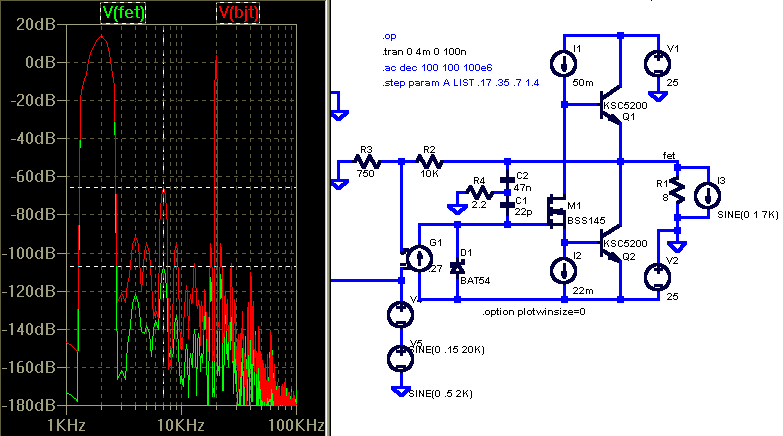
Increased loop gain at audio frequencies has improved 2 KHz harmonics ~ 30 dB and the 7 KHz output current induced signal is ~ 40 dB down with the mods in this sim
Speaker cable impedance will prevent the low level of the output impedance ( ~ 10 uOhms! ) from helping at the loudspeaker end but the amplifier’s distortion should show greater immunity to Graham’s “back EMF” concerns
JCX. Do you have those articles by Cherry and would you be willing to PM them to me? They sound like interesting reading but not being an AES member I can't access them. I had thought about joining the AES but heard too many things about it being "not what it used to be" and not worth joining... or maybe in having to ask you for the articles I'm proving myself wrong!? 😕
I don't have digital copies - the most active years for SS amplifier design info was in 1970's-80's JAES articles, tapering off thru the 90's, very few later articles are amplifier circuit design oriented
What a great thread with wonderful suggestions!
Have had great success with this unraveling faulty designs. Many amps have great phase margin under no load conditions. Put on the complex load and that phase margin magically disappears and the amp breaks into oscillation on a portion of the wave indicating gain is more than one at with 180 degrees of phase shift. Very bad for audio.
This can also show well common mode problems in stereo designs and lack of power supply rejection. Most amps I have tested show line frequency spikes on the virtual ground channel.
Enjoy🙂
Have had great success with this unraveling faulty designs. Many amps have great phase margin under no load conditions. Put on the complex load and that phase margin magically disappears and the amp breaks into oscillation on a portion of the wave indicating gain is more than one at with 180 degrees of phase shift. Very bad for audio.
This can also show well common mode problems in stereo designs and lack of power supply rejection. Most amps I have tested show line frequency spikes on the virtual ground channel.
Enjoy🙂
It's an old idea. IIRC Tim De Paravicini described this method for testing damping factor many years ago.
i've actually built a device for doing the current source method. it's a Howland current source with an added output stage. i need to do a bit more testing with it, but i need to replace the TL072 with something that has a bit wider power bandwidth first.
Loudspeakers and cables as sources
I noticed there is discussion of "complex speaker load" and would really like to add:
In stereo speakers the left speaker produces sound which drives the right speaker acoustically and thereby produces an electrical signal in the transducer which then is applied to the inverting input of the feedback amplifier. Loudspeakers are more than loads. Loudspeakers are sources of signals. Generators if you will.
Further, any RF around is picked up well by most speaker cables and likewise applied to the inverting input.
All these sources of noise and signal somehow must be controlled by the amplifier. Driving the output of the amplifier with either real or simulated signals and using the amplifier as a virtual ground is sound engineering practice with this thread adding many techniques to this sound practice. Of course one does not find many consumer amplifiers which are designed this way.
I noticed there is discussion of "complex speaker load" and would really like to add:
In stereo speakers the left speaker produces sound which drives the right speaker acoustically and thereby produces an electrical signal in the transducer which then is applied to the inverting input of the feedback amplifier. Loudspeakers are more than loads. Loudspeakers are sources of signals. Generators if you will.
Further, any RF around is picked up well by most speaker cables and likewise applied to the inverting input.
All these sources of noise and signal somehow must be controlled by the amplifier. Driving the output of the amplifier with either real or simulated signals and using the amplifier as a virtual ground is sound engineering practice with this thread adding many techniques to this sound practice. Of course one does not find many consumer amplifiers which are designed this way.
why do people want to strain at gnats?
in domestic setups typical speaker electrical-acoustic efficency is order of 1% - so coupled electrical-acoustic-electrical efficiency will be <<0.1%
if you don't terminate the "microphone" speaker you can measure the terminal V directly - then dividing by the speaker's impedance give a estimate of the current the amp would have to supply to to keep the speaker terminals at the commanded V
the number is trivial for any ampifier with low Z/high damping factor - less than many nonlinear terms from the speaker's own inductance/motor/suspension caused nonlinear currents
again Cherry's articles shows that distortion for these external error currents are equal or lower than the distortion from the forward signal causing the output stage to put out the same current - for low output impedance/high feedback factor amps their is no issue for any current within the output/supply's I,V limits
in domestic setups typical speaker electrical-acoustic efficency is order of 1% - so coupled electrical-acoustic-electrical efficiency will be <<0.1%
if you don't terminate the "microphone" speaker you can measure the terminal V directly - then dividing by the speaker's impedance give a estimate of the current the amp would have to supply to to keep the speaker terminals at the commanded V
the number is trivial for any ampifier with low Z/high damping factor - less than many nonlinear terms from the speaker's own inductance/motor/suspension caused nonlinear currents
again Cherry's articles shows that distortion for these external error currents are equal or lower than the distortion from the forward signal causing the output stage to put out the same current - for low output impedance/high feedback factor amps their is no issue for any current within the output/supply's I,V limits
Last edited:
It is not gnats if you throw in room modes and consider woofers. I have seen over 0.5 volts come out of an inactive driver driven by the other channel. Further, many amps will pass a lot of current but make extremely lousy virtual grounds. To simplify, at the output terminals low output impedance and an amazingly high input impedance. Now I know this sounds out of balance and that is exactly how many amplifiers and other power supplies behave.
still gnat sized - 500mV/8 Ohm ~= 60 mA which is about 1/2 the Class AB bias current per output Q recommended by just about everyone excepting perhaps Doug Self
at low frequency a high feedback SS amp can have uOhm output impedance
my sim above is showing <10 uOhm output Z at 7 kHz - admittedly Class A baised - but not actually what I would call a high feedback amp
the thread is in the Solid State amp forum, the topic is testing Solid State amp designs, specifically those designed to approximate Vsource outputs
there is no need to get excited over "back driven by the room sound" effects on such amps - at SPL compatable with human life
at low frequency a high feedback SS amp can have uOhm output impedance
my sim above is showing <10 uOhm output Z at 7 kHz - admittedly Class A baised - but not actually what I would call a high feedback amp
the thread is in the Solid State amp forum, the topic is testing Solid State amp designs, specifically those designed to approximate Vsource outputs
there is no need to get excited over "back driven by the room sound" effects on such amps - at SPL compatable with human life
JCX- believe what you want. Your "SIMs" are almost a complete waste of time and worthless unless that sim is accurately calibrated to a REAL circuit. I have the lowest output impedance amps made and none are micro-ohm scale in the output impedance which shows clearly your statement to be false. Go test a REAL amplifier and not some imagination on a computer and discover the FACTS and not your wishful sim. I do not happen to listen to simulated music on virtual or simulated speakers. In short, pretty much everything you say is incorrect. At least you are consistent. Further, I was talking input impedance at the output terminals and you are talking output impedance. Not the same thing in reality at all.
I would like to take this moment to say to everyone with a sim not calibrated to a real circuit with real result, you all mislead yourself and many others with your nonsense notions of how amplifiers work and performance of those circuits. All of you sim people need to build you "sim" with real parts and find out just how far off those sims are from reality. Indeed, I believe DIY audio should have some method for SIM heads to be segregated from people who actually build and test real circuits as sims are pretty much straight fantasy until accurately calibrated where a real circuit just cannot lie.
I would like to take this moment to say to everyone with a sim not calibrated to a real circuit with real result, you all mislead yourself and many others with your nonsense notions of how amplifiers work and performance of those circuits. All of you sim people need to build you "sim" with real parts and find out just how far off those sims are from reality. Indeed, I believe DIY audio should have some method for SIM heads to be segregated from people who actually build and test real circuits as sims are pretty much straight fantasy until accurately calibrated where a real circuit just cannot lie.
- Status
- Not open for further replies.
- Home
- Amplifiers
- Solid State
- Solid State Testing- Tug of war