

There are several versions of main DC Filter resp. DC blocker to avoid humming and buzzing, if there are DC components by the main voltage. In the PDFattachement I have filed several versions.
Here some URLs in this case:
http://www.diyaudio.com/forums/solid-state/2080-dc-filter.html
Christian's Homepage
L C Audio Technology / DC Filter
What Hi-Fi? Sound and Vision - Mains DC Blocking help
http://www.diyaudio.com/forums/soli...nt-limiter-their-amplifiers-very-special.html post #9
What is now the circuit with best reliability for such mains DC filter resp. mains DC blocker to block DC components from the otherwise singing and buzzing toroidal main transformer ?
I guess a corresponding number of parallel EPCOS foil's MKT's together with the suitable anti parallel connected diodes (possibly suitable anti parallel connected diode serial networks of two or three serial diodes)
Or an complete other solution that meets the same purpose is much
more better (e. g. a DC compensation network in parallel mode).
Here URLs regarded electrolytic caps:
Electrochemistry Encyclopedia -- Electrolytic capacitors
(ELECTROLYTIC CAPACITORS - basic description)
I note by the FTcap datasheets, that the max allowed voltage of reverse polarity of their electrolytics is always the same value of 2V,
independend of the forward voltage value - e. g.:
http://www.ftcap.de/downloads/elektrolyt/datenblaetter_2009/G2009.pdf
http://www.ftcap.de/downloads/elektrolyt/datenblaetter_2009/GW2009.PDF
by some other brands I get only 1V.
With respect to this - what is the right version to get highest reliability - that is the question.
Here some URLs in this case:
http://www.diyaudio.com/forums/solid-state/2080-dc-filter.html
Christian's Homepage
L C Audio Technology / DC Filter
What Hi-Fi? Sound and Vision - Mains DC Blocking help
http://www.diyaudio.com/forums/soli...nt-limiter-their-amplifiers-very-special.html post #9
What is now the circuit with best reliability for such mains DC filter resp. mains DC blocker to block DC components from the otherwise singing and buzzing toroidal main transformer ?
I guess a corresponding number of parallel EPCOS foil's MKT's together with the suitable anti parallel connected diodes (possibly suitable anti parallel connected diode serial networks of two or three serial diodes)
Or an complete other solution that meets the same purpose is much
more better (e. g. a DC compensation network in parallel mode).
Here URLs regarded electrolytic caps:
Electrochemistry Encyclopedia -- Electrolytic capacitors
(ELECTROLYTIC CAPACITORS - basic description)
I note by the FTcap datasheets, that the max allowed voltage of reverse polarity of their electrolytics is always the same value of 2V,
independend of the forward voltage value - e. g.:
http://www.ftcap.de/downloads/elektrolyt/datenblaetter_2009/G2009.pdf
http://www.ftcap.de/downloads/elektrolyt/datenblaetter_2009/GW2009.PDF
by some other brands I get only 1V.
With respect to this - what is the right version to get highest reliability - that is the question.
Attachments
Last edited:

Example one should do the trick (there are several threads about that particular DC blocker here). No need for lots of components. Just a nice simple way to prevent DC 🙂
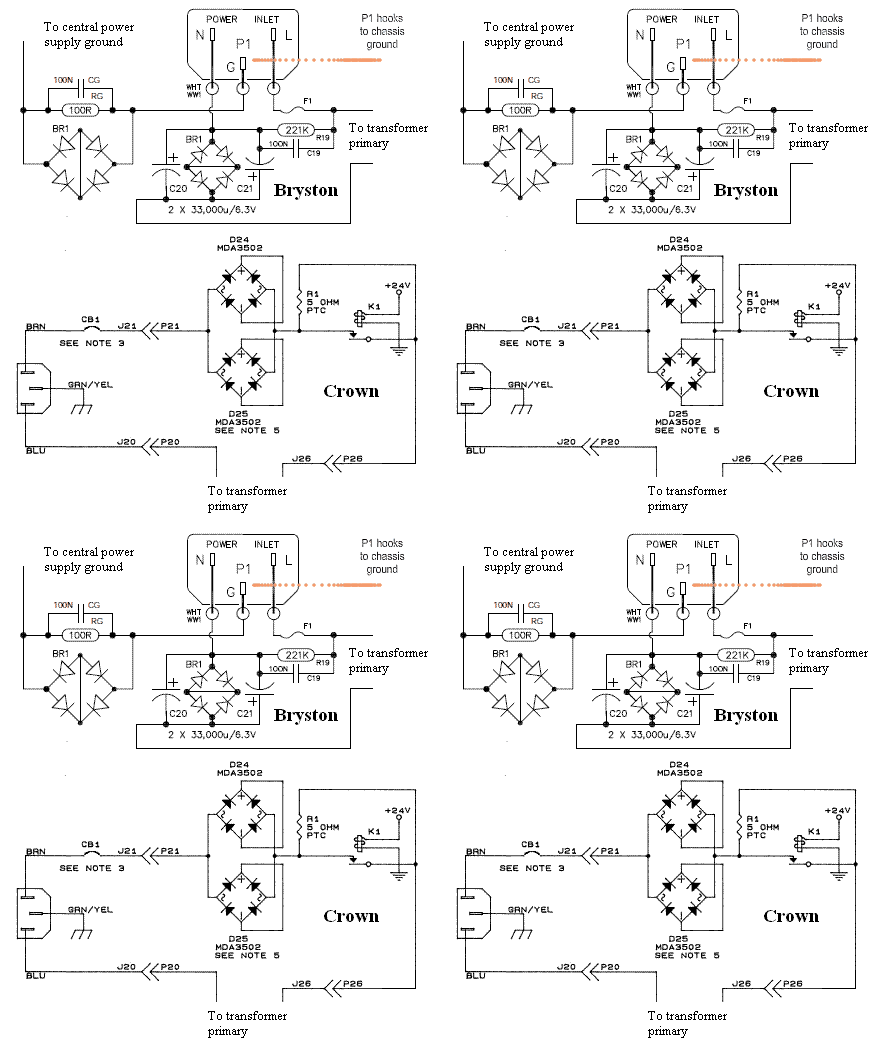
Crown's two bridge rectifiers are to create the dual polarity power supply.
Bryston's two bridge rectifiers are for a completely different purpose.
Bryston's two bridge rectifiers are for a completely different purpose.

As we can see in the above Crown schematic, the two bridges are in parallel to increase the current capacity for their large amplifiers. Note 5 says only one bridge is used on the smaller models.
The left-hand bridge on the Bryston schematic is out-of-circuit under normal use. Current only flows when there is a bad ground loop, its function is to keep the 100R resistor from burning up (and you will hear a nasty buzz until you fix the ground loop). The right-hand bridge is the DC blocker.
The left-hand bridge on the Bryston schematic is out-of-circuit under normal use. Current only flows when there is a bad ground loop, its function is to keep the 100R resistor from burning up (and you will hear a nasty buzz until you fix the ground loop). The right-hand bridge is the DC blocker.
Example one should do the trick (there are several threads about that particular DC blocker here). No need for lots of components. Just a nice simple way to prevent DC 🙂
Yes, but none of these threads answer my question from post # 1 (except that one filed about other headlines and therefore I don't find).
And what is the better and at the same time easy i. e. passive way in your opinion to remove DC components (except active power conditioner respectively uninterruptible power supply/UPS)?
Perhaps an isolating transformer?
Or an parallel DC compensation like this one of the follow URLs?
http://www.horch-gmbh.de/Produkte/Line Silencer.pdf
Horch Elektroakustik - open-end-music-professional (post #9)
Unfortunately, less than one weblink in English
The related circuit I want to know.
Last edited:

given the lack of formal data, we can't really comment on what is the most reliable approach 😕
however, anecdotally speaking (or if you held a gun to my head to make me choose ), i would probably vote for bryston's approach:
1. 20 year product warranty
2. products known to stand up to use in tough environments
3. bryston is still in business. in other words, items 1 and 2 have not been problematic enough to shut them down or even give their products a bad reputation
mlloyd1
however, anecdotally speaking (or if you held a gun to my head to make me choose
), i would probably vote for bryston's approach:1. 20 year product warranty
2. products known to stand up to use in tough environments
3. bryston is still in business. in other words, items 1 and 2 have not been problematic enough to shut them down or even give their products a bad reputation
mlloyd1
Yes, that is the only way that I also go. However - nevertheless it would be interesting to know who invented this topology, and used it at first.given the lack of formal data, we can't really comment on what is the most reliable approach 😕
however, anecdotally speaking (or if you held a gun to my head to make me choose
1. 20 year product warranty
2. products known to stand up to use in tough environments
3. bryston is still in business. in other words, items 1 and 2 have not been problematic enough to shut them down or even give their products a bad reputation
mlloyd1
The Crown Studio Reference 1 schematic is dated 1994, the Bryston 4BST is the first example I can find in the Bryston line is dated 1996.
The difference between the two is the pair of electrolytic caps in the Bryston, Crown doesn't seem to feel they are needed.
If you really want to know, build it like the Crown, and then try adding the Bryston caps.
The difference between the two is the pair of electrolytic caps in the Bryston, Crown doesn't seem to feel they are needed.
If you really want to know, build it like the Crown, and then try adding the Bryston caps.
After looking the different topologies again (attachement post # 1), I discover for me the Var. VII
from LC Technology about
L C Audio Technology / DC Filter
as my currently favourite.
At first look I had overlooked that the Zener diode is actually a bidirectional diode - at reverse mode like a normal diode (0V7 voltage loss).
Because the DC component from mains always have one direction, I can try to put in the main plug in reverse polarity if buzzing effects don't go away (unfortunately this isn't perform in all countries - independend of the kind of the mains plug).
In one of this two directions I get a DC filtering with max 4V3 and in the other one of 0V7.
Thus the solution from LC Technology is a good solution at least here in Germany because the mains connector polarity isn't defined.
from LC Technology about
L C Audio Technology / DC Filter
as my currently favourite.
At first look I had overlooked that the Zener diode is actually a bidirectional diode - at reverse mode like a normal diode (0V7 voltage loss).
Because the DC component from mains always have one direction, I can try to put in the main plug in reverse polarity if buzzing effects don't go away (unfortunately this isn't perform in all countries - independend of the kind of the mains plug).
In one of this two directions I get a DC filtering with max 4V3 and in the other one of 0V7.
Thus the solution from LC Technology is a good solution at least here in Germany because the mains connector polarity isn't defined.
LC technology calls their diode "tranzorber" (see schematic by the URL in the previous post). I have never heard this term and I think, LC technology means this term:
"TRANSIENT VOLTAGE SUPPRESSOR" = TVS (suppressor diode)
http://www.diotec.com/service/files/tvs-dioden.pdf
But I don't find such diodes below 5V6
"TRANSIENT VOLTAGE SUPPRESSOR" = TVS (suppressor diode)
http://www.diotec.com/service/files/tvs-dioden.pdf
But I don't find such diodes below 5V6

In the Bryston amp schematic there is a a device (Q10) adjacent to the Power Inlet labeled "MAC 2213A10FP".
What is it? Where can I find more about it?
What is it? Where can I find more about it?
Last edited:

Run motor run
If there is DC coming from your mains the first thing is contact the power company and complain. No DC can be on the grid because of an effect what used to be called "flux walking" which will stop the grid.
If you want to stop your local DC from UPS or other source, series in "motor run" type capacitors with the AC line. The motor run caps are specifically designed for 50/60Hz AC series operation and will handle high currents.
Find capacitor examples here:
Shine Capacitors | Products
If there is DC coming from your mains the first thing is contact the power company and complain. No DC can be on the grid because of an effect what used to be called "flux walking" which will stop the grid.
If you want to stop your local DC from UPS or other source, series in "motor run" type capacitors with the AC line. The motor run caps are specifically designed for 50/60Hz AC series operation and will handle high currents.
Find capacitor examples here:
Shine Capacitors | Products
Get real, your neighbor running his/her hairdryer will make the toroid in your house buzz.
Try complaining to the utility company about that and see what it gets you.
The Crown/Bryston design fixes work, and their designs have met with UL approval.
"In the Bryston amp schematic there is a a device (Q10) adjacent to the Power Inlet labeled "MAC 2213A10FP"."
It's a triac, used as a solid-state relay (power switch).
Try complaining to the utility company about that and see what it gets you.
The Crown/Bryston design fixes work, and their designs have met with UL approval.
"In the Bryston amp schematic there is a a device (Q10) adjacent to the Power Inlet labeled "MAC 2213A10FP"."
It's a triac, used as a solid-state relay (power switch).
In the Bryston amp schematic there is a a device (Q10) adjacent to the Power Inlet labeled "MAC 2213A10FP".
What is it? Where can I find more about it?
I also see this. But I haven't heard about Triacs (Triode for Alternating Current) suited for switching large torodial transformers cause its large inrush current.
Therefore I think, the type "MAC 2213A10FP" ("MAC2213A10FP") must be a new generation especially made for switch on/off of such transformers.
But where datasheets and application notes about this kind of Triacs ??
I don't find this. Only the follow weblinks about Onsemi's MAC series I have found:
MAC223-6 Datasheet pdf - TRIAC 25 AMPERE Effektivwert 200 bis 800 VOLT - Motorola
Triacs
Get real, your neighbor running his/her hairdryer will make the toroid in your house buzz.
Try complaining to the utility company about that and see what it gets you.
What was written was concerning DC on the mains and not about the buzz from the neighbors hair dryer. Please take the time to read before knee jerk comments.
I have in my life found one strange incidence of DC from the local main AC and yes the power company was very interested once they knew I was not an idiot. Turned out to be a bigger welder with a bad diode in another building dragging one half of the wave down resulting in offset whenever the spot weld was occurring. The welder was being used on a lower power setting so the users did not know of the problem. Actually the welder "charged up" a cap bank for the weld so the problem was invisible to the user as the actual weld was fine.
My point exactly, but unlike your situation with the welder (most likely in a location zoned industrial), the utility company is not going to want to hear about your neighbor's hair dryer.
Only one bridge needed for amps less than 500W
I like the Bryston circuit, and am particularly interested in the left side, where the safety ground from the line cord is connected to the main circuit ground through a resistor shunted by the bridge arrangement. I have done the same thing before in an amplifier for my own use, but was never sure if this approach would pass muster for a commercial product. If I understand the operation correctly, the resistance breaks ground loops that may occur among the safety grounds of interconnected equipment. The diode still provides safety ground protection by never allowing the circuit ground to differ from the safety ground (in a fault condition, for example) by more than 1.4V. This is why a large bridge device is presumably used. I am a little surprized that they used a resistor as large as 100 ohms. I used less than 10 ohms in my arrangement, which I think would be plenty to effectively break the ground while still maintaining a reasonably low impedance back to the safety ground.
Am I correct in assuming that Bryston still bolts the safety ground to the chassis, and that that is the only place where the chassis is connected? Am I correct in assuming that a non-direct connection of safety ground to chassis (as through the diode arrangement) would never be allowed?
Cheers,
Bob

For Class I equipment any conductive touchable parts must be either able to withstand a high voltage insulation test and pass less than 20uA (I think, off the top of my head), or pass a conductivity test and show less than 5mR and conduct 20A for at least 1 minute.
It would be expected to wire the earth from the input socket directly to the case with >20A rated wire. Then any loop breaker stuff goes between that point and the electronics.
Because of these constraints, Class I equipment is not really the ideal way to make audio equipment featuring unbalanced - or at least RCA phono - sockets. Class II is what should be used. This also has the side benefit of banishing ground loops.
It would be expected to wire the earth from the input socket directly to the case with >20A rated wire. Then any loop breaker stuff goes between that point and the electronics.
Because of these constraints, Class I equipment is not really the ideal way to make audio equipment featuring unbalanced - or at least RCA phono - sockets. Class II is what should be used. This also has the side benefit of banishing ground loops.
Last edited:
- Home
- Amplifiers
- Power Supplies
- Variations of DC Main Filter against buzzing Toroid Transformers - what is the right?