

This build is to revisit the previous design which sounded most natural and smooth. So much that the further effort to obtain dipole bass quantity had to be scrapped.
From measurement of different OB implementations I learnt that driver-baffle relationship is very important. If the inherent response is not smooth, no amount of EQ would result in good sound. 'Good' in here refers to the believable reproduction of performances.
These guys provided a good read on how to evaluate driver-baffle relationship. They experimented with 30 Linkwitzlab baffle variances. Smooth response relates to smooth polar measurements on and off axis. So a delta of 0 and 20 degress measurement should be flat, as well as 30 and 40 degrees.
So what makes this build special among the others I've done so far (about 15+ I think )
)

From measurement of different OB implementations I learnt that driver-baffle relationship is very important. If the inherent response is not smooth, no amount of EQ would result in good sound. 'Good' in here refers to the believable reproduction of performances.
These guys provided a good read on how to evaluate driver-baffle relationship. They experimented with 30 Linkwitzlab baffle variances. Smooth response relates to smooth polar measurements on and off axis. So a delta of 0 and 20 degress measurement should be flat, as well as 30 and 40 degrees.
So what makes this build special among the others I've done so far (about 15+ I think
)

Following the method use by DonWM on the link above, I compiled measurement data which was taken outdoor. They are not gated so diffraction and reflection have some influence. But it is important to get the details within the frequency response.
The data were taken at 0, 20, 30, and 45 degrees. Delta of on-axis vs. off-axis then calculated in an excel file. The 30 and 45 deg. measurement was reduced by 10db to show clarity on the graph. The resulting graph is below.
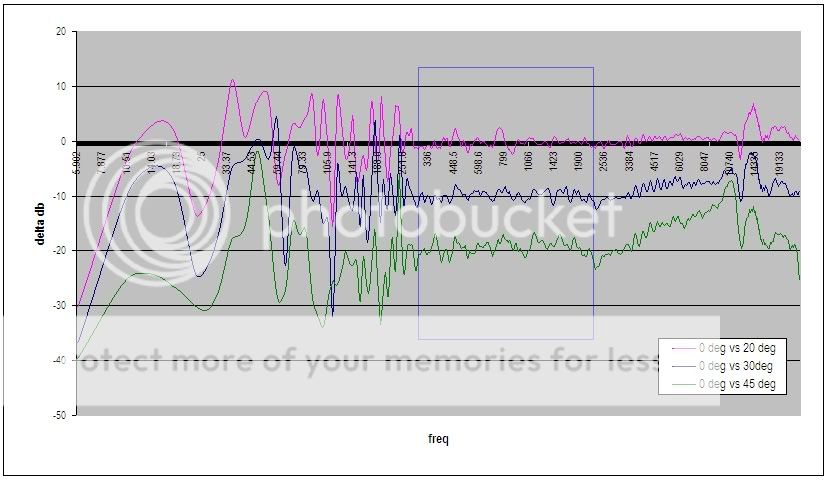
The resulting graph shows that from 250Hz up to 2kHz the polar response is practically flat for the combination of P13WH woofer and thin 19cm baffle. I really did not want to measure 30 baffles so was really pleasing to have this.
As a comparation, take a look at original Phoenix measurement, showing fairly flat polar response but with 700Hz peak.
Also, DonW's modified Phoenix showing good result from 200Hz to 1.7kHz. It's curious that his best result was with much narrower baffle compared to the original Phoenix as well.
DonW's method is really helpful in designing driver-baffle combination. A usual response plot can be used too but not as visible.
The data were taken at 0, 20, 30, and 45 degrees. Delta of on-axis vs. off-axis then calculated in an excel file. The 30 and 45 deg. measurement was reduced by 10db to show clarity on the graph. The resulting graph is below.
The resulting graph shows that from 250Hz up to 2kHz the polar response is practically flat for the combination of P13WH woofer and thin 19cm baffle. I really did not want to measure 30 baffles so was really pleasing to have this.
As a comparation, take a look at original Phoenix measurement, showing fairly flat polar response but with 700Hz peak.
An externally hosted image should be here but it was not working when we last tested it.
Also, DonW's modified Phoenix showing good result from 200Hz to 1.7kHz. It's curious that his best result was with much narrower baffle compared to the original Phoenix as well.
An externally hosted image should be here but it was not working when we last tested it.
DonW's method is really helpful in designing driver-baffle combination. A usual response plot can be used too but not as visible.
Midrange EQ
Next I experimented on the midrange equalisation. This is the second trickiest part of working with OB.
There are few schools of thoughts:
1. No EQ
2. Room EQ, measure from listening position
3. EQ the dipole peak (JohnK)
4. EQ the driver basket resonance (SL)
First one - No EQ.
The sound is subjectively acceptable. I actually swithed EQ and no-EQ just tu make sure. The smooth response helps but definitely the sound is coloured. If I put a mic in my listening room I can see broad peak at 600Hz. This manifests in piano recording. Check with headphones also confirms this.
Next I experimented on the midrange equalisation. This is the second trickiest part of working with OB.
There are few schools of thoughts:
1. No EQ
2. Room EQ, measure from listening position
3. EQ the dipole peak (JohnK)
4. EQ the driver basket resonance (SL)
First one - No EQ.
The sound is subjectively acceptable. I actually swithed EQ and no-EQ just tu make sure. The smooth response helps but definitely the sound is coloured. If I put a mic in my listening room I can see broad peak at 600Hz. This manifests in piano recording. Check with headphones also confirms this.
Greetings Gainphille, good to see you back in the cockpit. Didn't you sell your Alphas, what are you going to do about the lower end?
cheers fergs
cheers fergs

Re: Midrange EQ
Good job Gainphile 🙂
Optimize dipole is a very hard job !
I think it's important to suppress the dipole peak.
Good job Gainphile 🙂
Optimize dipole is a very hard job !
I think it's important to suppress the dipole peak.
Room EQ
Thanks. At the moment the low-end is supported by single Jaycar 10" in an H-Frame baffle. It does ok but severely limited in SPL as the equalisation is -3db at 20Hz. It struggles on organ music but with appropriate sound level it's sounds very deep. The woofer section is a later part of the development as I think it's quite easy. I am looking at Beethoven-type woofer approach.
I'll try to take some pics during the build. Been really lazy.
Anyway on to the 2nd type: Room EQ. Basically measurement taken a sitting position and equalised according to that.
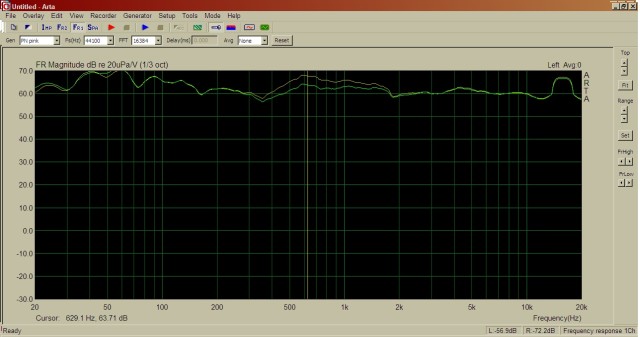
Green is the equalised response. With software parametric EQ it is easy to make changes and listen to the difference. But the problem with this type of approach is high-Q peaks are almost impossible to identify. They would be diffused by the room and showing up as broad peak.
Take an example: If a driver is exhibiting high Q peak such as those metal cone resonances, they would not be picked up by the microphone at listening position as the original peak. Thus the equalisation applied will be wrong.
"Playing" with the parametric EQ also is difficult. The graphs keep moving and at best the result will only be close approximation of what should be. My ears couldn't judge what's correct and what's wrong after few minutes.
I found out this method is not good.
Thanks. At the moment the low-end is supported by single Jaycar 10" in an H-Frame baffle. It does ok but severely limited in SPL as the equalisation is -3db at 20Hz. It struggles on organ music but with appropriate sound level it's sounds very deep. The woofer section is a later part of the development as I think it's quite easy. I am looking at Beethoven-type woofer approach.
I'll try to take some pics during the build. Been really lazy.
Anyway on to the 2nd type: Room EQ. Basically measurement taken a sitting position and equalised according to that.
Green is the equalised response. With software parametric EQ it is easy to make changes and listen to the difference. But the problem with this type of approach is high-Q peaks are almost impossible to identify. They would be diffused by the room and showing up as broad peak.
Take an example: If a driver is exhibiting high Q peak such as those metal cone resonances, they would not be picked up by the microphone at listening position as the original peak. Thus the equalisation applied will be wrong.
"Playing" with the parametric EQ also is difficult. The graphs keep moving and at best the result will only be close approximation of what should be. My ears couldn't judge what's correct and what's wrong after few minutes.
I found out this method is not good.

I've been doing room EQ just this last week. I've been getting excellent results - not subtle differences. I use 110ms gating time, so basically ungated. I place the mic at the listening position, but next I'm going to try spacial averaging to see if I can spot low Q peaks/dips. I use soundeasy's mls signal, and the results are very repeatable.
My graphs look a bit rougher than yours, even though I use 1/3 octave smoothing. Are yours smoother because of gating? Just guessing off the top of my head, I'd say I EQ'ed out some peaks with a Q of 3-5. A thought I had was that dipoles take ungated EQ well because their off-axis reflections should be spectrally similar to the on-axis.
Just a thought. Let us know how it progresses.
My graphs look a bit rougher than yours, even though I use 1/3 octave smoothing. Are yours smoother because of gating? Just guessing off the top of my head, I'd say I EQ'ed out some peaks with a Q of 3-5. A thought I had was that dipoles take ungated EQ well because their off-axis reflections should be spectrally similar to the on-axis.
Just a thought. Let us know how it progresses.
Hi Cuibono, thanks for your info. It's great to compare notes.
My measurements are ungated in these case. If you are able to spot peaks with Q=3 to 5 that's really impressive! The best I could do with this method was 1.4. Anything above that i could not spot.
I'm not sure why your measurements would be rougher. I am attaching here almost similiar measurement with no smoothing (1/24 db) and even that the trends are visible.
My measurements are ungated in these case. If you are able to spot peaks with Q=3 to 5 that's really impressive! The best I could do with this method was 1.4. Anything above that i could not spot.
I'm not sure why your measurements would be rougher. I am attaching here almost similiar measurement with no smoothing (1/24 db) and even that the trends are visible.
Attachments


Hi Gainy,
Nothing to add except to say that I've always loved that build in the first photo. Really nice setup.
Are you saying you've changed it?
Stu
Nothing to add except to say that I've always loved that build in the first photo. Really nice setup.
Are you saying you've changed it?
Stu
EQ of dipole peak vs. EQ of basket resonance
EQ Dipole peak is the method that I had been using for quite sometimes. Basically a 1m gated measurement is taken, preferably outdoor. This result in clear peak which the notch filter is based on.
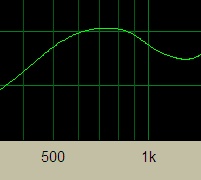
The notch filter itself is pretty shallow when the driver-baffle combination is right, and thus why I noticed that not equalising is also a possible option - albeit audibly not accurate.
However SL argues that the normal gating used in obtaining such measurement do not show what's really happening below 1kHz. His finding is that the driver rear basket will exhibit resonances. This is the peak that should be corrected, not the dipole peak. His argument is the driver-baffle combination have to be good enough to handle this.
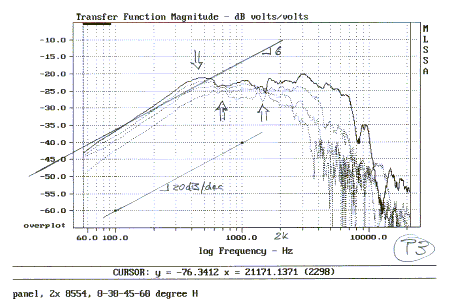
Removing the gating, and measuring outdoor, this is what I got from the measurement:
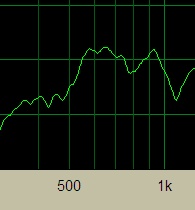
There is now peak showing just around 650Hz. Somewhat similiar to SL's finding of the Phoenix model, only occurring at higher frequency.
Which one is correct?
Very hard to tell. Without real anechoic chamber there is no way to do reliable measurements. I went back and forth to both notch filters and could not identify which one is more accurate. the low-Q notch or the higher-Q notch for the basket resonance. After days of many switching back and forth I settled with the low-Q, correcting the trends only. But I'm not sure if it is the right decision.
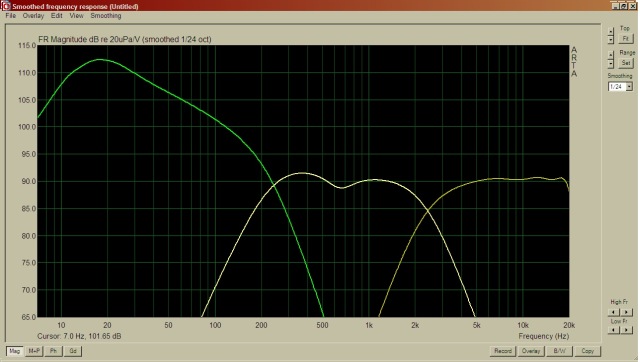
A bonus of using narrow baffle is the on and off-axis consistency is extended to 2.4kHz, relieving the tweeters from low-frequency duties and away from nasty distortion profiles nearing Fs (Hivi K-1 Fs is quite high). The resulting effect is more cleaner sounding highs.
EQ Dipole peak is the method that I had been using for quite sometimes. Basically a 1m gated measurement is taken, preferably outdoor. This result in clear peak which the notch filter is based on.
The notch filter itself is pretty shallow when the driver-baffle combination is right, and thus why I noticed that not equalising is also a possible option - albeit audibly not accurate.
However SL argues that the normal gating used in obtaining such measurement do not show what's really happening below 1kHz. His finding is that the driver rear basket will exhibit resonances. This is the peak that should be corrected, not the dipole peak. His argument is the driver-baffle combination have to be good enough to handle this.
Removing the gating, and measuring outdoor, this is what I got from the measurement:
There is now peak showing just around 650Hz. Somewhat similiar to SL's finding of the Phoenix model, only occurring at higher frequency.
Which one is correct?
Very hard to tell. Without real anechoic chamber there is no way to do reliable measurements. I went back and forth to both notch filters and could not identify which one is more accurate. the low-Q notch or the higher-Q notch for the basket resonance. After days of many switching back and forth I settled with the low-Q, correcting the trends only. But I'm not sure if it is the right decision.
A bonus of using narrow baffle is the on and off-axis consistency is extended to 2.4kHz, relieving the tweeters from low-frequency duties and away from nasty distortion profiles nearing Fs (Hivi K-1 Fs is quite high). The resulting effect is more cleaner sounding highs.
First photo of this build. I took 10cm off the original height to align drivers level to the ears more and could not believe how tiny it became
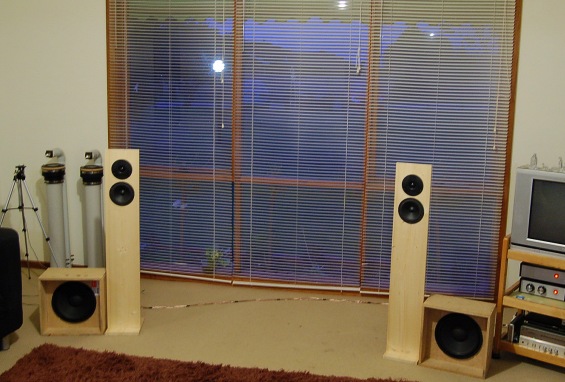
The u-frame woofers use an existing one and is the next area of attention. Possible options:
- Folding them to accommodate 2x 10" per channel. This will require some serious woodworking, or
- Keep 1 woofer/channel and decrease the size for a tiny OB system. This will need more capable woofer than that $14 jaycar
The u-frame woofers use an existing one and is the next area of attention. Possible options:
- Folding them to accommodate 2x 10" per channel. This will require some serious woodworking, or
- Keep 1 woofer/channel and decrease the size for a tiny OB system. This will need more capable woofer than that $14 jaycar
Hi gainphile,
Nice work! Congratulations.
Say, what is your finding in regard to the height of such narrow baffle?
Besides the peak(s) affected by driver-baffle symmetrization, I found (from the sims by Edge) the frequency response is mostly dominated by the smaller dimension of the baffle -- mostly width.
That is, on a narrow baffle, the variations of height affect the frequency response very little -- this is what those sims told me.
I myself have not made enough baffles to confirm that. I remember Mr. Nelson Pass mentioned the higher baffles sound better, though....
If the overall height doesn't matter (that much), how about shorten the mid-high section somewhat and place it on top of the bass bin ? (with some mechanical isolation if you like, of course)
Just a thought. 🙂
Nice work! Congratulations.
Say, what is your finding in regard to the height of such narrow baffle?
Besides the peak(s) affected by driver-baffle symmetrization, I found (from the sims by Edge) the frequency response is mostly dominated by the smaller dimension of the baffle -- mostly width.
That is, on a narrow baffle, the variations of height affect the frequency response very little -- this is what those sims told me.
I myself have not made enough baffles to confirm that. I remember Mr. Nelson Pass mentioned the higher baffles sound better, though....
If the overall height doesn't matter (that much), how about shorten the mid-high section somewhat and place it on top of the bass bin ? (with some mechanical isolation if you like, of course)
Just a thought. 🙂
Thanks CLS,
I did not hear any differences between high or short baffle. But massive difference for width. There was noticable beaming due to the alignment of drivers and my seating position which made me shortened it.
Yes, the main panel could simply sit on top of the woofers, but I just did not like them aesthetically (like Phoenix). It's a matter of personal taste I guess. Acoustically that would have been a better way of doing it as there will be no horizontal offsets, but I hear no sound degradation from offsetting the woofers.
I did not hear any differences between high or short baffle. But massive difference for width. There was noticable beaming due to the alignment of drivers and my seating position which made me shortened it.
Yes, the main panel could simply sit on top of the woofers, but I just did not like them aesthetically (like Phoenix). It's a matter of personal taste I guess. Acoustically that would have been a better way of doing it as there will be no horizontal offsets, but I hear no sound degradation from offsetting the woofers.
But I'm not sure if it is the right decision.
Should sound right to you ears ?
It could not be a only basket resonance, this frequency should stay constant. It is not the case, it depend on the width of the baffle.
It's very difficult to judge by ears though especially when I don't know the original program material. They both sound "right", I even compare them to pink noise + headphones. Also playing various types of recording to find out the contrasts.
Who got anaechoic room I can borrow? 😀
Who got anaechoic room I can borrow? 😀
Time alignment
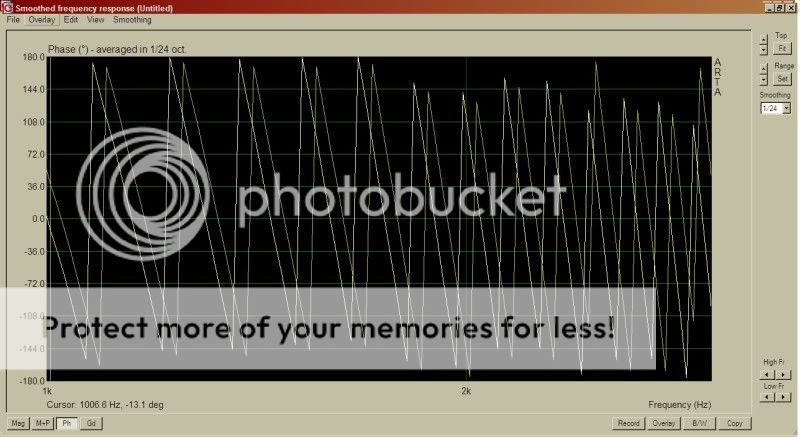
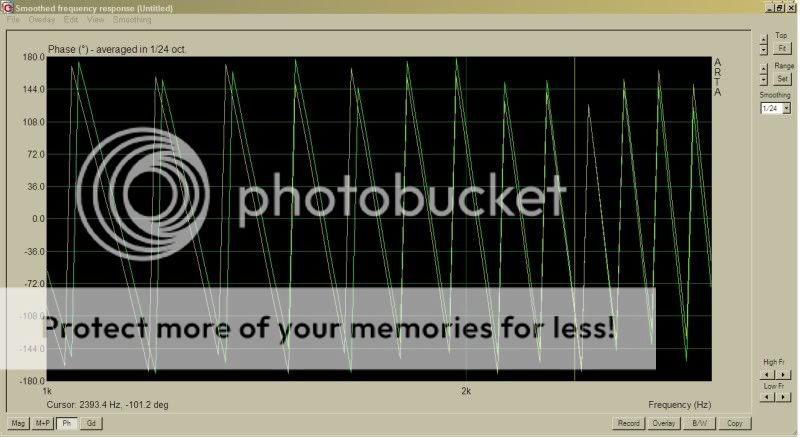
Some progress with the project, completed the time alignment.
Without alignment:
With time alignment:
The final delay is less then physical measurement which supports the idea that the acoustic centre of a driver is *not* the location of voice coil. It depends on the driver and frequency. With P13 at 2.4kHz it's well in front of the dustcap.
Some progress with the project, completed the time alignment.
Without alignment:
With time alignment:
The final delay is less then physical measurement which supports the idea that the acoustic centre of a driver is *not* the location of voice coil. It depends on the driver and frequency. With P13 at 2.4kHz it's well in front of the dustcap.
- Status
- Not open for further replies.
- Home
- Loudspeakers
- Multi-Way
- S9 OB - Revisiting narrow baffles