
We know that flux modulation is the name given to the change in permeability due to current through the voice coil (roughly speaking), and that there are (at least) two significant measurable effects - non-constant Le(i) and non-constant BL(i). The first comes from varying permeability of the iron through and around the voice coil. The second from the varying flux density (permeability -> field strength -> flux density) acting on the coil.
Can we not negate the effect of Le(i) by powering the driver with a current source (doesn't care about inductance) as opposed to a voltage source? Or is my understanding flawed?
Can we not negate the effect of Le(i) by powering the driver with a current source (doesn't care about inductance) as opposed to a voltage source? Or is my understanding flawed?
http://www.diyaudio.com/forums/showthread.php?s=&threadid=3889&perpage=25&highlight=&pagenumber=1
point me to some DIY designs and theory after you're done with that 🙂
point me to some DIY designs and theory after you're done with that 🙂

454Casull said:We know that flux modulation is the name given to the change in permeability due to current through the voice coil (roughly speaking), and that there are (at least) two significant measurable effects - non-constant Le(i) and non-constant BL(i). The first comes from varying permeability of the iron through and around the voice coil. The second from the varying flux density (permeability -> field strength -> flux density) acting on the coil.
Can we not negate the effect of Le(i) by powering the driver with a current source (doesn't care about inductance) as opposed to a voltage source? Or is my understanding flawed?
Yes, constant current does minimize the change of Le(i) but not as much the change of Bl(i).
To clarify, are you saying that constant current has a significant effect in attenuating BL(i)-related distortion? I thought that was strictly in the domain of the motor, not of the drive?Yes, constant current does minimize the change of Le(i) but not as much the change of Bl(i).

Some measurements here. Current drive (50 ohm source) reduced flux mod distortion about 10dB.
http://www.diyaudio.com/forums/mult...er-qts-you-cant-tuna-fish-10.html#post2755619
In the domain of the motor? The way to look at it is the magnetic circuit nonlinearity creates a nonlinear load. If you have a low source impedance driving the nonlinear load you can have low distortion voltage but distorted current. With a current source you can have low distortion current but distorted voltage. The later is preferable because force on the cone is related to current.
David S.
http://www.diyaudio.com/forums/mult...er-qts-you-cant-tuna-fish-10.html#post2755619
In the domain of the motor? The way to look at it is the magnetic circuit nonlinearity creates a nonlinear load. If you have a low source impedance driving the nonlinear load you can have low distortion voltage but distorted current. With a current source you can have low distortion current but distorted voltage. The later is preferable because force on the cone is related to current.
David S.
To clarify, are you saying that constant current has a significant effect in attenuating BL(i)-related distortion? I thought that was strictly in the domain of the motor, not of the drive?
Actually looking back, I think that was a typo and I meant to use BL(x), not BL(i). They both exist and the motor design determines which is the greater. Constant current would have an effect on BL(i), but if this is smaller than BL(x) (as it almost always is) then its effect would be negligable. Le(i) is a major concern because it occurs in a frequency range where x is negligable and hence it is the dominate nonlinearity in a driver in that range. BL(i) can also be a factor in this range as well, but generally not at lower frequencies.
Whether BL(x) is greater or smaller depends on frequency range. At low frequencies excursion is high and nonlinear BL vs. displacement dominates. At higher frequencies the excursion is negligible and hysteresis is the greater factor as shown in my curves. The transition in my measurements is a little above 100 Hz.
Now when you say Le(i) and BL(i) which one would be commonly called "flux modulation" (driving the magnetic opperating point around the hysteresis loop of the magnetic material)? I wouldn't think of that as Le related. There is an L vs. x term, commonly viewed as a "solenoidal force", but that is a 2nd order nonlinearity.
Note that the drop in 3rd harmonic from current drive is very comparable to the improvements that flux damping rings typically give.
Regards,
David S.
Now when you say Le(i) and BL(i) which one would be commonly called "flux modulation" (driving the magnetic opperating point around the hysteresis loop of the magnetic material)? I wouldn't think of that as Le related. There is an L vs. x term, commonly viewed as a "solenoidal force", but that is a 2nd order nonlinearity.
Note that the drop in 3rd harmonic from current drive is very comparable to the improvements that flux damping rings typically give.
Regards,
David S.
I'm still trying to wrap my head around this.
Right from the outset it is obvious that a current source eliminates effects stemming from variance in Le, therefore Le(i) and Le(x) as sources of distortion are negated. If this is true, then dominant source of distortion for high frequencies would be BL(i)? Kms(x) and BL(x) will change very little, whereas BL(i) may show variance as B can be affected by voice coil current; this is what you are referring to as hysteresis? I would argue that it's not the proper terminology as the field strength never gets low enough as to show an actual "loop" effect, but I digress...
In other words, for low excursions (BL(x) and Kms(x) are constant), the most effective ways to reduce distortion are to:
1) use a high output impedance (and EQ out impedance-related nonlinearities later as necessary)
2) reduce variance in BL(i) by:
2a) adding shorting rings/sleeves to reduce the change in B (how does this keep B from changing? by reducing the coil-opposed induced voltage?)
2b) pushing the magnetic iron around the voice coil gap closer to saturation so as to reduce the change in B
2c) by increasing the electrical resistivity of the "iron" to reduce change in B (see 2a)
2d) select a magnetic iron which has flat B vs H in region of interest, to eliminate change in B
It would make sense that 1) and 2a) result in the same effect, as you note.
What am I missing?
EDIT: So basically, a perfect driver would have a spider like the Dayton RSS subs or the Scan-Speak Illuminator 18WU (see Klippel data at DIYMA), a current source amp, the magnetic structure made from FINEMET FT-3H, and utilize XBL^2 in the gap.
Right from the outset it is obvious that a current source eliminates effects stemming from variance in Le, therefore Le(i) and Le(x) as sources of distortion are negated. If this is true, then dominant source of distortion for high frequencies would be BL(i)? Kms(x) and BL(x) will change very little, whereas BL(i) may show variance as B can be affected by voice coil current; this is what you are referring to as hysteresis? I would argue that it's not the proper terminology as the field strength never gets low enough as to show an actual "loop" effect, but I digress...
In other words, for low excursions (BL(x) and Kms(x) are constant), the most effective ways to reduce distortion are to:
1) use a high output impedance (and EQ out impedance-related nonlinearities later as necessary)
2) reduce variance in BL(i) by:
2a) adding shorting rings/sleeves to reduce the change in B (how does this keep B from changing? by reducing the coil-opposed induced voltage?)
2b) pushing the magnetic iron around the voice coil gap closer to saturation so as to reduce the change in B
2c) by increasing the electrical resistivity of the "iron" to reduce change in B (see 2a)
2d) select a magnetic iron which has flat B vs H in region of interest, to eliminate change in B
It would make sense that 1) and 2a) result in the same effect, as you note.
What am I missing?
EDIT: So basically, a perfect driver would have a spider like the Dayton RSS subs or the Scan-Speak Illuminator 18WU (see Klippel data at DIYMA), a current source amp, the magnetic structure made from FINEMET FT-3H, and utilize XBL^2 in the gap.
Last edited:
In my experience current drive our high source impedance only seems to have significant impact on hysteresis distortion. Please see my curves in the linked thread above.
There seem to be a lot of terms here and I'm not sure we are all on the same page (hence my question to Earl), so let me explain what my understanding is.
I assume Bl(x) means the drop in Bl as the woofer moves from the mid point. B field peaks in the middle of the magnetic circuit gap, the coil has equally spaced turns so a moving integration for the distance equivalent to coil height will give a BL that varies with excursion. Constant current drive seems to have no effect on this.
Le(x) would be inductance vs. coil centering. Usually the coil inductance goes up and the coil goes in and more core pole iron is in the coil. This is the definition of a solenoid and so current tends to draw the coil into the core pole. This is a cause of second harmonic distortion and in fact a woofer that is fully demagnitized will respond purely with 2nd harmonic output due to this force. As far as I know current drive makes no difference here.
Le(i) I'm not clear on. Actually I dont think Le varys with drive. Is this a term for hysteresis distortion?
By hysteresis distortion I mean the hysteresis of the magnetic material. Ferrite material gives rise to an operating point of the magnet circuit that is pushed around a minor loop by the drive of the voice coil and signal adding and subtracting from the DC magnetic field. This leads to 3rd harmonic distortion that is reduced by constant current drive. (Again, see my curves.) This occurs most at mid frequencies where inductance is minimal. "Flux modulation rings" provide a shorted turn that resists the variation in operating point and gives a similar reduction in 3rd harmonic. Neodymium and Alnico magnets suffer less from this effect. Pushing the structure to saturation, as you say, is also a cure.
Kms or suspension nonlinearity is an LF effect and is not, to my knowledge, impacted by source impedance. Note that my curves show a little indeterminant change in LF 2nd harmonic distortion and zero change for LF 3rd harmonic as source Z is changed.
As to what you are missing, I think we are in general agreement, so I wouldn't know.
David S
There seem to be a lot of terms here and I'm not sure we are all on the same page (hence my question to Earl), so let me explain what my understanding is.
I assume Bl(x) means the drop in Bl as the woofer moves from the mid point. B field peaks in the middle of the magnetic circuit gap, the coil has equally spaced turns so a moving integration for the distance equivalent to coil height will give a BL that varies with excursion. Constant current drive seems to have no effect on this.
Le(x) would be inductance vs. coil centering. Usually the coil inductance goes up and the coil goes in and more core pole iron is in the coil. This is the definition of a solenoid and so current tends to draw the coil into the core pole. This is a cause of second harmonic distortion and in fact a woofer that is fully demagnitized will respond purely with 2nd harmonic output due to this force. As far as I know current drive makes no difference here.
Le(i) I'm not clear on. Actually I dont think Le varys with drive. Is this a term for hysteresis distortion?
By hysteresis distortion I mean the hysteresis of the magnetic material. Ferrite material gives rise to an operating point of the magnet circuit that is pushed around a minor loop by the drive of the voice coil and signal adding and subtracting from the DC magnetic field. This leads to 3rd harmonic distortion that is reduced by constant current drive. (Again, see my curves.) This occurs most at mid frequencies where inductance is minimal. "Flux modulation rings" provide a shorted turn that resists the variation in operating point and gives a similar reduction in 3rd harmonic. Neodymium and Alnico magnets suffer less from this effect. Pushing the structure to saturation, as you say, is also a cure.
Kms or suspension nonlinearity is an LF effect and is not, to my knowledge, impacted by source impedance. Note that my curves show a little indeterminant change in LF 2nd harmonic distortion and zero change for LF 3rd harmonic as source Z is changed.
As to what you are missing, I think we are in general agreement, so I wouldn't know.
David S
Dave
I am kind of with "Casull" here in that I am not sure that "hysteresis" is the right word since I agree the circuit does not go around small loops when its near saturation, as it is (or certainly should be). Hysteresis happens only when the circuit has a low level of flux such that the flux change and the Coercive forces are related - and that relationship has hysteresis. But when the circuit is saturated, the coercive force changes, but the flux does not. But I will admit that you could be right, its really a detail that does not really matter. What matters is that constant current reduces "an" effect that is dominately non-symmetric. This is easily seen in the differential equations actually.
The terms Le, etc. are really lumped parameter terms for complex situations and may not be very useful in this context. (See the latest AES for a good discussion of Le and why it is not so simple.)
What Casull might be missing is that any flux changes through a shorted turn will generate a current in that turn which will act to oppose the flux change. This is how the B field is stabalized. A perfect short would not allow for any flux change through it.
When a copper cap is used this is to reduce the inductance and not so much to stabalize the field, although it acts on both aspects.
But all in all, other than some small differences in how we think about things we are all in agreement.
I am kind of with "Casull" here in that I am not sure that "hysteresis" is the right word since I agree the circuit does not go around small loops when its near saturation, as it is (or certainly should be). Hysteresis happens only when the circuit has a low level of flux such that the flux change and the Coercive forces are related - and that relationship has hysteresis. But when the circuit is saturated, the coercive force changes, but the flux does not. But I will admit that you could be right, its really a detail that does not really matter. What matters is that constant current reduces "an" effect that is dominately non-symmetric. This is easily seen in the differential equations actually.
The terms Le, etc. are really lumped parameter terms for complex situations and may not be very useful in this context. (See the latest AES for a good discussion of Le and why it is not so simple.)
What Casull might be missing is that any flux changes through a shorted turn will generate a current in that turn which will act to oppose the flux change. This is how the B field is stabalized. A perfect short would not allow for any flux change through it.
When a copper cap is used this is to reduce the inductance and not so much to stabalize the field, although it acts on both aspects.
But all in all, other than some small differences in how we think about things we are all in agreement.
People seem to confuse the copper caps and the flux shorting rings. There was a thread earlier where the confusion kept cropping up.
I was referring to the shorted turns rings usually placed down on the core pole. Both JBL and McIntosh have patents on surprisingly similar "fixes". They are both made of aluminum and are intentionally thick to be an effective short. Saturated poles and top plates may reduce the hysteresis effects but most woofers, without these techniques, still seem to have a fair amount of it.
The copper caps, copper plated core poles or silver plated poles reduce inductance rise as used by SEAS and in the old JBL LE8t.
Not sure why you wouldn't call it hysteresis when it really is a function of the hysteresis curve of the particular magnetic material.
David S.
I was referring to the shorted turns rings usually placed down on the core pole. Both JBL and McIntosh have patents on surprisingly similar "fixes". They are both made of aluminum and are intentionally thick to be an effective short. Saturated poles and top plates may reduce the hysteresis effects but most woofers, without these techniques, still seem to have a fair amount of it.
The copper caps, copper plated core poles or silver plated poles reduce inductance rise as used by SEAS and in the old JBL LE8t.
Not sure why you wouldn't call it hysteresis when it really is a function of the hysteresis curve of the particular magnetic material.
David S.
Yes, the whole curve exhibits hysteretic behaviour, but the region of interest is so restricted that a simple function could describe the behaviour of B vs H. Within this domain of H there is no hysteresis.People seem to confuse the copper caps and the flux shorting rings. There was a thread earlier where the confusion kept cropping up.
I was referring to the shorted turns rings usually placed down on the core pole. Both JBL and McIntosh have patents on surprisingly similar "fixes". They are both made of aluminum and are intentionally thick to be an effective short. Saturated poles and top plates may reduce the hysteresis effects but most woofers, without these techniques, still seem to have a fair amount of it.
The copper caps, copper plated core poles or silver plated poles reduce inductance rise as used by SEAS and in the old JBL LE8t.
Not sure why you wouldn't call it hysteresis when it really is a function of the hysteresis curve of the particular magnetic material.
David S.
Yes, the whole curve exhibits hysteretic behaviour, but the region of interest is so restricted that a simple function could describe the behaviour of B vs H. Within this domain of H there is no hysteresis.
Which is why there is no distortion...wait there is distortion!
Read here:
http://www.jblpro.com/catalog/support/getfile.aspx?docid=299&doctype=3
Linkwitz covers the subject well and (in section Q) even uses the H word.
Midrange distortion
I'm not sure why someone would argue against something from a theoretical point of view when practical measurements show it so clearly? The hysteresis-caused distortion effect of Ferrite magnet structures has been well understood and well documented since the 70s.
David S.
Dave
You seem to be equating flux modulation with hysteresis and to me they are not the same thing. Linkwitz makes a distinction as well when he uses both terms in different contexts.
No one argues that there is nonlinearity of the motor force, its whether the hysteresis of the field is the cause or just a modulation of the flux. They are not the same thing. I would agree that they both happen at the same time, but I also agree with Casull that the hysteresis is pretty small at the high B-H fields in the structure. Basically its the modulation of B that is the problem and the fact that there is a small hysteresis of that is not that significant.
You seem to be equating flux modulation with hysteresis and to me they are not the same thing. Linkwitz makes a distinction as well when he uses both terms in different contexts.
No one argues that there is nonlinearity of the motor force, its whether the hysteresis of the field is the cause or just a modulation of the flux. They are not the same thing. I would agree that they both happen at the same time, but I also agree with Casull that the hysteresis is pretty small at the high B-H fields in the structure. Basically its the modulation of B that is the problem and the fact that there is a small hysteresis of that is not that significant.
Interesting discussion. Can anyone here comment about the effect of the shape of the copper on the Scan-Speak 13m/8640 in the picture? I opened one up that had failed to get this photo. My initial thought is that it increases the effective surface area of the cap as a short (I think it extends into the gap) and it may provide some BL(x) improvement somewhat like a change in gap edge geometry might do.
Dave
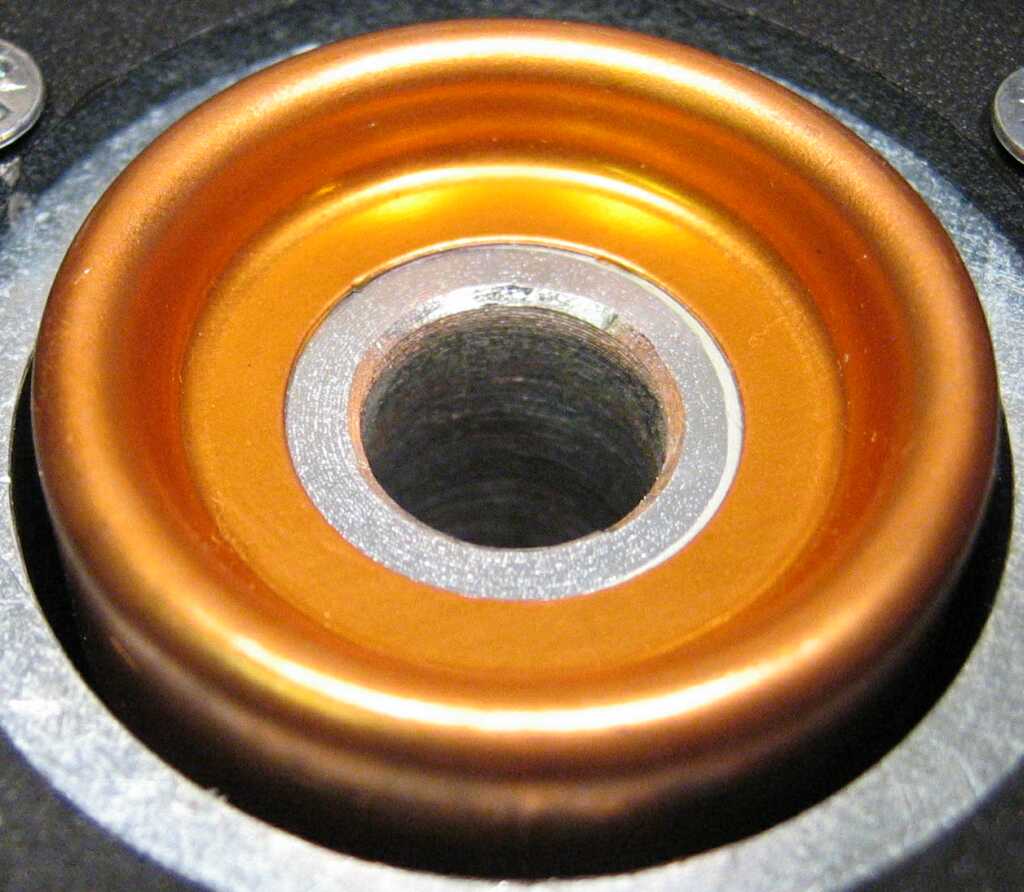
Dave
No, I am saying that flux modulation in the presence of hysteresis is the issue.
If B were linear then modulation of the B would do nothing but slightly reduce output level. Due to Hysteresis the B is nonlinear and so the modulation gives rise to distortion.
To say that the hysteresis is "pretty small" is not the point. It is present in most simple woofers and is one of the dominant causes of midrange distortion. My measurements show it hangs around the .3 to 1% range at a 90dB output level. I'm not claiming that it is audible or even the worst distortion effect of woofers, just that it is identifiable, caused by hysteresis effect, especially in Ferrite woofers, and that current drive is one mechanism for lowering it.
Any published data on magnetic material properties delves into major and minor loop hysteresis, so I'm not sure why anyone would try and deny it as a factor?
David S.
If B were linear then modulation of the B would do nothing but slightly reduce output level. Due to Hysteresis the B is nonlinear and so the modulation gives rise to distortion.
To say that the hysteresis is "pretty small" is not the point. It is present in most simple woofers and is one of the dominant causes of midrange distortion. My measurements show it hangs around the .3 to 1% range at a 90dB output level. I'm not claiming that it is audible or even the worst distortion effect of woofers, just that it is identifiable, caused by hysteresis effect, especially in Ferrite woofers, and that current drive is one mechanism for lowering it.
Any published data on magnetic material properties delves into major and minor loop hysteresis, so I'm not sure why anyone would try and deny it as a factor?
David S.

A copper ring in the vicinity of the voice coil will act to lower the inductance and make it more linear with current. To the extent that the voice coils flux goes through this ring ( only that flux that is normal to the plane of the ring) it will also act minimize the flux modulation. In a complex structure like that both things are going on at the same time and it would take a complex analysis to sort them out. And whats under the cap at the edge? Steel, air or copper?
Nobody is saying that the variations in H do not cause a change in B. The only thing is that this behaviour is not hysteretical with practical values of B and H. Just ignore the rest of the loop because it will be impossible to "go there".No, I am saying that flux modulation in the presence of hysteresis is the issue.
If B were linear then modulation of the B would do nothing but slightly reduce output level. Due to Hysteresis the B is nonlinear and so the modulation gives rise to distortion.
To say that the hysteresis is "pretty small" is not the point. It is present in most simple woofers and is one of the dominant causes of midrange distortion. My measurements show it hangs around the .3 to 1% range at a 90dB output level. I'm not claiming that it is audible or even the worst distortion effect of woofers, just that it is identifiable, caused by hysteresis effect, especially in Ferrite woofers, and that current drive is one mechanism for lowering it.
Any published data on magnetic material properties delves into major and minor loop hysteresis, so I'm not sure why anyone would try and deny it as a factor?
David S.
As I said before, this is strictly a matter of terminology, nothing more, nothing less.
Interesting discussion. Can anyone here comment about the effect of the shape of the copper on the Scan-Speak 13m/8640 in the picture? I opened one up that had failed to get this photo. My initial thought is that it increases the effective surface area of the cap as a short (I think it extends into the gap) and it may provide some BL(x) improvement somewhat like a change in gap edge geometry might do.
Dave
Good picture. I assume they have extended the copper cap to cover the full length of the overhung coil for maximum inductance reduction. It can help power handling as well by cooling the coil normally setting outside the gap. It won't impact BL vs. x because it is copper rather than ferrous. (To Earl's question the units I've seen that are similarly capped have air underneath with a square ended corepole. The particular formed shape of the copper extends the effect forward and makes for easier forming with a rounder shape.)
Related to that note that copper caps take away from the desire for a tight magnetic gap so the designers need to make some tradeoff between magnetic circuit optimization and the inductance modifying effect of the copper.
David S.
Last edited:
- Status
- Not open for further replies.
- Home
- Loudspeakers
- Multi-Way
- Flux modulation