

John, what do you think about the possibility of adding GRS to Mark Audio 7.3 in similar configuration?


Hey Buzz. I'm just down the road from you and I have the Vifas. We should get together and build one of these. I also have the Peerless woofers left over from the original Manzanita.
Shoot me a PM if you want.
Shoot me a PM if you want.

Mark Audio et. el...
Yes, many of the Mark Audio FR offerings could be mated to either the Peerless woofer (Manzanita) or the PE GRS 15 (Ultra). As usual, it comes down to doing the crossover - baffle layout work required to optimize the design.
But I have to say, the little Vifa is so damn good it is hard to beat! Especially when you factor in price and availability. So smooth over so many octaves and big enough to play reasonably loud in the 350-700 Hz range. This allows it to be very effective with a large diameter, medium displacement woofer. (assuming the above OB formats)
When I do these simple designs I consider a lot of factors beyound a smooth on axis response from the drivers. Rear radiation characteristics, operating Q on the baffle, usable low end cut off and how positioning distances and wing depth combine to form a response at the listening position. Add in keeping the crossover part count down to litereally a handfull, excellent drivers like the Mark Audio's do not necessarily end up being a good choice.
With that said, it is always interesting to play & learn!
Yes, many of the Mark Audio FR offerings could be mated to either the Peerless woofer (Manzanita) or the PE GRS 15 (Ultra). As usual, it comes down to doing the crossover - baffle layout work required to optimize the design.
But I have to say, the little Vifa is so damn good it is hard to beat! Especially when you factor in price and availability. So smooth over so many octaves and big enough to play reasonably loud in the 350-700 Hz range. This allows it to be very effective with a large diameter, medium displacement woofer. (assuming the above OB formats)
When I do these simple designs I consider a lot of factors beyound a smooth on axis response from the drivers. Rear radiation characteristics, operating Q on the baffle, usable low end cut off and how positioning distances and wing depth combine to form a response at the listening position. Add in keeping the crossover part count down to litereally a handfull, excellent drivers like the Mark Audio's do not necessarily end up being a good choice.
With that said, it is always interesting to play & learn!
Yes, many of the Mark Audio FR offerings could be mated to either the Peerless woofer (Manzanita) or the PE GRS 15 (Ultra). As usual, it comes down to doing the crossover - baffle layout work required to optimize the design.
But I have to say, the little Vifa is so damn good it is hard to beat! Especially when you factor in price and availability. So smooth over so many octaves and big enough to play reasonably loud in the 350-700 Hz range. This allows it to be very effective with a large diameter, medium displacement woofer. (assuming the above OB formats)
When I do these simple designs I consider a lot of factors beyound a smooth on axis response from the drivers. Rear radiation characteristics, operating Q on the baffle, usable low end cut off and how positioning distances and wing depth combine to form a response at the listening position. Add in keeping the crossover part count down to litereally a handfull, excellent drivers like the Mark Audio's do not necessarily end up being a good choice.
With that said, it is always interesting to play & learn!
I did not mean to offend in any way as to the sound of what you have clearly put much time and effort in to developing. There is no doubt that I may not come close to the quality that you have achieved, but was asking whether or not you thought it would be a worthwhile endeavor based on the specs. I greatly appreciate the time and effort you have put into this and will most likely build the GRS version.
Just having fun!!
Buzzforb
No worries! Just having fun, learning and sharing! Your question was a very good one. The Mark Audio drivers are very good and are legit candidates for two and three way OB applications.
My comments were intended to provide some additional insight as to my process and how system integration plays a large roll in realizing a usable outcome.
And I must admit, sometimes things just fall together and other times there is not enough time to get things right.
I have been working on my Big Boy 18" coaxial OB project now for almost FOUR years. Not steady to be sure, but have a Lot of hours in them. It's been so long in fact, P Audio no longer offers the coax as a standard production item!
I hope to be able to demo them at LSAF this coming May in Dallas. We shall see!
Best
Buzzforb
No worries! Just having fun, learning and sharing! Your question was a very good one. The Mark Audio drivers are very good and are legit candidates for two and three way OB applications.
My comments were intended to provide some additional insight as to my process and how system integration plays a large roll in realizing a usable outcome.
And I must admit, sometimes things just fall together and other times there is not enough time to get things right.
I have been working on my Big Boy 18" coaxial OB project now for almost FOUR years. Not steady to be sure, but have a Lot of hours in them. It's been so long in fact, P Audio no longer offers the coax as a standard production item!
I hope to be able to demo them at LSAF this coming May in Dallas. We shall see!
Best
The GRS - Vifa connection
Ryan
Yes, so far the Vifa best meets my goals for the "Ultra" low cost OB build. It just happens both are Paper cone drivers and compliment each other.
Basically it's as simple as they just sound good together!
I spent quite a bit of time auditioning small full range drivers similar in size but all having a higher cost than the vifa. Several were over $50 each dealer cost. There were a couple of T*rds, but most were quite good.
When I first measured the Vifa I thought my measurement system was not working properly. Dead flat from 200 Hz to 15 Khz on axis! Glad Zaph obtained similar results! Even with that great performance, you see that 4 of the 5 Ultra's crossover components are used to shape the Vifa's response.
Ryan
Yes, so far the Vifa best meets my goals for the "Ultra" low cost OB build. It just happens both are Paper cone drivers and compliment each other.
Basically it's as simple as they just sound good together!
I spent quite a bit of time auditioning small full range drivers similar in size but all having a higher cost than the vifa. Several were over $50 each dealer cost. There were a couple of T*rds, but most were quite good.
When I first measured the Vifa I thought my measurement system was not working properly. Dead flat from 200 Hz to 15 Khz on axis! Glad Zaph obtained similar results! Even with that great performance, you see that 4 of the 5 Ultra's crossover components are used to shape the Vifa's response.
When I get around to building mine, I'm going to set up the crossover so I can easily remove the trap. Then I will let my calibration system work that out instead of doing it with the passive components. I'll need to be able to put in back in though since this speaker will be too fun to keep in one place for long. It'll be a while though. Have another speaker project in front of this one.
John, here is a cleaned up version of your image. Please feel free to use it. Hopefully I got the values correct. I can fix them if there is anything wrong with them.
An externally hosted image should be here but it was not working when we last tested it.

Thanks Ryan!
Apprceciate you taking the time to create and post the Schematic.
I will be posting a Vifa reverse phase version soon. Only a couple part value changes.
Merry Christmas!
Apprceciate you taking the time to create and post the Schematic.
I will be posting a Vifa reverse phase version soon. Only a couple part value changes.
Merry Christmas!
Should anyone doubt the quality of the Vifa drivers, here are Zaph's measurements of it:
http://www.zaphaudio.com/temp/Vifa-TC9FD18-08-FR.gif
http://www.zaphaudio.com/temp/Vifa-TC9FD18-08-HD.gif
http://www.zaphaudio.com/temp/Vifa-TC9FD18-08-CSD.gif
http://www.zaphaudio.com/temp/Vifa-TC9FD18-08-FR.gif
http://www.zaphaudio.com/temp/Vifa-TC9FD18-08-HD.gif
http://www.zaphaudio.com/temp/Vifa-TC9FD18-08-CSD.gif
John, given the relatively low price of the Vifa, is there a strong bias on your part against using four of them in a vertical array to increase power handling in the 300 - 700 Hz range. Do you think the resultant lobing not worth the headroom gain?
They do at first glance look like near-ideal long line source candidates.
They do at first glance look like near-ideal long line source candidates.
Vifa TC9FD18-08 verticle line array
Russell
Assume your intent would be for a higher output, more dynamic OB speaker. The Vifa will fill the bill as well as most anything out there, esp when one factors in the power handling and low cost.
Yes there will be lobing issues, both with front and rear radiation.
The nice thing about the Vifa is the very low cost makes it easy to play with.
I have already put together a dual GRS 15 woofer OB with a single Vifa up top. Easy to add a second one and see what happens. The relatively low 500 HZ crossover the Vifa can handle, esp multiple Vifa's, would justify some experimentation!
How's that for saying I really don't know but would like try it out, or have some one else try.
Russell
Assume your intent would be for a higher output, more dynamic OB speaker. The Vifa will fill the bill as well as most anything out there, esp when one factors in the power handling and low cost.
Yes there will be lobing issues, both with front and rear radiation.
The nice thing about the Vifa is the very low cost makes it easy to play with.
I have already put together a dual GRS 15 woofer OB with a single Vifa up top. Easy to add a second one and see what happens. The relatively low 500 HZ crossover the Vifa can handle, esp multiple Vifa's, would justify some experimentation!
How's that for saying I really don't know but would like try it out, or have some one else try.
A vertical array by itself in an OB would be nice in a Home theater if a subwoofer was present and you have lots of digital eq available in the reciever or better yet microphone calibration. That's how I got my center channel in my avatar pic to sound about as good as it gets for vocals. It also features a 60w light bulb behind it for improved WAF. This really works well for a center channel if your subwoofer is close enough to integrate. Mine is just underneath the center under the table which has cut legs so it's shorter than normal. That vifa should have it's own thread perhaps
The biggest advantage of the calibration is that it can work out the oscillating dipole response and it corrects each channel so you can mix wildly different speaker types. Makes subwoofer integration about 1000 times easier too. It also corrects time alignment to a tenth of a milisecond.
There is a dedicated thread for the vifa
http://www.diyaudio.com/forums/full-range/148684-any-ideas-vifa-tc9fd-18-08-a-2.html#post2831584
not much going on there though
http://www.diyaudio.com/forums/full-range/148684-any-ideas-vifa-tc9fd-18-08-a-2.html#post2831584
not much going on there though

I'm trying to build the Manzanita as inexpensively as possible. Recycled wood etc. I've read through the thread and I get most of the answers I need. But a few crossover questions or at least needing verification before I order parts. Using this crossover for the Manzanita from post 465 which I assume is the current version.
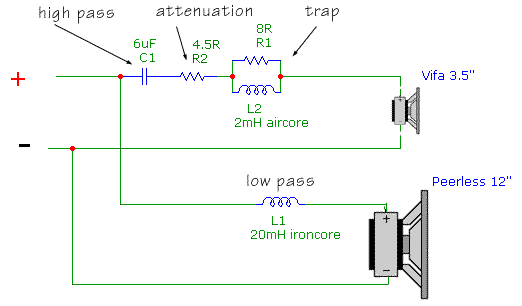
Question 1
Question 2
For the trap to function as designed, if the DCR of L2 varies from John's .3 ohm value does the value of R1 need to change? and if yes what value would I use if the DCR of L2 is 1 ohm.
Question 3
ERSE has a 20.0 mH 16 Gauge IXQ Coil with a DCR of .691 ohms. Any major issue using that for L1? The DCR is a bit higher than either of the coils listed in the BOMs.
Question 1
Using the above info and assuming the current design (John's personal pair) uses a Solen 14 ga. perfect lay which measures about .3 ohm, if the DCR of my L2 inductor is 1 ohm I would lower the resistance of R2 to somewhere in the 3.8 ohm range to compensate for the higher L2 resistance. Right?The 19 ga. Pano called out in his Bill of Materials (BOM) can work. It has the obvious advantages of lower cost and size. However, with it's higher resistance of about 0.9 ohms, an adjustment in the R2 pad resistor would be required to retain the tonal balance of the system as well as the desired Vifa crossover high pass slope. R2 would drop to around 3.5 to 4 ohms to compensate for the higher L2 resistance.
Question 2
For the trap to function as designed, if the DCR of L2 varies from John's .3 ohm value does the value of R1 need to change? and if yes what value would I use if the DCR of L2 is 1 ohm.
Question 3
ERSE has a 20.0 mH 16 Gauge IXQ Coil with a DCR of .691 ohms. Any major issue using that for L1? The DCR is a bit higher than either of the coils listed in the BOMs.
- Home
- Loudspeakers
- Multi-Way
- Fast, fun, Inexpensive OB project