

Ah, was it the one in the old Millhopper shopping center? NW corner of town? I used to hang out there circa 1973-76. Great shop.

Genius Designer Jean Hiraga's Altec 604E MLTL speaker uses a down-firing port that is slot-loaded into the integral base plinth.
Jean’s description sounds like Onken type narrow slot ports that exit around the bottom perimeter 4-sides. A 3-side exit might be better for against the wall designs.
Wide bandwidth woofers(1,400Hz on Altec 604E coax, 700Hz on Lynn's Altec 416E) generate significant midrange frequency SPL that must be absorbed by TL stuffing as in MLTL, or stuffing around generic ports. Allowing even modest SPL midrange woofer energy to exit a bass reflex port will be audible.
For my MLTL cabinets I use 2” Owens 703 fiberglass panels on all 3-sides inside the cabinet in order to keep cabinet reflextions off the the rear cone, plus formaldehyde-free loose fiberglass batting TL stuffing. I also put a 1.5" quarter round radius on all front edges for diffraction control. 1.5" is the largest bit available for a normal router.
I plan to try Gene Hiraga's narrow slotted base-plinth port ideas on my next MLTL and would appreciate any feedback on this port technology.
Jean’s description sounds like Onken type narrow slot ports that exit around the bottom perimeter 4-sides. A 3-side exit might be better for against the wall designs.
Wide bandwidth woofers(1,400Hz on Altec 604E coax, 700Hz on Lynn's Altec 416E) generate significant midrange frequency SPL that must be absorbed by TL stuffing as in MLTL, or stuffing around generic ports. Allowing even modest SPL midrange woofer energy to exit a bass reflex port will be audible.
For my MLTL cabinets I use 2” Owens 703 fiberglass panels on all 3-sides inside the cabinet in order to keep cabinet reflextions off the the rear cone, plus formaldehyde-free loose fiberglass batting TL stuffing. I also put a 1.5" quarter round radius on all front edges for diffraction control. 1.5" is the largest bit available for a normal router.
I plan to try Gene Hiraga's narrow slotted base-plinth port ideas on my next MLTL and would appreciate any feedback on this port technology.
Attachments


I can't claim much originality with the resistive-vent idea. The first place I saw a rigorous analysis of it was Richard Small's doctoral thesis - that was back in the mid-Seventies when I took a class from Dr. Ashley.
It was early days for Theile/Small theory, and resistive-vents were not part of the class material. I saw the big red hardcover book on Ashley's desk, and couldn't resist taking a look - chapters from Small's thesis were reprinted in those first AES Journal articles. Unfortunately, the resistive-vent chapter was not reprinted in the AES Journal, and is still hard to find, some forty years later.
I asked Ashley why the AES omitted that chapter, and the reason was interesting - RV enclosures are not as space-efficient as a vented enclosure, and have no obvious benefits over a closed-box. A brief scan of the chapter did indicate, as I suspected it might, that RV enclosures are not as sensitive to driver variations as the closed-box and vented-box equivalents.
A vented enclosure, as we all know these days, is a 4th-order highpass filter (Theile's great discovery), but like all 4th-order filters, is pretty sensitive to tuning conditions (this is true of opamp active filters as well). The damping supplied by the amplifier, and reflected through the BL product of the driver, has a critical effect on filter tuning. Unfortunately, amplifiers may exhibit nonlinear damping factors, and BL product is definitely not linear (well, L is a constant, but B can vary quite a lot).
By using a large resistive term in the electroacoustic highpass filter, not as much reliance on amplifier damping factor is needed. A resistive-vent enclosure, although not technically 3rd-order highpass filter, behaves like one in the passband of interest. At a very low frequency (less than 1~5 Hz), it reverts to a 4th-order system, although more heavily damped than a classical vented enclosure. From a designer's perspective, what's of interest is smooth variation in the group-delay characteristic, and low sensitivity to amplifier misbehavior and dynamic driver variations.
There's also another, more subtle benefit of resistive-vent enclosures. They're a bit more convenient for midbass drivers, since the heavily damped vent is not as prone to organ-pipe modes in the 400 to 800 Hz region, which are the bane of standard vented-cabinet designs. This is an area where the tricks used in TL enclosures come in handy - folding the path of the lossy vent, etc.
Resistive-vent enclosures have broader tuning that a vented enclosure; the output from a standard vent is typically 1/3 octave or less, basically a single large peak. By contrast, what comes out of the resistive vent is an octave or more, which lets the designer be a little more creative in locating the vent. Specifically, the vent can be located close to the floor, giving the speaker a bit of additional bass extension. Doing the same thing with a standard vented alignment is a little dangerous, since the floor coupling will have fairly unpredictable effects on the box tuning.
Vent location is an overlooked item in many vented-box loudspeakers. At the frequencies where the vent is effective - again, the output is typically less than 1/3 octave wide - the vent looks like a point-source (it is many times smaller than the wavelengths coming out of it). This point source has mirror-images in the floor, rear wall, and back wall, and the phase relation of these mirror images to the physical point source can make speaker location rather touchy in many rooms. At the frequencies where the vent is active (25~50 Hz), the walls and floor are nearly perfect reflectors, and damping materials have little effect.
If the vent has broader tuning - which is typical for RV enclosures and TL systems - and the location is directly on the floor, speaker location will not be quite as sensitive to room location.
It was early days for Theile/Small theory, and resistive-vents were not part of the class material. I saw the big red hardcover book on Ashley's desk, and couldn't resist taking a look - chapters from Small's thesis were reprinted in those first AES Journal articles. Unfortunately, the resistive-vent chapter was not reprinted in the AES Journal, and is still hard to find, some forty years later.
I asked Ashley why the AES omitted that chapter, and the reason was interesting - RV enclosures are not as space-efficient as a vented enclosure, and have no obvious benefits over a closed-box. A brief scan of the chapter did indicate, as I suspected it might, that RV enclosures are not as sensitive to driver variations as the closed-box and vented-box equivalents.
A vented enclosure, as we all know these days, is a 4th-order highpass filter (Theile's great discovery), but like all 4th-order filters, is pretty sensitive to tuning conditions (this is true of opamp active filters as well). The damping supplied by the amplifier, and reflected through the BL product of the driver, has a critical effect on filter tuning. Unfortunately, amplifiers may exhibit nonlinear damping factors, and BL product is definitely not linear (well, L is a constant, but B can vary quite a lot).
By using a large resistive term in the electroacoustic highpass filter, not as much reliance on amplifier damping factor is needed. A resistive-vent enclosure, although not technically 3rd-order highpass filter, behaves like one in the passband of interest. At a very low frequency (less than 1~5 Hz), it reverts to a 4th-order system, although more heavily damped than a classical vented enclosure. From a designer's perspective, what's of interest is smooth variation in the group-delay characteristic, and low sensitivity to amplifier misbehavior and dynamic driver variations.
There's also another, more subtle benefit of resistive-vent enclosures. They're a bit more convenient for midbass drivers, since the heavily damped vent is not as prone to organ-pipe modes in the 400 to 800 Hz region, which are the bane of standard vented-cabinet designs. This is an area where the tricks used in TL enclosures come in handy - folding the path of the lossy vent, etc.
Resistive-vent enclosures have broader tuning that a vented enclosure; the output from a standard vent is typically 1/3 octave or less, basically a single large peak. By contrast, what comes out of the resistive vent is an octave or more, which lets the designer be a little more creative in locating the vent. Specifically, the vent can be located close to the floor, giving the speaker a bit of additional bass extension. Doing the same thing with a standard vented alignment is a little dangerous, since the floor coupling will have fairly unpredictable effects on the box tuning.
Vent location is an overlooked item in many vented-box loudspeakers. At the frequencies where the vent is effective - again, the output is typically less than 1/3 octave wide - the vent looks like a point-source (it is many times smaller than the wavelengths coming out of it). This point source has mirror-images in the floor, rear wall, and back wall, and the phase relation of these mirror images to the physical point source can make speaker location rather touchy in many rooms. At the frequencies where the vent is active (25~50 Hz), the walls and floor are nearly perfect reflectors, and damping materials have little effect.
If the vent has broader tuning - which is typical for RV enclosures and TL systems - and the location is directly on the floor, speaker location will not be quite as sensitive to room location.
Last edited:

All ports have a resistive nature. You could still design a port to be pretty resistive, it just won't be as easy to built.
Lynn ... I found this in UK.answers, "Adding resistance to the air flow in the duct lowers the Q of the port and increases the resistive component of the impedance at the box tuning frequency, f.sub.B. The result will be increased woofer motion, i.e. over-excursion at f.sub.B, which undermines one of the primary advantages of the vented-box loudspeaker enclosure design." The "over-excursion" bothers me, would you be kind enough to translate? Zene
Compared to vented box, sealed or resisted-vent box gives you larger driver excursion in certain conditions. But larger is not necessary to be "over".
Lynn ... I found this in UK.answers, "Adding resistance to the air flow in the duct lowers the Q of the port and increases the resistive component of the impedance at the box tuning frequency, f.sub.B. The result will be increased woofer motion, i.e. over-excursion at f.sub.B, which undermines one of the primary advantages of the vented-box loudspeaker enclosure design." The "over-excursion" bothers me, would you be kind enough to translate? Zene
The "excursion control" of a conventional Theile/Small vented box is both a blessing and a curse. First off, excursion is only significantly reduced at the box frequency - in fact, right at the box frequency, in a low-loss enclosure and a slippery vent, woofer excursion can nearly drop to zero. All of the output, of course, is going out the vent, while the cone is nearly silent.
But this is a narrowband effect. An octave above the box frequency, excursion reduction is slight - very close to the closed-box equivalent - and an octave below the box frequency, excursion is very great, much more than the closed-box equivalent. An octave below the box frequency, the woofer is pretty much in free air, and there is little to limit excursion except for the fairly minor resistance of the spider and surround.
In a closed box, the air-spring of the enclosed air is in series with the woofer compliance, so woofer excursions in the below-cutoff region are much better controlled.
These are the inevitable tradeoffs of closed vs vented enclosures. You win in one area, and lose in others.
A resistive-vent system is simply intermediate in behavior between the two. No reason to get lost in the weeds pursuing the impossible dream of a "non-resonant" or "aperiodic" enclosure. The dream is impossible because all loudspeakers, regardless of operating principles, are both highpass and lowpass filters. In plain English, they do not have infinite bandwidth, and cannot have infinite bandwidth.
Since the loudspeaker must have a highpass function - the response doesn't go down to DC - that implies electroacoustic reactive filter elements. They cannot be avoided.
However - we can go a little deeper and ask how stable are these elements? What are they actually made of, and how stable are they under dynamic (musical) conditions? That's a more interesting question.
We can pin down what isn't going to change: the mass of the woofer, the volume of air in the box (although lossy filling can shift this a bit), and the length of wire on the voice coil (the L of BL product). What does change is the B term (which then changes driver Q and efficiency), suspension compliance (this can be quite nonlinear and exhibit hysteresis effects), and changes in amplifier damping factor as Class AB stages pass through the zero crossing, or momentary slew or voltage-clip events, when the feedback loop fails to correct the amplifier.
Since a resistive-vent system is simply an intermediate alignment between closed and vented box, we can make the intentionally added resistance of the vent a dominant part of the highpass filter, instead of a loss term we're trying to minimize. This makes the shift in driver Q and shifts in amplifier damping factor less critical to the electroacoustic highpass filter we'd like to synthesize. By contrast, a classical vented-box system is quite sensitive to shifts in driver Q and variations in amplifier damping factor.
I should add that choices like this frequently appear in amplifier design. If there are no real resistive terms in say, a driver stage, and the loads are all reactive or determined by things like current sources/sinks, the amplifier can enter odd states where the behavior becomes unpredictable. That's when "latching" or "sticking" events happen, or outright failure due to transient overcurrents. A small bleeder resistor in the right place can keep things from getting out of hand, and have the nice side effect of making sure the amplifier stays in the "textbook" range of operation.
It's a little dangerous to assume that XYZ interface component will always behave as theory says it should. Theile/Small theory implicitly assumes linear behavior from the driver, and near-zero (and linear) source impedance from the amplifier. The theory starts to break down when the driver goes nonlinear, or the amplifier exhibits nonlinear source impedance.
This is why I prefer to design low-Q crossovers that accept a range of source impedances and still stay within limits, and bass alignments that tolerate driver variation and a (limited) range of source impedances.
Last edited:

I've been following this thread off and on since it started, as I was originally interested in building the Ariel, - which for several reasons did not happen...
Now, it seems I've fallen back to old habits, and is looking for a new project....
To the point, though...
most people will probably associate 'resistive vent' with something like the old Scanspeak vents with fiber wool stuffing to make up for the resistance.....
Somehow this discussion make sme think of something undefined "else" ---?
What kind of box volume, and what sort of vent is referred to here, for the 416s?
Now, it seems I've fallen back to old habits, and is looking for a new project....
To the point, though...
most people will probably associate 'resistive vent' with something like the old Scanspeak vents with fiber wool stuffing to make up for the resistance.....
Somehow this discussion make sme think of something undefined "else" ---?
What kind of box volume, and what sort of vent is referred to here, for the 416s?
I think Lynn has a good feel for Q control.
It seems the kind of port also depends on driver characteristics. A port design that flattens the impedance as much as possible is really providing good control of the driver, allowing it to perform more optimally. Of course if the driver has short throw, then you exceed the limits quite easily, but that is where you really want to be careful how much peak SPL you are looking to get out of the driver at what frequency.
You can also try to design an aperiodic enclosure the wrong way, and end up with really dead music. The issue is applying appropriate resistance to the port while avoiding too much load on the driver. You also want the design to be tolerant to tolerance of the drivers over a period.
It seems the kind of port also depends on driver characteristics. A port design that flattens the impedance as much as possible is really providing good control of the driver, allowing it to perform more optimally. Of course if the driver has short throw, then you exceed the limits quite easily, but that is where you really want to be careful how much peak SPL you are looking to get out of the driver at what frequency.
You can also try to design an aperiodic enclosure the wrong way, and end up with really dead music. The issue is applying appropriate resistance to the port while avoiding too much load on the driver. You also want the design to be tolerant to tolerance of the drivers over a period.
Last edited:

Lynn ... thx for clearing up the UK quote I sent. It does seem best for us non-engineer types (well me anyway) to stick with typical round ports and do our best to optimize.
Zene
Zene
hi lynn,
what is the difference between the resistive vent and a QB3 alignment?
As DiyAudio forums members probably know, the classical range of Theile/Small alignments are:
Quasi-Butterworth 3 (QB3) --- Butterworth 4th-order (BW4) --- Chebychev 4th-order (C4)
As woofer Qts goes below 0.38, the alignment slides toward QB3, and as Qts goes above 0.38, it goes towards C4 alignments. Alignments BW4 and lower are free of ripple, while ripple increase as they move towards C4. The practical upper limit for driver Qts is around 0.45 to 0.5 (very large enclosures required, along with plenty of ripple).
The QB3 is somewhat misnamed: like all of the classical T/S alignments, it is a 4th-order highpass filter, but has a somewhat softer curve at the F3 frequency, and thus somewhat better group-delay characteristic (compared to BW4).
All vented systems have a zero in the woofer excursion at the box frequency; the depth of the zero is set by system losses - vent resistance, resistance in the driver suspension, and box leaks. In practical vented systems, the drop in woofer excursion is typically 10~20 dB, but as mentioned above, this is a narrowband reduction in excursion. At frequencies 1/2 octave or more below box frequency, excursion is (substantially) greater than the closed-box system, so the net excursion picture is a tradeoff. One of the more clever things a designer can do is set the box frequency very low, for example, 25 Hz or less, so the speaker is only rarely exposed to extreme LF input (which will increase in-band IM distortion and might damage the woofer).
This is true of all classical vented alignments, whether deep into QB3 territory, BW4, or C4. There are a number of higher-order alignments using active equalization at line level, with the best-known the BW6, using a 2nd-order highpass filter to synthesize a 6th-order highpass (first commercially realized in an Electro-Voice speaker in the mid-Seventies).
The majority of commercial vented loudspeakers are QB3's for the simple reason that modern (post-Seventies) woofers usually have Qts below 0.38, which has the side benefit of a smaller cabinet.
When I was at Audionics in the late Seventies, I preferred the sound of the Bessel 4th-order to the QB3. Back then, the computations were tedious on a handheld calculator, but is easy now. Part of the reason I may have preferred the sound is that the BL4 is less sensitive to woofer Qts variations than a QB3, at the expense of a somewhat higher F3. As you might imagine, the BL4 also has a bit better group delay compared to the the QB3.
The vent colorations of classical vented systems are an annoying problem for a 2-way system with a midbass driver. The Q of the vent modes is quite high and not responsive to electronic filtering, since notching-out the vent also notches-out the woofer response, not something we want to do. A common trick in some stand-mount speakers is a rear-mounted vent, but I've found speakers like this can be very "touchy" about room location - again, the vent is a compact point-source at the frequencies where the vent is active. What the listener hears is the vector sum of the physical vent, along with the floor reflection, rear-wall reflection, and side-wall reflection. The phase angles between the real vent and these reflections can lead to large deviations in response at the listening position.
Although the vent is our friend, it's also our enemy. It's good to reduce woofer excursion at the box frequency, but it's not good to have it rise very rapidly below the box frequency. The organ-pipe modes are very undesirable and quite audible once you start recognizing the coloration for what it is (put your ear next to the vent and you've trained yourself to hear the coloration). The tiny point-source is also troublesome - it's much smaller than the woofer, so moving the speaker an inch or so will change the phase relation between the physical source and the first three images. If the speaker were in free air, we wouldn't be concerned about the images, but in all real rooms, they are significant.
A resistive-vent system trades off bass extension (RV systems have F3's similar to closed-boxes, which is why the AES Journal did not publish the section in Richard Small's doctoral thesis on RV alignments) for a number of subtle improvements. Since the inductance of the vent is partially replaced by a resistance (in practice, the vent is lined with felt, or is a labyrinth with many folds), the vent tuning is broadened, and output is reduced. The electroacoustic system is not as critically dependent on amplifier damping (and driver Q) for flat response. If the opening of the vent is large, and against a room boundary (the floor), speaker location is not as critical.
The idea is to decrease sensitivity of the alignment to room location, driver Q, and amplifier damping factor. A QB3 alignment is not quite as critical as a C4, but is still very sensitive to these three parameters. A BL4 is somewhat better, but vent coloration and room location are not improved. A large-aperture (for example, 25" wide by 2" high) vent that is adjacent to the floor, and lined with felt throughout, takes the system closer to a resistive-vent alignment, at the expense of F3 extension. I don't consider that a loss, since the F3 extension of a classical vented system is quite sensitive to room location - bass will be very deep in some locations, but getting the other speaker to have a similar extension might be difficult.
If F3 extension is sensitive to room location, then the user has to make an awkward choice between bass-matching the left and right speakers, and the best-sounding locations for the midband (500 Hz to 5 kHz). It is unlikely the best-bass locations and best-imaging locations will be the same - this is the problem faced by nearly all owners of stand-mounted 2-way systems.
Ideally, a system should have multiple subwoofers spaced around the room, which gets around the best-bass versus best-imaging problem. Just position the speakers for best image quality, and let the multiple subwoofers handle everything below 60~80 Hz.
Failing that, though, I think it's a good idea to have a 2-way system that is reasonably free of vent coloration, and is not as sensitive to amplifier damping, driver Q, and vent location. A resistive-vent system can be useful for reducing these sensitivities, but others might argue that it is simpler to use a (2nd-order) closed-box system and set aside all the troubles with vents.
Last edited:

Failing that, though, I think it's a good idea to have a 2-way system that is reasonably free of vent coloration, and is not as sensitive to amplifier damping, driver Q, and vent location. A resistive-vent system can be useful for reducing these sensitivities, but others might argue that it is simpler to use a (2nd-order) closed-box system and set aside all the troubles with vents.
ok. so then do you go with a "properly aligned" 2nd order box, or is a "borderline" Qes woofer (~0.51) in a closed box suitable?
Seems to me we are leaning towards something ala Onken, or Bert Doppenbergs "Referance Bass" as pictured a few posts ago....?
Nothing complicated about a closed-box: just select an overall system Q in the 0.9 (very slight peak but better power-handling and smaller box) to 0.65 (best group-delay at the expense of decreased power-handling and larger box) range. That is a subjective trade-off; lower IM distortion can easily trump better group-delay performances, since lower distortion actually sounds like "speed" to most of us.
In principle, closed, vented, and resistive-vent box should sound nearly identical (given the same woofer), except for different F3 cutoffs and somewhat different IM distortion at the bottom of the working range. The woofer is in the piston band (flat response), and from 100 Hz on up, they really should be identical, no differences at all.
That's in principle. In practice, I hear quite different bass quality from closed, vented, resistive-vent, and TL systems, in the range well above cutoff. Why? I'm not entirely sure, except for the second-order kind of effects mentioned in the previous posts - dynamic variation in system Q, zeroes at very low frequencies leading to the VC moving slightly back and forth in the gap, etc. Of all the systems I've personally designed (too many variables assessing what other people do), my favorites are TL's and resistive-vent systems, with classical vented some distance behind, and closed-box my least favorite.
That's purely subjective, but I don't discount that. There's no point in designing something and not liking the result. The personal goal is a system I enjoy listening to.
In principle, closed, vented, and resistive-vent box should sound nearly identical (given the same woofer), except for different F3 cutoffs and somewhat different IM distortion at the bottom of the working range. The woofer is in the piston band (flat response), and from 100 Hz on up, they really should be identical, no differences at all.
That's in principle. In practice, I hear quite different bass quality from closed, vented, resistive-vent, and TL systems, in the range well above cutoff. Why? I'm not entirely sure, except for the second-order kind of effects mentioned in the previous posts - dynamic variation in system Q, zeroes at very low frequencies leading to the VC moving slightly back and forth in the gap, etc. Of all the systems I've personally designed (too many variables assessing what other people do), my favorites are TL's and resistive-vent systems, with classical vented some distance behind, and closed-box my least favorite.
That's purely subjective, but I don't discount that. There's no point in designing something and not liking the result. The personal goal is a system I enjoy listening to.
Last edited:
of course.
confirming your "favorites", the old jensen transflex design has become the epitome of subwoofer performance in contemporary times, especially for a portable type of stage system. while i've never heard one of these and the program material available to make one shine is probably slim (except for connecting an audio generator to the pre-amp inputs), i'm certain the sound is quite something! i have an EV T18 that does a pretty good job of growling the lows, but of course nothing compared to the transflex. i remember "discovering" this design while i was in college (ages ago). i copied the article and believe it was scanned and archived.
however, there is a 2 way system that some have said has no rivals. it is closed box. i've never heard it. but this link shows the simple design. of course this is not a professional stage speaker. don't know if the driver employed a "high compliance" design.
confirming your "favorites", the old jensen transflex design has become the epitome of subwoofer performance in contemporary times, especially for a portable type of stage system. while i've never heard one of these and the program material available to make one shine is probably slim (except for connecting an audio generator to the pre-amp inputs), i'm certain the sound is quite something! i have an EV T18 that does a pretty good job of growling the lows, but of course nothing compared to the transflex. i remember "discovering" this design while i was in college (ages ago). i copied the article and believe it was scanned and archived.
however, there is a 2 way system that some have said has no rivals. it is closed box. i've never heard it. but this link shows the simple design. of course this is not a professional stage speaker. don't know if the driver employed a "high compliance" design.

When are we going to see pics?
😉
I'd argue also, that classical vented systems can be improved quite a bit with the details- as you mentioned, lining a vent with felt can work, but a low-loss foam insert in conventional vents can be quite effective too (based upon subjective impressions of a single experiment, so get out the saltshaker boys). Likewise staggering vent length, flaring ends, etc, all refine the vent system and get it closer to ideal.
In the example shown, the foam is just a square piece folded into a U-shape and placed into the vent, extending past the inner boundary but not into the outer vent flare. An inner flare would be a good inclusion as well.
This is the system I'm using in my vented cabs, with an alignment that is more like an overdamped EBS than anything else- a slight knee but significantly bigger cab and than QB3 or C4, and tuning about where C4 would fall. (4.5 cu ft tuned to 37 or so, eminence magnum 15HO)
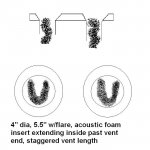
😉
I'd argue also, that classical vented systems can be improved quite a bit with the details- as you mentioned, lining a vent with felt can work, but a low-loss foam insert in conventional vents can be quite effective too (based upon subjective impressions of a single experiment, so get out the saltshaker boys). Likewise staggering vent length, flaring ends, etc, all refine the vent system and get it closer to ideal.
In the example shown, the foam is just a square piece folded into a U-shape and placed into the vent, extending past the inner boundary but not into the outer vent flare. An inner flare would be a good inclusion as well.
This is the system I'm using in my vented cabs, with an alignment that is more like an overdamped EBS than anything else- a slight knee but significantly bigger cab and than QB3 or C4, and tuning about where C4 would fall. (4.5 cu ft tuned to 37 or so, eminence magnum 15HO)
- Home
- Loudspeakers
- Multi-Way
- Beyond the Ariel