Go Back   Home > Forums > Live Sound > Instruments and Amps
Home Forums Rules Articles Store Gallery Blogs Register Donations FAQ Calendar Search Today's Posts Mark Forums Read

Instruments and Amps Everything that makes music, Especially including instrument amps.

Please consider donating to help us continue to serve you.

Ads on/off / Custom Title / More PMs / More album space / Advanced printing & mass image saving
Reply
 
Thread Tools Search this Thread
Old 17th March 2012, 05:19 PM   #11
diyAudio Member
 
Join Date: Apr 2010
Quote:
Originally Posted by dscottguitars View Post
A rotary 3 position 3 pole switch. In one pole, through a cap out the other pole, no bleeding from one cap to the other.
So you switched between cap values.
Quote:
Unless there is a tone control that really works, I am choosing this.
Choosing what?

Quote:
It is a guitar amp. I've used the standard Bassman tone, a treble cut circuit. I've tried many different sizes of pots and caps but still get the same results, good highs, but the lows then are too quiet. Or the opposite, too much lows. And then the pot only works for the first 33% of the turn, or the last, and then no variance with the rest of the turn.
Which Bassman circuit are you talking about? What values? What is the amplifier circuit you have, it all maters.

Quote:
I've also tried a variable high pass filter for tone, with a pot and cap to make it brighter. That was useless. Again, with different value pots and caps, all with the same - nothing results.
Kind of getting frustrated reading words but getting no information out of them.

Quote:
I have put these after the first tube, before it right from the jack and after the second tube. No luck. I have tried my own combinations of caps and configurations with the pot and still no luck.
So you put a high cut circuit on the input jack, basically repeating the tone control on your guitar (me assuming you have a tone control on the guitar)? After the first triode and then after the second. What does no luck mean? Did you get a high cut? What was missing? were you expecting a bass boost?

Quote:
I will try the tone calculator, but I am not holding my breath unless there is something there that is not on standard schematics.
The tone calculator has a couple of standard circuits to play with. Not the simple tone cut that it seems you have used. You may want to try one of them since you seem to want more than a high cut control can produce.

Quote:
As far as the tones: I'm not looking for anything weird. Crisp thin cutting highs-country; to boomy bassy lows without too much brightness-jazz. And if possible a mix in the middle.

I am looking for too bright for a fender single coil bridge pickup so you need to turn it down. And too much bass for a gibson humbucker neck pickup so you need it turned up. This would also interpret to be high enough for a humbucker and low enough for a single coil.
Seems you may need at least a treble-bass control.

Quote:
Who uses the tone control anyway?? On their guitar yes, but as far as I know everyone uses the amp with the tone on 10. So why not just eliminate it?
That is true, nobody uses their tone controls.

Quote:
I think I have found a better solution with the rotary switch. Bass boost, mid boost and bright boost.
We would be interested in seeing a schematic.

Quote:
I may not have described something above with terminology used correctly, please assume simple and that I'm trying what's out there not trying to reinvent the tone.

Thanks for your replies...

Daniel
Yes, words can be frustrating.
  Reply With Quote
Old 17th March 2012, 05:40 PM   #12
Cassiel is offline Cassiel  Libya
diyAudio Member
 
Cassiel's Avatar
 
Join Date: Sep 2004
Location: Madrid
Quote:
Is there such a thing as a variable capacitor for tone control?
Out of curiosity I did try this tone control on my guitar. It didn't work for long. You go crazy with too many options, and it's also difficult to get it 100 percent right. Not recommended for lazy players.

http://www.gibson.com/Files/schematics/thinline.gif
__________________
Hello
  Reply With Quote
Old 17th March 2012, 05:57 PM   #13
diyAudio Member
 
Join Date: Mar 2011
Choosing what... the rotary switch I just stated.

Which bassman....I only know of one bassman tone control... a 0.1 cap going to a 250K pot, and the wiper going to ground. the other end of pot is not connected.

This is what I meant about terminology... I put a pot in series with a cap connected to the wiper and the output side of the pot. This was to bypass highs around the pot.

No luck... it means it did not work!

Bass and treble controls... this is why I asked the original question, is there a tone control, ( assume a one pot control) that works...

See the drawing for the tone switch... I'm still working on the bass boost. The one there is still a bit bright.


Lastly: No one has answered the question...

A yes or no answer would be sufficient. If yes, a link or a drawing to back it up. If no, well, that's what I am presuming by asking the question that way...

It should not make a difference what type of amp it's for. Tone is a control that does one thing, adjust tone for any type of amplification. And since this is in the Instruments and Amps category, one should assume it is for an instrument amp. Bass, guitar, keyboard, or PA, they are all the same when it comes to adjusting the tone.
Attached Images
File Type: jpg tone switch schematic.jpg (19.2 KB, 187 views)
  Reply With Quote
Old 17th March 2012, 06:03 PM   #14
diyAudio Member
 
Join Date: Jan 2004
Got another one for you to try. I have an old Tele myself, and I built a 5F6 AKA '59 Bassman clone last year. I also built a classic 4-10 Jensen cabinet. I was getting frustrated with tone adjustment, and I added a "tone control" idea that I found on a Weber "Orange clone" schematic. It's a rotary switch, single pole 6 position, that replaces the coupling cap driving the phase splitter. The Weber schematic shows it before an FX loop, but I like it later in the circuit. It's wired so that the caps are successively added in series as you turn the switch. The Weber schematic shows 5x 0.047uF caps, but I made the first two quite a bit smaller, as this big 4x10 cabinet tends to be REALLY boomy at low volume, and the smaller caps tame it. The switch has a nice effect on the tone balance and gives lots of adjustment range.

Here's the link:
https://taweber.powweb.com/store/6o100_schem.jpg

cheers
  Reply With Quote
Old 17th March 2012, 06:09 PM   #15
diyAudio Member
 
Join Date: Mar 2011
Thanks Cassiel and Adam,

That Gibson looks similar to the rotary switch I have, but with many more and connected to a pot for more adjustment. These ideas are like the old 'eq' rotary switches on old stereos.

And like Printer answered, no one really uses the tone control on an amp anyway.

I like the three position option. The rest you can get with your pickup selector and guitar's tone control...
  Reply With Quote
Old 17th March 2012, 06:20 PM   #16
DF96 is offline DF96  England
diyAudio Member
 
Join Date: May 2007
Quote:
Originally Posted by dscottguitars
they are all the same when it comes to adjusting the tone.
I know very little about guitar amps, but I do know that the effect of a coupling capacitor depends critically on the resistance it feeds into (and the output impedance of the previous stage). Unless all amps use exactly the same circuit, which I doubt, then a tone control has to be designed for the particular amp you are interested in.

Perhaps the reason that nobody has answered your question is that those who understand guitar amps know that you have given insufficient information to enable the question to be answered.
  Reply With Quote
Old 17th March 2012, 06:25 PM   #17
Minion is offline Minion  Canada
diyAudio Member
 
Join Date: May 2006
Any passive tone controll is only going to cut frequencies not boost them ...... if you want to boost frequencies you should go for an active tone controll ..... I personally would rather have no tone controll than a passive tone controll .......

You can build an active 3 band tone controll with as little as a single opamp and a few resistors and capacitors ......
  Reply With Quote
Old 17th March 2012, 07:42 PM   #18
diyAudio Member
 
Join Date: Apr 2010
Quote:
Originally Posted by Minion View Post
Any passive tone controll is only going to cut frequencies not boost them ...... if you want to boost frequencies you should go for an active tone controll ..... I personally would rather have no tone controll than a passive tone controll .......

You can build an active 3 band tone controll with as little as a single opamp and a few resistors and capacitors ......
But any active tone control is only a passive tone control cloaked in an active (additional gain) configuration. If you boost gain and then cut unwanted frequencies (or cut and then boost signal) you end up with boost where you want it.

Personally I would rather have passive tone controls in a tube amp rather than throw an IC into the fray.
  Reply With Quote
Old 17th March 2012, 08:25 PM   #19
Minion is offline Minion  Canada
diyAudio Member
 
Join Date: May 2006
I guess to each his own ...... I hate the tone controlls in my tube amp , Ive tried it with a fender type controll and marshal and vox tone controll but never could get it the way I want it so I just max everything and run a 15 band EQ through my FX loop , but in my Solid state amp I use a 3 band active which for me was much more versitile than the passive .....
  Reply With Quote
Old 17th March 2012, 09:09 PM   #20
Simon B is offline Simon B  United Kingdom
diyAudio Member
 
Join Date: Dec 2011
Location: North-East England
Scott, as you note, the section is called "Instruments and Amps" Instruments do have circuits inside them too!

Unless you really know what you're doing, don't try putting an op-amp into a valve amp, it will die very quickly indeed (like, when you first switch it on).

Also, if you're just getting to grips with valve amps, op-amp circuitry is different, too much, too soon - same goes for active tone controls.

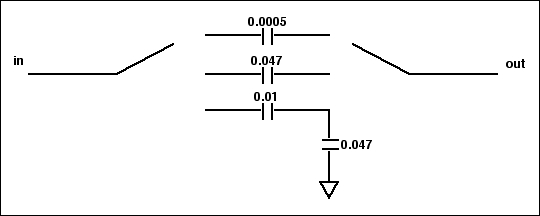
I've looked at your 2 pole three way switch circuit, it won't do what you want I'm afraid.

However, if you think of three completely separate circuits, with your 2 pole three way switch selecting from three possible inputs and three possible outputs, things start looking much brighter.

Like this:

tone switch schematic 02.jpg

So what you've got is three tone shaping networks, only one of which is in circuit at a time. What you need to do now is to work out what you want those networks to be.

There are two VERY IMPORTANT provisos:

Don't let DC level enter your switch at least on the left hand side (or switching will be something unforgettably ear-splitting)

Make sure that the valve you're connecting the output on the right hand side to has a constant value DC path to ground.

So what you end up with is actually more like this:

tone switch schematic 03.jpg

The cap on the input will will need a high voltage rating, the one on the output not very much.

Let me know what you think of this - it gives you opportunity to think about the tone networks independently - once you've got one working the way you want, the others can follow on later.

You're onto something that I think is a nice idea to get your amp working the way you want. Don't electrocute yourself.


Last edited by Simon B; 17th March 2012 at 09:16 PM.
  Reply With Quote

Reply


Hide this!Advertise here!
Thread Tools Search this Thread
Search this Thread:

Advanced Search

Posting Rules
You may not post new threads
You may not post replies
You may not post attachments
You may not edit your posts

BB code is On
Smilies are On
[IMG] code is On
HTML code is Off
Trackbacks are Off
Pingbacks are Off
Refbacks are Off


Similar Threads
Thread Thread Starter Forum Replies Last Post
Tone control argonrepublic Solid State 11 13th November 2011 01:32 AM
To tone control or not to... dagerman Tubes / Valves 12 27th June 2011 06:15 AM
Tone control argonrepublic Solid State 0 28th February 2010 12:12 AM
i need preamp schematics w/o tone control or volume control hernanstafe Parts 7 30th January 2008 03:12 AM
non-inverted tone control? otaku Chip Amps 0 29th January 2005 09:31 AM


New To Site? Need Help?

All times are GMT. The time now is 10:36 AM.


vBulletin Optimisation provided by vB Optimise (Pro) - vBulletin Mods & Addons Copyright © 2013 DragonByte Technologies Ltd.
Copyright ©1999-2013 diyAudio