
Hi CafeNoir,Files have been sent to production; I ordered 10 PCBs with 2oz copper.
Below is a virtual render of a populated board using Eagle3D.
Would be interested in a couple of these boards pls. Also any advice on bits to use and match up if needed,
Was there someone on here selling kits of matched semi conductors?
Pingushome
Pingushome,
jackinnj has been very kind to provide some kits (pcbs and parts) to the DIYers. They are available here, and I highly recommend it if you want best bang for the buck:
Tech DIY Company Store
My boards were made to accommodate mounted heatsinks, as well as other options (bias, filtering, etc.). They are a bit more expensive ($9 per board, so $18 for a stereo set), but if you still want it, I can put you down for two PCBs.
jackinnj has been very kind to provide some kits (pcbs and parts) to the DIYers. They are available here, and I highly recommend it if you want best bang for the buck:
Tech DIY Company Store
My boards were made to accommodate mounted heatsinks, as well as other options (bias, filtering, etc.). They are a bit more expensive ($9 per board, so $18 for a stereo set), but if you still want it, I can put you down for two PCBs.
One small note about Tech-DIY boards: the copper plane on one of the channels of the PCB is not connected to anything, even with the jumpers mentioned earlier. If one wants the pour to be connected to ground, one must scratch some silkscreen off and make a connection there. The issue is in the right part of the pcb, when seen from the top.
One of the reasons for making a gnfb amp with moderate nfb is to get a flat thd curve vs. freq. Usually you get a rising thd as frequency increases. With the same amount of nfb at all frequencies the thd should be constant over the audio range.
In fact this is the case. I see only 2 harmonics with either 1KHz or 10KHz and they are the same level. Plus, No higher orders -- no 5, 7, 9th etc.
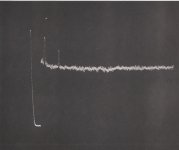
-110 -120dB
Thx-RNMarsh
In fact this is the case. I see only 2 harmonics with either 1KHz or 10KHz and they are the same level. Plus, No higher orders -- no 5, 7, 9th etc.
-110 -120dB
Thx-RNMarsh
Last edited:
there are plenty of distortion mechanisms that rise with frequency despite flat global loop gain - anywhere you have a nonlinear C
and if we are most concerned with IMD products in the most sensitive hearing bands then we don't want to "throw away" loop gain that gives distortion reduction there - global feedback does reduce even IMD difference products
so if you can have 26 dB more loop gain at 1 KHz than 20 kHz with common single pole compensation, the CCIF 19+20 kHz test 1 kHz IMD product is ~26 dB lower with the integrating loop gain curve than with the same amp with flat audio frequency loop gain below 20 kHz for typical output stage dominated distortion
and if we are most concerned with IMD products in the most sensitive hearing bands then we don't want to "throw away" loop gain that gives distortion reduction there - global feedback does reduce even IMD difference products
so if you can have 26 dB more loop gain at 1 KHz than 20 kHz with common single pole compensation, the CCIF 19+20 kHz test 1 kHz IMD product is ~26 dB lower with the integrating loop gain curve than with the same amp with flat audio frequency loop gain below 20 kHz for typical output stage dominated distortion
The point here is a narrow one. yes, i admit that. never-the-less, when one looks at all forms and causes there are a multitude of mechanisms to be sure. And, yes more fb will reduce distortions more Etc etc etc.
BUT --- if you look at the harmonic distribution - the harmonic structure, the harmonics them selves and which ones and their relative amplitudes to one another.......
With the Same amount of gnfb appplied at all freqs tends to give the same characteristics for the harmonic structure anywhere. You dont get one set at low freq and another at high freq. levels are the same and structures are the same. This has an affect on the percieved sound, I believe. A continuity in the sound that cant be duplicated any other way.
Thx-RNMarsh
BUT --- if you look at the harmonic distribution - the harmonic structure, the harmonics them selves and which ones and their relative amplitudes to one another.......
With the Same amount of gnfb appplied at all freqs tends to give the same characteristics for the harmonic structure anywhere. You dont get one set at low freq and another at high freq. levels are the same and structures are the same. This has an affect on the percieved sound, I believe. A continuity in the sound that cant be duplicated any other way.
Thx-RNMarsh
Pingushome,
jackinnj has been very kind to provide some kits (pcbs and parts) to the DIYers. They are available here, and I highly recommend it if you want best bang for the buck:
Tech DIY Company Store
My boards were made to accommodate mounted heatsinks, as well as other options (bias, filtering, etc.). They are a bit more expensive ($9 per board, so $18 for a stereo set), but if you still want it, I can put you down for two PCBs.
Thanks CafeNoir I'll check it out
Martin🙂


I was reading through this thread and then I saw someone mentioned "head" amp. Back in the old days, this richard marsh did in fact have a head amp from decades ago. Then I was clearing through my stored items and I came across this "head" amp. I am now wondering if I could reuse the power supplies from this.
It is Dick Marsh's Pre Preamp with 4 improved Sulzer power supplies with pre regs by 317/337. This is from the 80s. I guess back then this was somewhat cutting edge. Something tells me that if the Sulzers can provide the current, then it could in fact improve the current headphone amp. Any thoughts? Richard. And BTW big thanks for your efforts on this and other projects.
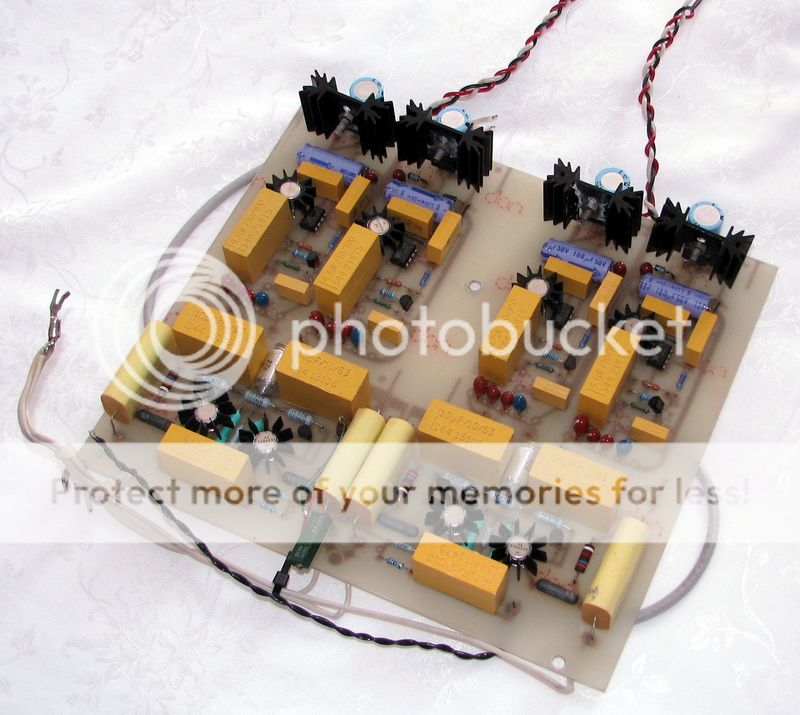
It is Dick Marsh's Pre Preamp with 4 improved Sulzer power supplies with pre regs by 317/337. This is from the 80s. I guess back then this was somewhat cutting edge. Something tells me that if the Sulzers can provide the current, then it could in fact improve the current headphone amp. Any thoughts? Richard. And BTW big thanks for your efforts on this and other projects.
Last edited:
Its good to see you have kept the good stuff even if you dont use MC cartridges anymore. The regulators will do wonderfully.... the regulators still get high marks for their performance and sound. You'll need one per channel as the Stock reg wont have enough current capacity to power both channels.
Nice looking workmanship. Mine never looked as good as yours and of others around the DIY site.
-Richard
Nice looking workmanship. Mine never looked as good as yours and of others around the DIY site.
-Richard

This is from the 80s.
Aargh, Philips polyester rash.
Quick, allergy pills.

Good news; boards just arrived 🙂
Time for a quick inspection. They look good to me so far
All people interested, expect a PM soon 😉
Dear CaféNoir,
Nice pc's! I am also interested in a pair.
Kind regards,
Joffrey
Dear CaféNoir,
Nice pc's! I am also interested in a pair.
Kind regards,
Joffrey
Unfortunately, all 10 boards have been sold by now!
I might do a rerun, since several people have shown their interest.
Again, send me PM.
Thnx
Likewise thanks CafeNoir. Great work
Busy for a week or two but will keep you posted the resits/caps on order🙂🙂
Martin
Likewise thanks CafeNoir. Great work
Busy for a week or two but will keep you posted the resits/caps on order🙂🙂
Martin
- Home
- Amplifiers
- Headphone Systems
- Marsh headphone amp from Linear Audio