

Forgive my stupidity, I don't understand "corner frequency" or "Fc and vice versa." Any clarification would be gratefully accepted as would an allowance for my ignorance.
Cutoff frequency - Wikipedia, the free encyclopedia
i think(?) that will help.
also subscribed for knowledge. these bloody things have me completely bamboozled.
also subscribed for knowledge. these bloody things have me completely bamboozled.
+1 and add me to the list.

There is a difference between the volume of a chamber between the driver and the horn's throat and a "constriction" (of sorts) that takes the open face of a driver that faces into the throat of a horn and reduces that opening so the volume of air now has to run through a smaller orifice. The second causes an increase in compression ratio.
What the former does is to form a Low Pass Filter (LPF) which means that if you were using a speaker that had output up into the midrange or above, with a volume between the speaker and the throat, the higher frequencies would be made to roll off, acoustically. Not electrically.
Of course too much volume there and you lose the benefit of having a horn at all...
There are formulas for this stuff... and Hornresp (if you can figure it out) will simulate this stuff pretty well - I am told!
_-_-bear
What the former does is to form a Low Pass Filter (LPF) which means that if you were using a speaker that had output up into the midrange or above, with a volume between the speaker and the throat, the higher frequencies would be made to roll off, acoustically. Not electrically.
Of course too much volume there and you lose the benefit of having a horn at all...
There are formulas for this stuff... and Hornresp (if you can figure it out) will simulate this stuff pretty well - I am told!
_-_-bear
There are formulas for this stuff... and Hornresp (if you can figure it out) will simulate this stuff pretty well - I am told!
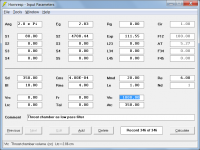
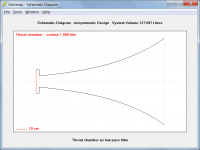
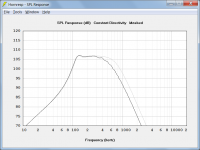
The attached Hornresp screenprints illustrate how a horn throat chamber can be dimensioned to act as an acoustic low pass filter. Screenprint 3 compares the power response of a horn having a throat chamber volume Vtc = 1000cc (gray trace) against the same horn with throat chamber volume Vtc = 2000cc (black trace).
Kind regards,
David
Attachments
Oh, somebody reading the thread mentioned to me about this:
http://www.quarter-wave.com/Horns/BLH_Design_Article.pdf
Also, my presumption - perhaps wrong - is that the OP was discussing a speaker that is/was more or less like the standard "PA/SR" type folded bass horn, with the front of the driver directly radiating. One sees this with folded horns and the "J scoop" type.
The "horns" that people have been building with the rather small mouth (things less than several feet on a side for the mouth) in my mind are tapered, unstuffed, transmission lines, not true horns - no matter what anyone calls them.
If they were true horns, then the mouth size would be so small as to cause monster comb filter effects... which for all I know, they have (I have not seen them measured, maybe because I am not looking?).
Fwiw, Fyi, and all that good stuff...
http://www.quarter-wave.com/Horns/BLH_Design_Article.pdf
Also, my presumption - perhaps wrong - is that the OP was discussing a speaker that is/was more or less like the standard "PA/SR" type folded bass horn, with the front of the driver directly radiating. One sees this with folded horns and the "J scoop" type.
The "horns" that people have been building with the rather small mouth (things less than several feet on a side for the mouth) in my mind are tapered, unstuffed, transmission lines, not true horns - no matter what anyone calls them.
If they were true horns, then the mouth size would be so small as to cause monster comb filter effects... which for all I know, they have (I have not seen them measured, maybe because I am not looking?).
Fwiw, Fyi, and all that good stuff...

It depends if you define a horn by laying down the stricture that it must be impedance matched down to Fc. If we are to apply our definitions so narrowly, then for example a 'tapered, un-stuffed transmission lines' is an oxymoron, since a transmission line, bysimilarly narrow defining standards, would be an untapered, stuffed (or otherwise damped) plane wave tube with the flattest possible impedance as the only objective.
It's really not worth getting hung up over definitions IMO. Life is far too short. As far as I'm concerned, I just call anything that expands toward the terminus a horn, since it will possess some degree of 1/2 wave behaviour.
It's really not worth getting hung up over definitions IMO. Life is far too short. As far as I'm concerned, I just call anything that expands toward the terminus a horn, since it will possess some degree of 1/2 wave behaviour.
Last edited:

Bear
[The "horns" that people have been building with the rather small mouth (things less than several feet on a side for the mouth) in my mind are tapered, unstuffed, transmission lines, not true horns - no matter what anyone calls them.
sorry, you are wrong look my double horns, calculate it, thats horns.
look my RDH20, measurements and Feedback the last.
Compair it with the speaker of the year 2012.
rdhmess
rdhfeedb
Voxativ Ampeggio loudspeaker Measurements | Stereophile.com
for understanding "about what"
about what
[The "horns" that people have been building with the rather small mouth (things less than several feet on a side for the mouth) in my mind are tapered, unstuffed, transmission lines, not true horns - no matter what anyone calls them.
sorry, you are wrong look my double horns, calculate it, thats horns.
look my RDH20, measurements and Feedback the last.
Compair it with the speaker of the year 2012.
rdhmess
rdhfeedb
Voxativ Ampeggio loudspeaker Measurements | Stereophile.com
for understanding "about what"
about what
@hm - I'd agree that your alphorn is a true horn... but I would also think that the mouth is way too small... I had difficulty deciphering the curves for the RDH20, even with google translate (I can not read German, sorry). I can see the clever construction technique, and that the wrapping of the "horn" exit around the main enclosure will sum to a larger area... but is it sufficient?
There seems to be a large dip at 100Hz or so, but that may be floor bounce, dunno.
If you look at Berenek, he shows the effect of two small of a mouth size as a comb filter... the question is if these construction methods serve to minimize the comb filter effect sufficiently or not.
Also, how much room lift is being counted upon - outside measurement or up in the air in a large (like gymnasium) room would tell us these things.
_-_-bear
There seems to be a large dip at 100Hz or so, but that may be floor bounce, dunno.
If you look at Berenek, he shows the effect of two small of a mouth size as a comb filter... the question is if these construction methods serve to minimize the comb filter effect sufficiently or not.
Also, how much room lift is being counted upon - outside measurement or up in the air in a large (like gymnasium) room would tell us these things.
_-_-bear
Also, my presumption - perhaps wrong - is that the OP was discussing a speaker that is/was more or less like the standard "PA/SR" type folded bass horn, with the front of the driver directly radiating.
The "horns" that people have been building with the rather small mouth (things less than several feet on a side for the mouth) in my mind are tapered, unstuffed, transmission lines, not true horns - no matter what anyone calls them.
Correct.
As Scott noted, these are true acoustical horns, i.e. a 1/2 WL resonator with sufficient mouth area over some portion of its BW to have a matching impedance with the surrounding medium, otherwise they wouldn’t have enough acoustical gain to sufficiently fill in below the driver’s natural roll off to provide both LF extension and baffle step compensation [BSC], if required. I like to refer to them as a big vent reflex [BVR] since they typically only horn load an octave or two of the lower mids with TL loading providing its mid bass ‘slam’. To get any useful bass out of them requires additional boundary/room loading.
Where most [all?] of the confusion comes from [to my mind anyway] is folks equating Fc [the frequency the horn 'rings' at and response rolls off below it] with F0 [the horn's 1/4 WL cut-off frequency], which can be several octaves below Fc depending on the driver’s specs.
Seems like ever since T/S came along, folks are either equating Fc to F0 and/or defining F0 as Fc, which implies that a small mouth horn can somehow defy the laws of physics as we currently understand them.
GM
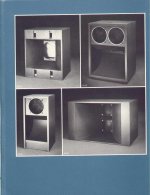
Along those same lines a few images for illustrative purposes...
Note that the long straight plywood horn is said to be good only to 45Hz - with that large mouth size...
the blue green thing, I leave to your imagination.
the others should be fairly obvious, and the PA types are probably not going to go even to 40Hz in singles, unless arrayed together to get a larger effective mouth size...
Having said all that, if the speakers that people are posting about sound good, and they are liked, all well and good. As I said in a private email to someone expert on this topic, it is difficult to get a small (modest size) enclosure to get down to ~30Hz no matter what, so if these do that I can understand why they are of interest.
_-_-bear
Note that the long straight plywood horn is said to be good only to 45Hz - with that large mouth size...
the blue green thing, I leave to your imagination.
the others should be fairly obvious, and the PA types are probably not going to go even to 40Hz in singles, unless arrayed together to get a larger effective mouth size...
Having said all that, if the speakers that people are posting about sound good, and they are liked, all well and good. As I said in a private email to someone expert on this topic, it is difficult to get a small (modest size) enclosure to get down to ~30Hz no matter what, so if these do that I can understand why they are of interest.
_-_-bear
Attachments
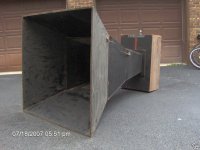


Since I have not been discussing your speakers Horst, I can't see why I should be looking at your measurements, or back-calculating your designs (the operating principles of which I am perfectly familiar with). As far as I am aware, they are pipes that expand toward the terminus and therefore they can be described as horns. What is your point?
By the way, I would appreciate it if you would stop calling me 'Scotti.'
By the way, I would appreciate it if you would stop calling me 'Scotti.'
Last edited:
sorry,
that you don´t read my measurements, and you didn´t calculate my double horns,
if i see how many members built horns without measurements at all it´s a laugh.
I said I found your graphs difficult to follow using the translation from the German... yes?
The number of people that build a design means very little about anything other than they like it.
I think I gave credit to the idea that it is ok with me if people like the sound, and also that it is difficult to get low bass from typical FR or similar drivers, so anything that manages that job has some benefits/merit. Is there something wrong with saying that??
Would you prefer it if I said all the possible design flaws instead? There are many. But that is not my game, thanks.
...the basic premise is that a tapered TL is NOT a horn exactly.
...a horn truncated before it fully expands to the intended LF rolloff point will never perform with flat freq response or a flat impedance.
Will the second point matter? That is up to others to decide, and do as they wish. It's not my aim to change anyone's mind, only to discuss the merits.
Where is the point where a "horn" and a "tapered TL" start to become the same thing?
Maybe someone would like to take up that point and say something concise and definitive?
_-_-bear
bear
please compair the measurements of
Voxativ Ampeggio loudspeaker Measurements | Stereophile.com
and my RDH20
rdhmess
tell us what you see, please
please compair the measurements of
Voxativ Ampeggio loudspeaker Measurements | Stereophile.com
and my RDH20
rdhmess
tell us what you see, please
Where is the point where a "horn" and a "tapered TL" start to become the same thing?
Maybe someone would like to take up that point and say something concise and definitive?
That's what GM & I have been doing (more or less). From my POV (I belive Greg has a similar take) I tend to use the term 'horn' for any pipe that expands toward the terminus, since it possesses some degree of 1/2 wave behaviour. It may or may not be impedance matched down to F0 (the 1/4 wave cutoff determined by axial length & taper). Ideally, it would be, but that is not always practical for obvious reasons.
Last edited:
- Status
- This old topic is closed. If you want to reopen this topic, contact a moderator using the "Report Post" button.
- Home
- Loudspeakers
- Full Range
- BLH compression chamber.