
Yes that's doable. However you'll need the LCD screen and the buttons to set your remote controller in the beginning at least.
Once the IR receiver is configured, then you can indeed remove the screen and the buttons although I don't recommend that (the screen displays valuable information and the buttons will come in handy the day you mislay your remote controller).
Once the IR receiver is configured, then you can indeed remove the screen and the buttons although I don't recommend that (the screen displays valuable information and the buttons will come in handy the day you mislay your remote controller).

OK, I hear you. I'll take a chance anyway.... Possible to support IR config via GUI(USB) procedure? Screen is a given!
No that's not ideal, there are too many buttons and I can't see how they're wired to 8 output pins.
I recommend placing 5 buttons in a cross-pattern (left/right/up/down/center) for navigating easily through the menu. A 6th button (SET) should lie somewhere near the cross, because it's by pressing this button that you confirm a change made in the menu.
The 2 remaining buttons (StandBy, Mute) can be placed elsewhere, up to you.
Would it be possible to use just some of the buttons like in the picture?
Attachments


Would it be possible to use just some of the buttons like in the picture?
ChaparK said he couldn't see how the buttons are wired to the output pins - I don't see what's changed there
The listing says the buttons are wired as a matrix. Unless chapark's design is expecting to see the same matrix then the connector on the button board won't work.
You may be able to wire directly to the back of some of the buttons and use it that way
Why not wait until the design, schematic and documentation are released and then work out what buttons may or may not work with it
The listing says the buttons are wired as a matrix.
I confirm you cannot use that keypad. You'll need 8 independent push-buttons.

If you want to build your own. Legs are 6x6 so there will be some bending aquired.

Quality Momentary Tactile Miniature/Mini/Micro/Small PCB Push Button Switch SPST | eBay
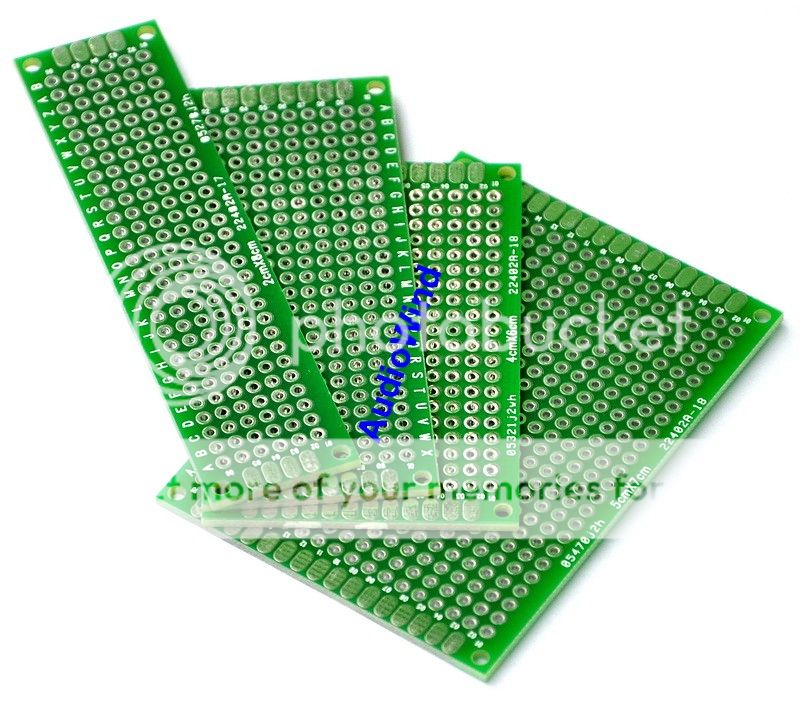
20x Double-Side Prototype PCB, Universal Board. | eBay
Quality Momentary Tactile Miniature/Mini/Micro/Small PCB Push Button Switch SPST | eBay
20x Double-Side Prototype PCB, Universal Board. | eBay
Supported functions are:
- On/Off One?
- Mute One?
- Volume +/- Two?
- Preset +/- Two?
- Preset 1, 2, ..., 9 Two?
- Source select One?
- Balance L/R Two?
- Bass +/- Two?
- Treble +/- Two?
How come it would be enough with 8 pushbuttons ?
- On/Off One?
- Mute One?
- Volume +/- Two?
- Preset +/- Two?
- Preset 1, 2, ..., 9 Two?
- Source select One?
- Balance L/R Two?
- Bass +/- Two?
- Treble +/- Two?
How come it would be enough with 8 pushbuttons ?
Supported functions are:
- On/Off One?
- Mute One?
- Volume +/- Two?
- Preset +/- Two?
- Preset 1, 2, ..., 9 Two?
- Source select One?
- Balance L/R Two?
- Bass +/- Two?
- Treble +/- Two?
How come it would be enough with 8 pushbuttons ?
We are all very impatient to get the hand on what Chapark is finalizing, and be sure that I will be one of the first to get one but may I humbly suggest you to wait for the product. Then, we will have, for sure, a lot of questions, suggestions and so on.
OK, about your specific question, a possible minimalistic answer:
- two for +/-
- one to move from functions to functions
- one to set ( a simultaneous push on +/- could even remove that one)
- one for mute / power (short push mute, long push ON/OFF)
This a forum where the main purpose is dialoge so If
I belive I have a relevant question I will ask it and I
would appreciate not being told, not to participate in
this dialoge.
If "Chapark" thinks that I'm asking irrelevant questions
or doesn't want questions asked (not likely) he can Pm
me that request
I belive I have a relevant question I will ask it and I
would appreciate not being told, not to participate in
this dialoge.
If "Chapark" thinks that I'm asking irrelevant questions
or doesn't want questions asked (not likely) he can Pm
me that request
Last edited by a moderator:
Some functions are multiplexed - the button's function depends on the context.
- On/Off and Mute have just these functions (i.e. no multiplexing)
- Up/Down let you navigate through the menu in a vertical way when it's on, otherwise they are the Volume buttons.
- Left/Right let you also navigate through the menu but in the horizontal direction, otherwise they open the Bass/Treble page.
- The Menu button opens/closes the menu
- The Set button lets you set an option in the menu, otherwise it opens the balance page if the menu is off.
The above explains maybe why i'd suggest to place some buttons in a cross-pattern (Up/Down/Left/Right and Menu in the center).
- On/Off and Mute have just these functions (i.e. no multiplexing)
- Up/Down let you navigate through the menu in a vertical way when it's on, otherwise they are the Volume buttons.
- Left/Right let you also navigate through the menu but in the horizontal direction, otherwise they open the Bass/Treble page.
- The Menu button opens/closes the menu
- The Set button lets you set an option in the menu, otherwise it opens the balance page if the menu is off.
The above explains maybe why i'd suggest to place some buttons in a cross-pattern (Up/Down/Left/Right and Menu in the center).
I'm sorry if I stepped on anyones toes a few posts back, there was no illwill intended. 🙂
I refrased it in a more appropriate way so please accept my apologies 🙂
"This a forum where the main purpose is dialoge so If
I belive I have a relevant question I will ask it and I
would appreciate not being told, not to participate in
this dialoge.
If "Chapark" thinks that I'm asking irrelevant questions
or doesn't want questions asked (not likely) he can Pm
me that request."
I refrased it in a more appropriate way so please accept my apologies 🙂
"This a forum where the main purpose is dialoge so If
I belive I have a relevant question I will ask it and I
would appreciate not being told, not to participate in
this dialoge.
If "Chapark" thinks that I'm asking irrelevant questions
or doesn't want questions asked (not likely) he can Pm
me that request."
Ok, first part's done. It will be placed on top of the case, right hand corner. 🙂
I will most likely skip the arrows.
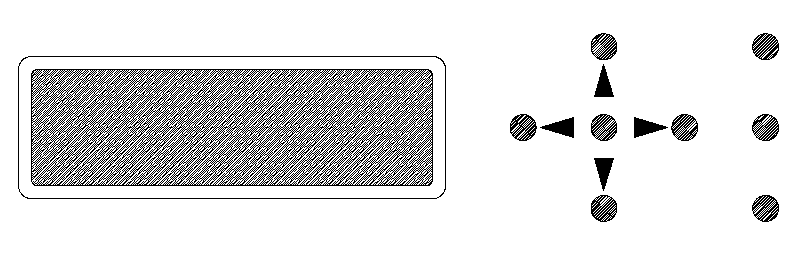
I will most likely skip the arrows.
Last edited:
As some guys here are already looking at the design of their unit, I'm posting a few snapshots of the LCD display to give an idea of what's available here.
I'm using a standard size 2x16 display with blue background and white characters. Remember that many sizes / background colors / character colors combinations are available in shops (or ebay).
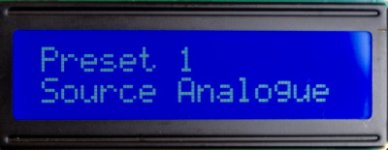
So this one below is the main screen, displaying on top the preset (preset name is customizable by user, could be My Preset for example), and on bottom the active source.
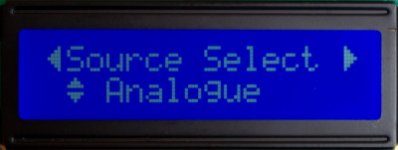
Here's a page from the menu, this one is for selecting the source. Note the arrows for reminding the user on how to use pushbuttons in order to navigate.
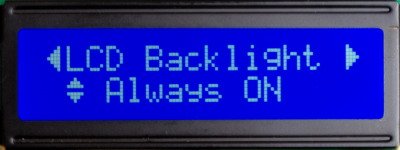
Another page from the menu showing LCD backlight management.
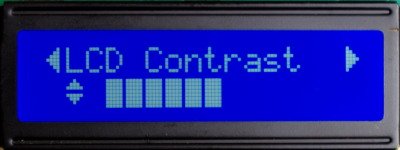
Yet another page from the menu for LCD contrast adjustment. I stop here with the menu, I suppose you got the idea.
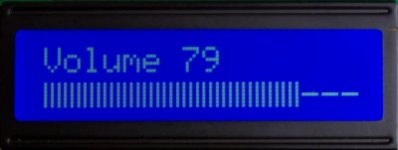
Here's what the LCD displays when the user adjusts the volume. After a short while, the display returns to the main screen (first picture on top).
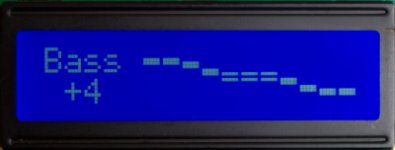
This is the bass adjustment page. You can see that there's a bit of bass added and treble is lowered a bit.
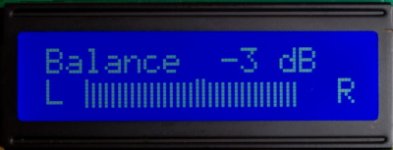
Balance, a bit moved to the left here.
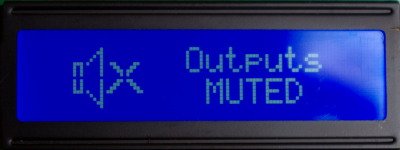
When outputs are muted, the LCD permanently displays this page so you don't wonder why the hell there's no sound. Note however you still can navigate in the menu.
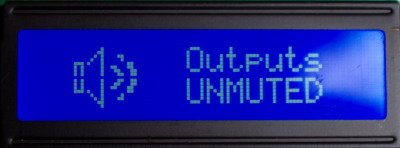
When the user unmutes, the LCD displays the screen below for 2 seconds then returns to the main screen (1st pic on top).
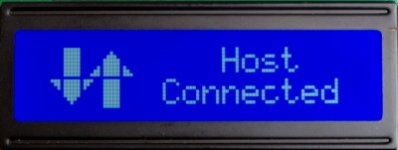
Finally, when the PC application is controlling the board, the keypad/IR sensor are disabled and the LCD shows the screen below.
I'm using a standard size 2x16 display with blue background and white characters. Remember that many sizes / background colors / character colors combinations are available in shops (or ebay).
So this one below is the main screen, displaying on top the preset (preset name is customizable by user, could be My Preset for example), and on bottom the active source.
Here's a page from the menu, this one is for selecting the source. Note the arrows for reminding the user on how to use pushbuttons in order to navigate.
Another page from the menu showing LCD backlight management.
Yet another page from the menu for LCD contrast adjustment. I stop here with the menu, I suppose you got the idea.
Here's what the LCD displays when the user adjusts the volume. After a short while, the display returns to the main screen (first picture on top).
This is the bass adjustment page. You can see that there's a bit of bass added and treble is lowered a bit.
Balance, a bit moved to the left here.
When outputs are muted, the LCD permanently displays this page so you don't wonder why the hell there's no sound. Note however you still can navigate in the menu.
When the user unmutes, the LCD displays the screen below for 2 seconds then returns to the main screen (1st pic on top).
Finally, when the PC application is controlling the board, the keypad/IR sensor are disabled and the LCD shows the screen below.
Looks good, for adjusting for example volume do I hold the button in
and release when satisfied or do I have to push ones for every 0,5db ?
and release when satisfied or do I have to push ones for every 0,5db ?
Looks good, for adjusting for example volume do I hold the button in
and release when satisfied or do I have to push ones for every 0,5db ?
Both are available.
Short button press allows you adjusting the volume step-wise.
Holding the button lets you adjust volume in a continuous fashion until button release.
The same applies to the remote controller volume buttons.
Interest from Austria 🙂
Hello,
i just wanted to say, that i am really interested in this project. But i'm kind of afraid if this project lies in my budget. Sorry If this has been answered before, but after reading till site 30 of the posts my brain stopped working properly.
I looked at your other projects/products at WAF Homepage. Will it be in such a price category or (hopefully) lower? Otherwise i will have to stay at miniDSP.
Anyway i want to congratulate for this great work!
One more Question, will the Software be open source? I may want to use another LCD. In colour and not 2x16 but with Pixels 😀.
But if not, this Solution should be good to.
br from Austria
Hello,
i just wanted to say, that i am really interested in this project. But i'm kind of afraid if this project lies in my budget. Sorry If this has been answered before, but after reading till site 30 of the posts my brain stopped working properly.
I looked at your other projects/products at WAF Homepage. Will it be in such a price category or (hopefully) lower? Otherwise i will have to stay at miniDSP.
Anyway i want to congratulate for this great work!
One more Question, will the Software be open source? I may want to use another LCD. In colour and not 2x16 but with Pixels 😀.
But if not, this Solution should be good to.
br from Austria
Greetings from Austria 🙂
Hello!
Big interest from Austria in this project.
Just two questions and sorry if answered before, but after reading till site 30 of this thread, my brain stopped working properly.
What will be the estimated price range? I've looked at you other projects at the WAF homepage, will it be in that region ( 900+ € ), or hopefully cheaper? If it's in this price league i will have to stick with miniDSP 🙁
Second; Will the Software be open Source? I maybe want to use another LCD Display (not 2x16 bw, but in Colour with Pixels, Nokia or something like that.) If it's not open Source, is there a possibility to drive the DSP over I²C so i can build my own lcd-driver/menu?
kind regards from Austria
Hello!
Big interest from Austria in this project.
Just two questions and sorry if answered before, but after reading till site 30 of this thread, my brain stopped working properly.
What will be the estimated price range? I've looked at you other projects at the WAF homepage, will it be in that region ( 900+ € ), or hopefully cheaper? If it's in this price league i will have to stick with miniDSP 🙁
Second; Will the Software be open Source? I maybe want to use another LCD Display (not 2x16 bw, but in Colour with Pixels, Nokia or something like that.) If it's not open Source, is there a possibility to drive the DSP over I²C so i can build my own lcd-driver/menu?
kind regards from Austria
- Home
- Source & Line
- Digital Line Level
- DSP Xover project (part 2)