
I purchased a couple of tiny boards based on the PAM8610 chip from Ebay. About $10. I want a tiny amp to feed my portable "Think-Geek" "crystal" speakers.
This chip feeds the class-D switched signal straight to the speakers, without any filtering. I added a few ferrite beads...
Works OK, until you get a transient bass-drum. That sends the amp into fits, with a noise I will describe as a "racous burp." 8W+8W of sine wave at 30Hz is fine, the transient bass is what sends the PAM8610 into fits.
Has anybody any idea where I should be looking to ameliorate the problem. I already have a huge cap on the power rail 🙂 I suspect it is some form of bootstrapping with too lower a capacitor value... has anybody any suggestions?
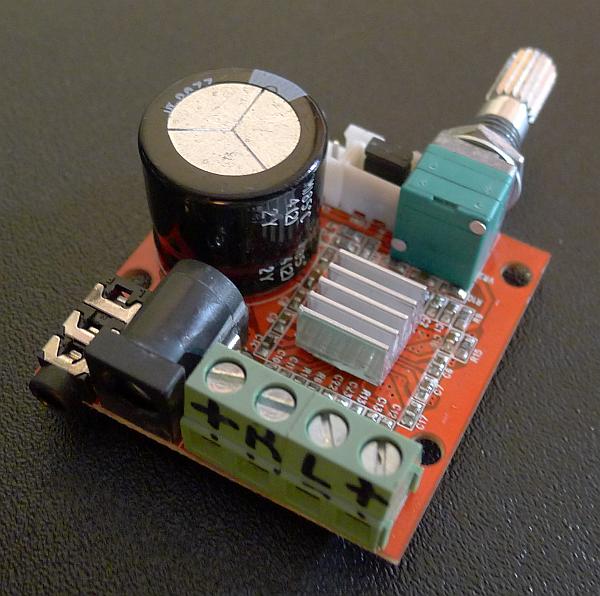
This chip feeds the class-D switched signal straight to the speakers, without any filtering. I added a few ferrite beads...
Works OK, until you get a transient bass-drum. That sends the amp into fits, with a noise I will describe as a "racous burp." 8W+8W of sine wave at 30Hz is fine, the transient bass is what sends the PAM8610 into fits.
Has anybody any idea where I should be looking to ameliorate the problem. I already have a huge cap on the power rail 🙂 I suspect it is some form of bootstrapping with too lower a capacitor value... has anybody any suggestions?
OK - board problems fixed
I went with my gut feeling and removed one of the bootstrapping capacitors to BSRN, BSRP, BSLN, BSLP which were easy to identify as C6, C7, C8 and C9.
It measured 570nF, pretty impressive for such a tiny cap, but less than the 1uF on the device data sheet. I dug some 1uF surface mount ceramics out of my toolkit 🙂 and put them in parallel with C6, C7, C8 and C9.
The $10 PAM8610 board now works really nicely. I used a plastic project box as a housing, but it fitted nicely into an Altoids tin. Actually, most people will not notice the original problem with bass transients. If you feed it with MP3, I suggest you may not even need the proper bootstrap caps.
Anyway, as long as nobody laughs at my soldering technique at this micro-scale, here is a closeup of the modified C6 and C7. You will need to remove the electrolytic to get at C8 and C9.
Oh - it works fine on 15V. I ran the voltage up to 17V on my own unit, just to make sure...
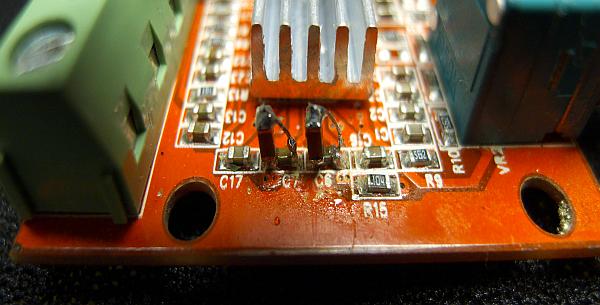
I went with my gut feeling and removed one of the bootstrapping capacitors to BSRN, BSRP, BSLN, BSLP which were easy to identify as C6, C7, C8 and C9.
It measured 570nF, pretty impressive for such a tiny cap, but less than the 1uF on the device data sheet. I dug some 1uF surface mount ceramics out of my toolkit 🙂 and put them in parallel with C6, C7, C8 and C9.
The $10 PAM8610 board now works really nicely. I used a plastic project box as a housing, but it fitted nicely into an Altoids tin. Actually, most people will not notice the original problem with bass transients. If you feed it with MP3, I suggest you may not even need the proper bootstrap caps.
Anyway, as long as nobody laughs at my soldering technique at this micro-scale, here is a closeup of the modified C6 and C7. You will need to remove the electrolytic to get at C8 and C9.
Oh - it works fine on 15V. I ran the voltage up to 17V on my own unit, just to make sure...
If you desperately needed a low-power amplifier for, eg, headphones, and size was the only criteria, then maybe you might look at this board.
The biggest downside is that when it goes into clipping there are audible "burps" on each peak, rather than just distortion. Thus it really isn't much good for driving speakers, as it doesn't have enough power to spare to eliminate the possibility of clipping.
The biggest downside is that when it goes into clipping there are audible "burps" on each peak, rather than just distortion. Thus it really isn't much good for driving speakers, as it doesn't have enough power to spare to eliminate the possibility of clipping.

Member
Joined 2009
Paid Member
does't sound as if the sound quality has impressed you ? if you avoid clipping (and I like the built-in clipping indicator !) does it sound good ?
I'm bumping this and making the same question as fraction did. If you try and run sensite 8ohm speakers with this at moderate volume will it be interesting?

trevmar, since you've done a little legwork experimenting with this board, I wonder if you can tell me a few other things. First, a lot of these class D chips seem to have selectable gain, and at leas on one (the Y148 Y148 Audio Amplifier Module - Free Shipping - DealExtreme ), I've noted that the board maker had the courtesy of lining up all the gain options, making a gain change as simple as moving a few 0 ohm resistors. Of course, as you already know, no board modifications are super simple on this size scale, so having the board at least set up for such mods is a huge help. Second, I need to be able to BTL tie the 2 outputs together to make a single MONO amp, better suited to a 4 ohm load. Most of these chips seem to make provision for this, but it has to be done at board design time, as simply tying the inputs 9and outputs) together is a "no no". Well "no no" or not, ant these prices I figure I can experiment some, and indeed with the Y148, though it is ill advised to do it this way, I did try just tying the outputs together along with the inputs, set the pot to full (to at least avoid any tracking error) and connected a 4 ohm speaker. It worked! in fact it worked so surprisingly well, with no apparent heating of the amp chip (at least to my calibrated finger ;-) So it makes me wonder if I could get away with doing the same with this PAM board. Ever try?
Peter Pan, the Y148 is an infinitely better chip than the PAM chip. The board you linked to has an output filter, which is a major omission from the PAM. I discarded my PAM, I just couldn't get any power from it, and have been focusing on the TDA7492/TDA7498 modules from SURE Electronics and the L20D (for high-end systems). The SURE ST boards are pretty good, especially after modding them. I am just finishing off a webpage describing the SURE mods, and will summarize them in a thread here at the weekend 🙂
.
.
Thanks trevmar. I figured as much, but for the size and price I can't resist trying to play with it. Yeah the Y148 has pretty amazing anti clipping feature too. Knowing how bad class D clipping can sound, and having connected it to an "unbridled" electric guitar with magnetic pickups, I was pretty taken back how well it handled at least a fair amount of transients. But as for that PAM board, there are at least a few apps I have in mind that could only be made possible by its small size, so I'll have to play with it a little. At least now i know about the bootstrap issue!
Having looked at the PAM chips specs, I see I can't do anything to increase its gain, but like I say... for its size, I can't resist checking it out. Only $10 to try, right? I HAVE ordered a few of those SURE electronics boards too.
I'd layout and build my own, but my eyes and nerves are just not cut out for working this small anymore. I could lay out an cut a board, but stuff it? What a mess it would be! 🙂
Looking forward to your web posts!
Having looked at the PAM chips specs, I see I can't do anything to increase its gain, but like I say... for its size, I can't resist checking it out. Only $10 to try, right? I HAVE ordered a few of those SURE electronics boards too.
I'd layout and build my own, but my eyes and nerves are just not cut out for working this small anymore. I could lay out an cut a board, but stuff it? What a mess it would be! 🙂
Looking forward to your web posts!
I bought this board before noticing it does not have any L-C filters at the outputs. Urgh! I am in the process of adding those, will let you know.
I'v also bought two of these cheep PAM8610-boards from E-bay. I have a problem with a low hissing-noise from speakers (8ohm). Is it something to with this problem? I really like these small
boards for PC-speaker-systems because of it's small size.
boards for PC-speaker-systems because of it's small size.


A great choice for $10 and 10w is the Sure TPA3110D2 sold on PE. No filters either but no problems with bass burps.
Trevmar - are you and Trevor Marshall one and the same? If so, I really enjoy the stuff your post on your website.
Trevmar - are you and Trevor Marshall one and the same? If so, I really enjoy the stuff your post on your website.
For experimenting one could get that PAM board real cheap
If you intend to use the PAM 8610 for experimenting and would provide your own wiring (and are licensed to operate a soldering iron and wire cutters) then you can get a minimalist PAM8610 board for about $1.75 off eBay (I ahave also seen a complete board for as low as $2.70, shipped) .... I got one. added my sockets and volume control and some of the mods described in this forum. Works fine with 5 ohm drivers and 12V 2A supply. This is not an audiophile gem but sure sounds far better then the TV it is connected to!
I also use a TDA7297 based amplifier module for which I paid $2.50.... sounds far better, handles peaks, bursts and low frequencies significantly better! I would say the TDA7297 based modules are far better value and more enjoyable to listen to (given the same speakers).
If you intend to use the PAM 8610 for experimenting and would provide your own wiring (and are licensed to operate a soldering iron and wire cutters) then you can get a minimalist PAM8610 board for about $1.75 off eBay (I ahave also seen a complete board for as low as $2.70, shipped) .... I got one. added my sockets and volume control and some of the mods described in this forum. Works fine with 5 ohm drivers and 12V 2A supply. This is not an audiophile gem but sure sounds far better then the TV it is connected to!
I also use a TDA7297 based amplifier module for which I paid $2.50.... sounds far better, handles peaks, bursts and low frequencies significantly better! I would say the TDA7297 based modules are far better value and more enjoyable to listen to (given the same speakers).
I bought one of these and it is unusable. Lots of noise with barely detectable music signal to be heard. I would describe the noise as white noise with some other more modulated sound, perhaps HF switching noise. I powered it from a 12 Volt battery. I tried 8 Ohm and 4 Ohm speakers. Maybe the biggest problem is a quality control issue and I got a dud board. I suppose it was risky trying such a cheap product with no output filtering.
Cheap chips
Hey Peter Pan,
This is probably old hat now, but check out **Banggood.com** They're doing 5 of those Pam boards for about usd15.00 inc free shipping. I have one of those boards from way back and it sounded ok to my crusted-up old ears, but it's not among my favourites. Just now putting together a TDA7297. Read rave reviews on this forum about this, so for a coupla $$ I'll give it a go.
Got a couple of YDA148 boards (hard to come by now for some reason). Have had one in service off and on for a while. In fact you gave me advice on it. I changed out the tank cap for a bigger 'un and it sounds nice, very easy to live with, and I don't thrash it. But hey, the hobby never stops, there's always another board waiting for me to trip over...
Cheers, Martin
Thanks trevmar. I figured as much, but for the size and price I can't resist trying to play with it. Yeah the Y148 has pretty amazing anti clipping feature too. Knowing how bad class D clipping can sound, and having connected it to an "unbridled" electric guitar with magnetic pickups, I was pretty taken back how well it handled at least a fair amount of transients. But as for that PAM board, there are at least a few apps I have in mind that could only be made possible by its small size, so I'll have to play with it a little. At least now i know about the bootstrap issue!
Having looked at the PAM chips specs, I see I can't do anything to increase its gain, but like I say... for its size, I can't resist checking it out. Only $10 to try, right? I HAVE ordered a few of those SURE electronics boards too.
I'd layout and build my own, but my eyes and nerves are just not cut out for working this small anymore. I could lay out an cut a board, but stuff it? What a mess it would be! 🙂
Looking forward to your web posts!
Hey Peter Pan,
This is probably old hat now, but check out **Banggood.com** They're doing 5 of those Pam boards for about usd15.00 inc free shipping. I have one of those boards from way back and it sounded ok to my crusted-up old ears, but it's not among my favourites. Just now putting together a TDA7297. Read rave reviews on this forum about this, so for a coupla $$ I'll give it a go.
Got a couple of YDA148 boards (hard to come by now for some reason). Have had one in service off and on for a while. In fact you gave me advice on it. I changed out the tank cap for a bigger 'un and it sounds nice, very easy to live with, and I don't thrash it. But hey, the hobby never stops, there's always another board waiting for me to trip over...
Cheers, Martin
Hey Peter Pan,
This is probably old hat now, but check out **Banggood.com** They're doing 5 of those Pam boards for about usd15.00 inc free shipping. I have one of those boards from way back and it sounded ok to my crusted-up old ears, but it's not among my favourites. Just now putting together a TDA7297. Read rave reviews on this forum about this, so for a coupla $$ I'll give it a go.
Got a couple of YDA148 boards (hard to come by now for some reason). Have had one in service off and on for a while. In fact you gave me advice on it. I changed out the tank cap for a bigger 'un and it sounds nice, very easy to live with, and I don't thrash it. But hey, the hobby never stops, there's always another board waiting for me to trip over...
Cheers, Martin
I didn't like that particulat PAM board, but this one definitly looks interesting...
PAM8610 Digital Amplifier Board 2x15W Two Channel Stereo Class D Sale - Banggood.com
Looks to be about the same power as the Y148. And as it turns out, since my original post, the pre-amp I've designed to work with the system has its own limiter/compressor. That was a major reason for my wanting the Y-148. and these are about 1/5 the price. I didn't know the Y148 was getting hard to find, but I'd venture a guess that some sellers on Ali_express probaly have some.
Peter Pan,
Saw that one, and was just about to press the button on a couple of pieces till I read some of the blurb. Started to look like a backward step despite the price. I do have a couple of Pam 8403 boards, one mounted into a case, all of 3wpc, but in real terms probably less than 1wpc into 8 ohms. I wanted to see (hear) if 1wpc would actually work, and on say Dark Side of the Moon, surprisingly it performs well beyond what one would expect for such a dynamic cd. Room full of volume from my Fostex 1/4 wave towers. Not hifi but certainly listenable with bags of detail. Lots of diy fun and satisfaction for loose change. I listen to a lot of Mike Oldfield, JM Jarre etc, so soundstage isn't too important but detail is.
What's not to like...?
Cheers, Martin
Saw that one, and was just about to press the button on a couple of pieces till I read some of the blurb. Started to look like a backward step despite the price. I do have a couple of Pam 8403 boards, one mounted into a case, all of 3wpc, but in real terms probably less than 1wpc into 8 ohms. I wanted to see (hear) if 1wpc would actually work, and on say Dark Side of the Moon, surprisingly it performs well beyond what one would expect for such a dynamic cd. Room full of volume from my Fostex 1/4 wave towers. Not hifi but certainly listenable with bags of detail. Lots of diy fun and satisfaction for loose change. I listen to a lot of Mike Oldfield, JM Jarre etc, so soundstage isn't too important but detail is.
What's not to like...?
Cheers, Martin
Not sure how the 8430 relates to the 8610 board. But i can't resist trying for the price. Where did you read bad reviews about it? The PAM 8610 chip is apparently made by Diodes Inc. Here's the spec sheet on the chip...
http://www.diodes.com/_files/datasheets/PAM8610.pdf
Definitely no built in compression, so i wouldn't dare use in my live guitar application if i didn't have my own limiter circuit. But as far as raw power and distortion levels, it seems pretty comparable to the Y148.
I did find a source of the Y148 boards. A few really, but only a few down around $10, so the price itself says its probably a much better board. But I'll soon know if the 8610 is worth its salt. 🙂
I do note that most of these boards recommend a heatsink for 4 ohm operation. Any idea wher i could get such small heatsinks, and how I'd properly mount them to the chips?
http://www.diodes.com/_files/datasheets/PAM8610.pdf
Definitely no built in compression, so i wouldn't dare use in my live guitar application if i didn't have my own limiter circuit. But as far as raw power and distortion levels, it seems pretty comparable to the Y148.
I did find a source of the Y148 boards. A few really, but only a few down around $10, so the price itself says its probably a much better board. But I'll soon know if the 8610 is worth its salt. 🙂
I do note that most of these boards recommend a heatsink for 4 ohm operation. Any idea wher i could get such small heatsinks, and how I'd properly mount them to the chips?
- Home
- Amplifiers
- Class D
- Tiny PAM8610 10W+10W board problems