

Hi guys,
Below I have presented a single measurement of this amplifier in frequency region.
My measurement jig consists of:
1. Xonar U7 MKII sound card
2. Dummy load consisting of four 22 Ohm 100 W resistors (400W in total)
3. Attenuator
Meassurements have been performed with the use of Arta Software.
Input: 418 mV RMS
Output: 9 V RMS
Dummy load resistance: 5.5 Ohm
Power supply: Capacitance Multiplier +/- 22V
Modest tools but quite adequate for the purpose of a DIYer.
Measurements are what they are. You can read into them whatever you want. Feel free to create your own opinion and I will not interfere. I have no interest whatsoever to influence your opinion. I make my money in a fair manner in a quite different profession, and I’m happy with that. However I perform instrumental measurements almost on daily basis and know very well how to understand the results and present them to other people, when necessary, without imposing my opinion. This is a sacred territory for me.
However, when someone presents measurements of such a modest amplifier and comments them fiery for six years, in unnecessary length of 15 pages with almost 300 posts, then the whole matter becomes suspicious – Despite the disclaimers.
On the other hand, there are plenty of diyers who like their amplifiers based on XY board. I understand them because this amplifier sounds great for my taste. However, I find utterly unkind individuals who underestimate this as cheap bad amplifier with saying “Your time, Your money”. But, my opinion is all mine and it belongs to me.
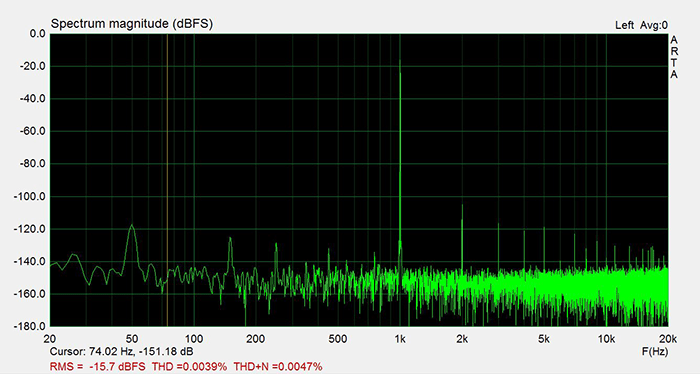
Below I have presented a single measurement of this amplifier in frequency region.
My measurement jig consists of:
1. Xonar U7 MKII sound card
2. Dummy load consisting of four 22 Ohm 100 W resistors (400W in total)
3. Attenuator
Meassurements have been performed with the use of Arta Software.
Input: 418 mV RMS
Output: 9 V RMS
Dummy load resistance: 5.5 Ohm
Power supply: Capacitance Multiplier +/- 22V
Modest tools but quite adequate for the purpose of a DIYer.
Measurements are what they are. You can read into them whatever you want. Feel free to create your own opinion and I will not interfere. I have no interest whatsoever to influence your opinion. I make my money in a fair manner in a quite different profession, and I’m happy with that. However I perform instrumental measurements almost on daily basis and know very well how to understand the results and present them to other people, when necessary, without imposing my opinion. This is a sacred territory for me.
However, when someone presents measurements of such a modest amplifier and comments them fiery for six years, in unnecessary length of 15 pages with almost 300 posts, then the whole matter becomes suspicious – Despite the disclaimers.
On the other hand, there are plenty of diyers who like their amplifiers based on XY board. I understand them because this amplifier sounds great for my taste. However, I find utterly unkind individuals who underestimate this as cheap bad amplifier with saying “Your time, Your money”. But, my opinion is all mine and it belongs to me.
Last edited:

Hoping to get some help from this thread on my XY LM3886 amp. I am trying to solve for what I believe to be a ground loop with a ton of RF, hum and buzz. Moving the speaker cables around changes the noise so it seems like my speaker cables are acting like antennas.
I followed the XY mods in the image below with the exception the 2 ohm resistor from signal return ground. I read someone say this resistor was only if the ground plane was not separated from the signal input.
I also added a Thiele network to the outputs plus 1nf capacitors from the rca GND to chassis.
I created a star ground and have everything attached back to it:
I guess my questions are:
- I am using a chipamp.com PSU where the V- and V+ respective grounds are separated. I tried a ground jumper connecting them with one wire going to the star ground, then a wire from each meeting at the star ground. Neither fixed my issue
- should I move my star ground to the PSU on a ground bridge then add a ground loop breaker?
I have tried an LM3886 almost 5 years ago with the same issues and gave up. I really want to tackle this one.

I followed the XY mods in the image below with the exception the 2 ohm resistor from signal return ground. I read someone say this resistor was only if the ground plane was not separated from the signal input.
I also added a Thiele network to the outputs plus 1nf capacitors from the rca GND to chassis.
I created a star ground and have everything attached back to it:
- Signal gnd, signal return ground
- PSU ground, main board grounds
- output ground
I guess my questions are:
- I am using a chipamp.com PSU where the V- and V+ respective grounds are separated. I tried a ground jumper connecting them with one wire going to the star ground, then a wire from each meeting at the star ground. Neither fixed my issue
- should I move my star ground to the PSU on a ground bridge then add a ground loop breaker?
I have tried an LM3886 almost 5 years ago with the same issues and gave up. I really want to tackle this one.


Thanks Tom.
I could just add a 100n across each filter cap on the amp boards? Just like the picture below?
My biggest problem I am trying to figure out right now is with the sig ground and the main ground. After separating the two by cutting the traces, where do I reconnect those two? I made a star ground and connected:
I had a bad ground loop, so I ran my sig gnd from the RCAs directly into the input on the board, then took wires from the same input on the board back to the sig ground and it seemed to fix most of the noise but I still get some RF and hissing with my ear about 6 inches from each speaker. I’m wondering if I should just jumper the two connections back together another way.
Thanks!
I could just add a 100n across each filter cap on the amp boards? Just like the picture below?
My biggest problem I am trying to figure out right now is with the sig ground and the main ground. After separating the two by cutting the traces, where do I reconnect those two? I made a star ground and connected:
- my input sig ground from the RCAs to the star ground
- my sig input on the board to star ground
- output ground to the star
- psu to the star
- both power gnd on the board to the star
I had a bad ground loop, so I ran my sig gnd from the RCAs directly into the input on the board, then took wires from the same input on the board back to the sig ground and it seemed to fix most of the noise but I still get some RF and hissing with my ear about 6 inches from each speaker. I’m wondering if I should just jumper the two connections back together another way.
Thanks!
Attachments

100 uF isn't enough to begin with. National Semiconductor (now TI) recommends 470 uF || 10 uF || 100 nF in the Application section of the LM3886 data sheet. I took that a bit further in my recommendations as newer and better parts have emerged since the folks at National wrote that data sheet. You can see my recommendations here: https://neurochrome.com/pages/supply-decoupling
I have seen the LM3886 oscillate with 4 Ω load and high-ish output voltage if the decoupling is up to the task.
Tom
I have seen the LM3886 oscillate with 4 Ω load and high-ish output voltage if the decoupling is up to the task.
Tom
Tom, I read your article about decoupling and I understand I need 470uf-1000V C1 and C2 caps, 10uf tantalum, and 4.7uf x7R. I’ll have to get creative mounting these to the bottom.
As for grounding, can you recommend how I should reconnect signal and power ground after cutting the trace to separate them?
I tried running everything to a star ground and I had a ground loop.
As for grounding, can you recommend how I should reconnect signal and power ground after cutting the trace to separate them?
I tried running everything to a star ground and I had a ground loop.
Yep: https://neurochrome.com/pages/groundingAs for grounding, can you recommend how I should reconnect signal and power ground after cutting the trace to separate them?
Star ground is usually the worst option.I tried running everything to a star ground and I had a ground loop.
Tom
Tom, thank you for the help. Here is the update on the amp:
I went with 1000uf, 22uf, and 4.7 x7r for the decoupling. I removed the two input connectors, soldered the 1000uf caps there, and put the 22uf caps IPO the 100uf caps. The 4.7uf x7r caps are soldered in parallel on the bottom.
I also removed the star ground and wired everything to the boards while incorporating a ground loop breaker (following Tom's guide).
Finally this is the quietest the unit has been since experimenting with it. I still notice the speaker cables will pick up a bit of noise if the cables are near AC wires or next to my power conditioner, but that is an easy fix.
Sounds good but I need to increase my gain or remove the volume pot. I added a 100k pot I had on hand but it seemed to lower the input vs running my source directly into it.
Also, I have 10000uf caps in the psu and I might increase these to 22000uf...
I went with 1000uf, 22uf, and 4.7 x7r for the decoupling. I removed the two input connectors, soldered the 1000uf caps there, and put the 22uf caps IPO the 100uf caps. The 4.7uf x7r caps are soldered in parallel on the bottom.
I also removed the star ground and wired everything to the boards while incorporating a ground loop breaker (following Tom's guide).
Finally this is the quietest the unit has been since experimenting with it. I still notice the speaker cables will pick up a bit of noise if the cables are near AC wires or next to my power conditioner, but that is an easy fix.
Sounds good but I need to increase my gain or remove the volume pot. I added a 100k pot I had on hand but it seemed to lower the input vs running my source directly into it.
Also, I have 10000uf caps in the psu and I might increase these to 22000uf...
Attachments


Just completely rearranged my LM3886 and made some changes.
I ended up removing the volume pot to run it as a power amp. I might end up adding a better 10k pot in the future with another input and switch.
Really happy with the results and the modifications. Thanks for the help.
- increased my psu caps to 22000uf
- changed my transformer from 18 VAC secondaries to 22 VAC (Antek as-2222)
- mounted the heatsink to the back of the chassis to create more room inside
- added a soft start and speaker protect relay
I ended up removing the volume pot to run it as a power amp. I might end up adding a better 10k pot in the future with another input and switch.
Really happy with the results and the modifications. Thanks for the help.
Attachments

Warum sollte das Netzteil geregelt sein?Und dieses Netzteil ist nicht geregelt, es ist nur ein normales, ungeregeltes Netzteil …
- Home
- Amplifiers
- Chip Amps
- Bought a XY LM3886 Kit