
what happened to the requirement for linearity.
The gain @ 7.5Apk is excellent @ >10000.
but at 25mA (~bias current) it is ~160.
The gain @ 7.5Apk is excellent @ >10000.
but at 25mA (~bias current) it is ~160.

AndrewT said:what happened to the requirement for linearity.
Very good point! Current gain of NJL3281D output and MJE15030 driver are "nearly" flat.
Attachments


I don't see the reason why mess with Darlingtons, gain curve tells you all. I really do not like to impose but please try my output stage schematic and you'll hear the difference compare to all classical outputs. Besides you won't have any problem with too large output currents of LME49811.🙂
Here is LME49810 (the chip itself) clipping property.
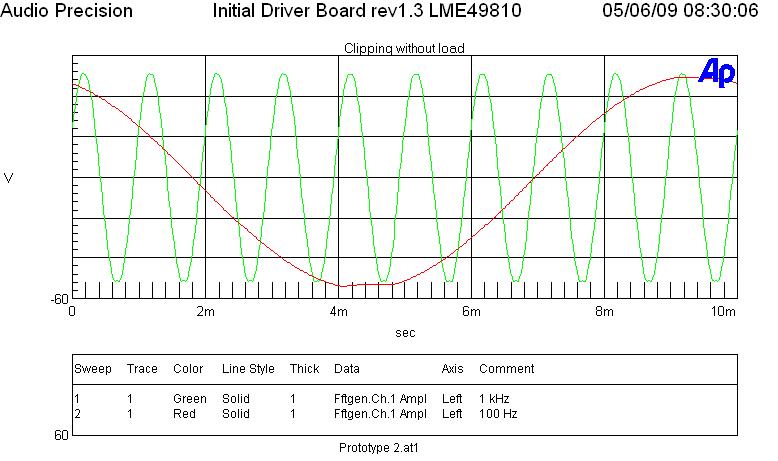
When there is not external load, except 100 k input impedance of the AP S1, the chip has symmetrical clipping.
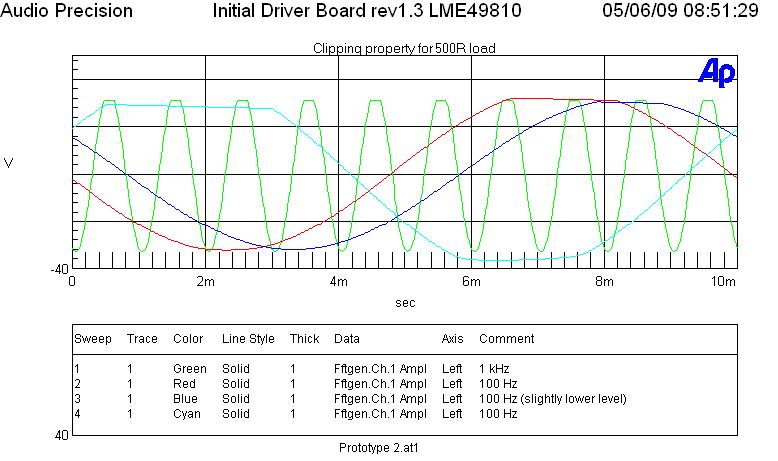
When a 500R resistor is added as load, the positive cycle clips earlier.
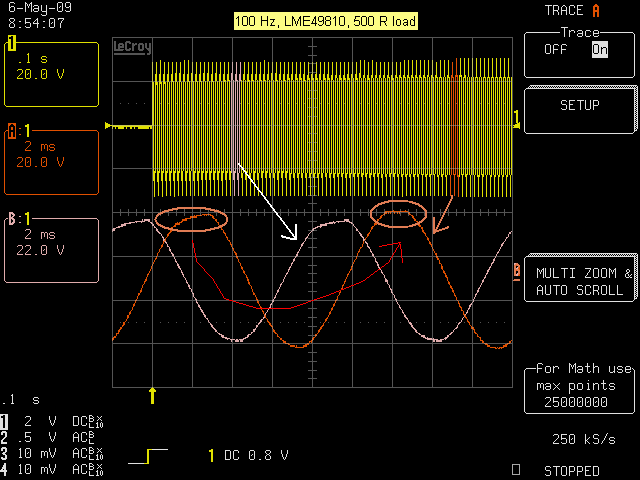
Here you can see how the waveform changes during chipping (slope to flat top).
When there is not external load, except 100 k input impedance of the AP S1, the chip has symmetrical clipping.
When a 500R resistor is added as load, the positive cycle clips earlier.
Here you can see how the waveform changes during chipping (slope to flat top).
Lazy Cat said:I don't see the reason why mess with Darlingtons, gain curve tells you all. I really do not like to impose but please try my output stage schematic and you'll hear the difference compare to all classical outputs. Besides you won't have any problem with too large output currents of LME49811.🙂
Dear Lazy Cat,
The only valid reason I can give you is that the STD03's (darlingtons) sounds exceptional good. Fast, totally holographic and deep.
I am a very spoiled listener, I owned Bryston 7B's Krell KMA200's Mark levinson NO 23.5 before and I am very critical. I build many power amps myself from mosfet to BJT to passlabs design. And the STD03's just blowed me away in combination with the LME49810. This is just a judgement by my ears and not any technical reasons.
With best regards,
Bas
Is it analogous to vacuum tube? They don't have "good curves". But there are good sounding tube amps. Although we can do many measurements to collect technical data, the final judgment is still sonic performance. We are making audio equipment for complex human auditory system.
panson_hk said:Is it analogous to vacuum tube? They don't have "good curves". But there are good sounding tube amps. Although we can do many measurements to collect technical data, the final judgment is still sonic performance. We are making audio equipment for complex human auditory system.
Exactly Panson.
I will admit as first that I was myself often blinded by pre judgements and "ideals"
The STD03 darlingtons's are a good example of that. Trust me I disliked them.. and I could never understood why brands as Musical Fidelity or Arcam used those Sanken darlingtons. Then I got a project where I needed to design a very very compact amplifier that can be as small as class D. So a logical step was a driver chip alla LME49810 and STD03 darlingtons. This way we safe a lot of space. No need for VBE multiplier circuit, no driver transistors. Very compact, mission accomplished. The whole project felt as a huge compromise and I didn't expected to much. Till it was all done and built and we start to listen... And then we got floored by the incredible holographic 3D stage, the speed and the bass tideness. Since then those STD03's became an obsession for me since I get totally hooked to this sound.
My point is, we should really try things out, even though we don't expect anything from it.
That is why I feel it is a good thing you test out all 3 driver chips. With actually built and listen to it, it all become clear. No specsheet or measurement can really tell you which of the three driver IC's wil sound best. Now you are able to actually listen to them. A second nice (listening) test would be, the drive IC with various output devices. From mosfet's to the ON thermal traks' and for sure give the STD03's also a try.
I believe by doing this, actually listen step by step to various parts of a circuit and combine them, this is the way to truly create an amplifier that fits your sound ideal and philosophy of how music reproduction should be. Measurements don't lie, but our ears don't lie either. Measurements can be manipulated or implemented differently. Our ears can cheat us and fool us as well. As often the truth lies somewhere in the middle 😉 😀
With best regards,
Bas

A (may be stupid 😀) question ,
Does, driving SAP15 (or STD03) devices directly with LME49811 cause any problem do you think?
Because as I see in Panson_HK's distortion analysis when you drive lower loads (like 1K) with 49811 then THD levels increases just after 2V RMS output! And we have a 200R bias trimmer between SAPs (or STD) bases...
So I am not sure that 200R trimpot seems a load or not from the LME side????
Does, driving SAP15 (or STD03) devices directly with LME49811 cause any problem do you think?
Because as I see in Panson_HK's distortion analysis when you drive lower loads (like 1K) with 49811 then THD levels increases just after 2V RMS output! And we have a 200R bias trimmer between SAPs (or STD) bases...
So I am not sure that 200R trimpot seems a load or not from the LME side????
Dear Bas,
Interesting comments. Would you be so kind to tell us how you managed the BIAS business in your LME49810/STD03 project?
Thanks in advance,
Michael
Interesting comments. Would you be so kind to tell us how you managed the BIAS business in your LME49810/STD03 project?
Thanks in advance,
Michael
Dxvideo said:A (may be stupid 😀) question ,
Does, driving SAP15 (or STD03) devices directly with LME49811 cause any problem do you think?
Because as I see in Panson_HK's distortion analysis when you drive lower loads (like 1K) with 49811 then THD levels increases just after 2V RMS output! And we have a 200R bias trimmer between SAPs (or STD) bases...
So I am not sure that 200R trimpot seems a load or not from the LME side????
AC (signal) current does not pass the trim pot. The voltage drop across 200R is a DC.
michahn said:Dear Bas,
Interesting comments. Would you be so kind to tell us how you managed the BIAS business in your LME49810/STD03 project?
Thanks in advance,
Michael
Dear Michael,
Sure I will share. See the attachment. Sorry it is so blurry but I can't upload higher resolution. It is just to get the idea. Forget the relays bias switch, this was just an experiment, to be able to switch between two bias levels 😉
For correct bias, set the resistor between biasP and biasN (of the LME49810) at 1Kohm. This way you have a voltage approx. 2340mV over the STD03 diode string, which gives the desired 2,5mA forward current to make the thermal compensation work. (my schematic says 470 ohm but is incorrect).
With the potmeter of 200 ohm meter between the diode string you set your desired idle current bias level. It can be wise to connect a bas16 diode in parallel with the potmeter. This to protect the outputstage in case the potmeter goes open circuit and destroy the outputstage.
Sanken advice 40mA through both Re's. The voltage drop should be for the following Re's:
0,1ohm Re = 4mV across both Re's
0,22ohm Re= 8,8 mV across both Re's
0,33ohm Re= 13,2mV across both Re's
0,5 ohm Re= 20mV across both Re's (not recommended)
Of course you can try higher bias settings and see if the thermal compensation remains reliable.
Above schematic is built, tested and reliable and very good sounding.
With a 400V/A transformer with 27VAC secondaries (gives +/- 38VDC.) I got the following power ratings just below clipping.
70 watt @ 8 ohm and 126 watt @ 4 ohm
With best regards,
Bas
Attachments

Dear,
As follow up on my last post. I still figure out a way to manage the bias with multiple pairs of STD03's with one single potmeter. I don't want to adjust 8 individual potmeters in case of 8 pairs STD03's 😉
With best regards,
Bas
As follow up on my last post. I still figure out a way to manage the bias with multiple pairs of STD03's with one single potmeter. I don't want to adjust 8 individual potmeters in case of 8 pairs STD03's 😉
With best regards,
Bas
So you told Sebastiaan that Darlington output blown you away but either you can be shure that my suggestion is also some kind of unusual for most DIY-ers and my BIGBT output also sound incredible like I said before as an iron fist in a velvet glove.
Lazy Cat said:So you told Sebastiaan that Darlington output blown you away but either you can be shure that my suggestion is also some kind of unusual for most DIY-ers and my BIGBT output also sound incredible like I said before as an iron fist in a velvet glove.
Dear Lazy Cat,
And that is why I am thrilled to built your design as well and find out (if you don't mind? 😀)
With best regards,
Bas
Lazy Cat said:So you told Sebastiaan that Darlington output blown you away but either you can be shure that my suggestion is also some kind of unusual for most DIY-ers and my BIGBT output also sound incredible like I said before as an iron fist in a velvet glove.
Dear Lazy Cat,
I took a second look at your schematics. Are you inspired by Brystons quad complementary topology? 😀
See: http://bryston.com/BrystonSite05/pdfs/28BSST/28B-SST-SCHEMATICS-20081128.pdf
With best regards,
Bas
Partly yes but the problem with Bryston's output stage is unsymmetry between driver's collector and emitter currents and therefore its influence to power transistors on either side. That's also very soundable effect, like some kind weird modulation. At mosfet driver this curents are completely symmetric, equal and free of all artefacts.
Lazy Cat said:Partly yes but the problem with Bryston's output stage is unsymmetry between driver's collector and emitter currents and therefore its influence to power transistors on either side. That's also very soundable effect, like some kind weird modulation. At mosfet driver this curents are completely symmetric, equal and free of all artefacts.
Dear Lazy Cat,
I like your idea of a mostfet driven quad complementary.. I owned Bryston 7BSST mono amplifiers in the past. I can only say that I really liked them, So it will be very likely that I like your design as well.
With best regards,
Bas
Here is an update for my project. LME49810 with MJL21194/93. Traditional VBE multiplier is used for bias generation.
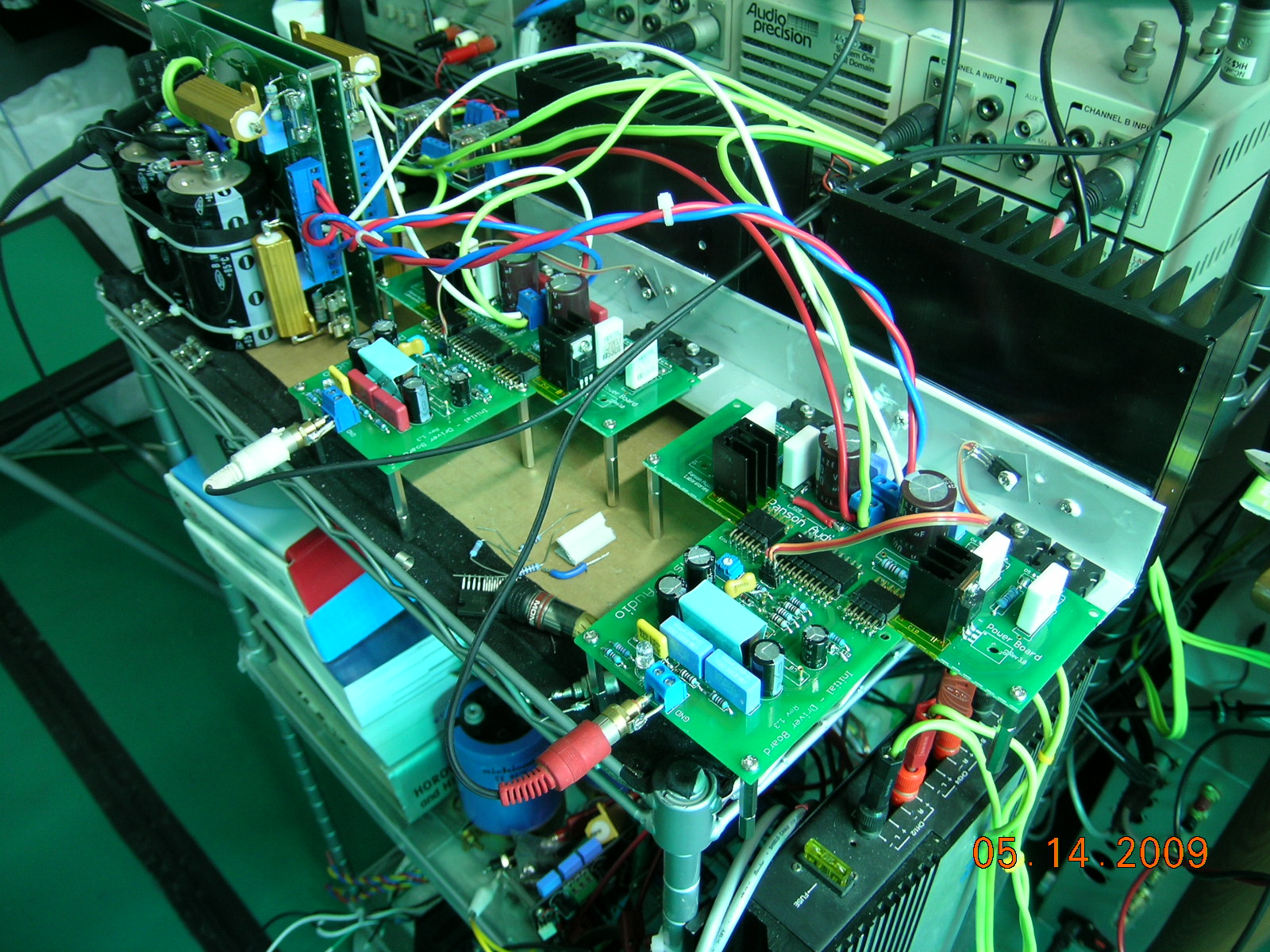
The THD vs output power is basically identical to that of using ThermalTrak. I will try listening test for them.
The THD vs output power is basically identical to that of using ThermalTrak. I will try listening test for them.

- Home
- Amplifiers
- Chip Amps
- Comparing LME49810, 49830 and 49811