
I finally found suitable enclosure and thinking to order one of the kits to introduce myself to world of "simple" gainclones as well as convinient way to test balanced vs single ended outputs of my dac. But which one?
I have Buffalo III dac with discrete Legato output stage and wanted to try shortest signal path possible using integrated (ES9018) volume control to output directly to chipamp.
LM3875 is easiest choice, but it means i'll have to use dac's bal>se stage which consist of opamp followed by a buffer (lme49600) and their neg.feedbacks which doesn't make it as short and straight as balanced outputs to say bridged LM4780 which are also coupling caps free (If common-mode DC is not a problem, can null differential DC). Or maybe i can use paired LM3875 in bridged configuration?
My speakers are 95db and 6 ohm minimum so should be easy load for both?
I'd appreciate opinions/suggestions 🙂
Hi Alexander
You can use Buff dac with output stage from lampizator then to chip amp, I'll do it to connect it directly to my LM3886. This may be a much better output and... no opamp!
http://lampizator.eu/shop/viewcategory.php?groupid=24
Last edited:

Hi Alexander
You can use Buff dac with output stage from lampizator then to chip amp, I'll do it to connect it directly to my LM3886. This may be a much better output and... no opamp!
Lampizator - AMBER TUBE KIT
FWIW, I ran a DAC (1541a) with Lampizator output hardwired to Peter's LM3886 via (lightspeed attenuator) happily for 5 years. First class sound. 2 components you can't do without are Peter's delux kit, and Lampizator output on your favorite DAC. If I recall the Buffalo is a voltage out DAC in which case you get to use the fabulous 6n6p tube. Otherwise if current, 6np2 is the winner.
Terrific sound
Hi Wlowes,
That's the way to go, I agree.
No matter the dac, nos, sabre, (the best as possible), I lampizate it to the LM amp.
And we can forget single ended versus balanced, (in this case....).
I'm glad to know you have the output stage from Lpztr. It means that may be I'm not crazy.
Hi Wlowes,
That's the way to go, I agree.
No matter the dac, nos, sabre, (the best as possible), I lampizate it to the LM amp.
And we can forget single ended versus balanced, (in this case....).
I'm glad to know you have the output stage from Lpztr. It means that may be I'm not crazy.
I finally ordered LM3875 kit to try, just a small question - is it really good idea to use transformer with 22v secondaries or 24v will work just as well? I ask because i already have one, but getting new 22v is no problem too if it's desireable...
Last edited:
Audiosector says:
"The attached graph shows powers output vs supply voltage for different loads. Based on that, for 8 ohm speakers 2 x 22V AC transformer is recommended, and for 4 ohm speakers 2 x 18V AC transformer. In practice, I didn't find any drawbacks with using 2 x 22V AC secondaries with 4 ohms either, so that value can be a good overall choice." - (from Peter Daniels guide)
I forgot tomention - i have 8 (6 min) ohm speakers, so i guess it should work for me at first, but 22V may be more optimal...
"The attached graph shows powers output vs supply voltage for different loads. Based on that, for 8 ohm speakers 2 x 22V AC transformer is recommended, and for 4 ohm speakers 2 x 18V AC transformer. In practice, I didn't find any drawbacks with using 2 x 22V AC secondaries with 4 ohms either, so that value can be a good overall choice." - (from Peter Daniels guide)
I forgot tomention - i have 8 (6 min) ohm speakers, so i guess it should work for me at first, but 22V may be more optimal...
Last edited:
I finally ordered LM3875 kit to try, just a small question - is it really good idea to use transformer with 22v secondaries or 24v will work just as well? I ask because i already have one, but getting new 22v is no problem too if it's desireable...
I used a 24v Plitron driving 8ohm speakers and was very happy with the result. It was my first DIY effort and served me well for many years. See post 1817 for description.

I finally ordered LM3875 kit to try, just a small question - is it really good idea to use transformer with 22v secondaries or 24v will work just as well? I ask because i already have one, but getting new 22v is no problem too if it's desireable...
Peter mentioned to me last year that 24Volts might even potentially work better
with the speaker I would be driving with it.
So you should be fine. Setbacks have prevented me from putting it together and my listening priorities due to apartment situation have switched to primarily headphone listening. I still intend to build it soon and run it temporarily as a headphone amp.
jgwtriode
Popping noise in NOS DAC
I have the original NOS DAC, Spdif input only. I have a switch/selector connected to it and use it with several sources.
This has worked fine for a while, but now I get a popping noise when playing it, regardless of source. The noise follows the signal. No signal, no noise.
It sounds "digital". I think ( but I cannot know for sure ) that the problem started when I connected my ( the kids, really ) new Blue Ray player to the DAC.
Any ideas for a troubleshoot ?
I have the original NOS DAC, Spdif input only. I have a switch/selector connected to it and use it with several sources.
This has worked fine for a while, but now I get a popping noise when playing it, regardless of source. The noise follows the signal. No signal, no noise.
It sounds "digital". I think ( but I cannot know for sure ) that the problem started when I connected my ( the kids, really ) new Blue Ray player to the DAC.
Any ideas for a troubleshoot ?

Sure it's not the DAC but the player that you are using.
I've had a similar noise with Foobar until I changed some settings...
I've had a similar noise with Foobar until I changed some settings...
I would think you were right ( haven't had the timeformuch troubleshooting) , the noise is a lot like the one I have heard when the bitrate settings are wrong.
The thing is that I get the same noise from two sources. Both the Wimp player, on the pc, and the tvdecoder toslink output have the same problem.
The thing is that I get the same noise from two sources. Both the Wimp player, on the pc, and the tvdecoder toslink output have the same problem.
Took another look just now. No matter the source, the noise starts as fast as I power up.
Increases with play, but is present also when not.
So no sources / signal - no noise.
Source plugged in and power on - noise.
Source playing - more noise.
I am tempted to desolder the 1543 chip and test another one. But it will be painful.
Increases with play, but is present also when not.
So no sources / signal - no noise.
Source plugged in and power on - noise.
Source playing - more noise.
I am tempted to desolder the 1543 chip and test another one. But it will be painful.
first Gainclone build - Audiosector Clone board by TheSlowDiyer
Completed build for LM3875 based Gainclone ... using clone board by TheSlowDiyer which is based exactly on the Audiosector board, utilising class A power supply with 120,000uF capacitance with 2x22V 300VA toroid...sounds terrific for circuit this size...with the heatsink I use, it barely even gets worm (after 8hrs of nonstop head banging music - close to 34C in a closed enclosure....completely quiet...no hiss, no buzz, even if I place my ear on the drivers...sharing the build picture in next post...
There are a couple of issues though, I think I see folks asking in this forum, not sure if they are resolved...
1) a slight thump on powerup and powerdown...guess a cap on feedback circuit could help reduce if not eliminate.
2) DC offset.....on powerup, there is no surge, however the DC exists in the range of -0.045V on one channel and -0.057V on the other...this technically does not hamper the listening, "BUT", after powerdown this DC shoots up to ~ -7.5V and then reduces itself in about 5 mins... and there is an amazingly loud thump in Speakers after about 3 mins of powerdown...this is quite noticeable...makeshift arrangement...10uFcaps at the output before powerdown (I had them at hand), this is definitely not the solution....
Apart from this, the only difference I see between my existing Norge 2000 150+150W amp and Gainclone is a bit weak bass, but amazingly better Vocals...I would definitely like to listen to this Amp for sure
Completed build for LM3875 based Gainclone ... using clone board by TheSlowDiyer which is based exactly on the Audiosector board, utilising class A power supply with 120,000uF capacitance with 2x22V 300VA toroid...sounds terrific for circuit this size...with the heatsink I use, it barely even gets worm (after 8hrs of nonstop head banging music - close to 34C in a closed enclosure....completely quiet...no hiss, no buzz, even if I place my ear on the drivers...sharing the build picture in next post...
There are a couple of issues though, I think I see folks asking in this forum, not sure if they are resolved...
1) a slight thump on powerup and powerdown...guess a cap on feedback circuit could help reduce if not eliminate.
2) DC offset.....on powerup, there is no surge, however the DC exists in the range of -0.045V on one channel and -0.057V on the other...this technically does not hamper the listening, "BUT", after powerdown this DC shoots up to ~ -7.5V and then reduces itself in about 5 mins... and there is an amazingly loud thump in Speakers after about 3 mins of powerdown...this is quite noticeable...makeshift arrangement...10uFcaps at the output before powerdown (I had them at hand), this is definitely not the solution....
Apart from this, the only difference I see between my existing Norge 2000 150+150W amp and Gainclone is a bit weak bass, but amazingly better Vocals...I would definitely like to listen to this Amp for sure
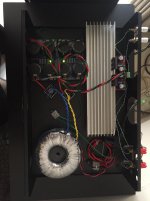
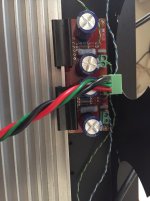
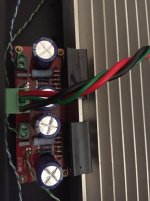
- Status
- Not open for further replies.
- Home
- More Vendors...
- Audio Sector
- AudioSector-chip amp kits, dacs, chassis