

Hello folks.
As many of you know I am working on a killer USB board and one of its features will be LVDS output of the PCM signals.
Well to support that I needed to test that it would actually work at the very high frequencies I was using. Well I am happy to report it absolutely does work, and extremely well!
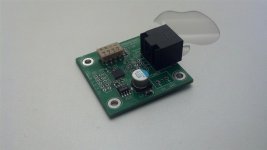
In the process I created a little module that is also useful for many other applications. That module is call "Teleporter" and here is what it does:
You use two(or more) of these modules for a complete application. One at the source and one at the DAC or some other receiving device. They are designed to be panel mounted using 90deg tabs on the PCB. We will probably proved some with the kit.
NOTE: Please install (or short with solder) J1 for normal (type 1) operation where two teleporters are used as transmitter and receiver. Omitting J1 allows for type-2 receiver mode.
See section 3.2.3 here:
http://www.ti.com/lit/an/slla108a/slla108a.pdf
Here is how I have used it so far:
Also if your board has a J2 position - that jumper connects the jack shield to GND. It is recommended to close J2 if you use shielded CAT5/6.
- DSD/PCM output from a modded Denon SACD player to Buffalo III.
- USB audio to Buffalo III. (up to 384khz tested so far with 256fs master clock)
I have tested it carrying a signal up to 100Mhz(master clock) and it worked flawlessly so far. It *should* be able to handle up to 125Mhz, but I have not tested that yet.
We will be making these available very soon. They will be fairly inexpensive but I do not know the price just yet. Brian and I need to work out the costs.
I am listing to an XMOS prototype at the moment with all of the PCM signals including the master clock being fed to the DAC via the interface. 🙂 It sounds awesome. What is more incredible is that I have been using as much at 100ft of CAT5 with absolutely no detectable ill effects.
Now there is an inexpensive and practical solution to moving PCM/I2S/DSD bits around from device to device without SPDIF or having to use expensive HDMI cables (which may not come in the length you need). CAT5 is much easier to work with and make custom lengths.
It also provides isolation in that there is no shared ground wire. You actually could use HDMI cable if you wanted you would just need to build an adapter, but there would be no advantage to doing so.
I routed the CAT5 connector so that the CAT5 twisted pairs are used for each discrete signal. This allows for more ideal noise rejection.
Now I need to beam up some more music. 🙂
Cheers!
Russ
As many of you know I am working on a killer USB board and one of its features will be LVDS output of the PCM signals.
Well to support that I needed to test that it would actually work at the very high frequencies I was using. Well I am happy to report it absolutely does work, and extremely well!
In the process I created a little module that is also useful for many other applications. That module is call "Teleporter" and here is what it does:
- It is a LVDS transceiver. It works in LVDS mode1 and mode 2. The LVDS channels are properly terminated.
- It has both a .1" header and RJ45(for CAT5) connector.
- It has an on-board low noise LT1763 regulator.
- It has 4 independent LVDS transceiver channels that can each be configured as a transmitter or receiver.
- Each channel either has TTL input (in transmit mode) or TTL output (in receive) mode.
You use two(or more) of these modules for a complete application. One at the source and one at the DAC or some other receiving device. They are designed to be panel mounted using 90deg tabs on the PCB. We will probably proved some with the kit.
NOTE: Please install (or short with solder) J1 for normal (type 1) operation where two teleporters are used as transmitter and receiver. Omitting J1 allows for type-2 receiver mode.
See section 3.2.3 here:
http://www.ti.com/lit/an/slla108a/slla108a.pdf
Here is how I have used it so far:
Also if your board has a J2 position - that jumper connects the jack shield to GND. It is recommended to close J2 if you use shielded CAT5/6.
- DSD/PCM output from a modded Denon SACD player to Buffalo III.
- USB audio to Buffalo III. (up to 384khz tested so far with 256fs master clock)
I have tested it carrying a signal up to 100Mhz(master clock) and it worked flawlessly so far. It *should* be able to handle up to 125Mhz, but I have not tested that yet.
We will be making these available very soon. They will be fairly inexpensive but I do not know the price just yet. Brian and I need to work out the costs.
I am listing to an XMOS prototype at the moment with all of the PCM signals including the master clock being fed to the DAC via the interface. 🙂 It sounds awesome. What is more incredible is that I have been using as much at 100ft of CAT5 with absolutely no detectable ill effects.
Now there is an inexpensive and practical solution to moving PCM/I2S/DSD bits around from device to device without SPDIF or having to use expensive HDMI cables (which may not come in the length you need). CAT5 is much easier to work with and make custom lengths.
It also provides isolation in that there is no shared ground wire. You actually could use HDMI cable if you wanted you would just need to build an adapter, but there would be no advantage to doing so.
I routed the CAT5 connector so that the CAT5 twisted pairs are used for each discrete signal. This allows for more ideal noise rejection.
Now I need to beam up some more music. 🙂
Cheers!
Russ
Attachments
Last edited:
Congratulations on your successful tests. This is great news, especially for us Buffalo users needing a better I2S feed, and isolation and better connectivity. Looking forward to the production products. - David

I have been using an Opus with SPDIF input via a Metronome for three
years plus, and really like it. If I put a TPA USB card in the Opus box,
does a direct PCM connection from that to the Metronome provide the
optimum arrangement (assuming the Teleporter is irrelevant there)?
The next question would be: Would connecting the TPA USB in
a separate box via a short USB cable to the computer and long
cables between Teleporters in the TPA USB box and the DAC
box be a better way to go?
Thanks,
Skip
years plus, and really like it. If I put a TPA USB card in the Opus box,
does a direct PCM connection from that to the Metronome provide the
optimum arrangement (assuming the Teleporter is irrelevant there)?
The next question would be: Would connecting the TPA USB in
a separate box via a short USB cable to the computer and long
cables between Teleporters in the TPA USB box and the DAC
box be a better way to go?
Thanks,
Skip
Very nice Russ!,
Now I can get started on taking the DSD signals out of the Denon player I have sitting around for a long while. My main concern was the length of the wire from the player to the DAC.
Other similar implementations seem to use a GMR isolator (NVEs il715). Did you figure there was no need? That would add $20 to each board though...
Now I can get started on taking the DSD signals out of the Denon player I have sitting around for a long while. My main concern was the length of the wire from the player to the DAC.
Other similar implementations seem to use a GMR isolator (NVEs il715). Did you figure there was no need? That would add $20 to each board though...
Very nice Russ!,
Now I can get started on taking the DSD signals out of the Denon player I have sitting around for a long while. My main concern was the length of the wire from the player to the DAC.
Other similar implementations seem to use a GMR isolator (NVEs il715). Did you figure there was no need? That would add $20 to each board though...
Not any need for it at all. As I said, it is already isolated. In fact adding something like that would be more harm than help since there is no GND to complete the circuit between source and the target. It is completely differential signal. Also because it is LVDS it is completely immune to latch-up issues that most isolators can be prone to.
It works wonderfully in the DSD application. I can imagine many more people modding SACD players now.
Pulse skew (which is the major cause of jitter) is about 55ps.
Propagation delay (not actually that critical as it will be the same for all four channels) is about ~3ns.
Channel to channel skew is a mere 60ps.
And of course The bottom line is - it sounds absolutely excellent when used with B3.
Cheers!
Russ
Propagation delay (not actually that critical as it will be the same for all four channels) is about ~3ns.
Channel to channel skew is a mere 60ps.
And of course The bottom line is - it sounds absolutely excellent when used with B3.
Cheers!
Russ
One key fact is that the intent is not simply isolation. Isolation is great but the key is being able to reliable transmit and receive signals up to 250Mbps(125Mhz). The NVE il715 for instance is only a 110Mbps part. That means it is really limited to about 55Mhz signals. Not nearly fast enough for what I want to do. Or rather what I have already done now. 🙂
Congratulations, interesting device🙂, how difficult it's to implement in a CD transport?
Very easy. Just find and wire the PCM/DSD signals and a 5-7.5 power supply. Just make sure the format is correct for the target DAC.
Cut a small square hole and drill a couple holes in the back panel and you have a modded player.
That all sounds VERY nice. Congratulations!
Question ... Jitter performance of the module?
Superb.
I posted some numbers here:
http://www.diyaudio.com/forums/twisted-pear/201106-introducing-bit-teleporter.html#post2793811
Much better than any of the current TTL isolator parts do.
Last edited:

Russ, Brian.......
....... make hundreds so we don't have to check the TPA site ten times a day to grab a couple🙂
....... make hundreds so we don't have to check the TPA site ten times a day to grab a couple🙂

Russ, Brian.......
....... make hundreds so we don't have to check the TPA site ten times a day to grab a couple🙂
I am hand building the prototypes and the first batch. After that, I will be producing them in much larger quantities. This will be a staple kit.
I will be more than happy to take BBB protos (Build By Brian)😎I am hand building the prototypes and the first batch.

Ok dumb question fellas.
I just want to build the Buffalo III to accept USB from my Mac mini. So I take it I need:
1) The Buffalo III + Trident, PS, etc...
2) Analog output stage of choice + PS (IVY, Legato, tube, etc...)
3) The New USB Receiver that Russ is working on
and do I need this 'Teleporter' or even a 'SPDIF module' if I am only going to have ONE input and that is USB?
Thanks,
Anand.
I just want to build the Buffalo III to accept USB from my Mac mini. So I take it I need:
1) The Buffalo III + Trident, PS, etc...
2) Analog output stage of choice + PS (IVY, Legato, tube, etc...)
3) The New USB Receiver that Russ is working on
and do I need this 'Teleporter' or even a 'SPDIF module' if I am only going to have ONE input and that is USB?
Thanks,
Anand.
If you are putting them all in the same box, you do not need a Teleporter.
One can still be used with the USB module's lvds output, in order to gain isolation from the computer, but it is not required.
One can still be used with the USB module's lvds output, in order to gain isolation from the computer, but it is not required.
Very easy. Just find and wire the PCM/DSD signals and a 5-7.5 power supply. Just make sure the format is correct for the target DAC.
Cut a small square hole and drill a couple holes in the back panel and you have a modded player.
So I only need to take the signal & ground from RCA ouput of the CD transport connect to the new module and a 5-7.5 positive power supply & the same at the BIII?
So I only need to take the signal & ground from RCA ouput of the CD transport connect to the new module and a 5-7.5 positive power supply & the same at the BIII?
No, that would be S/PDIF output. This module is for PCM (I2S) and DSD. It would work with S/PDIF, but there is no real need for it.
No, that would be S/PDIF output. This module is for PCM (I2S) and DSD. It would work with S/PDIF, but there is no real need for it.
So I have to take I2S from my CD transport & don't care about cable lenght, wow that's a very good advantatge because previously all I2S connexions was maximum 10 cm or so due that this kind of connexion was intended for use inside the same chassis, I look for my CEC TL1-X schematics to mod & have an I2S output (that was a very good upgrade, always I want to have an I2S connexion but never do it because I need more than 10cm of cable lenght), how many time do you think the modules will be available, thanks Russ & Brian to do this kind orf magic things for the DIY community.🙂
Last edited:
- Home
- More Vendors...
- Twisted Pear
- Introducing the bit "Teleporter"