
Hi,
besides the low distortion/low power vs high distortion/high power, and of course the connect mode is different, what's the sonic difference bewteen these two modes? I tried my KT88, it seems the triode mode is more smooth, how about your amp? Which one is "considered" better?
Thanks for sharing!
besides the low distortion/low power vs high distortion/high power, and of course the connect mode is different, what's the sonic difference bewteen these two modes? I tried my KT88, it seems the triode mode is more smooth, how about your amp? Which one is "considered" better?
Thanks for sharing!


Triode mode, electrically and physically, turns a tetrode or pentode into a triode by connecting the screen to the plate. You regain the plate resistance phenomenon (unique to triodes: pentodes, FETs and BJTs have no similar internal feedback mechanism and as a result have a constant-current output characteristic) by putting the plate's changing electric field immediately outside the grid, as happens by design in any normal triode.
Unfortunately this dramatically reduces perveance, reducing output power. A single 6L6 can produce 8W in pentode, dropping to a measly 1.6W at the same voltage, just for tieing screen to plate!
Distortion goes down a bit, compare 10% THD to only 5%; however, the same drop in gain can be had with local or global NFB, which is linear, and get 1 or 2%, at five times the power output to boot! (The screen grid is a nonlinear input, at least when moving in step with the output.)
Tim
Unfortunately this dramatically reduces perveance, reducing output power. A single 6L6 can produce 8W in pentode, dropping to a measly 1.6W at the same voltage, just for tieing screen to plate!
Distortion goes down a bit, compare 10% THD to only 5%; however, the same drop in gain can be had with local or global NFB, which is linear, and get 1 or 2%, at five times the power output to boot! (The screen grid is a nonlinear input, at least when moving in step with the output.)
Tim

As a generally held belief triode mode is better sounding... recent amps such as the RH84, Gary Pimm's 6AU6/47 PP, & Pete Millet's amp in the latest aXp are challenging that belief.
On the weekend, we converted a Mulligan (SE EL84 triode strapped) into an approximation of an RH84 (using parts on hand). Good enuff that it is going to be updated with proper parts & if long term auditioning verifies initial impresssions the more developed SE EL84 parafeed monoblocs will also be RHed... RH runs in pentode mode... the same feedback trick probably works with ultralinear (ie Peter Wendt)
dave
On the weekend, we converted a Mulligan (SE EL84 triode strapped) into an approximation of an RH84 (using parts on hand). Good enuff that it is going to be updated with proper parts & if long term auditioning verifies initial impresssions the more developed SE EL84 parafeed monoblocs will also be RHed... RH runs in pentode mode... the same feedback trick probably works with ultralinear (ie Peter Wendt)
dave

It's interesting how things go out of fashion, then back in again.
Using the feedback method which Dave was suggesting may impose a more severe load (lower impedance) to the driver - so was often considered a poorer choice than using global feedback from the secondary, as is commonplace now. It is most certainly not new - I just was browsing through the "Has anyone built this amp?" thread, and noticed something (this is apparently a fairly typical circuit for a '40s valve radio)
http://www.wkinsler.com/radios/5tubeamp.html
Notice R8?
Anyway, back to the original question - all of fixed screen (pentode), ultralinear, and triode mode have good and bad charateristics. There is no "best" choice.
Using the feedback method which Dave was suggesting may impose a more severe load (lower impedance) to the driver - so was often considered a poorer choice than using global feedback from the secondary, as is commonplace now. It is most certainly not new - I just was browsing through the "Has anyone built this amp?" thread, and noticed something (this is apparently a fairly typical circuit for a '40s valve radio)
http://www.wkinsler.com/radios/5tubeamp.html
Notice R8?
Anyway, back to the original question - all of fixed screen (pentode), ultralinear, and triode mode have good and bad charateristics. There is no "best" choice.
audiousername said:It is most certainly not new
Certainly isn't... i'm slowly scanning interesting articles out of my 1940s radio-Crafts and see it fairly often... an example attached.
dave
Attachments
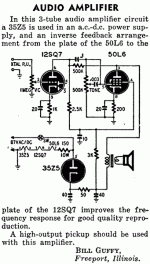

That layout looks hot hot hot, I guess windings for heaters and plate voltages back then were a little relaxedCertainly isn't... i'm slowly scanning interesting articles out of my 1940s radio-Crafts and see it fairly often... an example attached.
dave


Another difference is the coupling of the output tube to the load. In triode mode the speakers' impedance is directly coupled to the triode plate so the triodes gain goes up as the speakers impedance goes up. You get a little more output voltage gain to compensate for loss of efficiency in the speakers. In UL the feedback is tied to the G2 through the tap so the UL tap has dominant control over the output tube minimizing this effect.
I will listen to triode mode when I want to do serious listening and for the parties, when volume is more important than quality to be heard over the din, go UL.
I will listen to triode mode when I want to do serious listening and for the parties, when volume is more important than quality to be heard over the din, go UL.
That has to be one of the most insightful explanations I have heard yet. Never expected it. Thank you.Another difference is the coupling of the output tube to the load. In triode mode the speakers' impedance is directly coupled to the triode plate so the triodes gain goes up as the speakers impedance goes up. You get a little more output voltage gain to compensate for loss of efficiency in the speakers. In UL the feedback is tied to the G2 through the tap so the UL tap has dominant control over the output tube minimizing this effect.
I will listen to triode mode when I want to do serious listening and for the parties, when volume is more important than quality to be heard over the din, go UL.
Another difference is the coupling of the output tube to the load. In triode mode the speakers' impedance is directly coupled to the triode plate so the triodes gain goes up as the speakers impedance goes up. You get a little more output voltage gain to compensate for loss of efficiency in the speakers. In UL the feedback is tied to the G2 through the tap so the UL tap has dominant control over the output tube minimizing this effect.
This is probably what's responsible for most of the triode sound.
Actually, the opposite is true! In triode mode there is little increase in gain if the speaker increases its impedance. UL gives some increase in gain. Pentode mode gives a huge increase in gain. It is the lack of an increase in gain which is the advantage of the triode mode. However, the global NFB often used with pentode or UL mode can negate this advantage so the net effect may simply be that triode mode gives smaller peak output power.roline said:Another difference is the coupling of the output tube to the load. In triode mode the speakers' impedance is directly coupled to the triode plate so the triodes gain goes up as the speakers impedance goes up. You get a little more output voltage gain to compensate for loss of efficiency in the speakers. In UL the feedback is tied to the G2 through the tap so the UL tap has dominant control over the output tube minimizing this effect.
Triode mode is acceptable if you want to avoid global NFB and don't mind a poor damping factor (so presumably either have suitable speakers or prefer one-note bass).

I recently completed a 1625 (12V version of the 807) SE amplifier - running in pentode mode with regulated screens. It even has a 12J7 pentode driver and loop feedback from the secondary. It's sort of an "anti-300B" design with no special tricks, just old fashion RC coupling and cathode biasing. End result? I really like it, especially considering the sub-$600 price point.
I've built SE 2A3, SE 300B, SEUL 6550, and PP 6B4G amplifiers, but the pentode SE design easily runs with these previous designs. It just sounds different in its own way.
I've built SE 2A3, SE 300B, SEUL 6550, and PP 6B4G amplifiers, but the pentode SE design easily runs with these previous designs. It just sounds different in its own way.

besides the low distortion/low power vs high distortion/high power,
Actually, ultra linear mode gives higher power but *lower* distortion than triode mode. That's why its called ultra linear.
This is not quite the same as ordinary distributed loading which works on the same principle but doesn't tap the screens at the right percentage OT primary to get the lowest possible distortion.
Last edited:

- Status
- This old topic is closed. If you want to reopen this topic, contact a moderator using the "Report Post" button.
- Home
- Amplifiers
- Tubes / Valves
- Difference bewteen ultralinear & triode mode?