

Gday.
Anyone here can comment on this one.
There have been various threads here about the 5-20,
so i assume the schematic of that one is well known.
I started to read a article by Claus Byrith, over at Lundahl site,
(5-20 . + the CB 4-30)
Anyone here can comment on this one.
There have been various threads here about the 5-20,
so i assume the schematic of that one is well known.
I started to read a article by Claus Byrith, over at Lundahl site,
Code:
http://www.lundahl.se/pdfs/claus_byrith/amplifier_30wpp.pdfAttachments
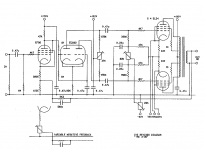

Yes, I enjoyed reading Claus Byrith's article, with his explanations of his redesign of the Mullard circuit. I haven't tried building Claus's circuit but it seems to make sense. I think he could have improved it still further if he'd included a CCS in the tail of the phase splitter but that would have caused additional complication.
In his article, Claus suggests that there are basically two established designs to choose from when building a P-P amplifier, namely, Williamson or Mullard. He recommends avoiding the Williamson style, because its two stages of capacitve coupling carry the risk of instability with global feed back. I can't disagree with his reasoning on that point. Incidentally, the same criticism could be levelled at the H.J. Leak designs, which are basically th same as Mullard's design except that they don't have DC coupling between the first and second stages.
However, there are other design options that Claus didn't mention, including the all-differential three-stage design, in which the first stage is a long-tail pair phase-splitter with CCS in the tail, DC coupled (or coupled through a step network) to the second stage, which is is a differential amplifier. It incorporates aspects of both the Mullard and Williamson designs and is my own personal preference. The DC (or step) coupling between first and second stages is compatible with global feedback and the circuit has the added advantage of good PSRR.
In his article, Claus suggests that there are basically two established designs to choose from when building a P-P amplifier, namely, Williamson or Mullard. He recommends avoiding the Williamson style, because its two stages of capacitve coupling carry the risk of instability with global feed back. I can't disagree with his reasoning on that point. Incidentally, the same criticism could be levelled at the H.J. Leak designs, which are basically th same as Mullard's design except that they don't have DC coupling between the first and second stages.
However, there are other design options that Claus didn't mention, including the all-differential three-stage design, in which the first stage is a long-tail pair phase-splitter with CCS in the tail, DC coupled (or coupled through a step network) to the second stage, which is is a differential amplifier. It incorporates aspects of both the Mullard and Williamson designs and is my own personal preference. The DC (or step) coupling between first and second stages is compatible with global feedback and the circuit has the added advantage of good PSRR.


- Status
- This old topic is closed. If you want to reopen this topic, contact a moderator using the "Report Post" button.