
Not hundred % sure that this one is not already here. A page that link to some very good readings: Miscellaneous Document Archive
Among the links on this page, my favorite of the day, a must read: Beam Power Tubes by O.H. Shade
Among the links on this page, my favorite of the day, a must read: Beam Power Tubes by O.H. Shade

I am a newbie to tubes and have always been interested in these glass thingies that I keep finding but I just put them in my bits box thinking"I must read up about these devices someday".
Only recently did I discover this forum and have built a surround chipamp but tonight I found this thread and more specifically,BHD's link to boozhoundslabs amplifier and some other theory links.
Boozhounds amp is a beutiful piece of craftsmanship and I have just got to make one,so I will be posting here a lot soon with silly questions.
This forum is great.
Only recently did I discover this forum and have built a surround chipamp but tonight I found this thread and more specifically,BHD's link to boozhoundslabs amplifier and some other theory links.
Boozhounds amp is a beutiful piece of craftsmanship and I have just got to make one,so I will be posting here a lot soon with silly questions.
This forum is great.
Hey dudes. I am going to make a tube preamp and also a guitar amp. I need to be unmoderated! Unmoderate me! Unmoderate me now! Will that do it?
replace 12au7 by 12ax7
hi, is that possible to replace a 12au7 by a 12ax7 in tube preamp
what kind of mods must i do to do it?
excuse me if the question has been posted many times
thank you
hi, is that possible to replace a 12au7 by a 12ax7 in tube preamp
what kind of mods must i do to do it?
excuse me if the question has been posted many times
thank you

Re: replace 12au7 by 12ax7
Originally posted by pstcho
"is that possible to replace a 12au7 by a 12ax7 in tube preamp"
I'm not the expert, but if you go to Tube Town and look up their report on preamp tubes, they suggest swapping a 12Au7 with a 12ax7 for more gain (40 vs 100). Also, Steve at Decware makes the same suggestion for one of his amps. Check out the three tubes in your tube manual.
Also aNooby hooked on tubes
Originally posted by pstcho
"is that possible to replace a 12au7 by a 12ax7 in tube preamp"
I'm not the expert, but if you go to Tube Town and look up their report on preamp tubes, they suggest swapping a 12Au7 with a 12ax7 for more gain (40 vs 100). Also, Steve at Decware makes the same suggestion for one of his amps. Check out the three tubes in your tube manual.
Also aNooby hooked on tubes
hi, thank you for your answer
it's the same connection but somebody in another forum told there's too mutch modify to make to have no trouble with noise because of impedance difference
somebody as already done it for a test?
thank you
it's the same connection but somebody in another forum told there's too mutch modify to make to have no trouble with noise because of impedance difference
somebody as already done it for a test?
thank you
New To Tube Testing
Hi, Great site here LOADED with info! My name is Stan & I'm from New York. I have a question on my B & K Dyna-Quik Model 650 & would be beyond grateful if someone could help me. I have a hundred + 6550 International KT-88 tubes and cannot figure out if my B & K has the socket for proper testing. Based on my built in chart that # falls in between two others with completely different sockets,sensitivity #'s & heater#'s. I am new to this end but not new to using tubes. Thanks & great site! Awesome info- I feel like I found a new home! If I need a new tester please let me know the best and most affordable recommendation. 6550stan
Hi, Great site here LOADED with info! My name is Stan & I'm from New York. I have a question on my B & K Dyna-Quik Model 650 & would be beyond grateful if someone could help me. I have a hundred + 6550 International KT-88 tubes and cannot figure out if my B & K has the socket for proper testing. Based on my built in chart that # falls in between two others with completely different sockets,sensitivity #'s & heater#'s. I am new to this end but not new to using tubes. Thanks & great site! Awesome info- I feel like I found a new home! If I need a new tester please let me know the best and most affordable recommendation. 6550stan
circuit safety question (noob question)
After reading this thread, I'm now respectfully cautious approaching my first project, but I also have visions of my first amplifier melting down on the workbench, the victim of cascading component failures. What are the inherent safety factors that go into a tube based amplifier circuit, how do you protect it from itself? Is it the high voltage components? What if they burn up? Is it the distance between components? If 120VAC becomes 400VDC, why not 600V if something breaks, creating a domino effect? What keeps 400V from the cabinet, the on/off switch, or the volume potentiometer ?
Also, I was looking at several inexpensive kits and it seemed clear the power supply plugs were not grounded plugs, they were two prong. I would have expected a grounded plug to be fundamental for safety. Why or why not?
On test equipment, there are references to a "signal generator" - does a Hewlett Packard 200CDR "Wide Range Oscillator" count? The range is 5 - 600,000 Hz, I've used it to test frequency response in speakers. If not this Oscillator, what should I look for, something that can do shaped waves, such as square or saw tooth, as well as sine waves? I also have a surplus HP1220A Oscilloscope and an older HP141B OScope with 1423A Time Base and 1402A Dual Trace Amplifier - will these be worth renovating? Or is this type of equipment 'old school'?
When you test an amplifier for quality of output, how much do you depend on the test equipment compared to listening tests, and how accurate can you get at all gain levels? Do you expect to see
a) low noise (of course),
b) accuracy at the output stage from 20 - 20,000Hz at some gain levels,
c) accuracy at the output stage at all gain levels,
d) a nice sounding amp, almost regardless of what shows on the oscilloscope?
Thanks much -
After reading this thread, I'm now respectfully cautious approaching my first project, but I also have visions of my first amplifier melting down on the workbench, the victim of cascading component failures. What are the inherent safety factors that go into a tube based amplifier circuit, how do you protect it from itself? Is it the high voltage components? What if they burn up? Is it the distance between components? If 120VAC becomes 400VDC, why not 600V if something breaks, creating a domino effect? What keeps 400V from the cabinet, the on/off switch, or the volume potentiometer ?
Also, I was looking at several inexpensive kits and it seemed clear the power supply plugs were not grounded plugs, they were two prong. I would have expected a grounded plug to be fundamental for safety. Why or why not?
On test equipment, there are references to a "signal generator" - does a Hewlett Packard 200CDR "Wide Range Oscillator" count? The range is 5 - 600,000 Hz, I've used it to test frequency response in speakers. If not this Oscillator, what should I look for, something that can do shaped waves, such as square or saw tooth, as well as sine waves? I also have a surplus HP1220A Oscilloscope and an older HP141B OScope with 1423A Time Base and 1402A Dual Trace Amplifier - will these be worth renovating? Or is this type of equipment 'old school'?
When you test an amplifier for quality of output, how much do you depend on the test equipment compared to listening tests, and how accurate can you get at all gain levels? Do you expect to see
a) low noise (of course),
b) accuracy at the output stage from 20 - 20,000Hz at some gain levels,
c) accuracy at the output stage at all gain levels,
d) a nice sounding amp, almost regardless of what shows on the oscilloscope?
Thanks much -

BHD said:This is a great idea for a thread.
This is one of the best beginner sites I've found, it walks you step by step through the design and construction of a simple single ended amp:
http://boozhoundlabs.com/howto/
🙂
WOW this was an awesome read! Thank you for this link!
Zc
😀
All About Circuits has a chapter devoted to tubes that is very well written.
http://www.allaboutcircuits.com/vol_3/chpt_13/index.html
Also, this link really helped me to understand how tubes work. It has cutesy diagrams that helped me to "get it."
http://www.tubedepot.com/whisbipo.html
http://www.allaboutcircuits.com/vol_3/chpt_13/index.html
Also, this link really helped me to understand how tubes work. It has cutesy diagrams that helped me to "get it."
http://www.tubedepot.com/whisbipo.html

Slow learner ...
I have been reading a lot of info and documents about tube amps ... but I still don't fully understand what makes a good tube combination.
In a 2 stage amp, what makes the input/driver stage couple well with the output stage ?
In a 3 stage amp, what is the right combo, and are there rules to follow for stage amplification factor ?
I do understand how each stage is build and calculated, but I found little info that explains stage coupling. Can you please guide me to some specific documentation or maybe explain what the parameters that guide stage coupling ?
I have been reading a lot of info and documents about tube amps ... but I still don't fully understand what makes a good tube combination.
In a 2 stage amp, what makes the input/driver stage couple well with the output stage ?
In a 3 stage amp, what is the right combo, and are there rules to follow for stage amplification factor ?
I do understand how each stage is build and calculated, but I found little info that explains stage coupling. Can you please guide me to some specific documentation or maybe explain what the parameters that guide stage coupling ?

Re: New To Tube Testing
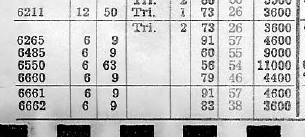
B&K 650 settings; (picture) (Tube/Heater/Socket/Section/Test-Pos/Good-Bad/True GM/Std.GM)
Do you not know; It's illegal to have hundred+ KT88/6550 in one house...
I would like to buy a few 😉
Arne K
6550stan said:Hi, Great site here LOADED with info! My name is Stan & I'm from New York. I have a question on my B & K Dyna-Quik Model 650 & would be beyond grateful if someone could help me. I have a hundred + 6550 International KT-88 tubes and cannot figure out if my B & K has the socket for proper testing. Based on my built in chart that # falls in between two others with completely different sockets,sensitivity #'s & heater#'s. I am new to this end but not new to using tubes. Thanks & great site! Awesome info- I feel like I found a new home! If I need a new tester please let me know the best and most affordable recommendation. 6550stan
B&K 650 settings; (picture) (Tube/Heater/Socket/Section/Test-Pos/Good-Bad/True GM/Std.GM)
Do you not know; It's illegal to have hundred+ KT88/6550 in one house...
I would like to buy a few 😉
Arne K
Attachments
there's a lot of good info here. sorry if it's been mentioned. lots of book downloads.
http://www.pmillett.com/technical_books_online.htm
http://www.pmillett.com/technical_books_online.htm
noisenyc said:check this lads. the radiotron online!
http://geek.scorpiorising.ca/RDH4.html
this mirror seems to be the fastest:
http://www.oldradioz.com/manuals/rdh4/
Hi.
Yes, RDH4 is a must to read for tube & related electrical/electroncis theories. Without sound therories one can't go very far in tubing/electronics building.
c-J
thanks
this thread is a godsend was getting frustrated trying to find a place to start with tubes
this thread is a godsend was getting frustrated trying to find a place to start with tubes

Basic question from clueless newbie
In a bi-amped system with one valve amp and one solid state (of roughly equal power) to choose from, would it be preferable to use the tube amp for high frequencies and the solid state for the low end, or vice versa? (crossover freq: 300Hz).
Thanks - I hope this isn't a controversial point, and that there is one, simple answer 🙂
In a bi-amped system with one valve amp and one solid state (of roughly equal power) to choose from, would it be preferable to use the tube amp for high frequencies and the solid state for the low end, or vice versa? (crossover freq: 300Hz).
Thanks - I hope this isn't a controversial point, and that there is one, simple answer 🙂
- Home
- Amplifiers
- Tubes / Valves
- On Line Tube Learning for newbies....