
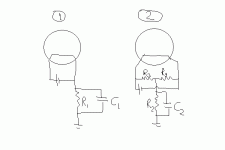
I'd use diagram 2. ALL the passive parts get shared between the 2 tubes. With a shared filament supply and shared passive parts, the 2 tubes have to be TIGHTLY matched. IMO, separate floating filament supplies is BETTER.
BTW, install a DPDT switch in the filament supply lines to reverse the DC polarity on the filaments. Change the DC polarity on the filaments 1X each week. The tubes will have longer service lives, since you're compensating for the voltage gradient effect DC heating introduces.
BTW, install a DPDT switch in the filament supply lines to reverse the DC polarity on the filaments. Change the DC polarity on the filaments 1X each week. The tubes will have longer service lives, since you're compensating for the voltage gradient effect DC heating introduces.
Thank you so much for your reply...
> IMO, separate floating filament supplies is BETTER.
Do you think separate floating filament supplies for indirectly heated valves are also better than a shared one ?
> BTW, install a DPDT switch in the filament supply lines to
> reverse the DC polarity on the filaments. Change the DC
> polarity on the filaments 1X each week. The tubes will have
> longer service lives, since you're compensating for the voltage
> gradient effect DC heating introduces.
I have never heard that before. Is it a big improvement in service life ? or just a little ?
MB
> IMO, separate floating filament supplies is BETTER.
Do you think separate floating filament supplies for indirectly heated valves are also better than a shared one ?
> BTW, install a DPDT switch in the filament supply lines to
> reverse the DC polarity on the filaments. Change the DC
> polarity on the filaments 1X each week. The tubes will have
> longer service lives, since you're compensating for the voltage
> gradient effect DC heating introduces.
I have never heard that before. Is it a big improvement in service life ? or just a little ?
MB
>>I have never heard that before. Is it a big improvement in service life ? or just a little ?<<
I can't say. Periodic flip/flopping the DC polarity on DHTs like the 2A3 and 300B is an attempt to pull even with AC heating in terms of emission longevity. The popular DHTs were designed for AC heating, which doesn't have a static potential gradient. My understanding is that the potential gradient DC heating introduces has an adverse effect on filament life, especially in terms of emission. Periodic flip/flopped DC heating rates to be "best" for filament life, since it deals with the potential gradient effect and eliminates the expansion and contraction of the Tungsten at 2X the line frequency/second.
>>Do you think separate floating filament supplies for indirectly heated valves are also better than a shared one ?<<
IMO, separate floating heater supplies for IDH tubes are indicated only when a "totem pole" topology is being used. In that case, action to prevent exceeding heater to cathode potential limits has to be taken.
I can't say. Periodic flip/flopping the DC polarity on DHTs like the 2A3 and 300B is an attempt to pull even with AC heating in terms of emission longevity. The popular DHTs were designed for AC heating, which doesn't have a static potential gradient. My understanding is that the potential gradient DC heating introduces has an adverse effect on filament life, especially in terms of emission. Periodic flip/flopped DC heating rates to be "best" for filament life, since it deals with the potential gradient effect and eliminates the expansion and contraction of the Tungsten at 2X the line frequency/second.
>>Do you think separate floating filament supplies for indirectly heated valves are also better than a shared one ?<<
IMO, separate floating heater supplies for IDH tubes are indicated only when a "totem pole" topology is being used. In that case, action to prevent exceeding heater to cathode potential limits has to be taken.

Hi,
While it won't hurt anything, I feel it's not necessary as 9/10 the getter will die before the cathode will.
When you deal with thoriated tungsten heaters then we're most likely talking Eimac territory anyway...Which I suppose is where this information comes from, no?
The risk with DC heaters is the formation of notching, something AC will prevent from happening by its very nature.
For as long as I've been dealing with tubes sticky heaters present not even .5% of all failures.
As said, it won't hurt...
Cheers,😉
Periodic flip/flopped DC heating rates to be "best" for filament life, since it deals with the potential gradient effect and eliminates the expansion and contraction of the Tungsten at 2X the line frequency/second.
While it won't hurt anything, I feel it's not necessary as 9/10 the getter will die before the cathode will.
When you deal with thoriated tungsten heaters then we're most likely talking Eimac territory anyway...Which I suppose is where this information comes from, no?
The risk with DC heaters is the formation of notching, something AC will prevent from happening by its very nature.
For as long as I've been dealing with tubes sticky heaters present not even .5% of all failures.
As said, it won't hurt...
Cheers,😉

I would tend towards diagram A, because it has a capacitor totally bypassing the cathode resistor, whereas B has some degeneration due to the 2x47ohm. Whether it makes a difference in practice... 
Also it is easy to have the A supply in a mirror image for the two tubes, so that you can simply swap the tubes over to reverse the polarity. You should check the archives, there was a thread about it somewhere... Here it is: http://www.diyaudio.com/forums/showthread.php?s=&threadid=12173&highlight=
Keep in mind that with two tubes sharing the same cathode resistor and cap you will need to calculate the bias settings.
And also its clearly not a floating filament supply, its connected to ground via a resistor! 😀
Also it is easy to have the A supply in a mirror image for the two tubes, so that you can simply swap the tubes over to reverse the polarity. You should check the archives, there was a thread about it somewhere... Here it is: http://www.diyaudio.com/forums/showthread.php?s=&threadid=12173&highlight=
Keep in mind that with two tubes sharing the same cathode resistor and cap you will need to calculate the bias settings.
And also its clearly not a floating filament supply, its connected to ground via a resistor! 😀
Hi,
I doubt it.
The advantage is, to my mind at least, an unproven one.
On the minus side you'll need twice the amount of components compared to solution #2.
If you're using something in the price range of the BGs that may as well tip the balance.
If the 2*47 Ohm is a pot it'll at least allow for some modicus of balancing out imperfect triodes...Keep in mind that matched pairs in reality never are, dynamically speaking.
Cheers,😉
has some degeneration due to the 2x47ohm. Whether it makes a difference in practice...
I doubt it.
Also it is easy to have the A supply in a mirror image for the two tubes, so that you can simply swap the tubes over to reverse the polarity.
The advantage is, to my mind at least, an unproven one.
On the minus side you'll need twice the amount of components compared to solution #2.
If you're using something in the price range of the BGs that may as well tip the balance.
If the 2*47 Ohm is a pot it'll at least allow for some modicus of balancing out imperfect triodes...Keep in mind that matched pairs in reality never are, dynamically speaking.
Cheers,😉
Hi,
First of all, thank you all...
Since any DC supply I mention is regulated, we may think like we have two different supplies at least in theory. In practice, I can build two seperate supplies or use seperate regulators for each channel, that is not a problem.
I think the best way is to use DC supplies with fixed-bias DHT valve. Then we have nothing like cathode resistor/capacitor. However, I do not want to mess with the bias supply and various protection circuits for it.
Moreover, I already have two different sets of cathode resistor/capacitor. I never have the idea of sharing those components.
Having looked at some books, I do not see any clear reason to ground the center of heater powered with DC supply. I think the best way is to use shared supply/shared components or seperate supply/seperate components. I do not know the practical implications of using all shared, but there must be a reason for all mono designs. I think I will build and check both.
Using a pot to balance matched pairs is a good idea, but it seems a bit impractical to me.
MB
First of all, thank you all...
Since any DC supply I mention is regulated, we may think like we have two different supplies at least in theory. In practice, I can build two seperate supplies or use seperate regulators for each channel, that is not a problem.
I think the best way is to use DC supplies with fixed-bias DHT valve. Then we have nothing like cathode resistor/capacitor. However, I do not want to mess with the bias supply and various protection circuits for it.
Moreover, I already have two different sets of cathode resistor/capacitor. I never have the idea of sharing those components.
Having looked at some books, I do not see any clear reason to ground the center of heater powered with DC supply. I think the best way is to use shared supply/shared components or seperate supply/seperate components. I do not know the practical implications of using all shared, but there must be a reason for all mono designs. I think I will build and check both.
Using a pot to balance matched pairs is a good idea, but it seems a bit impractical to me.
MB
- Status
- Not open for further replies.
- Home
- Amplifiers
- Tubes / Valves
- filament source connection to DHT