
Hi,
how do I determine what the bias voltage of the input tube is in this amp?
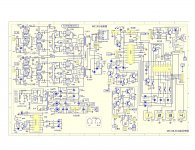
Do I simply measure the voltage between grid and cathode?
The reason I'm wondering is that I have a Pure ipod dock connected to it and it outputs a 2v signal at full volume on the dock (my cd player outputs at 2v as well). When I have the dock turned up fully (as I have been doing to match the cd player so I don't have a huge difference when switching sources) the sound through the amp has harsher high frequencies than when it is turned much lower.
The input sensitivity of the amp is .25v. I understand that if the positive peaks of the input signal exceed the bias voltage of the tube, they will be distorted...is this what's going on? Btw, I don't think it's a problem with the dock as the sound quality of both the cd player and the dock are indistinguishable to my ears when the dock is at max output (2v).
how do I determine what the bias voltage of the input tube is in this amp?
Do I simply measure the voltage between grid and cathode?
The reason I'm wondering is that I have a Pure ipod dock connected to it and it outputs a 2v signal at full volume on the dock (my cd player outputs at 2v as well). When I have the dock turned up fully (as I have been doing to match the cd player so I don't have a huge difference when switching sources) the sound through the amp has harsher high frequencies than when it is turned much lower.
The input sensitivity of the amp is .25v. I understand that if the positive peaks of the input signal exceed the bias voltage of the tube, they will be distorted...is this what's going on? Btw, I don't think it's a problem with the dock as the sound quality of both the cd player and the dock are indistinguishable to my ears when the dock is at max output (2v).

Well, the circuit diagram says -56v at the input point (just to the left of the two top output tubes (EL34s).
Since the cathode resistor is only 10 ohms/ 5W to ground, and just for laughs assigning a plate current of 40 mA for each tube, gives us about a .4 volt drop on the cathode resistor.
Further, the -56volts bias is stepped down a bit through the 50K pot(s), so it could wander anywhere from -56 to a voltage divided between the RP101 (50k ohm) and the R113 (33k ohm).
33/50 x 56 = 37 volts,
so the range of bias possible seems 37 - 56 volts.
A look at a datasheet for an EL34, combined with the High Voltage estimated to be produced by the powersupply, will give both an idea of the expected quiescent current and the ideal bias point.
The power supply is marked as A.C. 320 v winding, so that times .9 = 290 volts D.C. applied through the transformer to the plates.
Looks like there's a switch between Ultralinear and Triode modes, which at under 300 volts seems reasonable.
The datasheet for an EL34 can be found here:
http://www.datasheetarchive.com/EL34-datasheet.html#datasheets
Here's a typical loadline chart:
From this it looks like about -28 volts is ok for a 4k load and 300v supply...
Here's a higher power/voltage version:
Since the cathode resistor is only 10 ohms/ 5W to ground, and just for laughs assigning a plate current of 40 mA for each tube, gives us about a .4 volt drop on the cathode resistor.
Further, the -56volts bias is stepped down a bit through the 50K pot(s), so it could wander anywhere from -56 to a voltage divided between the RP101 (50k ohm) and the R113 (33k ohm).
33/50 x 56 = 37 volts,
so the range of bias possible seems 37 - 56 volts.
A look at a datasheet for an EL34, combined with the High Voltage estimated to be produced by the powersupply, will give both an idea of the expected quiescent current and the ideal bias point.
The power supply is marked as A.C. 320 v winding, so that times .9 = 290 volts D.C. applied through the transformer to the plates.
Looks like there's a switch between Ultralinear and Triode modes, which at under 300 volts seems reasonable.
The datasheet for an EL34 can be found here:
http://www.datasheetarchive.com/EL34-datasheet.html#datasheets
An externally hosted image should be here but it was not working when we last tested it.

Here's a typical loadline chart:
An externally hosted image should be here but it was not working when we last tested it.

From this it looks like about -28 volts is ok for a 4k load and 300v supply...
Here's a higher power/voltage version:
An externally hosted image should be here but it was not working when we last tested it.

Last edited:
The OP's question was about input bias, not output bias.
Doh!
The input section looks like an SSRP stack,
so the top tube is self-biasing, determined by its cathode resistor and the quiescent current.
The voltage across either R104 (1k5) or even R109 (33k) should allow a quick calculation of the current through the stack.
From the stack current and the cathode resistor, you can calculate the bias-voltage.
Since you are playing with high voltages, and to measure you must turn on the unit,
USE THE ONE-HAND IN POCKET RULE,
and be very careful with your probe!
Make sure your feet are on a rubber mat,
and your body can't touch any grounded metal on the bench.
This looks like a job for someone experienced in HV measurement,
as it is dangerous.
The range of current can be estimated by simply looking at the tube data for a 6J1, and/or a few schematics or projects which use this tube!
In any case, the bias can be closely predicted to a small range of values, without taking any risks.
But from your symptoms,
if you can get loudness from a different input without distortion,
then the input impedance could simply be overloading the output of your music source.
Why not try a buffer-preamp?
Its unlikely to be a fault of the amp,
but rather an impedance mismatch.
Last edited:

The input section looks like an SSRP stack,
so the top tube is self-biasing, determined by its cathode resistor and the quiescent current.
The voltage across either R104 (1k5) or even R109 (33k) should allow a quick calculation of the current through the stack.
From the stack current and the cathode resistor, you can calculate the bias-voltage.
Isnt is just easier to measure the voltage between pin 1-2 of the input tube (V102)?
Another thing is that if you overload the input stage you have probably already overloaded the output stage as well. It is (or should be) common practice to design an amplifier with some headroom before the last stage.
Last edited:
Yes, you can determine the bias for the input valve by measuring from cathode to ground. Where is your volume control? Bias is not the only issue, as you can get clipping at the anode too or at the output. You can't put a 2V signal into a 0.25V input.
Dang, I was afraid of that...since my (new!) cd player outputs @ 2v is there a simple remedy...or am I about to go shopping for a different player?
Is this Yaqin schematic?
Yes, this is the schematic for the ms-20l...it's not entirely correct though.
Doh!
The input section looks like an SSRP stack,
so the top tube is self-biasing, determined by its cathode resistor and the quiescent current.
The voltage across either R104 (1k5) or even R109 (33k) should allow a quick calculation of the current through the stack.
From the stack current and the cathode resistor, you can calculate the bias-voltage.
Since you are playing with high voltages, and to measure you must turn on the unit,
USE THE ONE-HAND IN POCKET RULE,
and be very careful with your probe!
Make sure your feet are on a rubber mat,
and your body can't touch any grounded metal on the bench.
This looks like a job for someone experienced in HV measurement,
as it is dangerous.
The range of current can be estimated by simply looking at the tube data for a 6J1, and/or a few schematics or projects which use this tube!
In any case, the bias can be closely predicted to a small range of values, without taking any risks.
But from your symptoms,
if you can get loudness from a different input without distortion,
then the input impedance could simply be overloading the output of your music source.
Why not try a buffer-preamp?
Its unlikely to be a fault of the amp,
but rather an impedance mismatch.
I don't think it's just the ipod dock, the cd player (2v output) gives the same sound as the dock...except when the dock's signal is attenuated, then it sound marvelous!
Isnt is just easier to measure the voltage between pin 1-2 of the input tube (V102)?
Another thing is that if you overload the input stage you have probably already overloaded the output stage as well. It is (or should be) common practice to design an amplifier with some headroom before the last stage.
Yes, I'm definitely out of my abilities attempting to assess the circuit...I just don't want to have to look for a different cd player...
Really curious if I am actually exceeding the bias volatge with a 2v signal.
It is unlikely that a power amp is going to have its main clipping point at the input, except if a fault is present. We still haven't heard where the volume control is.
Just seen your latest post. Do you have a volume control? You can't just put a 2V signal into a 0.25V input on a power amp. At the least you need a 'passive preamp' i.e. a volume pot in a box.
Just seen your latest post. Do you have a volume control? You can't just put a 2V signal into a 0.25V input on a power amp. At the least you need a 'passive preamp' i.e. a volume pot in a box.
Last edited:
It is unlikely that a power amp is going to have its main clipping point at the input, except if a fault is present. We still haven't heard where the volume control is.
Just seen your latest post. Do you have a volume control? You can't just put a 2V signal into a 0.25V input on a power amp. At the least you need a 'passive preamp' i.e. a volume pot in a box.
Right, sorry about that. There is a volume control on the amp...doh! Overlooked that.
That means the problem must lie elsewhere, doesn't it?
Why can't the Chinese draw a circuit in a way which shows how it works, instead of hiding how it works?
Assuming the volume pot is normal, apart from motor drive, then DC on the input may be the problem as BZed says. Omitting input coupling caps in an amp is OK for DIY if you know that the source will have them, but poor engineering in a commercial item.
Assuming the volume pot is normal, apart from motor drive, then DC on the input may be the problem as BZed says. Omitting input coupling caps in an amp is OK for DIY if you know that the source will have them, but poor engineering in a commercial item.
I wasn't sure about whether or not Yaqin had included blocking caps at the input...the schematic has a few errors. I did pull the bottom off the amp and there are no blocking caps, however I can measure no dc offset in the output of either source.
Curiously, the input tube's bias voltage is 1.9v though that's become a red herring I guess.
Curiously, the input tube's bias voltage is 1.9v though that's become a red herring I guess.
- Status
- This old topic is closed. If you want to reopen this topic, contact a moderator using the "Report Post" button.
- Home
- Amplifiers
- Tubes / Valves
- Exceeding bias voltage?