
Hello, I am very new to this site. I hope this is in the correct place.
Recently i built a AKGc60 tube microphone, but all it does is hum, i've been trying to locate the problem but no luck, if i replace the capsule with a capacitor it still hums. The only time it doesn't hum as much is when i remove the resistor running from the plate to the cathode.
Recently i built a AKGc60 tube microphone, but all it does is hum, i've been trying to locate the problem but no luck, if i replace the capsule with a capacitor it still hums. The only time it doesn't hum as much is when i remove the resistor running from the plate to the cathode.

You definitely need to ask some tech to look at your microphone. It may be hard though to convince some tech to try to help you after you found there a resistor running from plate to cathode.
If you look at the schematic of the AKG c60, its supposed to be there.
Also, i have been a tech for 10 years speciality being tubes, and this mic is just fighting me the whole way.
Attachments
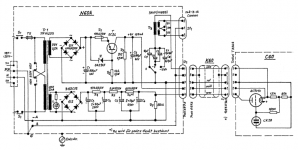
If you look at the schematic of the AKG c60, its supposed to be there.
Also, i have been a tech for 10 years speciality being tubes, and this mic is just fighting me the whole way.
Which resistor are you referring to? I don't see any resistor going straight from the anode to the cathode.
If you mean the bleeder R7 in the N60A unit which goes from anode to ground, then you may have to check whether all your supply electrolytic capacitors are OK.
Last edited:
Which resistor are you referring to? I don't see any resistor going straight from the anode to the cathode.
If you mean the bleeder R7 in the N60A unit which goes from anode to ground, then you may have to check whether all your supply electrolytic capacitors are OK.
I think he's talking about the 180 Meg. grid resistor from grid to bottom of the 1.5K cathode bias resistor. (180 Meg is pretty large for a grid resistor isn't it?)

These things are very fussy regarding layout and construction. They make noise if the layout is wrong. They make noise if you use the wrong type of PCB material. They make noise if the lead dress is slightly wrong. They make noise if you don't clean every trace of flux of the board, or if you use the wrong type of chemical to clean the board. They even make noise if you use the wrong type of PCB standoff. We don't even touch them when they come in the shop, just send them off to a guy who's been fixing them for 30 odd years...

If you look at the schematic of the AKG c60, its supposed to be there.
Also, i have been a tech for 10 years speciality being tubes, and this mic is just fighting me the whole way.
You might try taking this to the prodigy pro DIY forum. There are a number of mic experts over there.
I see no resistor from plate to cathode. Which resistor are you referring to?
The circuit is a bootstrapped cathode follower that has an input impedance much higher than the 180M resistor would suggest.
I assume since you are familiar with tube circuits that you have already checked the voltages and everything is normal. You also have no way of measuring the grid voltage with common equipment, so one remaining possibility is that your tube is a little gassy and won't work in a mic circuit.
Also you say you built the mic. Are you using an AC701k tube or something else?
Maybe try connecting a low impedance generator as input just to see if signal gets through. If everything seems OK then I would try a new tube.
Last edited:

Yes i was refering to the 180M ohm resistor, if i remove it the sound gets better, less hum but a little bassy.
The supplies are fine, brand new caps, check 100 times on my cap checker, etc.
The power supply is fine too.
The problem just seems to be coming from the MIC body.
I am using a 5703 tube.
The supplies are fine, brand new caps, check 100 times on my cap checker, etc.
The power supply is fine too.
The problem just seems to be coming from the MIC body.
I am using a 5703 tube.
The problem just seems to be coming from the MIC body.
How do you know, if it is completely shielded?
If it is not shielded, it must widely hum by definition.
How about a circuit diagram of exactly what you have built. And photographs. You said you have been a tub techie for 10 years - does that mean 10 years experience in designing, building and debugging sensitive circuits, or 10 years at swapping tubes in commercial equipment?
"Recently i built a AKGc60 tube microphone, but all it does is hum"
So it does more than hum; you do get sound? The first statement was a little misleading...
Could be shielding, could be heater supply, could be... I agree schematics and photos are needed if you want good help here. For example, how is the mic cable shield terminated wrt the mic body and how is the body shielded; i.e. is it a continuous enclosure to the capsule grille etc? How clean is the heater supply? How is the return handled e.g. is it a star ground so all AC currents cancel out?
The C60 is a bit interesting in that the transformer is located in the power supply box. You have a single ended signal coming all the way back the mic cable to the power supply box. This makes the grounding and AC return layout super critical.
Yes i was refering to the 180M ohm resistor, if i remove it the sound gets better, less hum but a little bassy.
The supplies are fine, brand new caps, check 100 times on my cap checker, etc.
The power supply is fine too.
The problem just seems to be coming from the MIC body.
I am using a 5703 tube.
So it does more than hum; you do get sound? The first statement was a little misleading...
Could be shielding, could be heater supply, could be... I agree schematics and photos are needed if you want good help here. For example, how is the mic cable shield terminated wrt the mic body and how is the body shielded; i.e. is it a continuous enclosure to the capsule grille etc? How clean is the heater supply? How is the return handled e.g. is it a star ground so all AC currents cancel out?
The C60 is a bit interesting in that the transformer is located in the power supply box. You have a single ended signal coming all the way back the mic cable to the power supply box. This makes the grounding and AC return layout super critical.
AKG C-60 hum
Btown 2009: I read the entire thread here with interest.
I own a number of tube condenser mics. AKG built a version (branded by Philips for sale in the US) in the 1960's of a C-60 using a 7586 nuvistor. The 7586 specs are superior to the 5703. The self impedance of a 5703 is 50 meg ohms, which means this is the unloaded input impedance to this tube. On the other hand, the 7586 (6DS4) nuvistor has a input impedance above 500 meg ohms with lower noise. Using the nuvistor means the mic capsule is loaded at very high impedance (180 meg ohms in parallel with 500 meg ohms or higher impedance) rather than 50 meg ohm in parallel with 180 meg ohm for a 5703. Correct loading of the mic capsule improves linear frequency response at the low end. Since the heater voltage of the 5703 and the 7586 nuvistor are the same, you should be able to take a nuvistor socket insert and build a suitable adaptor to replace the 5703.
I have used the 7586 to replace a AC701, which is expensive and hard to get. Minor power supply modification is necessary, the nuvistor socket insert mod can be wired in place of the AC701 with the nuvistor base (pins) pointed toward the input to the grid. (The shell of the 7586 must be grounded but this can also be done neatly.)
The following assumes you have the AKG power supply or an equivalent wired exactly like the AKG power supply.
If your power supply is a dual voltage model (110 v US, 220 v European), make sure the primary voltage selector switch is set to the correct value before plugging in the supply!
The electrolytic caps in the power supply MUST be good, test by substitution with a known good one. If any section is bad, you will get hum or excessive noise. Same deal with the rectifiers. Replace if leaky or bad. Check for cold or poor solder connections, especially grounded components.
The series pass current regulation transistor in the DC heater supply should not fail, nor should the zener reference diode. (A bad series pass transistor may show no filament voltage (open transistor or zener diode) or excessive filament voltage immediately at turn on (shorted transistor or zener diode).
Note that ALL voltage tests must be made using a good quality voltmeter, with the mic connected so the power supply is loaded properly. The heater voltage must not never exceed 4.0 volts at any time for a AC701 and 6.3 volts for a 7586 nuvistor (or 5703). If the heater supply voltage is excessive, especially at turn on, turn off power immediately to avoid damage and troubleshoot the regulator components. Since the heater supply is current regulated, the cold (low) heater resistance makes the power supply increase the tube heater voltage slowly by limiting the inrush current. (This is great for long tube life since the heater is brought up to operating voltage slowly by the regulator). Wait at least 5 minutes before setting or measuring voltages to insure the tube heater voltage has stabilized.
The setting of the filament voltage is important. There is a wire wound adjustable resistor in the power supply dropping the input voltage to the pass transistor. After confirming all components are good, connect a good DC voltmeter across the heater supply output and look for 3.6 volts for a AC701 or 5.7 volts for a 7586 (or 5703). If correction is necessary, turn power off, mark the initial position of the sliding tap carefully, and then move the tap incrementally (1 mm increment) and remeasure; repeat until the correct voltage is obtained. (Running the heater at full rated voltage is not necessary since the tube operates in a very low current anode follower mode, and the lower heater voltage improves "shot" noise or hiss...)
Another hum source is the bass rolloff circuit. The audio is returned from the mic unbalanced, and the bass roll off switch and its associated components are located in the power supply. If the switch is leaky or noisy, you will get hum. The wiring placement of the bass cut circuit and associated components is critical. The AKG C-60 supply also has a impedance matching transformer in the power supply. Make certain this transformer is mounted securely and any ground connections are secure. If you built the power supply, check the orientation of this transformer for minimum hum/noise.
In addition to the above, I connect mics under test mics to a preamp and monitor so I can simultaneously test and listen for problems or improvement.
Last but not least, BE CAREFUL working on the power supply. Approximately 205 volts is found off the HT bridge rectifier, and approximately 140 volts is the DC output of the supply under load. The capacitors hold a hazardous charge for several minutes after the supply is turned off. Carelessness resulting in short circuits will damage components in the power supply and/or mic.
Good luck...
Btown 2009: I read the entire thread here with interest.
I own a number of tube condenser mics. AKG built a version (branded by Philips for sale in the US) in the 1960's of a C-60 using a 7586 nuvistor. The 7586 specs are superior to the 5703. The self impedance of a 5703 is 50 meg ohms, which means this is the unloaded input impedance to this tube. On the other hand, the 7586 (6DS4) nuvistor has a input impedance above 500 meg ohms with lower noise. Using the nuvistor means the mic capsule is loaded at very high impedance (180 meg ohms in parallel with 500 meg ohms or higher impedance) rather than 50 meg ohm in parallel with 180 meg ohm for a 5703. Correct loading of the mic capsule improves linear frequency response at the low end. Since the heater voltage of the 5703 and the 7586 nuvistor are the same, you should be able to take a nuvistor socket insert and build a suitable adaptor to replace the 5703.
I have used the 7586 to replace a AC701, which is expensive and hard to get. Minor power supply modification is necessary, the nuvistor socket insert mod can be wired in place of the AC701 with the nuvistor base (pins) pointed toward the input to the grid. (The shell of the 7586 must be grounded but this can also be done neatly.)
The following assumes you have the AKG power supply or an equivalent wired exactly like the AKG power supply.
If your power supply is a dual voltage model (110 v US, 220 v European), make sure the primary voltage selector switch is set to the correct value before plugging in the supply!
The electrolytic caps in the power supply MUST be good, test by substitution with a known good one. If any section is bad, you will get hum or excessive noise. Same deal with the rectifiers. Replace if leaky or bad. Check for cold or poor solder connections, especially grounded components.
The series pass current regulation transistor in the DC heater supply should not fail, nor should the zener reference diode. (A bad series pass transistor may show no filament voltage (open transistor or zener diode) or excessive filament voltage immediately at turn on (shorted transistor or zener diode).
Note that ALL voltage tests must be made using a good quality voltmeter, with the mic connected so the power supply is loaded properly. The heater voltage must not never exceed 4.0 volts at any time for a AC701 and 6.3 volts for a 7586 nuvistor (or 5703). If the heater supply voltage is excessive, especially at turn on, turn off power immediately to avoid damage and troubleshoot the regulator components. Since the heater supply is current regulated, the cold (low) heater resistance makes the power supply increase the tube heater voltage slowly by limiting the inrush current. (This is great for long tube life since the heater is brought up to operating voltage slowly by the regulator). Wait at least 5 minutes before setting or measuring voltages to insure the tube heater voltage has stabilized.
The setting of the filament voltage is important. There is a wire wound adjustable resistor in the power supply dropping the input voltage to the pass transistor. After confirming all components are good, connect a good DC voltmeter across the heater supply output and look for 3.6 volts for a AC701 or 5.7 volts for a 7586 (or 5703). If correction is necessary, turn power off, mark the initial position of the sliding tap carefully, and then move the tap incrementally (1 mm increment) and remeasure; repeat until the correct voltage is obtained. (Running the heater at full rated voltage is not necessary since the tube operates in a very low current anode follower mode, and the lower heater voltage improves "shot" noise or hiss...)
Another hum source is the bass rolloff circuit. The audio is returned from the mic unbalanced, and the bass roll off switch and its associated components are located in the power supply. If the switch is leaky or noisy, you will get hum. The wiring placement of the bass cut circuit and associated components is critical. The AKG C-60 supply also has a impedance matching transformer in the power supply. Make certain this transformer is mounted securely and any ground connections are secure. If you built the power supply, check the orientation of this transformer for minimum hum/noise.
In addition to the above, I connect mics under test mics to a preamp and monitor so I can simultaneously test and listen for problems or improvement.
Last but not least, BE CAREFUL working on the power supply. Approximately 205 volts is found off the HT bridge rectifier, and approximately 140 volts is the DC output of the supply under load. The capacitors hold a hazardous charge for several minutes after the supply is turned off. Carelessness resulting in short circuits will damage components in the power supply and/or mic.
Good luck...
Btown2009: Here is a follow up to my earlier post concerning the C-60. Years ago, a early Neumann AC-701 mic supply contained "stabilytes" on the DC heater circuit. The "stabilytes" were Ni-Cad batteries that wouldn't hold a charge. For a AC701 heater supply, three of these were connected in series at the DC output to the mic. I just fixed a NSM power supply by putting three size AA Ni-Cads in place of the dead stabilytes. Since the AC ripple component is very low, you can use 3 Ni-Cads (in series) for a AC701 (3.6 vdc) supply, or 4 Ni-Cads (in series) for a 7586 or 5703 supply. I put 4 size AA ni-cads in series in a 7586 nuvistor DC heater supply, and the hum went down 12 db more.
Check the filament (and HT) supplies with a scope for excessive AC ripple; then test electrolytic capacitors by substitution. Replace leaky or bad capacitors in the HT and heater circuits before adding the Ni-Cads to the LV heater supply...you will have a real problem if the NiCads overheat due to excessive AC across them.
Check the filament (and HT) supplies with a scope for excessive AC ripple; then test electrolytic capacitors by substitution. Replace leaky or bad capacitors in the HT and heater circuits before adding the Ni-Cads to the LV heater supply...you will have a real problem if the NiCads overheat due to excessive AC across them.
- Status
- This old topic is closed. If you want to reopen this topic, contact a moderator using the "Report Post" button.
- Home
- Amplifiers
- Tubes / Valves
- Tube condenser microphone help!