

I was reading, found John Broskie's Constant Current Draw line amp article. That got me thinking that one can easily enforce constant current with CCS's. So, can I submit the following for criticism?
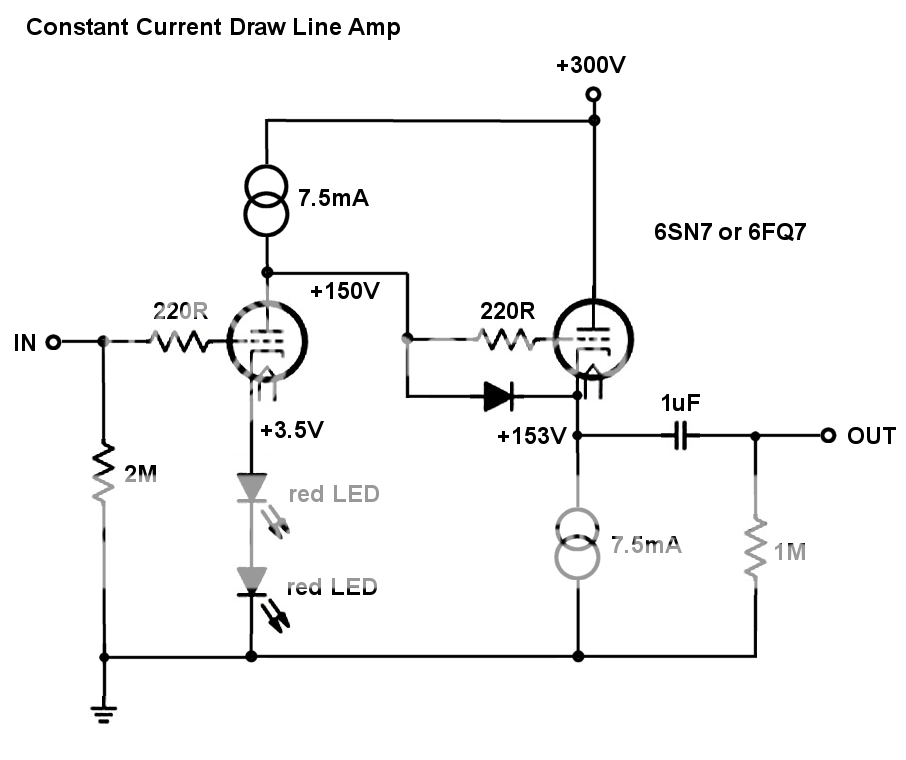
Has anyone built this?
Comments?
Thanks!
--
Has anyone built this?
Comments?
Thanks!
--

Member
Joined 2009
Paid Member
yes, you have created a Constant current amp at least as effectively as Broskie. The CCS loads allow lower voltage rails than with resistors and being high impedance loads the tubes will be operating in a more linear fashion. Not everyone likes CCS's as it introduces an active element into the load but that's for you to decide.
I agree with DF96 about the limitation. Ideally you want the external load to be as linear as possible. In such a case, if you know what that load is, you can adjust the CCS on one or the other tube to achieve constant current still. If the external load is not perfectly linear it should still be a small enough load that you can achieve good current balance. I believe it's bad practice to operate the cathode follower with a heavy load if you want good sound.
I agree with DF96 about the limitation. Ideally you want the external load to be as linear as possible. In such a case, if you know what that load is, you can adjust the CCS on one or the other tube to achieve constant current still. If the external load is not perfectly linear it should still be a small enough load that you can achieve good current balance. I believe it's bad practice to operate the cathode follower with a heavy load if you want good sound.
I sense an opportunity to learn something here...
In my proposed application, the load would be a 1 meter interconnect, nothing special, going to a push-pull tube power amp's input, which would be the 270k ohm grid resistor for a 6N6P triode section.
Can you tell me what you mean by "a heavy load"? Do you mean the low input impedance of a solid state amp, or possibly a volume control pot/stepped attenuator?
What constitutes a "small load"?
Thanks...
--
DF96 said:It is constant current until you attach a load.
Bigun said:I agree with DF96 about the limitation. Ideally you want the external load to be as linear as possible. In such a case, if you know what that load is, you can adjust the CCS on one or the other tube to achieve constant current still. If the external load is not perfectly linear it should still be a small enough load that you can achieve good current balance...
In my proposed application, the load would be a 1 meter interconnect, nothing special, going to a push-pull tube power amp's input, which would be the 270k ohm grid resistor for a 6N6P triode section.
Bigun said:I believe it's bad practice to operate the cathode follower with a heavy load if you want good sound.
Can you tell me what you mean by "a heavy load"? Do you mean the low input impedance of a solid state amp, or possibly a volume control pot/stepped attenuator?
What constitutes a "small load"?
Thanks...
--
Member
Joined 2009
Paid Member
I can't quantify the impact of load on the sound of a cathode follower as I haven't done the experiments myself.
From an engineering perspective, I would suggest you want the current flow through the load to be <10% of the standing current flow through the cathode follower.
You caught my attention when you mentioned a 1 metre interconnect. This cable is a transmission line, it has capacitance and inductance. Most likely the capacitance is the main worry. It could cause a roll-off at high frequencies as the combination of the interconnect capacitor and load resistor form a classic low pass filter. You should google that and calculate the roll-off frequency.
From an engineering perspective, I would suggest you want the current flow through the load to be <10% of the standing current flow through the cathode follower.
You caught my attention when you mentioned a 1 metre interconnect. This cable is a transmission line, it has capacitance and inductance. Most likely the capacitance is the main worry. It could cause a roll-off at high frequencies as the combination of the interconnect capacitor and load resistor form a classic low pass filter. You should google that and calculate the roll-off frequency.
A question which must always be asked is whether a line stage is needed at all. 1m of interconnect is hardly a difficult load - you could drive it with a 50k volume pot. If you thought that your power amp might have a non-linear input impedance then a simple cathode follower would do. Do you actually need gain?
The low pass filter is created by the line stage output resistance with the cable capacitance, not the load resistance. In almost all cases of short interconnects the effect can be ignored.Bigun said:You caught my attention when you mentioned a 1 metre interconnect. This cable is a transmission line, it has capacitance and inductance. Most likely the capacitance is the main worry. It could cause a roll-off at high frequencies as the combination of the interconnect capacitor and load resistor form a classic low pass filter. You should google that and calculate the roll-off frequency.
Last edited:
Member
Joined 2009
Paid Member
The low pass filter is created by the line stage output resistance with the cable capacitance, not the load resistance. In almost all cases of short interconnects the effect can be ignored.
Agreed.
...Do you actually need gain?
Yes, in my particular case. I was experimenting and wound up making a 2-stage, DC-coupled, push-pull 2A3 amp that I like quite a bit. However, it takes 3.5V peak to get to full power, so just a bit more than the 2V rms from a CD player. I only really need a voltage gain of about 4X, but I know I'm not going to get that from a small triode. So I'll live with a voltage gain of about 15X. That's about what I've got going now, and it works.
BTW, I'm currently using a 6N6P triode section as a simple common cathode stage with unbypassed cathode resistor and 15k plate resistor, so I figure I'm getting about 12X voltage gain. I should measure it, I know.
Maybe I don't need a cathode follower at all.
--
OK. Personally, I wouldn't worry too much about constant current operation. Just ensure the supply is properly decoupled.
- Status
- Not open for further replies.
- Home
- Amplifiers
- Tubes / Valves
- CCS's for CCD line amp?