

Such a circuit for a line pre-amplifier I have never seen before.
There are two negative feedback loops from the output:
1) One of the input of the last stage (470 K)
2) One to the cathode of the 6067 - first stage (100K+220K parallel in series with 2uF capacitor)
It looks a bit like a NDFL
The following questions arise for me to the attached schematic diagram (drawing and measure errors are not to rule out):
1) What is the aim of two volume controls (one on front site and one at the rear panel) ?
2) What is the name of the circuit topology behind the second volume control (last two stages with 12BH7 - at fist look a SRPP, but it isn't)?
3) The second volume control is inside of the globale NFB loop. Which consequenses are to expect in case of the different attenuator positions there?
4) The couple capacitor in front of the second volume control is a Sprague ceramic disc with a diameter of approximately 1 inch. What could be the advantage?
about
http://www.hifido.co.jp/KW/G0103/J/0-50/C05-25468-61439-00/
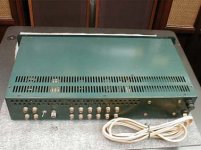
you will find some pics about this preamp.
There are two negative feedback loops from the output:
1) One of the input of the last stage (470 K)
2) One to the cathode of the 6067 - first stage (100K+220K parallel in series with 2uF capacitor)
It looks a bit like a NDFL
The following questions arise for me to the attached schematic diagram (drawing and measure errors are not to rule out):
1) What is the aim of two volume controls (one on front site and one at the rear panel) ?
2) What is the name of the circuit topology behind the second volume control (last two stages with 12BH7 - at fist look a SRPP, but it isn't)?
3) The second volume control is inside of the globale NFB loop. Which consequenses are to expect in case of the different attenuator positions there?
4) The couple capacitor in front of the second volume control is a Sprague ceramic disc with a diameter of approximately 1 inch. What could be the advantage?
about
http://www.hifido.co.jp/KW/G0103/J/0-50/C05-25468-61439-00/
you will find some pics about this preamp.
Attachments
Last edited:

There aren't actually two negative feedback loops in this design, the 470K resistor is part of the bias network for the 12BH7A, it is arguably partially bootstrapped by this connection..
The output stage is a white cathode follower..
The volume pot on the rear varies the available open loop gain that can be applied to the feedback loop, allowing one to vary the feedback margin. Presumably this would allow one to tailor the harmonic content of the output signal. Note that as designed it is quite possible to set it in such a fashion that either massive distortion or no sound at all will result. (As you approach the low end of the pot setting.)
The ceramic coupling cap is a fashion statement, and a highly non-linear one at that.
This seems like a fairly questionable design, the best I can say is that it is clearly intended to "interpret" the program material rather than reproduce it accurately...
The output stage is a white cathode follower..
The volume pot on the rear varies the available open loop gain that can be applied to the feedback loop, allowing one to vary the feedback margin. Presumably this would allow one to tailor the harmonic content of the output signal. Note that as designed it is quite possible to set it in such a fashion that either massive distortion or no sound at all will result. (As you approach the low end of the pot setting.)
The ceramic coupling cap is a fashion statement, and a highly non-linear one at that.
This seems like a fairly questionable design, the best I can say is that it is clearly intended to "interpret" the program material rather than reproduce it accurately...
Such a circuit for a line pre-amplifier I have never seen before.
There are two negative feedback loops from the output:
1) One of the input of the last stage (470 K)
2) One to the cathode of the 6067 - first stage (100K+220K parallel in series with 2uF capacitor)
It looks a bit like a NDFL
The following questions arise for me to the attached schematic diagram (drawing and measure errors are not to rule out):
1) What is the aim of two volume controls (one on front site and one at the rear panel) ?
2) What is the name of the circuit topology behind the second volume control (last two stages with 12BH7 - at fist look a SRPP, but it isn't)?
3) The second volume control is inside of the globale NFB loop. Which consequenses are to expect in case of the different attenuator positions there?kist
4) The couple capacitor in front of the second volume control is a Sprague ceramic disc with a diameter of approximately 1 inch. What could be the advantage?
about
???????? McIntosh/JBL/audio-technica/Jeff Rowland/Accuphase/?/?¾?????
you will find some pics about this preamp.
A strange circuit. It has the standard mistake which everyone seems to make: volume pot slider goes straight to grid, so pot gets noisy and valve has no bias when pot fails. Putting a volume pot inside a feedback loop means that it is an effects box, not a serious preamp.
The RIAA preamp section is running the ECC83 rather too near the region of grid current at below 1V bias, so distortion is quite likely at the HF end where the cartridge impedance rises. The 3K cathode resistor will inject thermal noise. The 22K anode resistor seems rather too small for an ECC83. Is that really a 1G resistor in the RIAA feedback network?
I enjoy pulling a commercial circuit to pieces. Does that mean I am a nasty person? If you were teaching valve audio you could set this as an exercise for students: one mark for every circuit mistake they find.
The RIAA preamp section is running the ECC83 rather too near the region of grid current at below 1V bias, so distortion is quite likely at the HF end where the cartridge impedance rises. The 3K cathode resistor will inject thermal noise. The 22K anode resistor seems rather too small for an ECC83. Is that really a 1G resistor in the RIAA feedback network?
I enjoy pulling a commercial circuit to pieces. Does that mean I am a nasty person? If you were teaching valve audio you could set this as an exercise for students: one mark for every circuit mistake they find.
<snip>
I enjoy pulling a commercial circuit to pieces. Does that mean I am a nasty person? If you were teaching valve audio you could set this as an exercise for students: one mark for every circuit mistake they find.
This one provides so much fodder, an abject lesson in questionable audio design. We all make mistakes, just usually not so many in one place.. (I have more than a few I'd like to keep buried.. 😱 ) Nasty? Nah, maybe more of a hard bitten realist.. IMHO.. 😀
Or barring shear incompetence maybe it's simply that one designer's mistake is another's deliberate choice..
Last edited:
Thank you very much for this explantations - at my own view is this the main reason, why I don't get schematic diagrams from the most manufacturers.
I will remove the obviously design errors.
The 1 G-Ohm resistor in the RIAA network isn't a misprint; the colors are brown-black-blue and the measured value is also 1 G-Ohm (exactly 1,06 G-Ohm).
I will remove the obviously design errors.
The 1 G-Ohm resistor in the RIAA network isn't a misprint; the colors are brown-black-blue and the measured value is also 1 G-Ohm (exactly 1,06 G-Ohm).
We all make mistakes. When I worked as a computer programmer I insisted that everyone's work was inspected by two or three of their peers in a code review. As well as picking up mistakes it also helped us learn from each other. Maybe the audio industry should do this, although having incompetent people inspect each other's work does not achieve very much.
PS a 1G resistor could mean that the RIAA response will depend on the weather, as atmospheric moisture is bound to affect its value unless it is sealed in a box (but even then there will be leakage paths around the outside of the box). A truly daft design!
PS a 1G resistor could mean that the RIAA response will depend on the weather, as atmospheric moisture is bound to affect its value unless it is sealed in a box (but even then there will be leakage paths around the outside of the box). A truly daft design!
Last edited:
We all make mistakes. When I worked as a computer programmer I insisted that everyone's work was inspected by two or three of their peers in a code review. As well as picking up mistakes it also helped us learn from each other. Maybe the audio industry should do this, although having incompetent people inspect each other's work does not achieve very much.
PS a 1G resistor could mean that the RIAA response will depend on the weather, as atmospheric moisture is bound to affect its value unless it is sealed in a box (but even then there will be leakage paths around the outside of the box). A truly daft design!
By my version of phono preamp I will realize an opposite approach: very low impedance RIAA network for caps in the aera between 10uF until 20uF for lowest possible microfonic effects.
Unfortunately this RIAA head amp will looks like as a big power amp device therefore. Cause many effects I will respect the performing will take several time mainly through the analyzing of the pro and cons of the various RIAA equalizing topologies. Do you know, what are the best threads about this topic here on diyaudio?
Last edited:
Thank you very much for this explantations - at my own view is this the main reason, why I don't get schematic diagrams from the most manufacturers.
I will remove the obviously design errors.
The 1 G-Ohm resistor in the RIAA network isn't a misprint; the colors are brown-black-blue and the measured value is also 1 G-Ohm (exactly 1,06 G-Ohm).
Brown-Black-Blue is actually 10M not 1G, anything over 30M is going to be fairly uncommon. 1G resistors are extremely rare in the field although they do exist..
Yes, thanks for that advice. In the attachement you will find all the corrections, that I have found in the schematic by troubleshooting on the device. I have marked the changes with a black triangle.Brown-Black-Blue is actually 10M not 1G, anything over 30M is going to be fairly uncommon. 1G resistors are extremely rare in the field although they do exist..
Who knows the values of the Mallory multi-capacitor for filtering the heater voltage?
Attachments
Last edited:
Even at 10M that feedback resistor could still be wrong. It ought to be something in the region of 1.5M, to give the 20dB RIAA LF shelf with the 150K. With infinite open-loop gain it would be 1.377M, but two '83 triodes don't quite give infinite gain - maybe a few hundred or even a thousand - so the resistor has to be bigger. If 10M is indeed the correct value, then the RIAA LF response will change as the valves age as there is virtually no feedback at the LF end. If 10M is too big, as I suspect, then this preamp might be fine for 'one-note-bass' when listening to reggae as the response will carry on rising past 50Hz (going downwards) instead of levelling off. You would also need a perfect turntable with perfect warp-free records. My guess is that the 'designer' is one of those who 'designs' by ear instead of using a calculator.
I've no doubt you're right based on what I have looked at already.. 
Fortunately it's new owner can fix most of these issues. Hopefully he got a good deal on its purchase.
Fortunately it's new owner can fix most of these issues. Hopefully he got a good deal on its purchase.
Yes, I hope so. A quick search reveals that it originally retailed at $2999! One day I may stop being amazed at the high prices being charged for poor circuits. Or should I join in? No, I don't know how to design circuits that bad.
Maybee the feedback loop should be connected to the 6067 anode or to the top of the second (backside) volume control.
Better the latter, as the voltage rating is only 200V on that 2u feedback capacitor.
The White Cathode Follower is already feedbacked & low impedance by design and needs not to be in the feedback loop.
If done like that, the second volume control makes sense in setting the output voltage level to the power amp used.
Are you sure Mr tiefbassuebertr, that it is connected to the WCF output?
Are not these multisection capacitors, used in the power supply, badly known for leakage currents through the electrolytic between the sections and passing on high frequency ripple??
Ceramic disk capacitors in the RIAA network....😱....etc
So, sorry to say (and I feel sorry for the customers), this schematic diagram design looks like made by a very unexperienced designer, with more confidence than knowledge.
JohanB
Better the latter, as the voltage rating is only 200V on that 2u feedback capacitor.
The White Cathode Follower is already feedbacked & low impedance by design and needs not to be in the feedback loop.
If done like that, the second volume control makes sense in setting the output voltage level to the power amp used.
Are you sure Mr tiefbassuebertr, that it is connected to the WCF output?
Are not these multisection capacitors, used in the power supply, badly known for leakage currents through the electrolytic between the sections and passing on high frequency ripple??
Ceramic disk capacitors in the RIAA network....😱....etc
So, sorry to say (and I feel sorry for the customers), this schematic diagram design looks like made by a very unexperienced designer, with more confidence than knowledge.
JohanB
The White Cathode Follower is already feedbacked & low impedance by design and needs not to be in the feedback loop.
If done like that, the second volume control makes sense in setting the output voltage level to the power amp used.
Are you sure Mr tiefbassuebertr, that it is connected to the WCF output?
Are not these multisection capacitors, used in the power supply, badly known for leakage currents through the electrolytic between the sections and passing on high frequency ripple??
Ceramic disk capacitors in the RIAA network....😱....etc
JohanB
Yes, the NFB is connected to the WCF output as shown in the schematic. In the meantime only the WCF works as line preamplifier, and the first stage now is death include removed 6067 (best sound in this mode, sensitivity of follow power amp alrerady 100mV).
The multisection capacitors for the high voltage are in good condition (Mallory offered mostly high quality and long-life products). I don't know for this one in the heater circuit because the value of capacity is unknown (no sticker on it). Ceramic disc capacities (both RIAA and line part) I have replace through KP versions.
I am also of the opinion that the circuit design and the choice of certainly devices was not really the yellow of the egg. Until this day I haven't understand, why line preamplifier must have more voltage gain than unity gain (a general problem also by most of currently available preamps in my view).
But there are also some positive details to find:
- two identical PCBs with an intermediate metal shield plate
- no tube sockets on the PCB and therefore no thermal stress (screwed tube sockets on the chassis)
- component site = solder site, therefore no disass'y of the PCB's necessary by troubleshooting and replacing the devices
- partly DALE resistors in use (the other kind of resistors I don't know)
- excellent workmanship
If it was vice versa (circuit design almost perfect but unfriendly service) it would be more difficult for me.
Attachments


Last edited:
Hi tiefbassuebertr,
Good you see the advantage of this as a chassie with power supply. It's a great item for new design and if you see it like that, I'm happy.
I'm only sorry for the total unscrupulous circuit design and the bad reputation this kind of engineering is for serious Hi-End producers.
I honor you for bringing this matter up to the surface, by your time consuming "reverse engeneering".
These unveils put a shadow over all products from the mentioned manufacturer and should make people suspicious to all manufacturers that don't want/dare/can produce a schematic diagram of ther products. Refuse to buy them!!.
There are many more ego-tripped impostors out there, longing for your hard earned bucks!!
About sensitivity of power amplifiers and gain in preamps, there was a kind of standard before, but it seems gone and forgot by now.
The "standard" was: line level in/out consumer @ -10dBV = 245mV
Line level in/out proffessional @ 0bDV = 760mV
Input power amp consumer +3dBV = 1V
Input power amp professional 0 - +6dBV = 0,76 to 1,5V
So the gain in a "standard" preamp should be arond 4-5 times (12-15dB)
But now when proffessional and consumer levels are mixed out of standard, a zero gain White Cathode Follower is in many cases a good solution for a preamp.
The WCF's in you amp is almost right done, except:
The 47K grid resistor in the lower tube should be 470KOhm.
The output signal should be taken out from the upper tubes cathode, not the lower tubes anode.
A resistor of a few hundred Ohms should be in series with the output capacitor, to isolate the WCF feedback loop from capacitive loads.
A 100-470uF 10V capacitor over the lower tubes cathode resistor will make the WCF work better.
The 0,47uF output capacitor seems to small if you're load impedance is lower than 30-40KOhm...Use the 2uF Sprague "Black Beuty" (I think I see on the photo) instead. 200V will be enough from that point.
The phono stage I don't comment, as it's in need for a complete redesign.
I agree everything DF96 (who seems to be a very competent engineer) comments on this design, and I know it's sensitive to complain on other peoples "work".
But in this case it must be done!!
JohanB
Good you see the advantage of this as a chassie with power supply. It's a great item for new design and if you see it like that, I'm happy.
I'm only sorry for the total unscrupulous circuit design and the bad reputation this kind of engineering is for serious Hi-End producers.
I honor you for bringing this matter up to the surface, by your time consuming "reverse engeneering".
These unveils put a shadow over all products from the mentioned manufacturer and should make people suspicious to all manufacturers that don't want/dare/can produce a schematic diagram of ther products. Refuse to buy them!!.
There are many more ego-tripped impostors out there, longing for your hard earned bucks!!
About sensitivity of power amplifiers and gain in preamps, there was a kind of standard before, but it seems gone and forgot by now.
The "standard" was: line level in/out consumer @ -10dBV = 245mV
Line level in/out proffessional @ 0bDV = 760mV
Input power amp consumer +3dBV = 1V
Input power amp professional 0 - +6dBV = 0,76 to 1,5V
So the gain in a "standard" preamp should be arond 4-5 times (12-15dB)
But now when proffessional and consumer levels are mixed out of standard, a zero gain White Cathode Follower is in many cases a good solution for a preamp.
The WCF's in you amp is almost right done, except:
The 47K grid resistor in the lower tube should be 470KOhm.
The output signal should be taken out from the upper tubes cathode, not the lower tubes anode.
A resistor of a few hundred Ohms should be in series with the output capacitor, to isolate the WCF feedback loop from capacitive loads.
A 100-470uF 10V capacitor over the lower tubes cathode resistor will make the WCF work better.
The 0,47uF output capacitor seems to small if you're load impedance is lower than 30-40KOhm...Use the 2uF Sprague "Black Beuty" (I think I see on the photo) instead. 200V will be enough from that point.
The phono stage I don't comment, as it's in need for a complete redesign.
I agree everything DF96 (who seems to be a very competent engineer) comments on this design, and I know it's sensitive to complain on other peoples "work".
But in this case it must be done!!
JohanB
Last edited:
Bypassing the WCF lower cathode will raise loop gain within the WCF and so reduce output impedance, but it might bring the risk of instability.
I like the idea of refusing to buy any audio kit which does not have a published circuit. Most items have their circuit published eventually anyway, so the truth comes out, but this does not help early buyers. I suppose those with good circuits do not want their competitors to see them, and those with bad circuits do not want their customers to see them.
I like the idea of refusing to buy any audio kit which does not have a published circuit. Most items have their circuit published eventually anyway, so the truth comes out, but this does not help early buyers. I suppose those with good circuits do not want their competitors to see them, and those with bad circuits do not want their customers to see them.
Hi,
this preamp design was one of the few of Shindo-sans designs of the early 1990s that was remarkably good and has a very dynamic sound with the SRPP output stage.
At the time of this design, Mr. Shindo has spent nearly more than a half lifetime with the design of tube amps, he started his Business in 1970s. His company has a lot of reputation now and his amps are the most sought after in the world. He uses lots of NOS parts, which no other designer has at hand and can choose from a wide variety.
The pics shown are on the internet for a long time, no pics of the model here described were shown by the user who made the circuit.
You folks, who criticice the circuit have never heard the amp in real, I can assure you, Shindo was well known what he was doing in the design, he was not beginner.
Some things are for sure against the old school of designs, but it all make sense in the way he wanted the amp to sound, and so makes the ceramic discs caps.
You will not understand some things from theorie, thats for sure. And so Shindo only can build such amps, thats his fortune and reason for growing success worldwide.
Learn mor about how components sound instead of criticizing an old man with lots of knowledge just form listening rather than designing by the schoolbook.
Sorry for bad english.
this preamp design was one of the few of Shindo-sans designs of the early 1990s that was remarkably good and has a very dynamic sound with the SRPP output stage.
At the time of this design, Mr. Shindo has spent nearly more than a half lifetime with the design of tube amps, he started his Business in 1970s. His company has a lot of reputation now and his amps are the most sought after in the world. He uses lots of NOS parts, which no other designer has at hand and can choose from a wide variety.
The pics shown are on the internet for a long time, no pics of the model here described were shown by the user who made the circuit.
You folks, who criticice the circuit have never heard the amp in real, I can assure you, Shindo was well known what he was doing in the design, he was not beginner.
Some things are for sure against the old school of designs, but it all make sense in the way he wanted the amp to sound, and so makes the ceramic discs caps.
You will not understand some things from theorie, thats for sure. And so Shindo only can build such amps, thats his fortune and reason for growing success worldwide.
Learn mor about how components sound instead of criticizing an old man with lots of knowledge just form listening rather than designing by the schoolbook.
Sorry for bad english.

At the time of this design, Mr. Shindo has spent nearly more than a half lifetime with the design of tube amps, he started his Business in 1970s.
That makes the incompetence of the design even more puzzling. But there is no design so bad that a clever marketer can't create a cult around it.
Hi,
if you mean with incompetence in Mr. Shindos design the criticized volume pot wiring, then I have to refer to the Western Electric 106A or 22D/E preamp circuit, which has the same wiring on this volume pot. Didnt the engineers knew how to wire a pot on the input gate of a tube? Give it a try and listen and dont judge only by the book. Otherwise you wont make it a trip to the high end sound but stumble by theoreticals.
Regards, Uwe
if you mean with incompetence in Mr. Shindos design the criticized volume pot wiring, then I have to refer to the Western Electric 106A or 22D/E preamp circuit, which has the same wiring on this volume pot. Didnt the engineers knew how to wire a pot on the input gate of a tube? Give it a try and listen and dont judge only by the book. Otherwise you wont make it a trip to the high end sound but stumble by theoreticals.
Regards, Uwe

Hi Sy,
Hmm, exactly where do you see "incompetence"?
The stuff works and despite what you and I may think of the subjective sound quality (assuming you heard Shindo Gear, I have), I know quite a few people who very much appreciate the kind of sound this gear makes.
The design is very traditional in some areas, non-traditional in others, but without knowing the design goals I think it would be premature to condemn without examination.
Ken Shindo aims for very specific sonic qualities. Due to friends exposure to Shindo as well as the original "german connection" I have long been aware of Shindo gear and it's idiosyncracies. Analysing it, listening to it and replicating it has thought me much about how certain design features/approaches influence the subjective, percieved sound.
For example the OP has noted the 10M resistor as being wrong, in the RIAA EQ. Well, Shindo's RIAA has a little bass boost designed in (so have all of mine incidentally, though not as much) but the main reason for the 10M is the lack of open loop gain in the Phonostage.
This is made more extreme due to the 22K load on the second halve of the ECC83, which drops gain but also offers more current and lower drive impedance to the RIAA Network, which avoids the rather greyish sound quality that seems to be the hallmark of the common RIAA Circuits using 1 ECC83 and feedback active EQ.
Also, before berating Ken Shindo about the ridiculous operating conditions of the 2nd ECC83, take note that some Studio Gear by Neumann (Germany) did the same.
The input switch is a matter of choice, I would probably leave it out, but Ken Shindo wants in place... Well, my commercial Phono Stage has three inputs, what can I say?
We could continue across the circuit, for example the rather low seeming coupling capacitor values in the line stage are used to reduce the feedback factor at low frequencies, which gives rise (intentionally) to increased non-linearity...
Finally, the strange seeming secondary Volume Control allows again different levels of NFB to be dialed in, so to speak to adjust the overall timbre to taste. Others have included similar in their design and given it some high falutin naims and claimed no-one else can do it...
Of course one can modify Shindo Gear though it seems missing the point. I personally would probably just sell it to someone who likes the sound and build something else, rather than to hack it up, just as I would refuse to "improve" a Kondo Amp or Preamp (but I have little qualms about Jadis, Convergent Audio Technologies, CJ, ARC and co.'s gear).
Ciao T
That makes the incompetence of the design even more puzzling.
Hmm, exactly where do you see "incompetence"?
The stuff works and despite what you and I may think of the subjective sound quality (assuming you heard Shindo Gear, I have), I know quite a few people who very much appreciate the kind of sound this gear makes.
The design is very traditional in some areas, non-traditional in others, but without knowing the design goals I think it would be premature to condemn without examination.
Ken Shindo aims for very specific sonic qualities. Due to friends exposure to Shindo as well as the original "german connection" I have long been aware of Shindo gear and it's idiosyncracies. Analysing it, listening to it and replicating it has thought me much about how certain design features/approaches influence the subjective, percieved sound.
For example the OP has noted the 10M resistor as being wrong, in the RIAA EQ. Well, Shindo's RIAA has a little bass boost designed in (so have all of mine incidentally, though not as much) but the main reason for the 10M is the lack of open loop gain in the Phonostage.
This is made more extreme due to the 22K load on the second halve of the ECC83, which drops gain but also offers more current and lower drive impedance to the RIAA Network, which avoids the rather greyish sound quality that seems to be the hallmark of the common RIAA Circuits using 1 ECC83 and feedback active EQ.
Also, before berating Ken Shindo about the ridiculous operating conditions of the 2nd ECC83, take note that some Studio Gear by Neumann (Germany) did the same.
The input switch is a matter of choice, I would probably leave it out, but Ken Shindo wants in place... Well, my commercial Phono Stage has three inputs, what can I say?
We could continue across the circuit, for example the rather low seeming coupling capacitor values in the line stage are used to reduce the feedback factor at low frequencies, which gives rise (intentionally) to increased non-linearity...
Finally, the strange seeming secondary Volume Control allows again different levels of NFB to be dialed in, so to speak to adjust the overall timbre to taste. Others have included similar in their design and given it some high falutin naims and claimed no-one else can do it...
Of course one can modify Shindo Gear though it seems missing the point. I personally would probably just sell it to someone who likes the sound and build something else, rather than to hack it up, just as I would refuse to "improve" a Kondo Amp or Preamp (but I have little qualms about Jadis, Convergent Audio Technologies, CJ, ARC and co.'s gear).
Ciao T
- Home
- Amplifiers
- Tubes / Valves
- Shindo MAZERIS BELLEVUS MODEL 454-2xAttenuator-How works this Circuit? 6067+12BH7