
I have a 20 year old tube amp in which the manufacturer recommended replacing the .22uf 600v Kimber Kap which is across one of the two filter caps to reduce ripple, I assume. The tech recommended replacing this cap with a PIO cap to improve sonics. Correct me if I'm wrong, but I don't see where the cap type, especially in this circuit position, can change the sound of the amp provided that the original cap is doing it's job. What do you guys think?
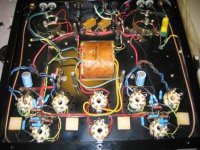
The yellow cap in question appears in the right rear of the attached photo. (Additionally, why isn't there a cap on the left most filter cap? Is it because the filter caps are in parallel and therefore doesn't require a second bypass cap or was the manufacturer being frugle?)
Thanks in advance.
The yellow cap in question appears in the right rear of the attached photo. (Additionally, why isn't there a cap on the left most filter cap? Is it because the filter caps are in parallel and therefore doesn't require a second bypass cap or was the manufacturer being frugle?)
Thanks in advance.
Attachments

The .22 won't be doing anything about ripple - it's an HF snuffer. They should be good for 10K hours at least. Could ask Kimber about actual durability.
The big electrolytics are a different matter. Even good quality screw-terminal types will degrade over the years. My experience is that they start sounding stale and dull long before you can measure anything wrong with them (capacitance meter, ESR meter tests). 10 years is usually enough, perhaps a little more for the best sorts.
KEMET/BHC do good sounding screw-term lytics:
FEBG - Electrolytic Capacitors
The big electrolytics are a different matter. Even good quality screw-terminal types will degrade over the years. My experience is that they start sounding stale and dull long before you can measure anything wrong with them (capacitance meter, ESR meter tests). 10 years is usually enough, perhaps a little more for the best sorts.
KEMET/BHC do good sounding screw-term lytics:
FEBG - Electrolytic Capacitors

Rubycon photo flash caps!!!! I see you've got them scattered around in there!
I always found they made a huge difference in taming power supply noise and attack (leading edge) transient response. Nicely done.
One well remembers a pair of ARC D-250's much hot rodded with scads of these sprinkled about............lightning transient response (the stock D-250 was not any slouch) but golly the inner voicing and sound stage imaging was extraordinary with the flash caps.
Though i have no idea what one would replace them with today as I doubt they are avail. anymore.
Anybody?
I always found they made a huge difference in taming power supply noise and attack (leading edge) transient response. Nicely done.
One well remembers a pair of ARC D-250's much hot rodded with scads of these sprinkled about............lightning transient response (the stock D-250 was not any slouch) but golly the inner voicing and sound stage imaging was extraordinary with the flash caps.
Though i have no idea what one would replace them with today as I doubt they are avail. anymore.
Anybody?
The .22 won't be doing anything about ripple - it's an HF snuffer. They should be good for 10K hours at least. Could ask Kimber about actual durability.
The big electrolytics are a different matter. Even good quality screw-terminal types will degrade over the years. My experience is that they start sounding stale and dull long before you can measure anything wrong with them (capacitance meter, ESR meter tests). 10 years is usually enough, perhaps a little more for the best sorts.
KEMET/BHC do good sounding screw-term lytics:
FEBG - Electrolytic Capacitors
Thanks for the response. should I add a .22 cap across the other filter cap also?
Re: the filter caps: so the fact that when I shut the amp off and the storage caps play solidly for about 20-30 seconds doesn't necessarily mean the caps aren't compromised from age and heat? I thought this was a good test of filter caps?
Thanks for the response. should I add a .22 cap across the other filter cap also?
Re: the filter caps: so the fact that when I shut the amp off and the storage caps play solidly for about 20-30 seconds doesn't necessarily mean the caps aren't compromised from age and heat? I thought this was a good test of filter caps?
Nope, they're just fine, at least for the present. I'd say plan budgeting to replace and sit back............... enjoy .

Rubycon photo flash caps!!!! I see you've got them scattered around in there!
I always found they made a huge difference in taming power supply noise and attack (leading edge) transient response. Nicely done.
One well remembers a pair of ARC D-250's much hot rodded with scads of these sprinkled about............lightning transient response (the stock D-250 was not any slouch) but golly the inner voicing and sound stage imaging was extraordinary with the flash caps.
Though i have no idea what one would replace them with today as I doubt they are avail. anymore.
Anybody?
Are you talking about the two light blue electros? I was just about to purchase either BG's or Elna Silmic's to replace them. So I guess I should keep them in there? Thanks.
Are you talking about the two light blue electros? I was just about to purchase either BG's or Elna Silmic's to replace them. So I guess I should keep them in there? Thanks.
Yes those are the critters!
Now this may, likely will, creatre a fire storm of debate, BUT yes I would just leave them alone. Elna's are always good though.
SY, kevinkr, wavebourn may have more erudition on these subjects, perhaps they will comment?????
Last edited:
IME, capacitance value retention does not mean that the sound quality is also retained. For instance, after 20 years, even mid-to-low-level solid state guitar amps show a marked improvement if you recap them. In old caps I have removed, I have rarely measured any cap loss or ESR increase, even when the amp really performed better.
It doesn't call for any expertise to find out, since the Rubycons look like small sizes. Take them out carefully, so you can put them back if preferred (mark the polarity!!). Get some Nichicon VX or VR series (known-good garden variety 'lytics) and try them instead. If the sound improves, you know you need new caps, and can look out the Elna catalogue; if not you only spent a little beer money finding out.
Same with the Kimbers. Try the PC/HV/S made by LCR - it's a proper ultra-low loss industrial FKP that can embarass many a boutique cap. For coupling or decoupling.
from Farnell/Newark. A budget part that really performs.
LCR COMPONENTS|PC/HV/S/WF 220NF 1KV|CAPACITOR, 220NF, 1000V | Farnell United Kingdom
It doesn't call for any expertise to find out, since the Rubycons look like small sizes. Take them out carefully, so you can put them back if preferred (mark the polarity!!). Get some Nichicon VX or VR series (known-good garden variety 'lytics) and try them instead. If the sound improves, you know you need new caps, and can look out the Elna catalogue; if not you only spent a little beer money finding out.
Same with the Kimbers. Try the PC/HV/S made by LCR - it's a proper ultra-low loss industrial FKP that can embarass many a boutique cap. For coupling or decoupling.
from Farnell/Newark. A budget part that really performs.
LCR COMPONENTS|PC/HV/S/WF 220NF 1KV|CAPACITOR, 220NF, 1000V | Farnell United Kingdom

Not sure whether or not those little blue critters are in fact photoflash caps, but if they are read on..
Long ago I had a couple of those Rubycon photoflash caps burst into flames for no apparent reason other than that they have 0 ripple tolerance and are not suitable for continuous use in even moderately warm temperatures or IMNSHO any other situation. They do have very low ESL/ESR which is the one thing that makes them pretty ideal from a very limited perspective for audio applications. I learned the hard way, but was at least aware of the risk - and I never used them in anything sold to a customer.
My perspective is that this fad originated long ago with someone who was all too willing to ignore manufacturer applications information and part specifications and who got away with it. Like many things in high end audio that doesn't necessarily make it a good idea. There are or have been in the past a fair number of incompetents designing audio gear unfortunately.
Given their advanced old age I would consider these as candidates for immediate replacement. You might or might not have any issue, but when they burn they are just a little difficult to extinguish and make a lot of smoke. 😀
😀
Long ago I had a couple of those Rubycon photoflash caps burst into flames for no apparent reason other than that they have 0 ripple tolerance and are not suitable for continuous use in even moderately warm temperatures or IMNSHO any other situation. They do have very low ESL/ESR which is the one thing that makes them pretty ideal from a very limited perspective for audio applications. I learned the hard way, but was at least aware of the risk - and I never used them in anything sold to a customer.
My perspective is that this fad originated long ago with someone who was all too willing to ignore manufacturer applications information and part specifications and who got away with it. Like many things in high end audio that doesn't necessarily make it a good idea. There are or have been in the past a fair number of incompetents designing audio gear unfortunately.
Given their advanced old age I would consider these as candidates for immediate replacement. You might or might not have any issue, but when they burn they are just a little difficult to extinguish and make a lot of smoke.
😀
Last edited:

Maybe it was already clear from the other posts, but you dont need to bypass the other cap. The powersupply is directly in your signal path; the signal goes from the output transformer primary to ground. It tries to take the least resistance/shortest way to ground, which is normally the last cap in the powersupply. If you bypass that with a better quality (film or pio) cap, that will be the shortest way. Especially for high frequencies recommended. If there's a big choke between both caps, that will work as a blocker for higher frequencies. So the second cap doesnt see much signal or higher frequencies. No need to bypass it.
gr. Paul
gr. Paul
Maybe it was already clear from the other posts, but you dont need to bypass the other cap. The powersupply is directly in your signal path; the signal goes from the output transformer primary to ground. It tries to take the least resistance/shortest way to ground, which is normally the last cap in the powersupply. If you bypass that with a better quality (film or pio) cap, that will be the shortest way. Especially for high frequencies recommended. If there's a big choke between both caps, that will work as a blocker for higher frequencies. So the second cap doesnt see much signal or higher frequencies. No need to bypass it.
gr. Paul
Thanks Paul and yes, I'm a rookie at all of this so I thank you for your comprehensive explaination.
So I would assume from what I've read that replacing the current Kimber film bypass with a PIO is not going to gain me much other than a thinner wallet.
Thanks Paul and yes, I'm a rookie at all of this so I thank you for your comprehensive explaination.
So I would assume from what I've read that replacing the current Kimber film bypass with a PIO is not going to gain me much other than a thinner wallet.
I dont know about the quality of the Kimber, but suspect it decent. If not, replacing can make a difference. But better to replace the Kimber with a really good cap, than to add a second kimber to the other electrolitic. You can even consider replacing the entire electrolitic with a mkp in oil, for instance a motorrun cap. (they are not very expensive, and miles ahead of the most electrolitics)
How large in capacity is the electrolitic?
I dont know about the quality of the Kimber, but suspect it decent. If not, replacing can make a difference. But better to replace the Kimber with a really good cap, than to add a second kimber to the other electrolitic. You can even consider replacing the entire electrolitic with a mkp in oil, for instance a motorrun cap. (they are not very expensive, and miles ahead of the most electrolitics)
How large in capacity is the electrolitic?
The filter caps are both 1100uf 450v.

As far as I remember Kimber caps were re-branded Sidereal Caps.I dont know about the quality of the Kimber, but suspect it decent
These metalised polypropylene caps were very highly rated, and in a very comprehensive test done by HI -FI News in 1985 had the best overall sound quality of all the high end types that they tested.
(I bought a pair and they still reside in my vintage Radford Valve amplifier)😀
Most metalised polypropylenes have a very long service life.
I have just re-capped an amplifier that was 25 years old. A Rauch DVT50s Lateral mosfet power amplifier.
I used BHC reservior caps and Elna slimics to replace the electrolylics. After an initial running in period where the bass seemed overblown, the sound is much improved, with gains noted in detail, timing, and stereo.
Overall replacing all the electrolytics was very significant, and worth every penny!
As far as I remember Kimber caps were re-branded Sidereal Caps.
These metalised polypropylene caps were very highly rated, and in a very comprehensive test done by HI -FI News in 1985 had the best overall sound quality of all the high end types that they tested.
(I bought a pair and they still reside in my vintage Radford Valve amplifier)😀
Most metalised polypropylenes have a very long service life.
I have just re-capped an amplifier that was 25 years old. A Rauch DVT50s Lateral mosfet power amplifier.
I used BHC reservior caps and Elna slimics to replace the electrolylics. After an initial running in period where the bass seemed overblown, the sound is much improved, with gains noted in detail, timing, and stereo.
Overall replacing all the electrolytics was very significant, and worth every penny!
Thanks for the info and i really would like to refresh the storage caps.
But I am having a problem finding the right replacement filter caps as the caps *must* have a 2" or less diameter to fit through the chassis. Any source of 1100 or 1200uf at 450-500v you guys can come up with would be appreciated. For reference, the rectifier tube is a 5V4 so I don't think I can go any higher in capacitance than 1200uf without blowing fuses or the rectifier.
Not sure whether or not those little blue critters are in fact photoflash caps, but if they are read on..
Long ago I had a couple of those Rubycon photoflash caps burst into flames for no apparent reason other than that they have 0 ripple tolerance and are not suitable for continuous use in even moderately warm temperatures or IMNSHO any other situation. They do have very low ESL/ESR which is the one thing that makes them pretty ideal from a very limited perspective for audio applications. I learned the hard way, but was at least aware of the risk - and I never used them in anything sold to a customer.
My perspective is that this fad originated long ago with someone who was all too willing to ignore manufacturer applications information and part specifications and who got away with it. Like many things in high end audio that doesn't necessarily make it a good idea. There are or have been in the past a fair number of incompetents designing audio gear unfortunately.
Given their advanced old age I would consider these as candidates for immediate replacement. You might or might not have any issue, but when they burn they are just a little difficult to extinguish and make a lot of smoke.
Thank you, kevinkr.
Actually the fad was a Peter Moncrief (IAR/TRT) Rosenberg thing (IIRC).
I have not experienced any issues such as you describe and I've used hundreds of those caps in pooged big ARC tube amps as well as industrial servo current drive amps (tool room lathes, specialized surface grinders, etc....which were tube current driver with "sand state" diff. inner loop feedback discriminator circuits).
They were also used extensively in record cutting lathe amplifiers (DMM, Direct To Disc).
However, the years have rolled on!!
But, as you state I'm gonna look closely at any I have still installed in my audio gear and yank them out.
Thank you, kevinkr.
Actually the fad was a Peter Moncrief (IAR/TRT) Rosenberg thing (IIRC).
I have not experienced any issues such as you describe and I've used hundreds of those caps in pooged big ARC tube amps as well as industrial servo current drive amps (tool room lathes, specialized surface grinders, etc....which were tube current driver with "sand state" diff. inner loop feedback discriminator circuits).
They were also used extensively in record cutting lathe amplifiers (DMM, Direct To Disc).
However, the years have rolled on!!
But, as you state I'm gonna look closely at any I have still installed in my audio gear and yank them out.
Probably the safest thing to do. 😀
I had used a bunch of them in my own projects and never had a single problem until that day.. 😀 Thought I was getting away with it, but the hot summer day that cap caught on fire was quite something.
I may be over-reacting, but below is the story..
The errant capacitor was in the external power supply of my newly completed pre-amplifier. This cap was the output cap of a tube based series pass regulator (no ripple, and no RF) and without any warning it caught on fire - and I could not put it out! The smoke pouring out of the PSU was the first clue that something was seriously wrong, the little flames perilously close to coming through the cover were the next. Strangely enough the music continued to play normally, the only symptom was the smoke and fire.
This was a new, fresh, not surplus Rubycon PF type purchased in quantity from a local electronics supply house.
After hastily removing the cover I tried smothering it, I tried a little water - nothing worked. Finally I ended up by putting on some oven mitts, cutting the wires, yanking it out, and dropping it in a sink full of water. It ended without serious damage to the PSU or the apartment, myself, or my GF, who at the time witnessed the whole thing, got me the mitts and filled the kitchen sink with water.
I subsequently removed all of the photoflash caps from the supplies in my gear, and today I generally don't use or recommend them. I have tried them as output coupling capacitors in a low voltage tube OTL headphone amplifier, but I don't really trust them much - I haven't used this amplifier at all in recent years either.
Kind of dramatic I'll admit. I learned a lesson that day and for me despite the clear benefits, mis-applying one of these caps IMHO is just not worth the (possibly small??) risk.
YMMV.. 😀
Last edited:
The writing on the blue caps in my amp say CE W M115. Nothing about photo flash. I just received some Elna II's to replace them. I'll let you know if I hear a difference but I'm still interested as to where I can get the filter caps for this amp.
Thanks.
Thanks.
The ALS30 series is the first choice.
BHC COMPONENTS|ALS30A102KF450|CAPACITOR, 1000UF, 450V | Farnell United Kingdom
You have to settle for 1000uF to stay at 2" diameter (4" long), but quality is more important than quantity at this rating. As Xoc1 noted, you can use these with confidence - just break them in before judging the sound.
BHC COMPONENTS|ALS30A102KF450|CAPACITOR, 1000UF, 450V | Farnell United Kingdom
You have to settle for 1000uF to stay at 2" diameter (4" long), but quality is more important than quantity at this rating. As Xoc1 noted, you can use these with confidence - just break them in before judging the sound.
The ALS30 series is the first choice.
BHC COMPONENTS|ALS30A102KF450|CAPACITOR, 1000UF, 450V | Farnell United Kingdom
You have to settle for 1000uF to stay at 2" diameter (4" long), but quality is more important than quantity at this rating. As Xoc1 noted, you can use these with confidence - just break them in before judging the sound.
Thanks but how do I order them with US dollars?
Cary has UCC 1200uf 450v caps for $36 each. I assume the BHC's are a better choice?
- Status
- Not open for further replies.
- Home
- Amplifiers
- Tubes / Valves
- Replace Bypass Cap?