

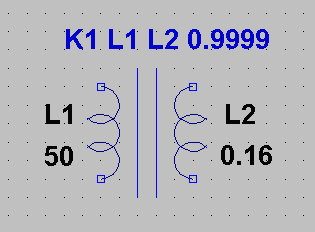
Try using two inductors with a K directive. According to the help file, the inductance ratio should be the same as the transformer's impedance ratio.


Could anybody explain me what is the compatibility between PSpice and LTSpice? Can the PSpice .lib (library), .slb (schematics symbol library), .olb (OrCAD capture library) and .sch (schematics) files be used in LTSpice?
Since the engine is SPICE either way, you should be able to import the model files with some minimal work. If I remember correctly, LTSpice will let you build schematic symbols and associate its ports with a SPICE model. The code's the important part, as long as the guts are the same you should be able to make it work.

You can use most .lib files if their syntax is similar enough to ltspice's native format, however I have never had any success with importing symbols or schematics from other flavors of spice.
how to model OPT in LTSpice
It handles single ended, push pull, UL of either SE or PP type, and does multiple output taps if wanted. Its only a linear model, just gives the overall frequency you specify. It doesnt model core effects, ie saturation. A lot of the parameters such as winding resistances are just guesses on my part, put in better ones if you know them.
Brief instructions :
Go to the first worksheet ( "Main Data" ) and either select from a transformer already there, or enter specs for one of your own. For example for the 2500 to 8 ohm you asked about you may pick the HAM12627SE type. Copy and paste the data given for that into the first line of the appropriate worksheet, in this case the SE UL tab. Change the cells with tap values if you wish. The spreadssheet calculates the values, and shows two LTSpice models, one with output taps and one without. Copy and paste the one you want into your .lib file of transformers subcircuits or onto your spice schematic or however you prefer to get it into spice, and away you go.
Here's how I do it. I use the attached spreadsheet that I developed. Note that this is just something I whipped up for myself, I have not made it super user friendly, it assumes you know about excel, and copying and pasting etc.Anyone know how to simulate OPT in LTspice?
It handles single ended, push pull, UL of either SE or PP type, and does multiple output taps if wanted. Its only a linear model, just gives the overall frequency you specify. It doesnt model core effects, ie saturation. A lot of the parameters such as winding resistances are just guesses on my part, put in better ones if you know them.
Brief instructions :
Go to the first worksheet ( "Main Data" ) and either select from a transformer already there, or enter specs for one of your own. For example for the 2500 to 8 ohm you asked about you may pick the HAM12627SE type. Copy and paste the data given for that into the first line of the appropriate worksheet, in this case the SE UL tab. Change the cells with tap values if you wish. The spreadssheet calculates the values, and shows two LTSpice models, one with output taps and one without. Copy and paste the one you want into your .lib file of transformers subcircuits or onto your spice schematic or however you prefer to get it into spice, and away you go.
Attachments
Hi Robert
Thanks a lot for your shared files
I use it for a short time now
But I've something to ask to you
Can you complete your spreadsheet with a CFB section
near like the UL tap in the Inductance, in fact, to simulate
far away my OPT
If it's possible and if you need real value about my OPT
Ask it , of course
I have on hand SE and PP with CFB and the way to do it is very similar
in front of UL
Best regards
Thanks a lot for your shared files
I use it for a short time now
But I've something to ask to you
Can you complete your spreadsheet with a CFB section
near like the UL tap in the Inductance, in fact, to simulate
far away my OPT
If it's possible and if you need real value about my OPT
Ask it , of course
I have on hand SE and PP with CFB and the way to do it is very similar
in front of UL
Best regards

Why?..the inductance ratio should be the same as the transformer's impedance ratio.
The 2 coils are on the same core so both the impedance ratio and inductance ratio will be = turns_ratio^2 according to Faraday
Here's how I do it. I use the attached spreadsheet that I developed. Note that this is just something I whipped up for myself, I have not made it super user friendly, it assumes you know about excel, and copying and pasting etc.
Interesting!
It looks like you are taking the transformer frequency response spec, making some assumptions about the source and load resistance, and then deriving an estimate for inductance from those assumptions. I wonder how accurate this is going to be from manufacturer's FR specs if they don't also specify the source and load resistance conditions.
I'm not quite following the derivation of the coupling factor K. Is the leakage inductance buried in the computation somewhere? Guess I need to study it some more...
Cheers!

Ty_Bower is so right. Check post 1 and 2! The picture together says it all!
Winding ratio in relation to inductance or impedance is another thing that works with the formula above.
Winding ratio in relation to inductance or impedance is another thing that works with the formula above.
Interesting!
It looks like you are taking the transformer frequency response spec, making some assumptions about the source and load resistance, and then deriving an estimate for inductance from those assumptions. I wonder how accurate this is going to be from manufacturer's FR specs if they don't also specify the source and load resistance conditions.
I'm not quite following the derivation of the coupling factor K. Is the leakage inductance buried in the computation somewhere? Guess I need to study it some more...
Cheers!
Not a problem for me , I make my own OPT , so no problem of manufacturers
It's just a approach of my next project by simulation
I found the SE UL and PP and PP UL model enough good in my
knowledge so Let's go for some new stuff
Why not ?
Ty_Bower is so right. Check post 1 and 2! The picture together says it all!
Winding ratio in relation to inductance or impedance is another thing that works with the formula above.
Sorry, I'm in agreement. Why? was rhetorical...
Using the mutual inductance method can you simulate a PP transformer (or UL) by putting two inductors in series with a mutual inductance directive for each coupling to the output inductor?
There is a great paper about modeling tranformers, at http://www.onsemi.com/pub/Collateral/AN1679-D.PDF .
I used its ideas to develop a way to create LTspice models of power transformers by using the results of simple measurements, which is viewable (and downloadable) at Spice Component and Circuit Modeling and Simulation .
I don't know how applicable it is to audio output transformers, since I only worried about one frequency for power transformers, and the power line was available as a stimulus signal, and a cheap multimeter could be used for the measurements. But it could probably be adapted.
Cheers,
Tom Gootee
I used its ideas to develop a way to create LTspice models of power transformers by using the results of simple measurements, which is viewable (and downloadable) at Spice Component and Circuit Modeling and Simulation .
I don't know how applicable it is to audio output transformers, since I only worried about one frequency for power transformers, and the power line was available as a stimulus signal, and a cheap multimeter could be used for the measurements. But it could probably be adapted.
Cheers,
Tom Gootee
Using the mutual inductance method can you simulate a PP transformer (or UL) by putting two inductors in series with a mutual inductance directive for each coupling to the output inductor?
K1 L1 L2 L3 L4 L5 1
Yeah, but you gotta break up the primary into four segments for UL...
I don't know how to split 20H into 43%/57%? I've always sim 50/50
5H + 5H. I'm uncertain the consequence of that fudge.
L5 above would be the secondary. Helps to show phase dots on the
schematic, to assure LTSpice adds everything the right way.
The sim sometimes flips out with mutual coupling less than 1.
I would suggest not setting 0.996 or whatever till after you
get the rest working as expected.
Last edited:

I have found a short description from LT. Worth reading.
http://cds.linear.com/docs/en/lt-journal/LTMag-V16N3-23-LTspice_Transformers-MikeEngelhardt.pdf
http://cds.linear.com/docs/en/lt-journal/LTMag-V16N3-23-LTspice_Transformers-MikeEngelhardt.pdf
- Status
- Not open for further replies.
- Home
- Amplifiers
- Tubes / Valves
- How to simulate OPT in LTspice?