
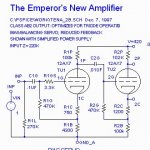
Sorry about this but I really don't understand this and I want to learn. In the attached input circuit from Norman Koren's TENA amp the 12AX7 input tube is said to be a standard voltage gain stage with local feedback derived between the cathode resistors.
That is fine but it looks like positive feedback to me. As input voltage rises the grid becomes less negative thus causing more current to flow down through the plate and out the cathode. This would raise the voltage on R1B would it not? It looks to me to be much like taking the bottom output of a cathodyne and feeding it back to the input. I am sure that there is something about the relationship of bias currents and R1C that makes it all work but I am missing it.
Can you help me?
mike
P.S. interesting choice of input tube huh?
That is fine but it looks like positive feedback to me. As input voltage rises the grid becomes less negative thus causing more current to flow down through the plate and out the cathode. This would raise the voltage on R1B would it not? It looks to me to be much like taking the bottom output of a cathodyne and feeding it back to the input. I am sure that there is something about the relationship of bias currents and R1C that makes it all work but I am missing it.
Can you help me?
mike
P.S. interesting choice of input tube huh?
Attachments
mashaffer said:Can you help me?
Sure

The important thing here is the voltage between the grid and the cathode (which is represented by R1c). When the current (and hence the voltage on) R1c increases, the cathode becomes more positive of the grid which offsets the turning on and is negative feedback.
I haven't used this circuit, but there is a theoretically ideal amount of cathode resistance in offsetting the characteristic curvature of a triode, that is not necessarily the same as the required bias resistance. The "reduced feedback", as it is put, reminds me of this.
In the circuits I have used, the grid is taken to ground and the extra resistance is bypassed for AC.
In the circuits I have used, the grid is taken to ground and the extra resistance is bypassed for AC.

mashaffer said:
That is fine but it looks like positive feedback to me. As input voltage rises the grid becomes less negative thus causing more current to flow down through the plate and out the cathode. This would raise the voltage on R1B would it not? It looks to me to be much like taking the bottom output of a cathodyne and feeding it back to the input.
Hi
R1G and R2G indeed produce positive feedback ,a kind of bootstrapping, that increase the input impedance of the stage ( and the distortion to ...
).As already pointed only R1C and R2C introduce local negative feedback...
- Status
- This old topic is closed. If you want to reopen this topic, contact a moderator using the "Report Post" button.