

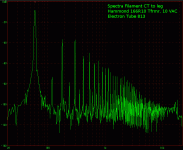
The junkpile finally got large enough for a stab at the SE 813 or 828 in the plans for a couple of years. One of the remaining questions was how to handle the filaments. I started with the simplest and took at wide band look from centre tap to ground of an AC transformer driving an 813. No wonder some claim it has more 'life'. See below. Granted it wasn't hum balanced and some of the hash can be expected to cancel, this is still nasty. With the mains disconnected the measurement dropped to the -140 dB floor across the board so I have no doubt it's the real thing.
One for the files.
One for the files.
Attachments

Do you think these harmonics are present in the power lines due to industrial loads and/or SMPS? What would you get with a pure sine wave into the tube?
Interesting that there could actually be some truth to the "cleaner power" explanation of why tube amps sound better late at night...
Interesting that there could actually be some truth to the "cleaner power" explanation of why tube amps sound better late at night...

wow, that does look somewhat unpleasant.
What software/HW are you using to take those measurements, btw?
(newbie to DIY measurements, here)
What software/HW are you using to take those measurements, btw?
(newbie to DIY measurements, here)
The spectrum above was taken right at the 10 volt secondary of the filament transformer, ground tied to centre tap. A measurement done afterwards from leg to leg was of course 6dB higher overall but otherwise the same. How much of it appears on the plate is naturally dependent on tube and circuit but it's unquestionably on the cathode. As to the cause, I suspect it's the transformer!
Here's why. I benched a very low distortion (0.02%) parafeed headphone amp using a toroidal 240 volt to 20 volt power transformer. The max plate swing into the primary is about 100 volts p-p. Curious how an EI transfomer would perform as an OPT I substituted the same Hammond filament transformer seen here, which is rated 120 volt to 10 volt. Since the voltage ratios are the same the headphone amp plate load should have been roughly equivalent. The distortion shot through the roof and displayed a very complex set of harmonics. The result got me curious about the Hammond in a filament application where it's getting near double the primary voltage and delivering real current. I'll leave it to the black art 'magnetmaticians' to comment on cause but I suspect the core material, i.e. Hammond strikes again.
The standard logic dictates that EI power transformers are preferable in audio partially due to higher internal losses acting to filter power line junk. Toroids are so effcieint and wide band everything passes straight through. As I so often find, the picture is much more complex when a meter enters it. This was intended to be a 'budget' 813SE but now I'm torn between Tentalab CCS filament supplies using these transformers or finding toroid 10 VAC trannies.
Majestic: The software is WaveSpectra 1.31 - http://www.ne.jp/asahi/fa/efu/soft/ws/ws.html - which was just recently updated to 1.40. In combination with Sinegen - http://e-cat.nm.ru/sinegen/ - it makes a great freeware PC suite.
Here's why. I benched a very low distortion (0.02%) parafeed headphone amp using a toroidal 240 volt to 20 volt power transformer. The max plate swing into the primary is about 100 volts p-p. Curious how an EI transfomer would perform as an OPT I substituted the same Hammond filament transformer seen here, which is rated 120 volt to 10 volt. Since the voltage ratios are the same the headphone amp plate load should have been roughly equivalent. The distortion shot through the roof and displayed a very complex set of harmonics. The result got me curious about the Hammond in a filament application where it's getting near double the primary voltage and delivering real current. I'll leave it to the black art 'magnetmaticians' to comment on cause but I suspect the core material, i.e. Hammond strikes again.
The standard logic dictates that EI power transformers are preferable in audio partially due to higher internal losses acting to filter power line junk. Toroids are so effcieint and wide band everything passes straight through. As I so often find, the picture is much more complex when a meter enters it. This was intended to be a 'budget' 813SE but now I'm torn between Tentalab CCS filament supplies using these transformers or finding toroid 10 VAC trannies.
Majestic: The software is WaveSpectra 1.31 - http://www.ne.jp/asahi/fa/efu/soft/ws/ws.html - which was just recently updated to 1.40. In combination with Sinegen - http://e-cat.nm.ru/sinegen/ - it makes a great freeware PC suite.
In retrospect, noise was probably the wrong term. Filament mains distortion more accurately describes what I think is happening.
I performed some similar measurements, the results can be found here:
AC supply noise
The harmonics are originating from the mains and are the result of power supplies chopping of the top of the sine wave. If you chop the top of a sine wave it will start to look like a square wave. A square wave is made up of only odd harmonics and this is what you see in the spectrum.
If there is DC offset on the mains this can also create problems. Not all transformers can handle this which results in harmonics on the secondary, mechanical hum and heating of the transformer.
To minimize the noise on the heater supply I used a Lundahl mains transformer (with air gap to handle DC), a CRC filter and a MachMat VCCS. With this approach I got the noise on the heater down to 0.067mV.
Note: It is important how you measure the noise. If you use autobias the heater supply will float above ground, measuring unbalanced will skew the results. You have to measure the differential noise on the load.
See: DC heater supply part 4, Revenge of the Caps
AC supply noise
The harmonics are originating from the mains and are the result of power supplies chopping of the top of the sine wave. If you chop the top of a sine wave it will start to look like a square wave. A square wave is made up of only odd harmonics and this is what you see in the spectrum.
If there is DC offset on the mains this can also create problems. Not all transformers can handle this which results in harmonics on the secondary, mechanical hum and heating of the transformer.
To minimize the noise on the heater supply I used a Lundahl mains transformer (with air gap to handle DC), a CRC filter and a MachMat VCCS. With this approach I got the noise on the heater down to 0.067mV.
Note: It is important how you measure the noise. If you use autobias the heater supply will float above ground, measuring unbalanced will skew the results. You have to measure the differential noise on the load.
See: DC heater supply part 4, Revenge of the Caps

AC is third best
Moving from ac filament supply to dc (current) is one of the most striking improvements possible in a DHT amplifier!
Here's how I implemented mine:
http://www.diyaudio.com/forums/showthread.php?s=&threadid=38248&perpage=25&pagenumber=2
Piotr Grzesik tried this circuit out on a linestage DHT amp, and compared it to other dc voltage and current implementations and reported "More life & energy, with a beautiful clarity!"
That's very much how it sounded to me. It's the cross-coupled transistor current source that really makes it work beautifully, far better than any IC-based solutions.
My pair of heaters has been in service with the same set of JJ 300Bs for three years now, and despite being purely current drive, the voltage accuracy is still 4.91V and 4.96V after this time.
Try Guido's module, or DIY one like this. I'll be doing circuit boards (bare PCBs) for it soon, it's really good enough to deserve a wider audience.
Moving from ac filament supply to dc (current) is one of the most striking improvements possible in a DHT amplifier!
Here's how I implemented mine:
http://www.diyaudio.com/forums/showthread.php?s=&threadid=38248&perpage=25&pagenumber=2
Piotr Grzesik tried this circuit out on a linestage DHT amp, and compared it to other dc voltage and current implementations and reported "More life & energy, with a beautiful clarity!"
That's very much how it sounded to me. It's the cross-coupled transistor current source that really makes it work beautifully, far better than any IC-based solutions.
My pair of heaters has been in service with the same set of JJ 300Bs for three years now, and despite being purely current drive, the voltage accuracy is still 4.91V and 4.96V after this time.
Try Guido's module, or DIY one like this. I'll be doing circuit boards (bare PCBs) for it soon, it's really good enough to deserve a wider audience.
Hi Gerrit. Your 'flat topping' comment piqued my curiousity. You're right, the AC waveform at the filament is highly distorted but I think we're saying the same thing when I ascribe it to a minimally spec'd core. In this case the Hammonds are rated for 8A and the 813 draw at 5A so it's not like it's running on the edge. An 828 draw 3 1/4A and will be tested later today. It might end up an 828 amp instead.

Good point. The mains DC offset is in the range of 3/4 volts. A 100uF motor run in series with the primary helps a tiny bit but the filament waveform is still highly distorted, roughly equivalent to a soft-clipped triangle wave.
Since there was a new version of Wavespectra to take for a spin, the results were checked with and without a primary DC blocking cap. No appreciable difference.
Interesting. I'd been wondering about adding big DC blocking capacitors. I'll experiment myself, but it looks as though I won't see much benefit.
I wouldn't be surprised if the transformer is fine and there's just that much debris on the mains. I know for a fact that at my place this is the case.
Dang you arend-jan if you're not right. I read your post this morning and took a quick look with a scope at my home service. Not believing what I saw I took a second look at work across town. Still not believing it I investigated the permissible harmonic content of Canadian power utilities. The Ottawa region for example permits almost 9% total with specifications for harmonics to around the 30th! I'm flabbergasted. Something's changed dramatically since I last looked at this at least a decade back, or so I recall, but you were right. The AC on my outlets is a roughly triangular clipped wave, and at under 5% total THD (according to the Audio Precision 1 at work), it's in spec.
I still suspect transformer distortion has an impact on the nature of the distribution, likely the missing 2nd and 4th, however the bulk of the issue is undoubtedly elsewhere. There's no question in my mind AC filaments aren't the best answer.
I still suspect transformer distortion has an impact on the nature of the distribution, likely the missing 2nd and 4th, however the bulk of the issue is undoubtedly elsewhere. There's no question in my mind AC filaments aren't the best answer.
I guess the solution would be to generate our own power. A solar panel setup with a very low distortion pure sine wave inverter should do the trick. This way one can get very clean power which is also stable.
I suspect that if the hum consists only of a 50Hz(or 60Hz) pure sine wave the audibility of the hum will be greatly reduced (think Fletcher-Munson curves).
I suspect that if the hum consists only of a 50Hz(or 60Hz) pure sine wave the audibility of the hum will be greatly reduced (think Fletcher-Munson curves).

Gerrit Boers said:a very low distortion pure sine wave inverter should do the trick.
Therein lies the problem. It is very difficult to build/purchase a quality inverter with low noise. Most are PWM derived from IGBT's, with varying degrees of output stage filtering. The source impedance of these supplies is not exactly stellar, either.
I've recently taken some harmonic measurements of my service, with similar results. Top of the waveform is chopped off and rounded at the edges. All odd harmonics, of course. I'm considering experimenting with the Sola ferroresonant voltage regulators to try and clean this up. They aren't perfect harmonic filters, but they will improve the spectrum to benefit AC heating, I would think. Will also certainly clean up the noise from the inverter, if one cares to cascade.
Maybe heating DHT's with a ferroresonant supply has some merit - keep running the B+ supply from line voltage, as source impedance still isn't very low.
Therein lies the problem. It is very difficult to build/purchase a quality inverter with low noise. Most are PWM derived from IGBT's, with varying degrees of output stage filtering. The source impedance of these supplies is not exactly stellar, either.
I was afraid of that. If it was simple I would have already implemented such a setup. What about an old-fashioned approach: DC motor + AC alternator? I know it's clunky and there will be a problem with mechanical noise but the distortion could be very low and the source impedance should also be low.
I'll be curious how your Sola work out. We use them here and there at work, usually on sensitive gear backed up with generators, but haven't seen filtering specs. The problem is the short spacing between the junk and the harmonics. Also, Sola lists 3% THD for the MCR Portable Series without details on harmonic distribution. The spectrum posted earlier represents a little over 4% THD on the mains. Those aren't promising numbers.
Gerrit Boers said:What about an old-fashioned approach: DC motor + AC alternator? I know it's clunky
Definitely clunky, and quite extreme to get clean AC, it would seem. Personally, unless the motor/alternator or generator is outdoors, the idea doesn't excite me. Always worth a try, tho.
rdf said:Also, Sola lists 3% THD for the MCR Portable Series without details on harmonic distribution.
Agreed, that has been my experience as well, not perfect sine wave output. However, the MCR's I have seen typically drive high harmonic loads (computers, PLC's, etc) that require a stable supply. Due to the high source impedance, the Sola was expectantly distorting a little, but for the most part, due to load. Give a Sola a resistive, passive load (filament), I suspect a much more harmonic free output is possible. I will take some measurements when I get an opportunity.
- Status
- Not open for further replies.
- Home
- Amplifiers
- Tubes / Valves
- DHT AC Filament Noise