
Can anyone shed any light on why my TDA7294 blew up. It is in a Polk Audio Sub and just decided one day to blow a fuse. After replacing the fuse and powering up it did it again. Turned out the chip was fried so a purchased a new one and fit it to the PCB.
(note: at the point of testing the 2nd chip, the heat sink was not fitted, nor was the speaker connected.)
I turned on the power and it the chip blew almost straight away.
The voltage to the chip is 27v on +PVs and +Vs (both pins connected on PCB). -27v on -PVs and -Vs (both pins connected on PCB).
On Standby the standby and mute pins both see 13.5v changing to -6.4v when standby is switched to ON.
Was I wrong to turn on the power without the heat sink even though there was no load connected?
Both failed chips had holes in them in the same place.
(note: at the point of testing the 2nd chip, the heat sink was not fitted, nor was the speaker connected.)
I turned on the power and it the chip blew almost straight away.
The voltage to the chip is 27v on +PVs and +Vs (both pins connected on PCB). -27v on -PVs and -Vs (both pins connected on PCB).
On Standby the standby and mute pins both see 13.5v changing to -6.4v when standby is switched to ON.
Was I wrong to turn on the power without the heat sink even though there was no load connected?
Both failed chips had holes in them in the same place.
I doubt it should have blown so quickly even without a load but it would be wise to attach it to the heat sink before trying.
My guess would be that there is a dead short somewhere in the output on the PCB or the wires to the driver.
I would normally suspect that the voicecoil in the driver is fried but you indicate it was not connected.
My guess would be that there is a dead short somewhere in the output on the PCB or the wires to the driver.
I would normally suspect that the voicecoil in the driver is fried but you indicate it was not connected.

Search for the TDA7924 threads. There is a warning about instant blow up if the two supply pins ( input stage and output stage ) do not stay within a few volts of each other. So if you have a resistor between output stage supply pins and input stage supply pins and these are blown , then 'bang' goes your chip.
READ the threads and check the application data for 7294 and 7293 . You might spot the problem with your unit.
Cheers.
READ the threads and check the application data for 7294 and 7293 . You might spot the problem with your unit.
Cheers.
I did spend quite a bit of time before I posted this equiry looking at the threads and you are right, there is a lot of info on this chip. However I found nothing that explains what is heppening with mine.
I am a little concerned with the "Boucherot cell" off the optput that on my PCB is a 4.7ohm resistor with a cap after it to ground. I am tempted to remove it as it could be the cause of the blow on startup.
I am a little concerned with the "Boucherot cell" off the optput that on my PCB is a 4.7ohm resistor with a cap after it to ground. I am tempted to remove it as it could be the cause of the blow on startup.

It's not wise to connect without heatsink at all. Before you remove the zobel/bucherot check it's resistance (and capacitance if your meter can do that) as it should be there.

I have been building TDA7294 boards from time to time for several years now. Here goes some advice:
- Check for solderballs, solder bridges or bad soldering.
- Never solder a replacement chip without some heatsink attached, the heat applied to the pins will destroy it most times. Otherwise, you will have to solder the pins one by one leaving gentle time inbetween to prevent excess heat to build up.
- Even whith the heatsink attached, allow a few seconds for the chip to cool down after soldering each group of three or four pins or so.
- Replace the small electrolytic capacitors related to the chip, particularly the bootstrap one. They cost very little, yet they can cause new chips to blow instantaneously if they are faulty.
- The chip may blow if MUTE or STANDBY inputs are left "floating".
- Never remove the RC output cell, doing so may cause instability and ultimately destroy the IC.
- Be aware that a new chip may be partially damaged due to excess soldering heat or electrostatic discharge and it will fail after a few hours or days of operation. TDA7294 seemed to be quite a delicate IC ultil it's mounted in a PCB.
- Check for solderballs, solder bridges or bad soldering.
- Never solder a replacement chip without some heatsink attached, the heat applied to the pins will destroy it most times. Otherwise, you will have to solder the pins one by one leaving gentle time inbetween to prevent excess heat to build up.
- Even whith the heatsink attached, allow a few seconds for the chip to cool down after soldering each group of three or four pins or so.
- Replace the small electrolytic capacitors related to the chip, particularly the bootstrap one. They cost very little, yet they can cause new chips to blow instantaneously if they are faulty.
- The chip may blow if MUTE or STANDBY inputs are left "floating".
- Never remove the RC output cell, doing so may cause instability and ultimately destroy the IC.
- Be aware that a new chip may be partially damaged due to excess soldering heat or electrostatic discharge and it will fail after a few hours or days of operation. TDA7294 seemed to be quite a delicate IC ultil it's mounted in a PCB.

I have built about dozen of TDA7293 amps, and have found the bootstrap capacitor is the greatest problem maker. They degrade after time and at first cause some degradation of sound, and later blowing of the chips.
Thanks for all the great advise.
One more question, with no input, I assumed that I would have no output. Is this assumption correct or do I get output on power up?
One more question, with no input, I assumed that I would have no output. Is this assumption correct or do I get output on power up?
".....................with no input, I assumed that I would have no output................"
😱
No output ! Did you really doubt that ?
😱
No output ! Did you really doubt that ?
Not really no but it seems to negate the idea that the fault is connected to a short on the output don't you think?
You could get an output without an input IF your amp is oscillating. Without a heatsink it will be dead in a moment . With a heatsink attached it might survive the time required to power down. That of course is a worst case scenario.
Better you replace the bootstrap capacitor ( check polarity ) and any resistors in the supply line to the input stage. You could compare resistor values ( in circuit) with the good channel.
Removing the Zobel R/C network might make it unstable . Even if the capacitor is a short , the resistor will prevent a direct short to ground.
Cheers.
Better you replace the bootstrap capacitor ( check polarity ) and any resistors in the supply line to the input stage. You could compare resistor values ( in circuit) with the good channel.
Removing the Zobel R/C network might make it unstable . Even if the capacitor is a short , the resistor will prevent a direct short to ground.
Cheers.
Good news, the amp is now working fine. It turned out the fault was at least one of the two 4700uf filter caps. When these were replaced the voltage went up to +- 35volts.
Thanks to all that replied to my query
Thanks to all that replied to my query
Sounds fine to me but that doesn't mean much as I have nothing to compare it to. It's the only sub I have ever owned.
Regards
Regards
Z5500 tda7294 blow out
Sorry for the dead thread revival
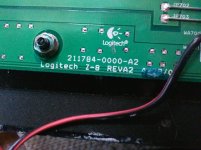
For years my Logitech Z5500 (board Z-8 REVA2 )
has been making crackling popping sounds
and I bought a replacement for it and palmed it off to mum because it would work for a while before it would kick in
anyhow today I decided I would crack it open and have a look
I had cranked it right up for ages and it would not cause the noise I wanted. Giving up I put it back together , but when I powered it back up it had a huge humm noise and before I could get the power switch it blew
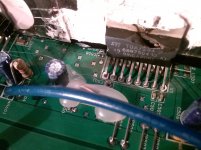
pulled it apart to find the tda7294 blown
I can not think of anything I would have done to cause a failure apart from having it on the boost setting and not actually powering it off with its controller , I just flipped the power switch before assembling just in case I shorted something when putting its back plate back on
so could this have been the culprit and it finally caved in after a good heat soak , or would something else be the issue ? where else should I check before blowing up an replaced tda7294 ?
Sorry for the dead thread revival
For years my Logitech Z5500 (board Z-8 REVA2 )
has been making crackling popping sounds
and I bought a replacement for it and palmed it off to mum because it would work for a while before it would kick in
anyhow today I decided I would crack it open and have a look
I had cranked it right up for ages and it would not cause the noise I wanted. Giving up I put it back together , but when I powered it back up it had a huge humm noise and before I could get the power switch it blew
pulled it apart to find the tda7294 blown
I can not think of anything I would have done to cause a failure apart from having it on the boost setting and not actually powering it off with its controller , I just flipped the power switch before assembling just in case I shorted something when putting its back plate back on
so could this have been the culprit and it finally caved in after a good heat soak , or would something else be the issue ? where else should I check before blowing up an replaced tda7294 ?
Attachments
- Status
- Not open for further replies.
- Home
- Loudspeakers
- Subwoofers
- TDA7294 failure