
I am looking at adding a horn sub in my main system. I have plenty of room to build a 25 or 30 foot long front loaded horn but the mouth would have to be in the front of the listening area a few feet behind the main speakers. The concern is for the delay in the long horn so I have done a little bit of reading.
I do not want to use a delay line on the mains. From what I have read it seems that if the sub is crossed over no higher than about 60Hz the 8mS or so delay of an 8 to 10 foot horn would not be a problem and I would even be able to put one of this size behind the listening position eliminating most of even that delay but that would only get me down to about 30Hz give or take. This would no doubt be better than what I have and plenty for the 16' pedal stops and most other instruments but would still leave the 32' pedal tones absent.
So where does this leave me? How low of crossover point and how steep of crossover is necessary to make nearly 20mS of delay acceptable? Do I build a 30Hz horn and then catch the last octave some other way? I could add an IB sub but then if I am going to go with that much amplifier power and that many drivers then what is the point in the horn sub in the first place?
I could build a 30Hz horn and a 15Hz horn (There is room for both) and cross over to the 15Hz sub with a steep crossover at 30Hz. Certainly at that low of frequency the delay would be immaterial.
Of course one option would be to just be satisfied with a 30Hz sub and let the brain fill it in for me.
Thoughts?
I do not want to use a delay line on the mains. From what I have read it seems that if the sub is crossed over no higher than about 60Hz the 8mS or so delay of an 8 to 10 foot horn would not be a problem and I would even be able to put one of this size behind the listening position eliminating most of even that delay but that would only get me down to about 30Hz give or take. This would no doubt be better than what I have and plenty for the 16' pedal stops and most other instruments but would still leave the 32' pedal tones absent.
So where does this leave me? How low of crossover point and how steep of crossover is necessary to make nearly 20mS of delay acceptable? Do I build a 30Hz horn and then catch the last octave some other way? I could add an IB sub but then if I am going to go with that much amplifier power and that many drivers then what is the point in the horn sub in the first place?
I could build a 30Hz horn and a 15Hz horn (There is room for both) and cross over to the 15Hz sub with a steep crossover at 30Hz. Certainly at that low of frequency the delay would be immaterial.
Of course one option would be to just be satisfied with a 30Hz sub and let the brain fill it in for me.
Thoughts?
If you want a 15hz horn and have the space for it then just build the 15hz sub. There won't be a need to cross at 30hz. Just run the one sub up to your XO frequency for your main speakers.
A little more on the options
Here is a diagram of my listening room.
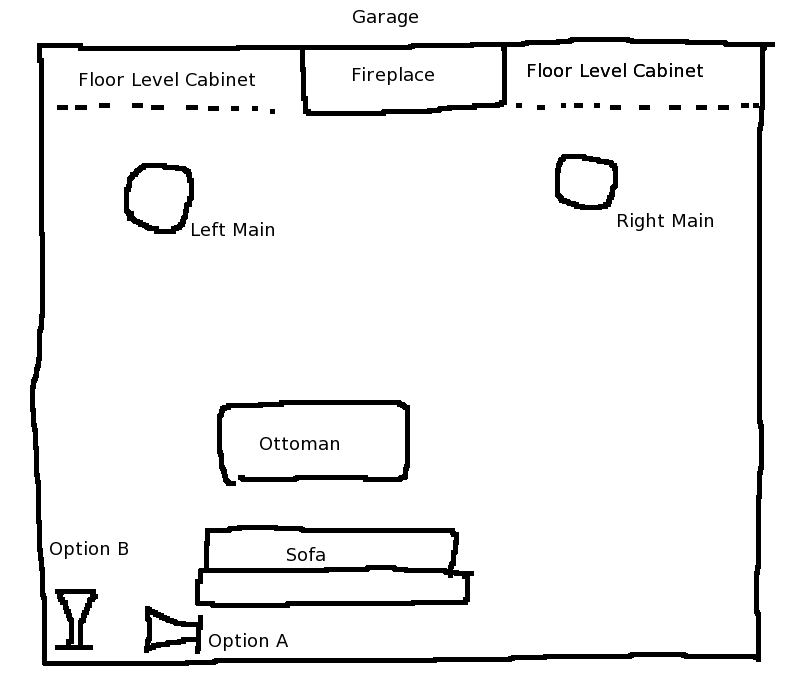
If I did built in horns they would be in the garage with the mouths above the floor cabinets on either side of the fireplace. My main speakers are home made OB with a 5 1/2" wide range Foster OEM and 10" high Q helper woofer. They are able to handle down to 60Hz pretty easily. It is about 10 feet from the seating position to the mains.
A couple of possibilities on a "smaller" Horn would be to replace the large ottoman with the sub and upholster it so that it can be used as a footstool or place it behind the sofa. If used as a footstool it wouldn't take up any more space but it would loose all advantage from corner loading.
By putting it behind the sofa I can get some corner loading. On question I have is whether Option A or Option B is better for corner loading. In option A the mouth points into the corner parallel to the back wall and in Option B it points out from the corner parallel to the side wall. I could build it either way. In fact it might be possible to have the mouth wrap around the end of the sofa and form an end table (this would be option B).
What I am thinking of for the smaller horn is two sheets of plywood spaced about 1.5' to 2' apart with the mouth on the smaller side. I would cover it with something attractive and use it as a knick-knack shelf.
Here is a diagram of my listening room.
If I did built in horns they would be in the garage with the mouths above the floor cabinets on either side of the fireplace. My main speakers are home made OB with a 5 1/2" wide range Foster OEM and 10" high Q helper woofer. They are able to handle down to 60Hz pretty easily. It is about 10 feet from the seating position to the mains.
A couple of possibilities on a "smaller" Horn would be to replace the large ottoman with the sub and upholster it so that it can be used as a footstool or place it behind the sofa. If used as a footstool it wouldn't take up any more space but it would loose all advantage from corner loading.
By putting it behind the sofa I can get some corner loading. On question I have is whether Option A or Option B is better for corner loading. In option A the mouth points into the corner parallel to the back wall and in Option B it points out from the corner parallel to the side wall. I could build it either way. In fact it might be possible to have the mouth wrap around the end of the sofa and form an end table (this would be option B).
What I am thinking of for the smaller horn is two sheets of plywood spaced about 1.5' to 2' apart with the mouth on the smaller side. I would cover it with something attractive and use it as a knick-knack shelf.
Attachments

Hi mashaffer,
From your description of your main speakers you could get away with a whole slew of solutions without resorting to full size front loaded horns (not that there is anything wrong with those 🙂). You already mentioned the IB (that would be my choice, e.g.: dual 15s per side in push-pull plenums). The diversified forms of OBs are an obvious fit with your mains...
I don't know if you have followed the discussions on Tom Danley's tapped horns (and bjorno's T-TWQTs), and djk's PPSL subwoofers, these technologies would be possible candidates. Maybe, take a look at djk's description of his comparison between a large corner horn and his PPSL in Post #10 - http://www.diyaudio.com/forums/subwoofers/177905-thread-those-interested-ppsl-enclosures.html.
The other thing I like to point out is the Geddes approach to optimizing multiple subs. See the link in Post #5 - http://www.diyaudio.com/forums/subwoofers/134568-multiple-small-subs-geddes-approach.html
Regards,
From your description of your main speakers you could get away with a whole slew of solutions without resorting to full size front loaded horns (not that there is anything wrong with those 🙂). You already mentioned the IB (that would be my choice, e.g.: dual 15s per side in push-pull plenums). The diversified forms of OBs are an obvious fit with your mains...
I don't know if you have followed the discussions on Tom Danley's tapped horns (and bjorno's T-TWQTs), and djk's PPSL subwoofers, these technologies would be possible candidates. Maybe, take a look at djk's description of his comparison between a large corner horn and his PPSL in Post #10 - http://www.diyaudio.com/forums/subwoofers/177905-thread-those-interested-ppsl-enclosures.html.
The other thing I like to point out is the Geddes approach to optimizing multiple subs. See the link in Post #5 - http://www.diyaudio.com/forums/subwoofers/134568-multiple-small-subs-geddes-approach.html
Regards,

Speed of sound is about 1130 feet per second. 1130/25feet =45.2 Hz .I do not want to use a delay line on the mains.
So where does this leave me? How low of crossover point and how steep of crossover is necessary to make nearly 20mS of delay acceptable? Do I build a 30Hz horn and then catch the last octave some other way? I could add an IB sub but then if I am going to go with that much amplifier power and that many drivers then what is the point in the horn sub in the first place?
With a steep (24dB per octave) crossover at 45 Hz, you can reverse the polarity of the 25 foot path length sub or top cabinets and be "in phase" at the crossover point, even though the sub will lag by a wavelength.
One problem with that is we hear what arrives first as louder (the Haas effect) so you will tend to turn up the subs to compensate for their being behind. They will sound "slow".
If you listen to fast music, say 120 beats per minute, the beats are only 8.3 ms apart, lagging bass will screw with the timing and the music looses impact. Even at 60 BPM, 16.6 ms per beat, the timing will be off.
Pipe organ music probably won't matter, the hall reverb times are so long as to mask any speaker time alignment ;^).
Proper integration of subs is so much easier when using DSP, seems a waste to build 25 foot long speakers and not time align them. The price of a decent DSP will be less than the materials for the huge cabinets.
Thanks for the responses folks.
I had never heard of PPSL before so had to look it up. Looks like it is kind of a cross between a ported enclosure and a transmission line. Apparently it doesn't have the mushiness of a normal poerted enclosure. It looks like you might get some of the same distortion reduction as a horn but not the increased output, the lower usable frequency range or the decreased displacement (unless I am missing something). I have several electronic organ drivers that don't do much in regular enclosures but model very nicely in horns getting at least and extra octave of output (usually more) and tremendously more output at low excursions. I think I have a couple of identical organ woofers and a couple of Magnavox woofers (all 12") so I could try it as a proof of concept. I have not yet found a site describing how to model it though.
The cost of DSP is not what holds me back, it just doesn't fit with the direction that I am heading. To go from turntable into all vacuum tube electronics and then stick DSP in the middle just bothers me. Prejudice I suppose but there it is. I like the horn for efficiency and impact but I would rather give that up then have to add a DSP in the mix. So if I can't handle the delay acoustically I will probably opt for a different option. From what little I have read so far it seems that the PPSL might have a lot of the same impact and clarity as an OB or horn sub so it has really piqued my interest.
I have considered IB and it was in fact one of my favorite ideas initially. What bothered me about it was the tremendous number of expensive drivers needed and the bank of high powered amplifiers required (4 15" drivers at at least $150 each plus hundreds of watts of new amplifiers). The horn seemed like an elegant way to avoid those issues, but as we can clearly see they have their own issues. If I had a larger room I would just put the horns in front of the mains, maybe my next house. 😉
I have thought about tapped horns but wouldn't they have the same delay problems as a front loaded horn?
I had never heard of PPSL before so had to look it up. Looks like it is kind of a cross between a ported enclosure and a transmission line. Apparently it doesn't have the mushiness of a normal poerted enclosure. It looks like you might get some of the same distortion reduction as a horn but not the increased output, the lower usable frequency range or the decreased displacement (unless I am missing something). I have several electronic organ drivers that don't do much in regular enclosures but model very nicely in horns getting at least and extra octave of output (usually more) and tremendously more output at low excursions. I think I have a couple of identical organ woofers and a couple of Magnavox woofers (all 12") so I could try it as a proof of concept. I have not yet found a site describing how to model it though.
The cost of DSP is not what holds me back, it just doesn't fit with the direction that I am heading. To go from turntable into all vacuum tube electronics and then stick DSP in the middle just bothers me. Prejudice I suppose but there it is. I like the horn for efficiency and impact but I would rather give that up then have to add a DSP in the mix. So if I can't handle the delay acoustically I will probably opt for a different option. From what little I have read so far it seems that the PPSL might have a lot of the same impact and clarity as an OB or horn sub so it has really piqued my interest.
I have considered IB and it was in fact one of my favorite ideas initially. What bothered me about it was the tremendous number of expensive drivers needed and the bank of high powered amplifiers required (4 15" drivers at at least $150 each plus hundreds of watts of new amplifiers). The horn seemed like an elegant way to avoid those issues, but as we can clearly see they have their own issues. If I had a larger room I would just put the horns in front of the mains, maybe my next house. 😉
I have thought about tapped horns but wouldn't they have the same delay problems as a front loaded horn?
Last edited:
The briliance behind Djk's PPSL is not the complexity but the simplicity of reduction of mechanical side effects that do occur with any LF driver and in the most effective way. Therefore PPSL can be used with all systems; basreflex, horns, TH's, bandpass ect....I had never heard of PPSL before so had to look it up. Looks like it is kind of a cross between a ported enclosure and a transmission line. Apparently it doesn't have the mushiness of a normal poerted enclosure.
Last edited:
So how would I model PPSL in say boxplot? Lets say I wanted to look at a ported version just for simplicity. Would I just model a regular BR with two drivers or would I need to do something else to account for the slot loading?
Just like you said, model a regular BR with two drivers. Than you add the extra volume of the plenum with the outcome volume of the BR and voila (of course you also need to add the extra volume for the bas reflex port, driver and internal bracing as usual).
Yes, a tapped horn does require delay to time align.Thanks for the responses folks.
I have thought about tapped horns but wouldn't they have the same delay problems as a front loaded horn?
You could use a tube tape recorder with properly spaced record and playback heads to delay the top cabinets if you want to keep it all analog, in time, and euphonic . You'll need to replace the tape after every 30 hours of use, demag and clean heads, but that's all part of the retro fun, right ?
I'm glad I use my tube stuff for music production, rather than reproduction ;^).
Art

From time to time, people actually build these fantasy giant horns in their houses, and post pictures. But is there any good evidence any of them work nicely?
I like horns and believe, perhaps without basis in fact, that only something like a Klipschorn wafts air around a room with a big volume authority no other woofer provides.
For sure you don't need more than one mixed-bass woofer to make the waves although some few people think stereo sub-woofers have some benefit. But for sure you do need two or more heterogeneous woofers to tame the room - a conclusion many of us have been quite committed to in recent years.
I like horns and believe, perhaps without basis in fact, that only something like a Klipschorn wafts air around a room with a big volume authority no other woofer provides.
For sure you don't need more than one mixed-bass woofer to make the waves although some few people think stereo sub-woofers have some benefit. But for sure you do need two or more heterogeneous woofers to tame the room - a conclusion many of us have been quite committed to in recent years.
Last edited:
Hi mashaffer,
I seems that Geddes has settled on bandpass subwoofers, and uses three subwoofers together with the full low range of the mains as outlined in the link in Post #4 of this thread: "...Post #5 - Multiple Small Subs - Geddes Approach...".
Another thread that may be of interest is mwmkravchenko's TRIO12 FLH: http://www.diyaudio.com/forums/subwoofers/168697-trio-12-front-loaded-horn-subwoofer.html.
Regards,
I seems that Geddes has settled on bandpass subwoofers, and uses three subwoofers together with the full low range of the mains as outlined in the link in Post #4 of this thread: "...Post #5 - Multiple Small Subs - Geddes Approach...".
Another thread that may be of interest is mwmkravchenko's TRIO12 FLH: http://www.diyaudio.com/forums/subwoofers/168697-trio-12-front-loaded-horn-subwoofer.html.
Regards,
Hi mashaffer,
I seems that Geddes has settled on bandpass subwoofers, and uses three subwoofers together with the full low range of the mains as outlined in the link in Post #4 of this thread: "...Post #5 - Multiple Small Subs - Geddes Approach...".
Another thread that may be of interest is mwmkravchenko's TRIO12 FLH: http://www.diyaudio.com/forums/subwoofers/168697-trio-12-front-loaded-horn-subwoofer.html.
Regards,
Yup, like I said, the whole club is now keen on multiple woofers to combat room influences... since (1) the room gives the bass response quite a walloping and (2) no practical way to address the room influence except through multiple woofers.
Toole goes into great length about multiple woofers. But the take-away message is just mix-and-match.
Kravscenko is a reliable guide.
Footnote: not clear to me what the limits are for the mix-and-match method. My impression is that you can mix in almost anything, even woofers with not-so-low cut-offs and come out ahead... might have something to do with the logs add together. Ah, Ein Heldenleben is playing the mountain motifs just now on PBS.....
Last edited:
TB46 wrote: Ein Heldenleben (A Hero's Life).
 You seem to have some relation to my 'neighbours', don't you?
You seem to have some relation to my 'neighbours', don't you?- Status
- Not open for further replies.
- Home
- Loudspeakers
- Subwoofers
- Getting the last octave in horns