

The Keystone Sub™ cabinet works well with a variety of speakers of quite different parameters and sizes.
The Keystone is named for it’s exit shape, similar to a keystone. Like keystone lens correction for off axis projection, the keystone exit corrects some frequency response problems that result when a rectangular exit is used with the particular fold pattern employed in it’s construction.
Any person wishing to duplicate my Welter Systems designs for their own use is welcome to, any person or corporate entity that would like to produce them for sale please contact me to arrange a licensing deal to avoid violation of intellectual property rights as defined in section 27 of the Universal Declaration of Human Rights adopted as international law in 1976.
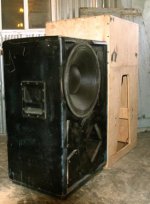
Similar in size to many 2x18” cabinets, exterior dimensions are 45 inches tall, 26.5 wide, 22.5 deep.
Weight is around 150 pounds, 68 Kilos, depending on the drivers and plywood used.
More information about the design are available in these posts:
Tapped Horn Vs. Bass Reflex Case Study - diyAudio
Horn Extender/Wave-guide for TH
Tapped Horn Directivity
Corrected plans are available in post # 487, including parts layout, thanks to NEO Dan, with the exception that the bottom of part "F" is 89 degrees, the front of "G" is a 5 degree angle, the back of "G" is 3 degrees as shown in post #478.
The previous plans #94 and #97 (thanks Oliver) have some errors due to my providing Oliver with some incorrect numbers, sorry for the confusion.
Assembly instructions are in post #1525:
https://www.diyaudio.com/community/...ng-18-15-12-inch-speakers.185588/post-7043072
Photos of finished Keystone Subs and the bass reflex (BR) cabinet as it was used for testing are in post 1039.
Photos of the cabinet interior are in Post #99 and clarification of the 9 braces used in #206 and #451.
Distortion results are in post #12, there is a typo: The * should read: third (odd order) harmonic louder than second.
Those tests were done using 77 volt sine waves (kids, don't try this at home!!), a bit less than "full power", used the 1500W AES power specification of another B&C driver rather than the 1700 W rating of the 18SW115-4.
The upper reduction in output noted in the TH sine wave tests compared to the BR tests are due to the TH upper pass band low impedance points, while the BR has a steadily rising impedance. As the tests were started from low frequency, which has better heat pumping, and ended with upper frequencies, which don't pump as much heat from the voice coil, the upper pass band compression noted in the TH compared to the BR was due to the lower upper impedance causing voice coil heating, raising impedance, causing "power compression" at 77 volts, after less than 50% duty cycle over a few minutes time.
Hornresp inputs are available in post #96 and 130.
The link explaining how distortion was measured expired, an explanation is in post #315, and a correction in #316.
PASC built a Keystone Sub TH ("tapped horn") and a xoc1 18" TH and reported his findings in posts #114 & 115.
The lower frequency response corners using a partially covered exit, ("step down" mode) is in #262, but the description is wrong:"TH18S20" has the upper 5 inches of the exit covered with plywood, exit is 20" from bottom to top. The "step down" cover results in as much as an 8 dB increase in 30 Hz level (with only 8" from bottom to top left open), but with progressive losses in the upper bass range, so for most music the trade off is not worth the extension.
The Keystone B-Low (a low "B" note is 30.87 Hz) testing started early October of 2017, initial reports using a B&C18TBW100-4 driver are in post #1135. Photos and the response curves with the B&C18TBW100-4 and the 15” Dayton PA385S-8 and a "step down" cover plate are in post #1167.
Comparative tests using the Keystone Sub loaded with an 18 inch B&C18SW115 (four ohm nominal), a 15 inch Eminence 4015LF (eight ohm), and two Eminence Lab 12 (6/2 =3 ohm) were conducted in March of 2011.
The same 16.6 inch diameter cut out was used in each case, the 4015LF used a “doughnut” adapter, the Lab 12s used an adapter that centered the two speakers on the cut out and provided a stand off so they would not slap at high excursions. The Lab 12s have a "saddle shape" frequency contour, the 96 Hz peak needs to be removed with EQ for flat response.
There are a few other peaks and dips in the response curves due to very windy conditions, often requiring waiting minutes between gusts to record responses. Test day was literally a sand storm, the bottom of the cabinet was filled with coal dust and tumbleweeds after.
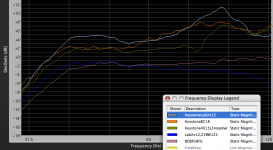
All the speakers were driven with the same level. The 4015LF is actually about the same sensitivity as the 2x12 pair, since it has about double the impedance minima.
A BR (bass reflex) LAB 2x12" (36 FB) cabinet, exactly half the size of the Keystone sub is shown in the blue trace, it’s upper response is slightly reduced due to a Butterworth 125 Hz filter, all the other subs used a BW 1000 Hz filter.
As can be seen the 15.5 gross cubic foot Keystone Sub TH loaded with the B&C18SW115-4 sensitivity averages 6 dB greater than a 8.75 gross cubic foot BR.
Twice the power and drivers in a pair of BR cabinets weighing at least 40 pounds more, and occupying 2 cubic feet more trailer space are required to equal the SPL output of one Keystone Sub. The pair of BR would be capable of few dB more output below 45 Hz, the Keystone Sub +3dB or more SPL above 45Hz, more "punch" where you may want it.
There are subjective sonic differences between the TH Keystone Sub and the BR cabinet when they are driven hard enough to approach the thermal and linear excursion limits of the driver. Running subs at "full tilt boogie" is common for most applications desiring the maximum output for the minimum trailer space, and the most "bang for the buck".
1) The TH cone is under more stress at the same input voltage than the BR, this results in slightly more distortion, and the distortion spectra is at different harmonic points- the TH sounds "louder" when driven hard.
2) The BR looses LF output due to "port compression" (turbulence) relative to upper level. The TH does not suffer from any "port compression", but suffers from more upper pass-band "power compression" than the BR. The net result is the TH sounds a bit more "aggressive" (more 45-100 Hz output) at low drive levels compared to the BR, but at high drive levels, sounds "fatter" due to the LF range not reducing, while the upper range is "compressed".
These two differences are program dependent, music with wide dynamic range won't reveal the thermal problems, while compressed and droning LF content will increase both, subjectively and measurably.
Subjectively, with the same drive level, the Keystone Sub using the B&C18 seems a bit more “punchy”, more stuff falling off shelves in the shop, and more "foot feel" in the sidewalk vibrating during out door tests. The B&C18 takes full power from a bridged Crest CC2800 effortlessly, while the Eminence 4015L 15" seemed a bit “wheezy” at a lower drive level, the Eminence LAB 2x12" in between.
The Eminence speakers used in the tests are a bit more sensitive, the 4015LF would be the best “bang for the buck” output per watt/cost for low power applications. Making a slightly wider cabinet would allow two 15 inch speakers to fit, which would probably allow about 3 or 4 dB more output at the low corner, and 5 or 6 dB more upper level with only about 20% increase in cabinet size. The Lab 12s sound cleaner, and with the same voltage applied are louder than the 4015L. For those with limited amplifier or AC power or budget, the Eminence speakers are good choices for the Keystone cabinet.
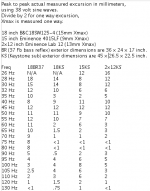
Looking at the low excursion of the Keystone vs. BR in the region from 50-90 Hz, it is evident that the cone is under a lot of stress, quite audible sounds of distress may be heard at high drive levels using lightweight (low Mms) cones.
The very stiff cones of the Lab 12 and the B&C18SW125 can take the stresses and sound clean, when pushed hard the 4015LF sounds pretty awful.
The B&C18SW115-4, though less sensitive than the Eminence speakers, will go a lot louder with a cleaner sound given more power due to its greater linear excursion capabilities, more even BL curves (the magnet "pushes" harder further), more power handling with better cooling, and a super stiff cone and suspension.
Using Hornresp simulations at rated Xmax values, (and impedance minima) average level from 35-100 Hz, the Keystone has these output levels:
BC21SW152-4 131.6 dB, 92 volts, 3.4 ohms, 2489 watts
BC18SW115-4 130.1 dB, 76v, 3.43 ohms, 1683 watts
BC18TBW100-4 127.8 dB, 59v, 3.32 ohms, 1048 watts
Eminence 2xLab12 126.3 dB, 36.5v, 2.22 ohms, 600 watts (300W per driver) 128.4 dB at 40 Hz.
Eminence 4015LF 121.9 dB, 38v, 5.17 ohms, 279 watts
The average impedance is higher than the minima, closer to the nominal rating of the speakers.
Other than the 4015LF, which did not sound good (by comparison) in this cabinet, the other drivers are capable of considerably more peak level (140+dB) without sounding bad.
I consider "safe" limiting for the Keystone sub using a B&C18SW115-4 to be as follows:
A) Use the DCR of the loudspeaker to determine the voltage setting, the DCR of the B&C18SW115-4 is 3.3 ohms, the minimum impedance of it loaded in the Keystone Sub approaches that value at Fb, where cone movement (and forced air cooling) is also at minimum.
B) The manufacturer's "Continuous Program" rating of 3400 watts is OK for peak limiting, using short time constants of a few wavelengths duration.
C) Long term "RMS" limiting with a time constant of longer than 500 ms (milliseconds) should be no more than half the rating of 1700 watts (850 watts), as AES ratings are conducted in free air (the actual power dissipated is less than 1/2 the nominal "wattage"), while driver's voice coils heat up far more when loaded in the Keystone "tapped horn" due to the far lower average impedance than the free air test. If you tend to get "heavy handed" on the volume fader playing compressed music over long time periods, use 425 watts.
If using other drivers, substitute their "Continuous Program" and 1/4 to 1/2 of the "Nominal" RMS rating for peak and average limiting settings, using the DC resistance, not the nominal speaker impedance for figuring the compressor/limiter threshold voltage settings.
Compressor/limiters will not protect a loudspeaker from excursion related mechanical damage.
Your Keystone sub should use a 30Hz 24 dB per octave Butterworth high pass filter to protect drivers from mechanical damage if amplification capable of exceeding the driver's Xmech rating are used.
Art
Welter Systems, Inc.
The Keystone is named for it’s exit shape, similar to a keystone. Like keystone lens correction for off axis projection, the keystone exit corrects some frequency response problems that result when a rectangular exit is used with the particular fold pattern employed in it’s construction.
Any person wishing to duplicate my Welter Systems designs for their own use is welcome to, any person or corporate entity that would like to produce them for sale please contact me to arrange a licensing deal to avoid violation of intellectual property rights as defined in section 27 of the Universal Declaration of Human Rights adopted as international law in 1976.
Similar in size to many 2x18” cabinets, exterior dimensions are 45 inches tall, 26.5 wide, 22.5 deep.
Weight is around 150 pounds, 68 Kilos, depending on the drivers and plywood used.
More information about the design are available in these posts:
Tapped Horn Vs. Bass Reflex Case Study - diyAudio
Horn Extender/Wave-guide for TH
Tapped Horn Directivity
Corrected plans are available in post # 487, including parts layout, thanks to NEO Dan, with the exception that the bottom of part "F" is 89 degrees, the front of "G" is a 5 degree angle, the back of "G" is 3 degrees as shown in post #478.
The previous plans #94 and #97 (thanks Oliver) have some errors due to my providing Oliver with some incorrect numbers, sorry for the confusion.
Assembly instructions are in post #1525:
https://www.diyaudio.com/community/...ng-18-15-12-inch-speakers.185588/post-7043072
Photos of finished Keystone Subs and the bass reflex (BR) cabinet as it was used for testing are in post 1039.
Photos of the cabinet interior are in Post #99 and clarification of the 9 braces used in #206 and #451.
Distortion results are in post #12, there is a typo: The * should read: third (odd order) harmonic louder than second.
Those tests were done using 77 volt sine waves (kids, don't try this at home!!), a bit less than "full power", used the 1500W AES power specification of another B&C driver rather than the 1700 W rating of the 18SW115-4.
The upper reduction in output noted in the TH sine wave tests compared to the BR tests are due to the TH upper pass band low impedance points, while the BR has a steadily rising impedance. As the tests were started from low frequency, which has better heat pumping, and ended with upper frequencies, which don't pump as much heat from the voice coil, the upper pass band compression noted in the TH compared to the BR was due to the lower upper impedance causing voice coil heating, raising impedance, causing "power compression" at 77 volts, after less than 50% duty cycle over a few minutes time.
Hornresp inputs are available in post #96 and 130.
The link explaining how distortion was measured expired, an explanation is in post #315, and a correction in #316.
PASC built a Keystone Sub TH ("tapped horn") and a xoc1 18" TH and reported his findings in posts #114 & 115.
The lower frequency response corners using a partially covered exit, ("step down" mode) is in #262, but the description is wrong:"TH18S20" has the upper 5 inches of the exit covered with plywood, exit is 20" from bottom to top. The "step down" cover results in as much as an 8 dB increase in 30 Hz level (with only 8" from bottom to top left open), but with progressive losses in the upper bass range, so for most music the trade off is not worth the extension.
The Keystone B-Low (a low "B" note is 30.87 Hz) testing started early October of 2017, initial reports using a B&C18TBW100-4 driver are in post #1135. Photos and the response curves with the B&C18TBW100-4 and the 15” Dayton PA385S-8 and a "step down" cover plate are in post #1167.
Comparative tests using the Keystone Sub loaded with an 18 inch B&C18SW115 (four ohm nominal), a 15 inch Eminence 4015LF (eight ohm), and two Eminence Lab 12 (6/2 =3 ohm) were conducted in March of 2011.
The same 16.6 inch diameter cut out was used in each case, the 4015LF used a “doughnut” adapter, the Lab 12s used an adapter that centered the two speakers on the cut out and provided a stand off so they would not slap at high excursions. The Lab 12s have a "saddle shape" frequency contour, the 96 Hz peak needs to be removed with EQ for flat response.
There are a few other peaks and dips in the response curves due to very windy conditions, often requiring waiting minutes between gusts to record responses. Test day was literally a sand storm, the bottom of the cabinet was filled with coal dust and tumbleweeds after.
All the speakers were driven with the same level. The 4015LF is actually about the same sensitivity as the 2x12 pair, since it has about double the impedance minima.
A BR (bass reflex) LAB 2x12" (36 FB) cabinet, exactly half the size of the Keystone sub is shown in the blue trace, it’s upper response is slightly reduced due to a Butterworth 125 Hz filter, all the other subs used a BW 1000 Hz filter.
As can be seen the 15.5 gross cubic foot Keystone Sub TH loaded with the B&C18SW115-4 sensitivity averages 6 dB greater than a 8.75 gross cubic foot BR.
Twice the power and drivers in a pair of BR cabinets weighing at least 40 pounds more, and occupying 2 cubic feet more trailer space are required to equal the SPL output of one Keystone Sub. The pair of BR would be capable of few dB more output below 45 Hz, the Keystone Sub +3dB or more SPL above 45Hz, more "punch" where you may want it.
There are subjective sonic differences between the TH Keystone Sub and the BR cabinet when they are driven hard enough to approach the thermal and linear excursion limits of the driver. Running subs at "full tilt boogie" is common for most applications desiring the maximum output for the minimum trailer space, and the most "bang for the buck".
1) The TH cone is under more stress at the same input voltage than the BR, this results in slightly more distortion, and the distortion spectra is at different harmonic points- the TH sounds "louder" when driven hard.
2) The BR looses LF output due to "port compression" (turbulence) relative to upper level. The TH does not suffer from any "port compression", but suffers from more upper pass-band "power compression" than the BR. The net result is the TH sounds a bit more "aggressive" (more 45-100 Hz output) at low drive levels compared to the BR, but at high drive levels, sounds "fatter" due to the LF range not reducing, while the upper range is "compressed".
These two differences are program dependent, music with wide dynamic range won't reveal the thermal problems, while compressed and droning LF content will increase both, subjectively and measurably.
Subjectively, with the same drive level, the Keystone Sub using the B&C18 seems a bit more “punchy”, more stuff falling off shelves in the shop, and more "foot feel" in the sidewalk vibrating during out door tests. The B&C18 takes full power from a bridged Crest CC2800 effortlessly, while the Eminence 4015L 15" seemed a bit “wheezy” at a lower drive level, the Eminence LAB 2x12" in between.
The Eminence speakers used in the tests are a bit more sensitive, the 4015LF would be the best “bang for the buck” output per watt/cost for low power applications. Making a slightly wider cabinet would allow two 15 inch speakers to fit, which would probably allow about 3 or 4 dB more output at the low corner, and 5 or 6 dB more upper level with only about 20% increase in cabinet size. The Lab 12s sound cleaner, and with the same voltage applied are louder than the 4015L. For those with limited amplifier or AC power or budget, the Eminence speakers are good choices for the Keystone cabinet.
Looking at the low excursion of the Keystone vs. BR in the region from 50-90 Hz, it is evident that the cone is under a lot of stress, quite audible sounds of distress may be heard at high drive levels using lightweight (low Mms) cones.
The very stiff cones of the Lab 12 and the B&C18SW125 can take the stresses and sound clean, when pushed hard the 4015LF sounds pretty awful.
The B&C18SW115-4, though less sensitive than the Eminence speakers, will go a lot louder with a cleaner sound given more power due to its greater linear excursion capabilities, more even BL curves (the magnet "pushes" harder further), more power handling with better cooling, and a super stiff cone and suspension.
Using Hornresp simulations at rated Xmax values, (and impedance minima) average level from 35-100 Hz, the Keystone has these output levels:
BC21SW152-4 131.6 dB, 92 volts, 3.4 ohms, 2489 watts
BC18SW115-4 130.1 dB, 76v, 3.43 ohms, 1683 watts
BC18TBW100-4 127.8 dB, 59v, 3.32 ohms, 1048 watts
Eminence 2xLab12 126.3 dB, 36.5v, 2.22 ohms, 600 watts (300W per driver) 128.4 dB at 40 Hz.
Eminence 4015LF 121.9 dB, 38v, 5.17 ohms, 279 watts
The average impedance is higher than the minima, closer to the nominal rating of the speakers.
Other than the 4015LF, which did not sound good (by comparison) in this cabinet, the other drivers are capable of considerably more peak level (140+dB) without sounding bad.
I consider "safe" limiting for the Keystone sub using a B&C18SW115-4 to be as follows:
A) Use the DCR of the loudspeaker to determine the voltage setting, the DCR of the B&C18SW115-4 is 3.3 ohms, the minimum impedance of it loaded in the Keystone Sub approaches that value at Fb, where cone movement (and forced air cooling) is also at minimum.
B) The manufacturer's "Continuous Program" rating of 3400 watts is OK for peak limiting, using short time constants of a few wavelengths duration.
C) Long term "RMS" limiting with a time constant of longer than 500 ms (milliseconds) should be no more than half the rating of 1700 watts (850 watts), as AES ratings are conducted in free air (the actual power dissipated is less than 1/2 the nominal "wattage"), while driver's voice coils heat up far more when loaded in the Keystone "tapped horn" due to the far lower average impedance than the free air test. If you tend to get "heavy handed" on the volume fader playing compressed music over long time periods, use 425 watts.
If using other drivers, substitute their "Continuous Program" and 1/4 to 1/2 of the "Nominal" RMS rating for peak and average limiting settings, using the DC resistance, not the nominal speaker impedance for figuring the compressor/limiter threshold voltage settings.
Compressor/limiters will not protect a loudspeaker from excursion related mechanical damage.
Your Keystone sub should use a 30Hz 24 dB per octave Butterworth high pass filter to protect drivers from mechanical damage if amplification capable of exceeding the driver's Xmech rating are used.
Art
Welter Systems, Inc.
Attachments
Last edited:


Interesting stuff Art,
I think the keystone opening has the effect of shortening the last segment making the driver closer to the horn mouth, and the keystone mouth area could be simulated as a mouth cover plate in HR. Do you have any models you can share? Or even the dimensions? We can draw up what you have and create the model.
I think the keystone opening has the effect of shortening the last segment making the driver closer to the horn mouth, and the keystone mouth area could be simulated as a mouth cover plate in HR. Do you have any models you can share? Or even the dimensions? We can draw up what you have and create the model.

Thanks for the extended tests.
Are there other threads about this keystone concept?
The OP has 3 links to other threads.
A circular cover plate does not have the same effect as the Keystone shape.Interesting stuff Art,
I think the keystone opening has the effect of shortening the last segment making the driver closer to the horn mouth, and the keystone mouth area could be simulated as a mouth cover plate in HR. Do you have any models you can share? Or even the dimensions? We can draw up what you have and create the model.
Have you found a way to simulate anything but a circular mouth in Hornresp?
I did dozens of models that had upper dips, or not enough low extension.
The Keystone exit shape allowed the low extension without a dip below 100 Hz.
Sharing models that don't match the "as built" cabinet does not seem useful to me.
Exterior dimensions are 45H x 26.5W x 22.5 D.
The compression ratio is 2.5 to one, ultimate path length is about 312 centimeters.
The Keystone exit perhaps could be thought of as a longer path for low frequencies and shorter path for the upper pass band, providing loading to a fairly low corner while reducing some upper peaks and dips.
Art
Dan,You are the OP 😀
Is there any more info you will be sharing with us?
I'll be posting distortion figures for the various configurations, with comparisons to the same drivers in BR cabinets with similar LF corners.
Preliminary review of the data has confirmed that TH add in an upper band of distortion compared to BR, one of the reasons they "sound different" than BR or conventional horns.
Art
intresting stuf again.
normally the lab 12 isn't realy a good th candidate,for ~35 ish (simulated)
if i ever gona bild my symetric th,i deffenetly gone tryout some different mouths.
normally the lab 12 isn't realy a good th candidate,for ~35 ish (simulated)
if i ever gona bild my symetric th,i deffenetly gone tryout some different mouths.
A circular cover plate does not have the same effect as the Keystone shape.
Have you found a way to simulate anything but a circular mouth in Hornresp?
I did dozens of models that had upper dips, or not enough low extension.
The Keystone exit shape allowed the low extension without a dip below 100 Hz.
Sharing models that don't match the "as built" cabinet does not seem useful to me.
Exterior dimensions are 45H x 26.5W x 22.5 D.
The compression ratio is 2.5 to one, ultimate path length is about 312 centimeters.
The Keystone exit perhaps could be thought of as a longer path for low frequencies and shorter path for the upper pass band, providing loading to a fairly low corner while reducing some upper peaks and dips.
Art
IMO the problem for simulation is not the shape but that the mouth opening is not at the end of the line but along the path leading up to it, and that's where the sliders come into play. Your keystone could easily be an egg...

We could call it the scrambler... wha wha wha

The Lab 12 pair definitely sounded better than the 4015LF.intresting stuf again.
normally the lab 12 isn't realy a good th candidate,for ~35 ish (simulated)
if i ever gona bild my symetric th,i deffenetly gone tryout some different mouths.
Most of the "classic" one fold THs do not have the mouth opening at the "end of the line", their mouth location is the same relative position as the Keystone. However, the Keystone shape provides a different loading than a square or rectangular shape.IMO the problem for simulation is not the shape but that the mouth opening is not at the end of the line but along the path leading up to it, and that's where the sliders come into play.
Distortion Tests
Below are distortion figures for the BC18SW115-4 in the BR cabinet and the Keystone, and a pair of lab 12 in the Keystone, using sine wave tests.
The 6 ohm Eminence Lab 12 is rated at 400 watts, tests were done at 800 watts, 49 volts into 3 ohms.
The B&C BC18SW115-4 is rated at 1500 watts, it was tested with 77.5 volts into 4 ohms.
Distortion was taken as the nearest whole number from the “distortion calculator” chart below, no attempt was made to sum all the various distortion harmonics together.
More detail in the methodology and distortion readings for other speakers can be seen in this thread, page six sums up most of the information:
PSW Sound Reinforcement Forums: LAB Lounge => JBL SRX718 - Basic Distortion Measurements
My test computer was carried away by a gust of wind yesterday, suffered a four foot drop, breaking the screen :^(. An expensive gust that occurred just before the last test I was going to attempt before it started to rain.
Unfortunately I will not be able to post any distortion screen shots until the computer is repaired.
The BC18SW115-4 BR 38 Fb averaged 120.6 dB, 2.69% distortion.
The BC18SW115-4 TH averaged 126.52 dB, 5.438% distortion.
The 2xLab12 TH averaged 124.33 dB, 6.375% distortion.
In a previous test, 2xLab12 in a ported cabinet averaged 117.12 dB, 6.25% distortion.
So much for “ tapped horns are cleaner than BR” myth.
Especially since the TH have more distortion up high, the 80 Hz harmonics march right up into the 320 Hz and above range.
Of course, if the BR were given enough power to be the same level as the TH, it’s distortion would be higher, though the upper end would probably still be clean.
The 2xLab12 TH is about 2 dB more sensitive than the B&C TH, so should have been within a dB of it with half the power, but the B&C was 2.188 dB louder overall.
Other than below 30 Hz,( all the cabinets need a 28 Hz or so filter) the B&C probably would be OK with at least 3000 watts peak.
The overall margin of level difference between the BC18SW115-4 in the BR compared to the TH is 5.92 dB, about the same as the sensitivity difference was in the magnitude response.
However the BR has lost LF relative to HF in the high power sine wave tests compared to the Magnitude Response tests, perhaps to port compression.
The B&C TH is the inverse, the upper 90 Hz area peak has gone away at high power sine wave testing.
Port compression is well known, the loss of upper frequencies, that is kind of “different”.
The Lab 12s, however, retained their more prominent 90-100 Hz peak, the only frequencies that broke the 130 dB one meter barrier, assuming I have Smaart SPL calibrated correctly.
I think it is within a dB or so of reality, and the BK-4004, used for the tests is rated for 148 dB at less than 1% THD.
Comparing the frequencies from 35 to 70 Hz:
The BC18SW115-4 BR 38 Fb averaged 119.53 dB.
The BC18SW115-4 TH averaged 127.27 dB.
The 2xLab12 TH averaged 124.28 dB.
In the lower range, the TH is louder than the BR by 7.74 dB, and the BC18TH has beat the Lab 12TH by 2.99 dB, using about 3 dB more power. The Lab 12s were pretty well maxed out at 50 Hz, while the BC18SW115-4 could still take another 3 dB or more overall, probably achieving 5- 6 dB more output.
I did high volume magnitude response tests to see if these frequency response differences show up with pink noise, using an amp capable of 85 volts just at clip level, the response curves for the BC18SW115-4 looked almost identical at their curves at -10 dB.
The Lab 12 had a slight dip in the range from around 45-60 Hz at high power compared to low, the power level was enough to cause power compression, as evidenced by the 45-60 Hz dip still evident even at low power until the voice coils cooled down.
During testing, at times I noted the Lab 12 magnet structure getting fairly warm compared to the ambient temperature, and a fair amount of heat coming from the vent, while the BC18SW115-4, getting almost double the power of the two Lab 12,
The amp used for the test was a Speaker Power “Torpedo” SP1-4000-DS, a “plate amp” designed to be put in a speaker cabinet, it is a good power match for the Lab 12s, (and will power four in Paraline without problem) but a bit light for the BC18SW115-4.
All this testing is expensive, I blew up a QSC PL3602 comparing it to the SP1-4000-DS, then broke my computer yesterday.
And after all the testing with the BC18SW115-4, although it will definitely put out more level than the Lab 12 or 4015LF speakers, unless I get some more powerful amps, I’ll hardly see any increase in the LF output of my system.
The many pleasures of DIY.
Art Welter
You are the OP 😀
Is there any more info you will be sharing with us?
Below are distortion figures for the BC18SW115-4 in the BR cabinet and the Keystone, and a pair of lab 12 in the Keystone, using sine wave tests.
The 6 ohm Eminence Lab 12 is rated at 400 watts, tests were done at 800 watts, 49 volts into 3 ohms.
The B&C BC18SW115-4 is rated at 1500 watts, it was tested with 77.5 volts into 4 ohms.
Distortion was taken as the nearest whole number from the “distortion calculator” chart below, no attempt was made to sum all the various distortion harmonics together.
More detail in the methodology and distortion readings for other speakers can be seen in this thread, page six sums up most of the information:
PSW Sound Reinforcement Forums: LAB Lounge => JBL SRX718 - Basic Distortion Measurements
My test computer was carried away by a gust of wind yesterday, suffered a four foot drop, breaking the screen :^(. An expensive gust that occurred just before the last test I was going to attempt before it started to rain.
Unfortunately I will not be able to post any distortion screen shots until the computer is repaired.
The BC18SW115-4 BR 38 Fb averaged 120.6 dB, 2.69% distortion.
The BC18SW115-4 TH averaged 126.52 dB, 5.438% distortion.
The 2xLab12 TH averaged 124.33 dB, 6.375% distortion.
In a previous test, 2xLab12 in a ported cabinet averaged 117.12 dB, 6.25% distortion.
So much for “ tapped horns are cleaner than BR” myth.
Especially since the TH have more distortion up high, the 80 Hz harmonics march right up into the 320 Hz and above range.
Of course, if the BR were given enough power to be the same level as the TH, it’s distortion would be higher, though the upper end would probably still be clean.
The 2xLab12 TH is about 2 dB more sensitive than the B&C TH, so should have been within a dB of it with half the power, but the B&C was 2.188 dB louder overall.
Other than below 30 Hz,( all the cabinets need a 28 Hz or so filter) the B&C probably would be OK with at least 3000 watts peak.
The overall margin of level difference between the BC18SW115-4 in the BR compared to the TH is 5.92 dB, about the same as the sensitivity difference was in the magnitude response.
However the BR has lost LF relative to HF in the high power sine wave tests compared to the Magnitude Response tests, perhaps to port compression.
The B&C TH is the inverse, the upper 90 Hz area peak has gone away at high power sine wave testing.
Port compression is well known, the loss of upper frequencies, that is kind of “different”.
The Lab 12s, however, retained their more prominent 90-100 Hz peak, the only frequencies that broke the 130 dB one meter barrier, assuming I have Smaart SPL calibrated correctly.
I think it is within a dB or so of reality, and the BK-4004, used for the tests is rated for 148 dB at less than 1% THD.
Comparing the frequencies from 35 to 70 Hz:
The BC18SW115-4 BR 38 Fb averaged 119.53 dB.
The BC18SW115-4 TH averaged 127.27 dB.
The 2xLab12 TH averaged 124.28 dB.
In the lower range, the TH is louder than the BR by 7.74 dB, and the BC18TH has beat the Lab 12TH by 2.99 dB, using about 3 dB more power. The Lab 12s were pretty well maxed out at 50 Hz, while the BC18SW115-4 could still take another 3 dB or more overall, probably achieving 5- 6 dB more output.
I did high volume magnitude response tests to see if these frequency response differences show up with pink noise, using an amp capable of 85 volts just at clip level, the response curves for the BC18SW115-4 looked almost identical at their curves at -10 dB.
The Lab 12 had a slight dip in the range from around 45-60 Hz at high power compared to low, the power level was enough to cause power compression, as evidenced by the 45-60 Hz dip still evident even at low power until the voice coils cooled down.
During testing, at times I noted the Lab 12 magnet structure getting fairly warm compared to the ambient temperature, and a fair amount of heat coming from the vent, while the BC18SW115-4, getting almost double the power of the two Lab 12,
The amp used for the test was a Speaker Power “Torpedo” SP1-4000-DS, a “plate amp” designed to be put in a speaker cabinet, it is a good power match for the Lab 12s, (and will power four in Paraline without problem) but a bit light for the BC18SW115-4.
All this testing is expensive, I blew up a QSC PL3602 comparing it to the SP1-4000-DS, then broke my computer yesterday.
And after all the testing with the BC18SW115-4, although it will definitely put out more level than the Lab 12 or 4015LF speakers, unless I get some more powerful amps, I’ll hardly see any increase in the LF output of my system.
The many pleasures of DIY.
Art Welter
Attachments


Hi Art,
My condolences on your losses.
What took out the QSC?
It would be nice to see the difference in the keystone vs a normal box width terminated TH mouth.
My condolences on your losses.
What took out the QSC?
It would be nice to see the difference in the keystone vs a normal box width terminated TH mouth.

I completely understand your situation, testing equipment the right way takes so much time just to get accurate results. It must have taken an enormous amount of time to build and test all your stuff.
Now others can see and review your findings ... To bad it came at the cost of some of your equipment. What are your thoughts on the doubling distortion figure for the 18" TH vs the 18" BR? Could it be from the TH being less damped than the BR.?
Anyways thanks for the info.
Now others can see and review your findings ... To bad it came at the cost of some of your equipment. What are your thoughts on the doubling distortion figure for the 18" TH vs the 18" BR? Could it be from the TH being less damped than the BR.?
Anyways thanks for the info.
Last edited:
No, it was out of the warranty period. Had I had high speed internet when I bought the QSC amps, I could have taken advantage of an extended warranty which would have covered the amp. I asked Bob Lee from QSC for extending the warranty as a favor, but no dice.
The damage was not too bad, one blown output transistor, $100 repair plus a 100 mile round trip X 2.
The MacBook was out of warranty by a bit too, but physical damage would not have been covered anyway, as I found out yesterday.
I will have to remember to use a "safety belt" on the computer for outside testing.
Art Welter
Hopefully I can show you that when the MacBook is repaired, all the Smaart records were on that machine, and I had not backed it up during the Keystone project,Hi Art,
My condolences on your losses.
What took out the QSC?
It would be nice to see the difference in the keystone vs a normal box width terminated TH mouth.
The QSC protection circuit did not respond quick enough to avoid damage when presented with a dead short with the inputs wide open with a very robust pink noise signal.
I normally turn off amp power and zero the inputs after each gig, but I had missed doing that with the PLX-3602. Five of the six amps I had on the last gig were all turned down, I happened to plug in to the one that was not zeroed.
I plugged in the input, plugged in the output, plugged in the AC, click clack click clack of the protection circuit.
A clip lead connecting the VOM test leads to the load resister bank had shifted, causing a dead short. If the amp's inputs had been brought up slowly, the protection circuit probably would have saved it.
Oh well, can't help bad luck...
Art
eremy,I completely understand your situation, testing equipment the right way takes so much time just to get accurate results. It must have taken an enormous amount of time to build and test all your stuff.
Now others can see and review your findings ... To bad it came at the cost of some of your equipment. What are your thoughts on the doubling distortion figure for the 18" TH vs the 18" BR? Could it be from the TH being less damped than the BR.?
Anyways thanks for the info.
All the TH research, design time and testing have occupied most of my time since the beginning of February.
Not sure what you mean by the TH being “less damped” neither the TH or Thiele BR use any damping material in the cabinet.
Acoustically, I would think the TH dampens the speaker more than a BR.
The Keystone TH is almost 6 dB more sensitive overall than the BR, more in the upper region of the pass band.
To get that sensitivity, seems both sides of the cone are “working harder”, the extra loading stress seems to translate to more distortion.
The Lab 12 had a bit more distortion than the BC18SW115-4, but it’s distortion figures did not change as much between BR and TH. The BC18SW115-4 is a very stiff cone, but the Lab 12 is cone is even stiffer.
The Lab 12 suspension is looser than the BC18SW115, it is probably a bit above Xmax at the 30 and 50 Hz tests.
I did not test the distortion of the 4015LF in the Keystone, but from my listening tests it was obviously more distorted than in the BR cabinet I measured it in previously.
The 4015LF cone feels almost “mushy” by comparison to the BC18SW115.
Stiff cones seem to help lower distortion in TH.
The Eminence 3015LF is popular in TH, it is lighter (and therefore more sensitive) than the 4015LF. I’d expect it’s distortion to be higher also.
Frequency, phase and transient response differences all make for different sounding speakers. Distortion is one of the “big four” regarding speakers, yet is seldom mentioned.
It’s funny to see people worry about .01 distortion in amplifiers, when good speakers, pushed to rated power levels, frequently exceed 10%.
The testing I did can easily be done by anyone with an RTA, it would be interesting to see more results from different DIY and commercial cabinets.
Art Welter
Hopefully I can show you that when the MacBook is repaired, all the Smaart records were on that machine, and I had not backed it up during the Keystone project
Hopefully the MacBook is not super expensive to repair, I know guard my MBP like a hawk.
I've been using a free dropbox account to handle the backup of measurement files and programs like Hornresp across Mac and PC systems. Here is my referral link to dropbox it'll get us both some extra space. Another awesome and free thing that I use is evernote, these guys should get a nobel.

Dang Art. Careful with the equipment man. Of course its just not a complete day of testing without frying a sound card or mechanically breaking an $800 driver. Both things I have done.
TH distortion is more variable than what you see with traditional direct radiator systems. Some areas are very very clean and others within the fr will have much higher thd than the equivalent direct radiator. The varying loading and pressures on the cone, the xmax variance and more importantly the acoustic boosting at certain freqs causes the thd profile to be highly range dependant unlike a traditional direct box that has a predictable but comparatively smooth thd profile. TH's have much greater swings in thd level through out the operational range.
TH distortion is more variable than what you see with traditional direct radiator systems. Some areas are very very clean and others within the fr will have much higher thd than the equivalent direct radiator. The varying loading and pressures on the cone, the xmax variance and more importantly the acoustic boosting at certain freqs causes the thd profile to be highly range dependant unlike a traditional direct box that has a predictable but comparatively smooth thd profile. TH's have much greater swings in thd level through out the operational range.
- Home
- Loudspeakers
- Subwoofers
- Keystone Sub Using 18, 15, & 12 Inch Speakers