

My (former) mains PA uses rather small horn top cabinets, only 26.5 inch wide. The sealed conical expansion FLH (front loaded horn) response drops below 200 Hz, but using fourteen 8" drivers per side makes the response OK to around 70 Hz. When I need a bit more low end and directivity I use wave-guides in front of the stack, it gives the low end of the horn a 3 dB boost down to around 70 Hz, and maintains the 90 degree pattern down pretty low.
In front of the Keystone TH (tapped horn) cabinet, the wave-guide increases SPL (sound pressure level) by an average of 3 dB over the entire sub-woofer pass-band from 36 to 100Hz.
The wave-guide adds SPL to any LF (low frequency) enclosure by increasing forward directivity.
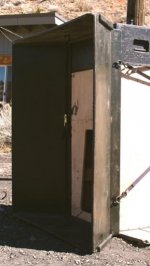
The wave-guides in the photos below are constructed from four pieces (top and bottom, left and right sides), and break down to a package about 6" (inches) x 20" x 54.75". Ratchet straps are used to attach the four parts, and to attach the wave-guides to the mains cabinets. There are no rattles even at the full peak power of around 6600 watts per stack. Since the wave-guides couple a larger area/volume of air in front of the stack, SPL in the immediate vicinity directly in front of the stack is actually lower than without the wave guide.
The wave-guides take a few minutes extra time to set up, but considering the cost to output level increase they afford in a small cargo space, the equivalent of doubling speaker cabinets without paying for the second set is quite worth it on gigs that need a lot of SPL using the minimum amount of power.
To sum up, the advantages of horn extensions and wave-guides ("barn-doors") are several:
1) Some venues are simply too small to use a really large horn in.
2) Horn extensions can be made to nest like Dixie cups, as did the Community "Leviathan" horns from the 1970s, or can be made in four parts, like my 1977 (or 1978?) exponential FLH "Collapsable Crunchers", or the wave-guides described from this century. Any of those approaches can reduce the transport volume by as much as 90% compared to a single horn of equal size, but do require more set up time, construction is more difficult, and some extra hardware is required.
3) The two "tunings" (Fb or Fc) afforded allow a horn extension to be left off if program material does not require the extra LF (low frequency) extension. That said, a cabinet designed for horn extensions may be a compromise in either configuration, especially in TH compared to FLH designs.
4) Wave-guides can add 3-6 dB forward gain with no power compression, drastically reducing power demands for a given SPL compared to the same cabinets without, and require no special design consideration regardless of cabinet design- they work equally well on BR (bass-reflex), TH, or FLH. The bigger the wave-guide, the better, for more forward gain and reduced rear "wash", while also reducing SPL in the immediate near-field directly in front of the cabinets.
Some wave-guide construction details are in post #40.
An example of a rather ineffective TH extension is in post #9, and a far more effective TH in post #49.
Art
In front of the Keystone TH (tapped horn) cabinet, the wave-guide increases SPL (sound pressure level) by an average of 3 dB over the entire sub-woofer pass-band from 36 to 100Hz.
The wave-guide adds SPL to any LF (low frequency) enclosure by increasing forward directivity.
The wave-guides in the photos below are constructed from four pieces (top and bottom, left and right sides), and break down to a package about 6" (inches) x 20" x 54.75". Ratchet straps are used to attach the four parts, and to attach the wave-guides to the mains cabinets. There are no rattles even at the full peak power of around 6600 watts per stack. Since the wave-guides couple a larger area/volume of air in front of the stack, SPL in the immediate vicinity directly in front of the stack is actually lower than without the wave guide.
The wave-guides take a few minutes extra time to set up, but considering the cost to output level increase they afford in a small cargo space, the equivalent of doubling speaker cabinets without paying for the second set is quite worth it on gigs that need a lot of SPL using the minimum amount of power.
To sum up, the advantages of horn extensions and wave-guides ("barn-doors") are several:
1) Some venues are simply too small to use a really large horn in.
2) Horn extensions can be made to nest like Dixie cups, as did the Community "Leviathan" horns from the 1970s, or can be made in four parts, like my 1977 (or 1978?) exponential FLH "Collapsable Crunchers", or the wave-guides described from this century. Any of those approaches can reduce the transport volume by as much as 90% compared to a single horn of equal size, but do require more set up time, construction is more difficult, and some extra hardware is required.
3) The two "tunings" (Fb or Fc) afforded allow a horn extension to be left off if program material does not require the extra LF (low frequency) extension. That said, a cabinet designed for horn extensions may be a compromise in either configuration, especially in TH compared to FLH designs.
4) Wave-guides can add 3-6 dB forward gain with no power compression, drastically reducing power demands for a given SPL compared to the same cabinets without, and require no special design consideration regardless of cabinet design- they work equally well on BR (bass-reflex), TH, or FLH. The bigger the wave-guide, the better, for more forward gain and reduced rear "wash", while also reducing SPL in the immediate near-field directly in front of the cabinets.
Some wave-guide construction details are in post #40.
An example of a rather ineffective TH extension is in post #9, and a far more effective TH in post #49.
Art
Attachments


Last edited:


Would/was there any difference to the output if the extender were to be made to fit just the height and width dimensions of the mouth of the keystone. Or did you find better results with the full length/width unit?
This is all very interesting and I wonder if this effect works on other types of enclosures. Looks like you have done a ton of work to get this box just right, good job!
Will this designs be replacing your lab 12 BR's?
This is all very interesting and I wonder if this effect works on other types of enclosures. Looks like you have done a ton of work to get this box just right, good job!
Will this designs be replacing your lab 12 BR's?
I will probably keep one pair of the dual Lab 12 for small shows.Would/was there any difference to the output if the extender were to be made to fit just the height and width dimensions of the mouth of the keystone. Or did you find better results with the full length/width unit?
This is all very interesting and I wonder if this effect works on other types of enclosures. Looks like you have done a ton of work to get this box just right, good job!
Will this designs be replacing your lab 12 BR's?
The extender happened to work quite well with the Keystone sub, it may work well with other TH designs of similar aspect ratio.
Reducing the size to the height of the mouth would probably reduce the gain by half.
A TH extender may benefit many other systems.Awesome , good to see your design will benefit your system.
A 3 dB increase with a sheet of plywood is a big deal.
Wave guide implementation
Art,
this is quite interesting, to say the least!
Wave guides have been in use for a long time, and are well known to work for front loaded horns. However, they are not really in the vogue currently, so for many they may appear ground breaking.
I am not sure, but I suspect you may be one of the first to use a wave guide for tapped horns. I would like to say, that like JBell and other builders, your research and voluntary sharing of findings should be lauded!
And now some questions:
Why is the wave guide the height of the cabinet, as opposed to being the height of the mouth?
Have you considered - If you built the wave guide as a rigid unit, but with at least 3 sides angled - you could nest/stack them neatly in one another?
What angle are your sides at?
What minimum length do you recommend for the sides or for path extension?
If I make them for the JBELL stadium horns, would you suggest any differences to your approach?
Thanks!
Kind regards, Ben
Art,
this is quite interesting, to say the least!
Wave guides have been in use for a long time, and are well known to work for front loaded horns. However, they are not really in the vogue currently, so for many they may appear ground breaking.
I am not sure, but I suspect you may be one of the first to use a wave guide for tapped horns. I would like to say, that like JBell and other builders, your research and voluntary sharing of findings should be lauded!
And now some questions:
Why is the wave guide the height of the cabinet, as opposed to being the height of the mouth?
Have you considered - If you built the wave guide as a rigid unit, but with at least 3 sides angled - you could nest/stack them neatly in one another?
What angle are your sides at?
What minimum length do you recommend for the sides or for path extension?
If I make them for the JBELL stadium horns, would you suggest any differences to your approach?
Thanks!
Kind regards, Ben
Last edited:
A ridged side “Dixie Cup” approach could save time in set up if one has the room, the Community Leviathan did that for their horn extenders.And now some questions:
Why is the wave guide the height of the cabinet, as opposed to being the height of the mouth?
Have you considered - If you built the wave guide as a rigid unit, but with at least 3 sides angled - you could nest/stack them neatly in one another?
What angle are your sides at?
What minimum length do you recommend for the sides or for path extension?
If I make them for the JBELL stadium horns, would you suggest any differences to your approach?
Thanks!
Kind regards, Ben
I don’t have the room for that, the wave guides (double in height to what was shown in front of the Keystone sub) fit on either side of speaker cabinets in the front “V” section of my 5 x8 foot trailer.
Having angled top and bottom also makes stacking problematic, another reason in favor of a flat top and bottom.
The wave guides I have were made to extend the mid/high horns in my system, the horn extension is 90 degrees (45 degrees each side), 15 inches from front to back.
As I mentioned in the OP, the wave-guide/extender increases the low end of the mid horn by about 3 dB down to around 70 Hz, but using it in front of bass reflex cabinets or folded horn cabinets below 70 Hz, the wave-guides did not increase level noticeably in that range.
So I really did not have high expectations when I tried the wave-guide with the Keystone sub, though a quick model using Hornresp looked promising enough for me to do the test.
I stack my top cabinets on top of my sub cabinets.
When I use the wave-guides, they stack from the ground up, so whether they would do anything for the sub response really made no difference .
The 3 dB increase across the entire sub range was a pleasant surprise .
The Keystone sub has a rather large front panel to mouth compared to many TH designs, which makes for a larger boundary. The wave guide more than doubles that boundary, and when mirrored by the ground plane, makes for five times the frontal area boundary.
The large boundary increases directivity so forward gain is increased, while level to the sides and behind is reduced, the same as what is observed when multiple TH are arrayed.
Extending an array’s front to double the area probably would also increase directivity by a similar amount as I measured.
As far as using a wave-guide with the JBELL stadium horns, (or any other tapped horn) I’d suggest the bigger, the better, but I’d expect from my test that doubling the frontal area should result in 3 dB forward gain, and a corresponding rearward loss.
My educated guess would be to make the wave-guide twice the width as height, as the height is doubled by the ground plane, and a large area square should be optimum as a boundary.
That said, a taller aspect ratio will reduce vertical coverage while maintaining horizontal coverage, so if the audience is all on one plane (no balcony seating) a square mouth shape may be preferable.
Won’t cost anything but time to prop up some plywood (assuming you have some sheets already) in various configurations and measure and listen to the results.
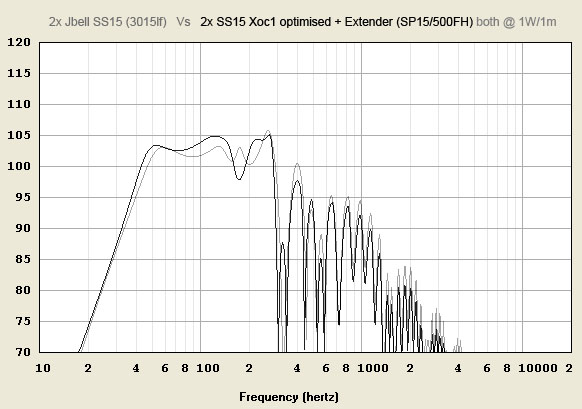
Found a test done using FLH with the same type of waveguide/extension as used on the Keystone TH, the waveguide worked better than I remembered, chart below.
The pair of Chorn cabinets have a frontal area the same as a single Keystone.
Just did more testing using various BR stack configurations with and without flat extenders:
http://www.diyaudio.com/forums/subwoofers/204472-multiple-cabinet-combined-response.html
The pair of Chorn cabinets have a frontal area the same as a single Keystone.
Just did more testing using various BR stack configurations with and without flat extenders:
http://www.diyaudio.com/forums/subwoofers/204472-multiple-cabinet-combined-response.html
Attachments

That extension appears to have no flare
May I ask, isn't some flare important for these extensions?
Regards, Ben
P.S. nice sim!
May I ask, isn't some flare important for these extensions?
Regards, Ben
P.S. nice sim!
Hi Ben,
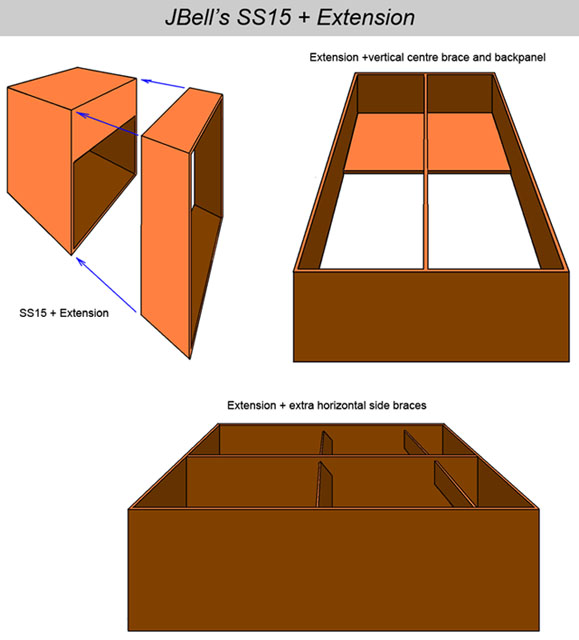
Thanks, but I don't use fancy software for that, just draw them in Paint.
Nope, they don't have to flare out if you know what you are doing. Large waves don't see anything that small. You can even make your TH out of 6 straight sections if it doesn't need to play above its full wavelength. This one was another rough idea to make the SS15 (Xoc1 optimised version) couple better in stacks, loaded with the Monacor SP15/500FH.
Thanks, but I don't use fancy software for that, just draw them in Paint.
Nope, they don't have to flare out if you know what you are doing. Large waves don't see anything that small. You can even make your TH out of 6 straight sections if it doesn't need to play above its full wavelength. This one was another rough idea to make the SS15 (Xoc1 optimised version) couple better in stacks, loaded with the Monacor SP15/500FH.
Last edited:
Nice
Your paint skills certainly exceed mine!
Occasionally I have seen a few quite pricey subs extended like this...
though I must say, years ago when I saw my first one, I thought it was BS - a bass reflex box with the sides, top and bottom extended forward maybe 3 times the depth of the cabinet!
This does of course mean that we could make a 19mm sleeve that slides completely over the cabinet for transport / storage and extends when in use by sliding out.
It could be braced very much like you have indicated at the front, maybe I'd add diagonal or angled bracing.
Regards, Ben
Your paint skills certainly exceed mine!
Occasionally I have seen a few quite pricey subs extended like this...
though I must say, years ago when I saw my first one, I thought it was BS - a bass reflex box with the sides, top and bottom extended forward maybe 3 times the depth of the cabinet!
This does of course mean that we could make a 19mm sleeve that slides completely over the cabinet for transport / storage and extends when in use by sliding out.
It could be braced very much like you have indicated at the front, maybe I'd add diagonal or angled bracing.
Regards, Ben
Would something like this have a greater effect?
http://sp3.fotolog.com/photo/19/50/9/refugiosonido/1248065648953_f.jpg
The Levan horn extension
or does one design make the system more directional
Regards, Ben
http://sp3.fotolog.com/photo/19/50/9/refugiosonido/1248065648953_f.jpg
The Levan horn extension
or does one design make the system more directional
An externally hosted image should be here but it was not working when we last tested it.
whilst another increases efficiency or lowers cutoff?Regards, Ben
Hi Ben,
In the end he used a iron frame with mash front and for attachment he used 'butterfly' connections, as used in flightcases. It seems to work very well and he uses the extension units for storing his cables. The goal was freq. extension to 40Hz and had to fit in his station car with a max of 400Euro for 2 drivers.
Yes, it does improve coupling in stacks gives an improved directivity pattern and some low end extension.
In the end he used a iron frame with mash front and for attachment he used 'butterfly' connections, as used in flightcases. It seems to work very well and he uses the extension units for storing his cables. The goal was freq. extension to 40Hz and had to fit in his station car with a max of 400Euro for 2 drivers.
Yes, it does improve coupling in stacks gives an improved directivity pattern and some low end extension.
Last edited:
flat to 40Hz
is very good for a cabinet that small and efficient! I am thinking about building an extender for my sixpack, once that is complete.
And now I'm off to make some sawdust!
Regards, Ben
is very good for a cabinet that small and efficient! I am thinking about building an extender for my sixpack, once that is complete.
And now I'm off to make some sawdust!
Regards, Ben
Btw the extension for Xoc1's optimization of the SS15 is 27,2cm deep, but it will do for the standard SS15 as well.
Last edited:

I am thinking about putting a horn mouth attachment infront of Marc O. Double MBP-46 getting the wood in two weeks, I will put up pics when I start, thanks!
Hi Djlivex,I am thinking about putting a horn mouth attachment infront of Marc O. Double MBP-46 getting the wood in two weeks, I will put up pics when I start, thanks!
A reflector like 'side ears' that Art suggested will work but a true extension of the system will give troubles since it is a 'tuned' bandpass and not a 1/4WL horn or pipe.
- Home
- Loudspeakers
- Subwoofers
- Horn Extender/Wave-guide for TH