
OK all, this is kinda long, but I could really use your opinions about this!
I write for Car Audio & Electronics, testing some amplifiers so far. The editor would like more subwoofer testing, and I'd be glad to oblige. But, what should we measure?!?! Note: This is for a consumer magazine, not the AES Journal, total testing has gotta be reasonably quick and focus on stuff ordinary folks can understand easily.
SPL:
Output is subwoofer buyer's chief concern, SPL vs. distortion is a key item:
- What frequency(ies)? Again, gotta be quick, and not disturbed by the resonance frequency. 10 Hz? 16 Hz? 25 Hz?
- What THD+N? 10%? 3%? 20%? Don't want something too low, but don't want to damage drivers either.
- I can't justify an expensive laser; is there any cheap way to measure the speaker's excursion while it is playing? It'd be nice to give excursion numbers.
Parameters shift:
For a bunch of reasons, we probably won't measure parameters.
HOWEVER it does seem important to capture how the performance shifts from progressively higher excursion.
- How about showing impedance curves at like 1, 3, 10, 30, 100... watts? (Using 0.1 ohms as a series current detector may be tough with a MLSSA's input sensitivity)
- Or maybe impulse response would be easier to understand? (MUCH easier, can just calculate from the same measurement as the frequency response). Would this show noticeable change at various drive levels?
Let me explain more about setup limitations:
- I'm acquiring a MLSSA system, so want to use that.
- Can use an AP to measure SPL distortion.
- Basically I can measure outdoors, or in the middle of my garage.
Again, I'm just concerned about repeatable measurements, not whether anyone else can duplicate what I'm doing to six decimal places.
Currently I'm thinking of the sub box on the floor, sub facing forward, mic on the floor out in front. Of course this gives a distorted measurement due to the ground plane, but that would scale out adding a vehicle correction. We're not concerned about absolute numbers or comparing to anyone else's tests (which are generally not standard anyway...). Readers can compare to the other tests which will follow and at least that will be apples-to-apples.
- What do you think?
The garage is highly preferable, as the setup can be left in place, and measurement is possible even during bad weather.
- But how about the unavoidable rattling? How can I decide if that is masked enough by the main signal to be irrelevant?
Of course I can clear space around the sub, and rearrange some stuff, but it would be impossible to remove ALL rattles...
THANKS!
I write for Car Audio & Electronics, testing some amplifiers so far. The editor would like more subwoofer testing, and I'd be glad to oblige. But, what should we measure?!?! Note: This is for a consumer magazine, not the AES Journal, total testing has gotta be reasonably quick and focus on stuff ordinary folks can understand easily.
SPL:
Output is subwoofer buyer's chief concern, SPL vs. distortion is a key item:
- What frequency(ies)? Again, gotta be quick, and not disturbed by the resonance frequency. 10 Hz? 16 Hz? 25 Hz?
- What THD+N? 10%? 3%? 20%? Don't want something too low, but don't want to damage drivers either.
- I can't justify an expensive laser; is there any cheap way to measure the speaker's excursion while it is playing? It'd be nice to give excursion numbers.
Parameters shift:
For a bunch of reasons, we probably won't measure parameters.
HOWEVER it does seem important to capture how the performance shifts from progressively higher excursion.
- How about showing impedance curves at like 1, 3, 10, 30, 100... watts? (Using 0.1 ohms as a series current detector may be tough with a MLSSA's input sensitivity)
- Or maybe impulse response would be easier to understand? (MUCH easier, can just calculate from the same measurement as the frequency response). Would this show noticeable change at various drive levels?
Let me explain more about setup limitations:
- I'm acquiring a MLSSA system, so want to use that.
- Can use an AP to measure SPL distortion.
- Basically I can measure outdoors, or in the middle of my garage.
Again, I'm just concerned about repeatable measurements, not whether anyone else can duplicate what I'm doing to six decimal places.
Currently I'm thinking of the sub box on the floor, sub facing forward, mic on the floor out in front. Of course this gives a distorted measurement due to the ground plane, but that would scale out adding a vehicle correction. We're not concerned about absolute numbers or comparing to anyone else's tests (which are generally not standard anyway...). Readers can compare to the other tests which will follow and at least that will be apples-to-apples.
- What do you think?
The garage is highly preferable, as the setup can be left in place, and measurement is possible even during bad weather.
- But how about the unavoidable rattling? How can I decide if that is masked enough by the main signal to be irrelevant?
Of course I can clear space around the sub, and rearrange some stuff, but it would be impossible to remove ALL rattles...
THANKS!
Your room (garage) will always affect your low freq measurements because of the room modes. This is why I would do them out in a field. IMO these kind of measurements are of limited use because as soon as the sub goes into a car (a small room, or a big bass cabinet) many of the sub parameters change, and then change again when you open a window (now its a large ported bass cabinet).

Imitation is the sincerest form of flattery. I was quite a fan of Nousaine's subwoofer tests in Car Stereo Review years ago. Nice mix of objectivity and subjectivity. Might be worth giving them a look.
I'm not a fan at all of most of the current CA&E subwoofer tests. They're usually useless IMO, unless I happen listen to the same music on the same system in the same car at the same level as the tester used for his tests. And even then, who's to say that the tester's idea of what is "good performance" matches my own?
Why don't you want to include parameter measurements BTW? Because my suggestion would be to get the sub Klippel'd, then publish the t/s parameters and the BL and suspension graphs as part of the test report - the t/s parameters will help with custom box design and those graphs will give a pretty good idea of how consistent the subwoofer is within its excursion limits. Pictures can speak a thousand words in this regard 🙂. If getting the sub Klippel'd isn't an option, then a graph of the impedance curves at various levels may be useful, but it might be a bit more difficult for the casual reader to translate those curves to how the subwoofer performs at higher levels.
What would help also is a description of what the subwoofer's behaviour is like as it approaches its limits. Does it simply stop getting louder? Does its tone change and by how much? Does it reach its limits very audibly? Does it suffer from motor noise at high output levels? The CA&E report on the subwoofers I now use in my car was decent, but if it had also said that the motor noise was very noticeable at higher levels, I may have chosen another brand / model to fill my needs.
I'm not a fan at all of most of the current CA&E subwoofer tests. They're usually useless IMO, unless I happen listen to the same music on the same system in the same car at the same level as the tester used for his tests. And even then, who's to say that the tester's idea of what is "good performance" matches my own?
Why don't you want to include parameter measurements BTW? Because my suggestion would be to get the sub Klippel'd, then publish the t/s parameters and the BL and suspension graphs as part of the test report - the t/s parameters will help with custom box design and those graphs will give a pretty good idea of how consistent the subwoofer is within its excursion limits. Pictures can speak a thousand words in this regard 🙂. If getting the sub Klippel'd isn't an option, then a graph of the impedance curves at various levels may be useful, but it might be a bit more difficult for the casual reader to translate those curves to how the subwoofer performs at higher levels.
What would help also is a description of what the subwoofer's behaviour is like as it approaches its limits. Does it simply stop getting louder? Does its tone change and by how much? Does it reach its limits very audibly? Does it suffer from motor noise at high output levels? The CA&E report on the subwoofers I now use in my car was decent, but if it had also said that the motor noise was very noticeable at higher levels, I may have chosen another brand / model to fill my needs.
Your room (garage) will always affect your low freq measurements because of the room modes. This is why I would do them out in a field. IMO these kind of measurements are of limited use because as soon as the sub goes into a car (a small room, or a big bass cabinet) many of the sub parameters change, and then change again when you open a window (now its a large ported bass cabinet).
Mmm, good point. Actually come to think of it I could run curves at each spot and see how much the room modes affect things. Maybe I can find a sweet spot in the garage 😎
As for "limited use":
If I measure subwoofer A 104 dB at 10Hz at 10% THD+N in my garage, then subwoofer B at 107 dB, that implies each sub can move a certain electromechanically limited maximum amount of air.
That won't change in other situations. In a box in a car sub A might measure 114 dB, but sub B should then measure 117 dB. That does presume the car loads them in the same way, but those differences won't affect the mechanical limits which restrict the maximum SPL.
--> I'm not trying to measure/predict the frequency response in the car, I want to numerically measure the maximum output but in a way readers will relate to.

I think it would be worth measuring actual output power versus claimed. Car audio tops the consumer audio pyramid for absurd claims and lies.
Take the "1000w" number on the case and see what you get at an actually tenable distortion ratio into 8 or 4 ohms. I'd be curious to see how far off from reality they are.
Take the "1000w" number on the case and see what you get at an actually tenable distortion ratio into 8 or 4 ohms. I'd be curious to see how far off from reality they are.
Good suggestion! Tom knew what he was doing, I liked his reports too. I'll take a look....Nousaine's subwoofer tests...
That's why I want to introduce some numeric measurement 😛I'm not a fan at all of most of the current CA&E subwoofer tests...
There are a lot of ways to measure parameters. The best of the "standard" methods is what Vance Dickason does in Voice Coil, constant-voltage sweeps at various power levels from a very low source impedance, creating detailed LEAP5 models. BUTWhy don't you want to include parameter measurements BTW?...
A) It's hugely time consuming, tough to justify from a money vs. website traffic point of view.
B) Why do that when a lot of folks just shove the numbers into box programs based on electric filter theory? Those are handy, but just a rough approximation, so considering point A, we don't feel inclined to do a LOT of work to get really precise numbers which will help only a very few people.
We'd rather spend the time & budget reviewing more subs, instead.
The Klippel is cool, but expensive and again time consuming. It is really a design tool, and it's measurements overkill for casual readers. It's describing the inner workings of the sub, but what readers really care about is just what is the result-how much SPL can I get?
Great point! I'll see what I can do....What would help also is a description of what the subwoofer's behaviour is like as it approaches its limits...Does it suffer from motor noise...?...
There are a lot of ways to measure parameters.
Then use a simple test as a "standard", as it can be repeated by most hobbyists. You can use a WT3 to measure the t/s parameters (use the delta-compliance method to determine Vas). Testing can be completed in under an hour, assuming that you have a test box.
Why do that when a lot of folks just shove the numbers into box programs based on electric filter theory? Those are handy, but just a rough approximation
A rough approximation is better than nothing at all. As many manufacturers quote t/s parameters, a simple t/s parameter test can also serve to determine how truthful those manufacturers actually are 🙂. I've noticed certain manufacturers seem to publish parameters that are quite close to measured ones (JBL, Infinity and even Pyramid (years ago - not sure about now). Others, well, let's just say tend to be a bit "overly optimistic" with their published parameters.
...Others, well, let's just say tend to be a bit "overly optimistic" with their published parameters.
"Optimistic" is probably not the right word-that would apply to some brand's power ratings 😡😱
There's just a big difference driving something with through 100 ohms, with millivolts of test signal across the woofer, versus a 0.1 ohm source impedance with several volts of sine wave. Also, you can get variation from sample to sample, carelessness with test box sealing, etc.
Ah, missed my other point.
There are just a lot of different ways to measure, and most are not aware that their methods, while "legitimate" are actually poor.
--> Yet, folks have successfully designed boxes from those "poor" numbers for years!
Probably this is because sealed boxes are just not so sensitive, and ported boxes built with some fine tuning. OR the woofers are just shoved into a premade box anyway.
Plus, due to logistics and timing, many measure ONE hand-made sample and probably round the numbers a little because it's silly to publish "Fs = 36.749 Hz" since production will vary.
If parameters I measure don't match, it's not that anyone is lying.
--> So I have NO interest in trying to publish if a manufacturer is "lying" or "wrong"
It's not really so, and it's too arguable.
Another problem with providing parameters would be annoying my neighbors were I to do 552 point LMS sweeps at repeatedly higher voltages.
But I take your point, and will think if I could do something "worthy" with MLSSA.
...If I can get an amp that will respond down to DC 😱
There are just a lot of different ways to measure, and most are not aware that their methods, while "legitimate" are actually poor.
--> Yet, folks have successfully designed boxes from those "poor" numbers for years!
Probably this is because sealed boxes are just not so sensitive, and ported boxes built with some fine tuning. OR the woofers are just shoved into a premade box anyway.
Plus, due to logistics and timing, many measure ONE hand-made sample and probably round the numbers a little because it's silly to publish "Fs = 36.749 Hz" since production will vary.
If parameters I measure don't match, it's not that anyone is lying.
--> So I have NO interest in trying to publish if a manufacturer is "lying" or "wrong"
It's not really so, and it's too arguable.
Another problem with providing parameters would be annoying my neighbors were I to do 552 point LMS sweeps at repeatedly higher voltages.
But I take your point, and will think if I could do something "worthy" with MLSSA.
...If I can get an amp that will respond down to DC 😱
There are just a lot of different ways to measure, and most are not aware that their methods, while "legitimate" are actually poor.
Actually AFAIK t/s parameter measurement by different systems produces fairly consistent results across the board. If there are gross differences between the results, that's likely due to error in the measurement process, or modification of the process (e.g. trying to measure t/s parameters using large signals).
If parameters I measure don't match, it's not that anyone is lying.
I'm not interested if Fs is off by a few Hz, or Qts is off by a few points. However, when a manufacturer claims an Fs of 21 Hz and Fs measures 31 Hz, or claims that Qts is 0.31 and measured Qts turns out to the 0.68, that's a whole other matter entirely. And yes, that HAS happened to me, so yes, I would like to know how close the measured specs are to the published ones.
FWIW, every now and then someone brings a driver by me to check it out. As a first step, I usually run a low frequency signal through it for a short while at sufficient amplitude to get the cone really moving and listen for what audibly happens as cone excursion increases and determine a rough idea of the usable Xmax from that (this test has the advantage of automatically performing any "break-in" required for the next series of tests). I then hook up the WT3 and check Fs, Qes, Qms, Qts and Re within a few minutes. If they're close to published specs, I assume the Vas is close to published specs as well and don't bother with measuring that. If they are NOT close to published specs however, I go the extra step and measure Vas using the delta-compliance method. From start to finish this takes about an hour or so (which usually includes explaining to the person why I'm doing specific tests and what the results mean).
There's just a big difference driving something with through 100 ohms, with millivolts of test signal across the woofer, versus a 0.1 ohm source impedance with several volts of sine wave.
Of course - one is proper t/s parameter measurement (which involves the use of SMALL SIGNALS), and the other one is not.
Also, you can get variation from sample to sample, carelessness with test box sealing, etc.
If variation from sample to sample is large enough to move measured t/s parameters far away from published ones, then I wouldn't be interested in buying drivers from that manufacturer anyway - I'd have no confidence that what I'm buying would be a decent match for the published specs which drove my interest in the driver in the first place.
Wrt test box sealing, that will only affect Vas measurement, a parameter for which wider variations can be tolerated anyway.
Of course - one is proper t/s parameter measurement (which involves the use of SMALL SIGNALS), and the other one is not.
Ha ha ha, well, you're correct about that!
Yeah, Dick Small told me once the assumptions in his work were often ignored. I'm paraphrasing a lot, but his point was not to extend those that work out of the domain of those assumptions. Dick is now retired and probably not reading this 😉 but I abase myself in his general direction anyway.
Ermmmm...My feeling is it should affect the Q value by changing Rms? Gag. I'd have to look at equations again, maybe you are correct.Wrt test box sealing, that will only affect Vas measurement...
..SNIP...
I'm not interested if Fs is off by a few Hz, or Qts is off by a few points. However, when a manufacturer claims an Fs of 21 Hz and Fs measures 31 Hz, or claims that Qts is 0.31 and measured Qts turns out to the 0.68, that's a whole other matter entirely. And yes, that HAS happened to me, so yes, I would like to know how close the measured specs are to the published ones.
...SNIP...
+ eleventy bazillion and then some.....
To be blunt - what is the point in "testing" a subwoofer driver if you're not going to measure the Thiele-Small parameters? With a Woofer Tester 2 or WT3, accurate Thiele-Small parameters are not at all difficult to do. Praxis (even the free version) will do them too, and will allow higher drive levels. So long as measurements are done in a consistent environment with a consistent technique, they are quite repeatable. Measuring a known sub at the same time can identify errors with equipment, technique, or environment.
I'm with Brian here - spend the time, take the measurements, present the results. Numbers win. That is the first thing I look for in a review (and often - the last thing I ever find).
Subjective fluff about how a particular song sounds with Brand X's sub in a box I don't have in a vehicle I don't own is not a review that I would go out of my way to read, but rather a review that I would avoid, as it is entirely a waste of my time. If you want to differentiate yourself and your publication from the crowd - don't pull any punches - bring real measurements to the table and get rid of the useless fluff. It is a review after all - not an advertisement.
Last edited:
littlemike;2322037Subjective fluff about how a particular song sounds with Brand X's sub in a box I don't have in a vehicle I don't own is not a review that I would go out of my way to read said:Yes, I don't want to be doing just that. I want to add more value to the readers.
...what is the point in "testing" a subwoofer driver if you're not going to measure the Thiele-Small parameters? ...So long as measurements are done in a consistent environment with a consistent technique, they are quite repeatable...
First, let me say that what I believe readers are MOST concerned with in a sub, and reading reviews thereof, is HOW LOUD DOES IT PLAY????
--> So, that is by far my first priority
Second, parameters are repeatable, IF you use the same equipment. Even then you'll see a few percent variation.
- Run a MLSSA and an LMS on the same sub in the same setup-different numbers. Been there, done that. Also with...SysID, I think it was. Different machines drive the speaker differently, and thus give different results.
- Increase the drive level: different numbers as well, even if the signal is still "small."
Especially the Q numbers tend to show the most divergence, and unfortunately show the biggest effect on box simulations.
So I do NOT want to spend a lot of time generating numbers simply in order to say if the manufacturer's numbers are "wrong" when that word cannot be justified. The editor would rather spend that time reviewing more subs.
And I definitely don't want to spend huge time to generate LEAP5 models and do box simulations to recommend the "best" boxes for the woofer when in real life the sub will go in a premade box, or maybe someone else's box design, but rarely whatever I came up with.
Nor can power testing be justified, though it would be great. Aside from methodology problems, it would also be very time consuming and manufacturers would stop sending samples!
However, back to parameters, I've seen some factories do goofy things, like
- Measure the sub face up so that not only does gravity suck the cone down, 🙁 but the magnet vent is blocked as well! 😱
- Or, the speaker is measured hanging on a chain...which also has a resonance frequency...distorting the impedance curve...😱
--> It's definitely a very good point to somehow check if the manufacturer's parameters seem reasonable.
When I actually get the MLSSA I'll have to check further what can be done to do that efficiently. Obviously Fs can be checked quickly, but the Q and such requires more thought. One idea that does occur to me is to demand the manufacturer explain their test procedure. If they can't answer, that could be a danger signal.
Thanks for the inputs, my brain is a-whirlin'!
Last edited:
Plenty of magazines over the years have had no qualms about filling pages with "reviews" that are little more than paraphrases of press releases. So, I suppose verifying straightforward facts like T-S parameters would be considerably better than just writing "It has a shiny magnet and it goes boom".
Still, in a magazine that actually costs money to buy on the newstand, I'd hope to find more thorough tests than I could perform myself, and preferably done by someone who's been published in the A.E.S. Journal.
Still, in a magazine that actually costs money to buy on the newstand, I'd hope to find more thorough tests than I could perform myself, and preferably done by someone who's been published in the A.E.S. Journal.
I think the usual parameters of raw drivers that are measured are well known. It might be useful to measure them and compare them to the manufacturer's specs, but that would only be for raw drivers people intend to build an enclosure for ... after all, that's what the measurements are for.
And, if reviewers aren't doing that, well, it's an easy fix.
However, if you're looking for useful test parameters that perhaps only a magazine/blog reviewer can do, because they get exposed to larger amounts of product than any consumer can ever expect to have available, I think that, for subwoofers, it's the room gain (in a car, "cabin gain") and resulting frequency response that is really missing from sub reviews.
I think you should set up a "standard" test room that represents the volume of a vehicle, and test in there (along with the other, usual tests). It probably should be loosely "car cabin shaped" as far as ratio of one length to another goes, but that's about it.
People who develop OEM sound systems for cars use, not surprisingly, an actual car cabin (stripped of the unnecessary, like the F+R subframes that holds the fenders + similar body panels, engine and suspension.etc although eventually they use the whole car as well).
As for the standard size, the current most popular size bought in the US is the EPA Mid-Sized Car with interior volume between 110 and 119 Cubic Feet (3.11 and 3.37 m3). Sounds like 115 would be a good compromise, if you were to try that and use that size. Whatever ... what matters is it's standardized by you and you continue to use it.
If people get an idea of cabin gain for a given sub (frequency response and relative output will be affected by the cabin gain) they can use that to help them decide on a sub. Just average the curves a bit (not too much ... we want this to be more useful that the averages the speaker manufacturers give us), and tell everyone what your measuring standard is.
It certainly will be closer than anechoic or free air measurements, and will help differentiate the car environment from the home theatre environment, which is really all most car guys have to go with.
Naturally everyone's car will be different from your standard, but I'll bet your readers would soon figure out what the deviation is for a given model vehicle and apply that accordingly. You might even get more people reading/posting your site or mag if you encourage that.
And, if reviewers aren't doing that, well, it's an easy fix.
However, if you're looking for useful test parameters that perhaps only a magazine/blog reviewer can do, because they get exposed to larger amounts of product than any consumer can ever expect to have available, I think that, for subwoofers, it's the room gain (in a car, "cabin gain") and resulting frequency response that is really missing from sub reviews.
I think you should set up a "standard" test room that represents the volume of a vehicle, and test in there (along with the other, usual tests). It probably should be loosely "car cabin shaped" as far as ratio of one length to another goes, but that's about it.
People who develop OEM sound systems for cars use, not surprisingly, an actual car cabin (stripped of the unnecessary, like the F+R subframes that holds the fenders + similar body panels, engine and suspension.etc although eventually they use the whole car as well).
As for the standard size, the current most popular size bought in the US is the EPA Mid-Sized Car with interior volume between 110 and 119 Cubic Feet (3.11 and 3.37 m3). Sounds like 115 would be a good compromise, if you were to try that and use that size. Whatever ... what matters is it's standardized by you and you continue to use it.
If people get an idea of cabin gain for a given sub (frequency response and relative output will be affected by the cabin gain) they can use that to help them decide on a sub. Just average the curves a bit (not too much ... we want this to be more useful that the averages the speaker manufacturers give us), and tell everyone what your measuring standard is.
It certainly will be closer than anechoic or free air measurements, and will help differentiate the car environment from the home theatre environment, which is really all most car guys have to go with.
Naturally everyone's car will be different from your standard, but I'll bet your readers would soon figure out what the deviation is for a given model vehicle and apply that accordingly. You might even get more people reading/posting your site or mag if you encourage that.
Last edited:
THD(x) might be useful. Or rather a stepped measurement every mm P-P or so.
That way you know when the driver "bottoms out" and how hard. And will tell you real Xmax (10% THD)
This should be done at Fs and the THD of the drive current should be measured.
The signal over a 10ohm resistor should work I think. I use a balanced sound card and just taps the voltage drop over the resistor directly.
AES2-1984-r2003 says this about Xmax:
"Voice-coil peak displacement at which the “linearity” of the motor deviates by 10%, Xmax. Linearity may
be measured by percent distortion of the input current or by percent deviation of displacement versus input
current. Manufacturer shall state method used. The measurement shall be made in free air at ƒS."
+ one of these
Frequently Asked Questions
That way you know when the driver "bottoms out" and how hard. And will tell you real Xmax (10% THD)
This should be done at Fs and the THD of the drive current should be measured.
The signal over a 10ohm resistor should work I think. I use a balanced sound card and just taps the voltage drop over the resistor directly.
AES2-1984-r2003 says this about Xmax:
"Voice-coil peak displacement at which the “linearity” of the motor deviates by 10%, Xmax. Linearity may
be measured by percent distortion of the input current or by percent deviation of displacement versus input
current. Manufacturer shall state method used. The measurement shall be made in free air at ƒS."
+ one of these
Frequently Asked Questions
Since this is Car Audio & Electronics you are wasting your time asking questions here. The things people would like to see here are not what the majority of the mobile audio world care about, and I would bet 95% of your readership would care even less.
The fact that you are deflecting most of the suggestions here just exemplifies that difference. The fact that articles are ads in reality doesn't help.
A magazine poll would do you worlds more good.
The fact that you are deflecting most of the suggestions here just exemplifies that difference. The fact that articles are ads in reality doesn't help.
A magazine poll would do you worlds more good.
Last edited:
That came out a little different than intended. 😀
I would figure out what your readership would like, and then just ask questions about the things you need to figure out to do them.
The bit about how to measure xmax cheaply for example:
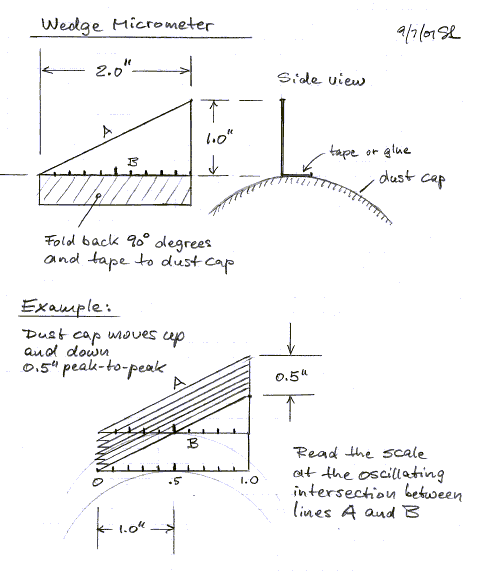
I would figure out what your readership would like, and then just ask questions about the things you need to figure out to do them.
The bit about how to measure xmax cheaply for example:
...better than just writing "It has a shiny magnet and it goes boom".
Dang! That was my game plan, you gave it away! 😀
That's what I'm struggling towards....more thorough tests than I could perform myself...
I don't want to just write "I played "Love Me Like A Reptile" into it and it ROCKED! But the early transient edge of the 1812 Overture cannons was missing a level of fine nuance..." I agree that is not very useful without some kind of measurements to explain the results.
I'd like to:
- Explain what technologies and features are in the woofer, reducing any technobabble to something understandable or call "nonsense" as needed. This presumes the manufacturer even provides any information, which amazingly they sometimes do not.
- Somehow quantify the output capabilities of the sub.
As for the parameters, I can see by all the comments it is very important to at at least check if the manufacturer's specs are off. Sure, it would be nice to see a whole set of stuff like in Voice Coil, but I don't know if that's economically possible-I'll have to actually get the equipment and research it more.
I do appreciate all the comments! I posted here BECAUSE I hope to create test protocols both understandable to neophytes and casual readers, but that knowledgeable readers will still find useful.
- Status
- Not open for further replies.
- Home
- Loudspeakers
- Subwoofers
- HELP! What's important to measure in subwoofers?