

Folding a new bass horn design or adjusting the dimensions of an existing design to meet a specific requirement can be somewhat of a challenge and prone to error. To make the process easier and to avoid errors as much as possible, I've created a number of different Excel workbooks that can assist with the folding process. All of them should be considered as "works in progress" as I'm continually adding new features and of course fixing the odd bugs that I come across, so always make sure to check here for the latest version before using any of these workbooks. Some of them I've actually used to design and build my own subwoofers (the best way to confirm that the workbook in question works), and in those cases I've included a link to the project sin question. If you have any questions about the spreadsheets, please post them to this thread, thanks!
The latest versions of the workbooks are available at this location:
The Subwoofer DIY Page
The latest versions of the workbooks are available at this location:
The Subwoofer DIY Page
Attachments
Last edited:
One issue that's come up is calculated horn length.
I used the "centerline" method to determine horn length. I've also not included any "end effects" in the calculation. I used the spreadsheet to produce the layout for my POC2 TH. It predicted a horn length of 245cm (as required by HornResp). However, when I measured the TH's lowest resonance frequency, it turned out to be more like 43 Hz, not 40 Hz as predicted by HornResp. Reverse-engineering this in HornResp (i.e. adjusting the path length until the predicted resonance frequency increased to 43 Hz) results in an effective path length of 231 cm, which is much shorter than that given by either the centerline method or the square-root method. Any ideas?
I used the "centerline" method to determine horn length. I've also not included any "end effects" in the calculation. I used the spreadsheet to produce the layout for my POC2 TH. It predicted a horn length of 245cm (as required by HornResp). However, when I measured the TH's lowest resonance frequency, it turned out to be more like 43 Hz, not 40 Hz as predicted by HornResp. Reverse-engineering this in HornResp (i.e. adjusting the path length until the predicted resonance frequency increased to 43 Hz) results in an effective path length of 231 cm, which is much shorter than that given by either the centerline method or the square-root method. Any ideas?

You are worried about 3 hz?
For one thing Fs usually goes up when a driver is actually in a horn. The air mass loading inside the box is different than outside. Especially in a tapped horn as compact as yours. Another thing is how well broken in is the driver? That 3 hz should even out After a bit oh exercise.
Playing with the spreadsheet is pretty cool. Still have to figure out the auto function but it seems to do what you designed it for. I'll mess with it some more tonight. I'll punch in a couple other horns.
Now many I have designed are up to S5 in the sections. I have taken for granted that you are simply looking for beginning area, path length and mouth area. Is this correct?
One question is if you could set it up with sections as Hornresp could you then calculate horns with a partial negative flare rate? Lots of my designs seem to function better with a section that acts more like a resonator than a true horn flare.
Mark
For one thing Fs usually goes up when a driver is actually in a horn. The air mass loading inside the box is different than outside. Especially in a tapped horn as compact as yours. Another thing is how well broken in is the driver? That 3 hz should even out After a bit oh exercise.
Playing with the spreadsheet is pretty cool. Still have to figure out the auto function but it seems to do what you designed it for. I'll mess with it some more tonight. I'll punch in a couple other horns.
Now many I have designed are up to S5 in the sections. I have taken for granted that you are simply looking for beginning area, path length and mouth area. Is this correct?
One question is if you could set it up with sections as Hornresp could you then calculate horns with a partial negative flare rate? Lots of my designs seem to function better with a section that acts more like a resonator than a true horn flare.
Mark
You are worried about 3 hz?
Yup
 . More correctly, I'm worried about a measured result that's 7.5% off the predicted result.
 For one thing Fs usually goes up when a driver is actually in a horn. The air mass loading inside the box is different than outside. Especially in a tapped horn as compact as yours. Another thing is how well broken in is the driver? That 3 hz should even out After a bit oh exercise.
I'm concernined about the resonance frequency of the horn, not the driver. It's represented by the first impedance minimum and it's independent of driver characteristics. It's solely dependent on the characteristics of the horn.
Playing with the spreadsheet is pretty cool. Still have to figure out the auto function but it seems to do what you designed it for. I'll mess with it some more tonight. I'll punch in a couple other horns.
Now many I have designed are up to S5 in the sections. I have taken for granted that you are simply looking for beginning area, path length and mouth area. Is this correct?
Not quite. I found a way to mathematically describe the size and shape of the tapered and stepped horn illustrated in the graph and relate those to beginning area, path length and mouth area. The technique can be theoretically expanded to include other parameters such as varying flare rate, but the important thing is to be able to mathematically describe how the folds in the horn are developed to fit into the cross-section of the box that needs to be built to hold it.

Is the different panel colors an option...example: red for incorrect length & blue for correct length?
I've attached an updated version of the spreadsheet that does this. When the graph is red, the panel dimensions have not been optimized. When optimized, the graph turns blue.
Attachments
How was I able to obtain a 132.82L blue enclosure when my inputs are for a 210L enclosure?


L = 274.32 108.00 balance = 0.00
S1 = 516.13 L-check = 172.2
hmin = 6.42 L'-check = 167.8
S4 = 1032.26 dL = 4.4
hmax = 12.84 2.5%
p = 1.91 0.75
d = 40.64 16.00 17.50
h = 40.64 16.00 17.50
w = 80.42 31.66 33.16
delta = 0.02
Vol (1) = 212.38 l. 7.50 cu.ft.
Vol (2) = 166.42 l. 5.88 cu.ft.

L = 274.32 108.00 balance = 0.00
S1 = 516.13 L-check = 172.2
hmin = 6.42 L'-check = 167.8
S4 = 1032.26 dL = 4.4
hmax = 12.84 2.5%
p = 1.91 0.75
d = 40.64 16.00 17.50
h = 40.64 16.00 17.50
w = 80.42 31.66 33.16
delta = 0.02
Vol (1) = 212.38 l. 7.50 cu.ft.
Vol (2) = 166.42 l. 5.88 cu.ft.
Last edited:
How was I able to obtain a 132.82L blue enclosure when my inputs are for a 210L enclosure?
From your images, it looks like you haven't optimized L. Your horn's length should be 274.3 cm, based on the HornResp input screen. However the value for L-check in your image is much less than 274.3 cm. Another sign that something's wrong is that the net volume (Vol 1) is more than the gross volume (Vol 2).
It looks like you have to complete steps 4 and 6 about three times to get the correct results (the chart plotting component that swaps the colours in the graph only checks the "balance" figure, not the "L-check" figure).
When you say "centerline" do you mean right angles through the corners? If so, this will always be a little long, and the horn will play shorter.One issue that's come up is calculated horn length.
I used the "centerline" method to determine horn length.
I haven't looked at your sheet yet. Is it unlocked?
You will have better luck if you can get the program to use SQRT(Inside path*Outside path) as the length of each section. This is the easiest way to get the average path length.
When you say "centerline" do you mean right angles through the corners? If so, this will always be a little long, and the horn will play shorter.
I used that approach.
I also measured using arcs around the corners, and present that in the spreadsheet as L'.
I've also included the srqt method in the spreadsheet. Interestingly enough, the answer it gives is usually within a few mm of the centerline method.
Hmm... something seems off. EDIT: I read this wrong.I've also included the srqt method in the spreadsheet. Interestingly enough, the answer it gives is usually within a few mm of the centerline method.
Here is a picture with a bend made up of three 25cm squares, and the lengths derived from the most popular methods, and my own in the middle.
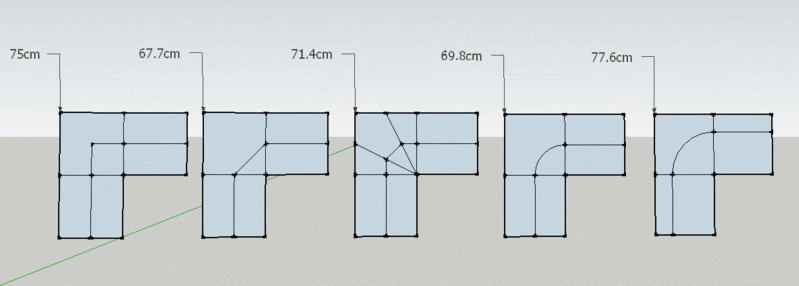
The Square-root method comes in at 70.71.
Try running this through your program to see what it comes up with.
Last edited:
How about an IF/THEN Statement:
Blue = [{Vol (1) = Vol (2)} + balance = 0.00]?


Vol (1) is calculated using S1, S4 and L, and it's not dependent on any of the measurements of the box, so it's somewhat misleading at this point.
I'll adjust the spreadsheet to reflect the correct net volume of the box.
"balance" is the difference in height between the front and back of the box, using the calculated values for the folded horn's dimensions in the box. For the box to actually be a box, it should be zero. This is where Excel's "Goal Seek" function comes in handy
.
Hi Brian
Home early from work with a tummy ache. But a whole lot oh gingerale and I'm getting better.
Been playing with the spreadsheet. Boy am I stupid. It finally dawned on me that the thickness of the material is in cm not mm. Now the folds make sense.
Still have not quite figured out the goal seek function. I found it but hell if I know how to make it work. But fiddle with the box sizes enough and I get pretty close to the desired sizes.
I have to say cool.
And I have to agree that from a viewpoint of your math skills the descrepancy you described earlier is significant. A real life box rarely measures as modeled. It is always close. But I'm guessing you want to get as close as is posible.
Mark
Home early from work with a tummy ache. But a whole lot oh gingerale and I'm getting better.
Been playing with the spreadsheet. Boy am I stupid. It finally dawned on me that the thickness of the material is in cm not mm. Now the folds make sense.
Still have not quite figured out the goal seek function. I found it but hell if I know how to make it work. But fiddle with the box sizes enough and I get pretty close to the desired sizes.
I have to say cool.
And I have to agree that from a viewpoint of your math skills the descrepancy you described earlier is significant. A real life box rarely measures as modeled. It is always close. But I'm guessing you want to get as close as is posible.
Mark
I have been reading the thread. As Brian pointed out the method of measureing down the middle of the bends is one of the most accurate means of determining horn path length when it is folded. That is what I have used for years.
I tried a front loaded horn that is obviously tappered. I can't get the crazy thing to behave. My deviation from error is small but it don't look like a horn to me! I even used the as built sizes. I'll check what I did again and see if there are any obvious mistakes.
I have a couple of ideas for labeling the cells so it is a bit easier to
Mark
Mark
I tried a front loaded horn that is obviously tappered. I can't get the crazy thing to behave. My deviation from error is small but it don't look like a horn to me! I even used the as built sizes. I'll check what I did again and see if there are any obvious mistakes.
I have a couple of ideas for labeling the cells so it is a bit easier to
Mark
Mark
Did you ever throw your TH model into AkAback to see if the p or c constants used in HR were the reason for your 3Hz measurement difference?
No, not yet. I'm an absolute noob wrt Akabak.
I tried a front loaded horn that is obviously tappered. I can't get the crazy thing to behave.
LOL - that probably wouldn't work. The spreadsheet can only model the layout of the folded TH as illustrated in the graph, as that's the only one I can mathematically describe at the moment (I really have to spend some time and show the position of the driver in the TH!).
Once I can work out other foldings, I'll include them in the spreadsheet.
- Home
- Loudspeakers
- Subwoofers
- Spreadsheet for Folded Horn Layouts...