

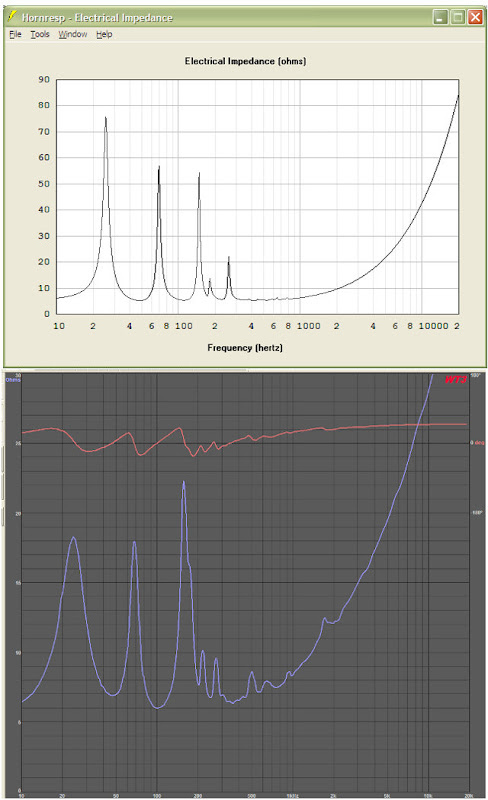
Here's the predicted impedance, along with the measured impedance, of the sub from this thread. If you've built a tapped horn and you don't see multiple dips in the impedance plot, you're doing it wrong

The dip at 50 hertz corresponds with the tuning, and excursion will be very low. Below that, it's going to unload, so watch out for overexcursion

The pic above shows the predicted response of the subwoofer I've documented in this thread.
Why are you modelling in 4PI space?
Why are you modelling in 4PI space?
I've switched to 2pi, makes it easier to work with Akabak.
Also, I've updated the plans, because the P-Audio woofer is no longer made. The new plans are the same as the old plans, except they use a woofer that's readily available from Parts Express, costs about half as much, and weighs less. How's that for progress?
Audio Psychosis • View topic - One Hundred Dollar SQL Sub
I've switched to 2pi, makes it easier to work with Akabak.
Also, I've updated the plans, because the P-Audio woofer is no longer made. The new plans are the same as the old plans, except they use a woofer that's readily available from Parts Express, costs about half as much, and weighs less. How's that for progress?
Audio Psychosis • View topic - One Hundred Dollar SQL Sub
That's a bass guitar driver you're suggesting as a replacement - are you sure it's up to the task of doing low frequencies with low distortion?
How about this one? B&C 10CL51 10" Neodymium Woofer | Parts-Express.com
That's a bass guitar driver you're suggesting as a replacement - are you sure it's up to the task of doing low frequencies with low distortion?
How about this one? B&C 10CL51 10" Neodymium Woofer | Parts-Express.com
That's a better choice I think. I opted for the Eminence because it's widely available, and Bill Fitzmaurice tends to choose good drivers for horns. (He uses that driver in some of his designs.)
The stamped frame 12" woofer from B&C looks good too. Not much more money, and offers a lot more displacement.
Also, I found a mistake in my folding scheme. I don't think it will affect the response much, but it *will* make it easier to build if you fold it differently. Details here:
Audio Psychosis • View topic - One Hundred Dollar SQL Sub
Also, I found a mistake in my folding scheme. I don't think it will affect the response much, but it *will* make it easier to build if you fold it differently.
The fold works (see the THAM15 thread) but, as I found out, you need to be pretty anal about the bracing in the first part of the fold, to avoid measurable and audible distortion due to panel flex (particularly as one of those flexing panels is in contact with the ground).
My "Dogfood Duct" mod can be used to deal with the sharp dip that sometimes appears 'round 150~200 Hz, effectively extending the effective bandwidth of the horn. The mod lowers of the 'Q' of the horn's rolloff at the lower end a little, but this might actually be a good thing, depending on the intended use. It's similar to the "mass-loading" that Taterworks brought up in that thread (which to me sounds like the alignment is just being converted into a big 6th order series-tuned BP box), except that the panel is located within the horn itself, rather than at the mouth, and there's little or no drop in efficiency, and more important, the size of the horn doesn't change
.
Well here's some pis of a very small tapped horn I designed and had built from a 5" driver from a JVC HTIB system. I will post the design I came up with for the TB 6.5 as soon as I draw it up again. I sell my computers and I have lost a few HDDs lately so I will have to model it again. As soon as I have the $50 for one of those drivers I will build it up for sure.
Hello brasko,
I yhink I have a similar Jvc 5" Sub. can you share plan for tapped horn you made for this Sub
Regards
Viki

smallest TH
Hello i get a measurement feedback for my SUB FANFARE double TH,
eliminates the lowest bass reso impedanz, no peaks over 100 Hz, for using up to
250 Hz.
measurement in a very large room, my own passiv in 22 qm,
take a look:
fanfareFB
fanfaremess
Hello i get a measurement feedback for my SUB FANFARE double TH,
eliminates the lowest bass reso impedanz, no peaks over 100 Hz, for using up to
250 Hz.
measurement in a very large room, my own passiv in 22 qm,
take a look:
fanfareFB
fanfaremess
Attachments
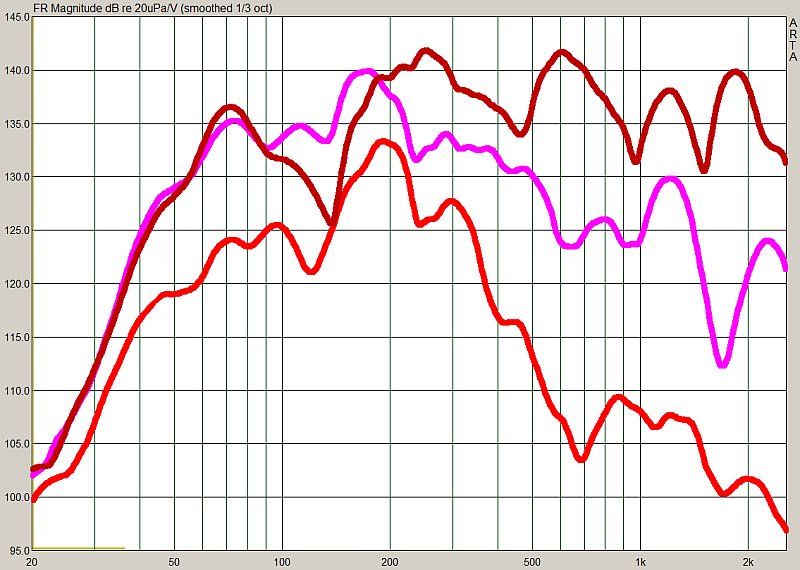
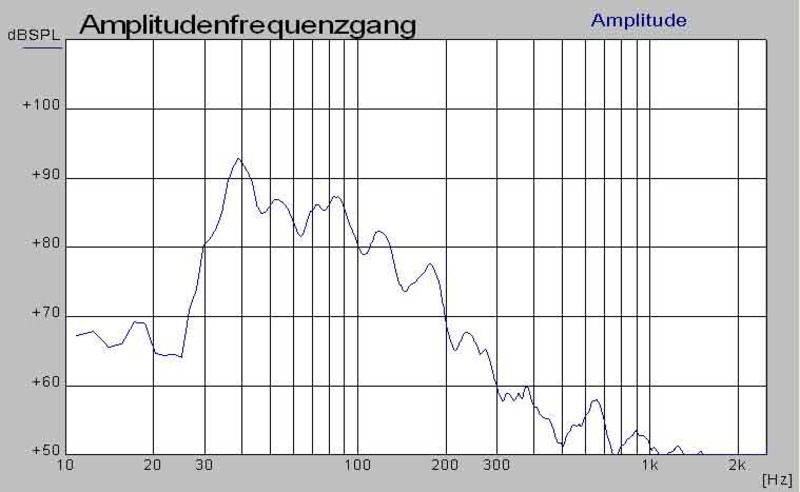
I found this pic on my hard drive, which shows the response of the 4.5cf tapped horn with a 12" woofer (dark red), the 3.1cf tapped horn with three eights (purple), and a 4cf horn with a single eight (red).
Measurements are outside; in car expect a big bump below 80hz thanks to cabin gain.
All three are measured at the exact same volume level on the amplifier, but the twelve is drawing the least current, due to it's higher impedance. The twelve has the highest efficiency of all of them, since Hoffman's Iron Law rules the day. The triple8 has the highest power handling and the smallest size of all of them, because it has the highest displacement. Note that the SPL level on this measurement is more accurate than the previous measurement. (IE, the twelve is more efficient than the initial measurements showed. When it comes to efficiency, bigger = better.)
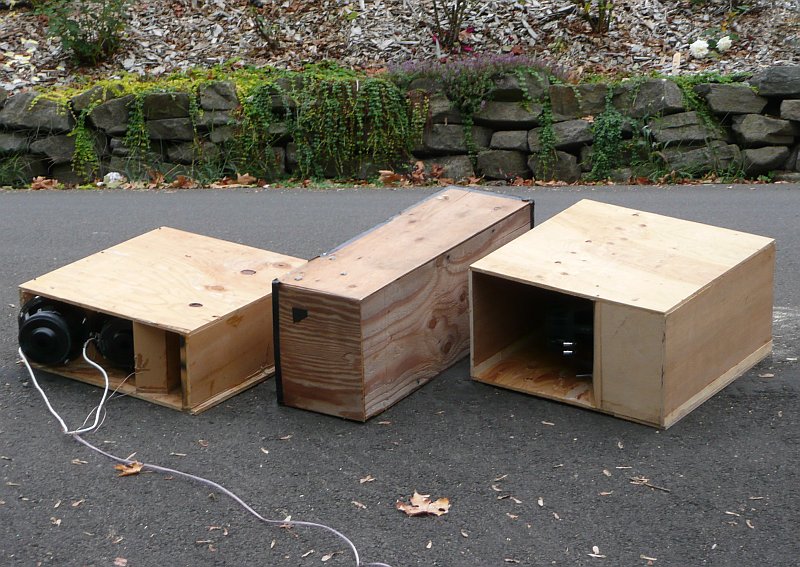
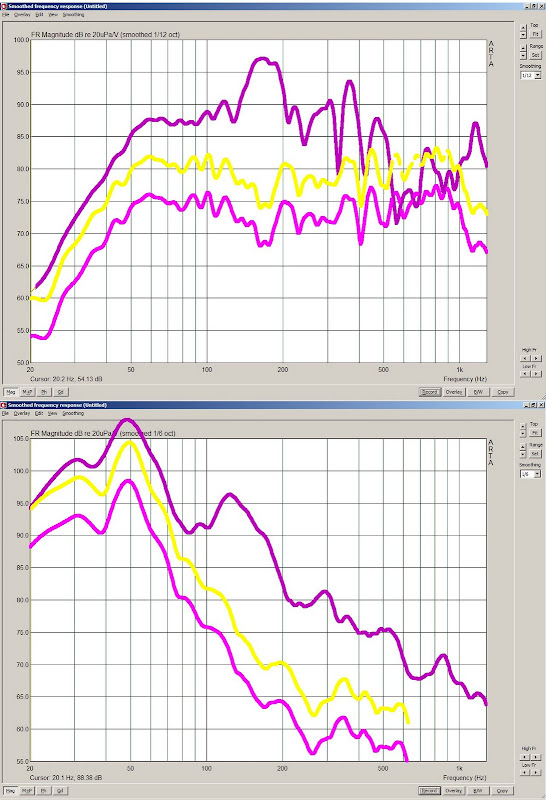
This afternoon I was digging around for some measurements, and found this in-car and out-of-car measurement of three of my subs. Two are tapped horns; one is a front loaded horn.
IIRC, I'd raised the level on the topmost of the three, in order to illustrate the response shape better.
Basically I think this graph shows a few things:
- the th-mini clone is really loud. (That's the topmost one.) Even though it's an easy build and a 6ohm-ish load.
- The lowest graph is my autotuba clone. Kind of amazing to see that it plays nearly all the way to 1khz. Looks like it's F3 is about 60hz.
The one in the middle, which is tough to build, is called a 'Triple8'. It's not an easy build, and it's not as efficient as the TH-Mini clone, but it should take the most power, due to the use of three woofers.
The second graph shows the response of the three subs in-car; the first graph is on my driveway. With a bit of a cut at 60hz, all three can play flat to 20hz in the car.

Does anyone participating in this thread have an actual Danley Mini?
I know it was just a guess but I can tell you the drawing in post 34 is not how they are built.
I had two genuine Danley Mini's for a while and dare say their performance is far beyond their size and seemingly no matter how much power you give them they just get louder, their sound quality does not seem to change.
I'm just wondering if anyone has really duplicated one or has a real reference.
All the best,
Barry.
I know it was just a guess but I can tell you the drawing in post 34 is not how they are built.
I had two genuine Danley Mini's for a while and dare say their performance is far beyond their size and seemingly no matter how much power you give them they just get louder, their sound quality does not seem to change.
I'm just wondering if anyone has really duplicated one or has a real reference.
All the best,
Barry.
When I first built these (pictured) I had JBL 2404H's in them. Now they have JBL 2206J's in them. They sound better with the 2206's and they play stupid loud, though not with the easy test anything rig in the picture. It's the best use for these drivers I have come up with yet.
It's amazing how physically strong these drivers are. When you watch the cone motion as compared to the sound output you just can't help but thinking they are going to break at the voice coil former/cone junction, but they don't.
Two of them on the ground have a measured smooth rising response of about 10dB from 30 to 140Hz at about 4 meters. I need to measure the four of them and then build about six more.
It's amazing how physically strong these drivers are. When you watch the cone motion as compared to the sound output you just can't help but thinking they are going to break at the voice coil former/cone junction, but they don't.
Two of them on the ground have a measured smooth rising response of about 10dB from 30 to 140Hz at about 4 meters. I need to measure the four of them and then build about six more.
Attachments
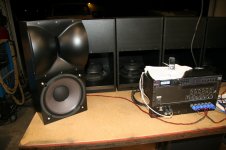

The 2204 sounds better than the 2206 as a direct radiator, but the 2206 works better in a tapped horn.
2206B gif by dkleitsch | Photobucket
2206B gif by dkleitsch | Photobucket

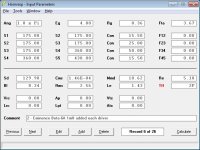
Here is a compact tapped horn. Uses two Eminence Beta-6A woofers. The Beta-6A woofers are little monsters compared to the previous drivers Eminence made. In the T/S parameters I entered 1.43mH for the voice coil inductance to reflect adding a 1mH coil in series with each driver. This was to flatten the response. Should be usable from 80Hz to 300Hz. Lastly, since the drivers are in parallel the input voltage should be 2V instead of 4V. I forgot to change that. I haven't built it yet, but hope to sometime this summer. just too busy right now.
Attachments
Last edited:
"I agree with brsanko - the most interesting tapped horns are the ones which use miniature drivers. "
right,
i made a TH horn with WAL 416 Mivoc, 4" 16 Ohm,
i made 2+2 different, my double horn concept.
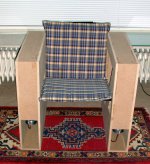
only 15 cm deep, for wall or sat place or seat.
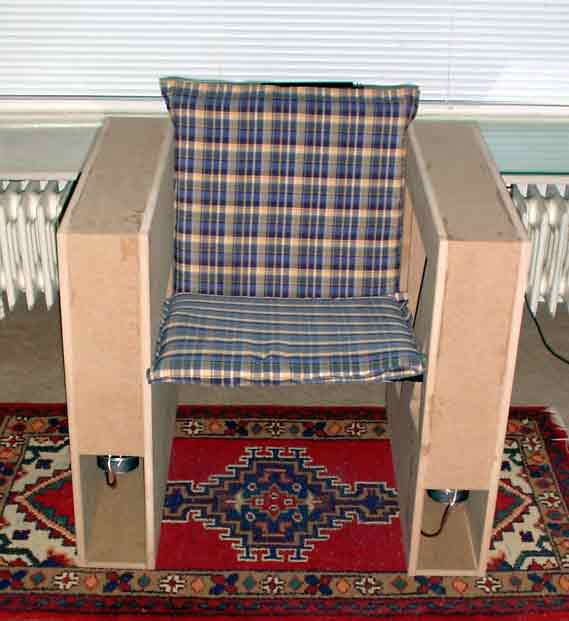
with 15 mH 220 µF


I never saw any of your speaker design plans shared with audio community,or I missed somehow.
- Status
- This old topic is closed. If you want to reopen this topic, contact a moderator using the "Report Post" button.
- Home
- Loudspeakers
- Subwoofers
- The Smallest Tapped Horn