
Hi Everyone,
Just letting you know that Hornresp Version 18.00 has now been released.
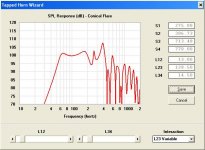
The Tapped Horn Wizard tool has been significantly enhanced. For a given overall horn length, flare rate and driver specification, the optimum driver position can be determined more easily than before.
Note that there are three ‘Interaction’ options. The operation of the first two should be pretty obvious from the titles. The third ‘L12 & L34 Linked’ setting enables the user to “slide” the driver along the mounting baffle / separating panel towards or away from the 180 degree bend (similar to changing the acoustic path length of a slide trombone).
Hopefully the Tapped Horn Wizard is now a far more useful tool. Enjoy 🙂.
Kind regards,
David
Just letting you know that Hornresp Version 18.00 has now been released.
The Tapped Horn Wizard tool has been significantly enhanced. For a given overall horn length, flare rate and driver specification, the optimum driver position can be determined more easily than before.
Note that there are three ‘Interaction’ options. The operation of the first two should be pretty obvious from the titles. The third ‘L12 & L34 Linked’ setting enables the user to “slide” the driver along the mounting baffle / separating panel towards or away from the 180 degree bend (similar to changing the acoustic path length of a slide trombone).
Hopefully the Tapped Horn Wizard is now a far more useful tool. Enjoy 🙂.
Kind regards,
David
Attachments


WOW, that's great David, thanks again for your continuing efforts!
PS I only just noticed that a large L1-2 can give a very big improvement in response shape. It causes a big notch that removes the first peak, leaving a response that is very easy to crossover. An L1-2 of 70cm works brilliantly on a 35Hz tapped horn I'm playing with. It uses up very little space because the area at that end of the horn is so small (even tapering to zero if you want.) I never noticed this effect before.
Cheers
William Cowan
PS I only just noticed that a large L1-2 can give a very big improvement in response shape. It causes a big notch that removes the first peak, leaving a response that is very easy to crossover. An L1-2 of 70cm works brilliantly on a 35Hz tapped horn I'm playing with. It uses up very little space because the area at that end of the horn is so small (even tapering to zero if you want.) I never noticed this effect before.
Cheers
William Cowan
Thanks William - the new wizard certainly makes it a lot easier to “tune” a tapped horn, and it is also great fun to use 🙂.
Incidentally, I found an error in the code controlling the L12 and L34 scroll bars - please use Product Number 1800-080323 or higher.
Kind regards,
David
Incidentally, I found an error in the code controlling the L12 and L34 scroll bars - please use Product Number 1800-080323 or higher.
Kind regards,
David
Brilliant & thanks
David,
the latest version is great!
My TH, finished yesterday, was designed using v17 (and a little AkAbaK). Thank you. Measurements to follow elsewhere, when I convince myself that I have something reliable to show.
The TH wizard would certainly have accelerated the process. This is particularly the case as - knowing that what I built would be an approximation - I looked for low sensitivity to L12 and L34 which are probably the most difficult parameters to hit spot on, given they are about the same order as the driver dimensions and transverse directions in the horn. Sliding the sliders and seeing minimal changes to the response was something of a relief.
Ken
David,
the latest version is great!
My TH, finished yesterday, was designed using v17 (and a little AkAbaK). Thank you. Measurements to follow elsewhere, when I convince myself that I have something reliable to show.
The TH wizard would certainly have accelerated the process. This is particularly the case as - knowing that what I built would be an approximation - I looked for low sensitivity to L12 and L34 which are probably the most difficult parameters to hit spot on, given they are about the same order as the driver dimensions and transverse directions in the horn. Sliding the sliders and seeing minimal changes to the response was something of a relief.
Ken
A very nice idea, i like it alot. With growing CPU power, programs where you change a variable and instantly see the frequency response change, instead of clicking on "compute it", seem to be the logical next step.
Thanks Ken, thanks MaVo.
Hornresp Version 18.10 has just been released - tapped horns can now have a throat chamber. The TH schematic diagram has been modified to show the throat chamber, and the two sides of the driver diaphragm are now more clearly displayed.
Kind regards,
David
Hornresp Version 18.10 has just been released - tapped horns can now have a throat chamber. The TH schematic diagram has been modified to show the throat chamber, and the two sides of the driver diaphragm are now more clearly displayed.
Kind regards,
David
Hi Everyone,
Hornresp Version 18.20 has just been released - tapped horns can now have two segments between the driver entry points if required. See Note 7 on page 15 of the Help file for details.
Kind regards,
David
Hornresp Version 18.20 has just been released - tapped horns can now have two segments between the driver entry points if required. See Note 7 on page 15 of the Help file for details.
Kind regards,
David
Hi David
Excellent news, it's often possible to get better response with a slow flare section followed by a faster one between the tap points -- see Tom's patent, first in the list at http://tinyurl.com/2xkxav
Is there a reason the tapped horn wizard doesn't work with 4 sections? It doesn't change the horn shape, only slides the tap points along the predefined shape, so I don't see the reason.
Cheers
Ian
Excellent news, it's often possible to get better response with a slow flare section followed by a faster one between the tap points -- see Tom's patent, first in the list at http://tinyurl.com/2xkxav
Is there a reason the tapped horn wizard doesn't work with 4 sections? It doesn't change the horn shape, only slides the tap points along the predefined shape, so I don't see the reason.
Cheers
Ian
iand said:Is there a reason the tapped horn wizard doesn't work with 4 sections? It doesn't change the horn shape, only slides the tap points along the predefined shape, so I don't see the reason.
Hi Ian,
In a four-segment horn the tap points are defined by the values of L12 and L45. Shifting the tap points in a horn having a fixed overall length will alter the lengths of segments 1 and 4, and therefore the overall profile of the horn.
In a three-segment horn the tap points are defined by the values of L12 and L34. The Wizard automatically re-sets the profile to that of a single flare using the expansion rate of the middle segment (either Con or Exp) with the throat area being S1, the mouth area being S4 and the overall length being L12 + L23 + L34.
If this is done with a four-segment horn, it defeats the purpose of initially specifying two different-profile segments between the tap points.
The way that the input screen and simulation model are structured, the tap points cannot be defined independently - they need to be specified using segment length values.
Hope this makes sense 🙂.
Kind regards,
David
tb46 said:Another very useful and fun addition to a great program.
Thanks David.🙂
Thanks Oliver 🙂
Kind regards,
David
iand said:Is there a reason the tapped horn wizard doesn't work with 4 sections? It doesn't change the horn shape, only slides the tap points along the predefined shape, so I don't see the reason.
Hi Ian,
After posting my last message I thought some more about how the tapped horn wizard could be made to work with a four segment system, and have already started work on implementing the necessary changes 🙂.
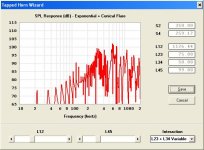
The four segment input form will be as shown in the attached screenprint. Note that only those parameter values that are changed by the operation of the wizard are now displayed (S1, S3 and S5 values are not shown).
I will let everyone know once Hornresp Version 18.30 is released. It may take me a week or so to arrange, as I am a bit short on time at the moment.
Kind regards,
David
Attachments

David McBean said:
Hi Ian,
After posting my last message I thought some more about how the tapped horn wizard could be made to work with a four segment system, and have already started work on implementing the necessary changes 🙂.
The four segment input form will be as shown in the attached screenprint. Note that only those parameter values that are changed by the operation of the wizard are now displayed (S1, S3 and S5 values are not shown).
I will let everyone know once Hornresp Version 18.30 is released. It may take me a week or so to arrange, as I am a bit short on time at the moment.
Kind regards,
David
David, you deserve a medal 🙂
Cheers
Ian
Hi Thawach and Ian,
Just letting you know that Hornresp Version 18.30 has been released. The tapped horn wizard now works with both three and four segment systems.
Kind regards,
David
Just letting you know that Hornresp Version 18.30 has been released. The tapped horn wizard now works with both three and four segment systems.
Kind regards,
David
McBean u are good...good...good...good...and good and good=very good. i'm waiting for...waiting for...waiting for.....=a long time
O..O..che i love u rarely.
Thanks
😀
O..O..che i love u rarely.
Thanks
😀
David McBean said:Hi Thawach and Ian,
Just letting you know that Hornresp Version 18.30 has been released. The tapped horn wizard now works with both three and four segment systems.
Kind regards,
David
That was a *very* short week... 🙂
Thanks for all the work, it's rare indeed to get such a rapid response (or sometimes, any response) to requests for software enhancements.
Ian
Invalid result error.
Hi David,
After installing V18.30 I got an
"Invalid result. Change input data." error
on all tapped horn simulations.
I'm attaching an input parameter sheet for you to see. Maybe you can help. V18.20 works just great.
If you would be so kind as to take a look at this and let me know what I'm missing, I would appreciate it.
Thanks again for all the fine work, Regards
Hi David,
After installing V18.30 I got an
"Invalid result. Change input data." error
on all tapped horn simulations.
I'm attaching an input parameter sheet for you to see. Maybe you can help. V18.20 works just great.
If you would be so kind as to take a look at this and let me know what I'm missing, I would appreciate it.
Thanks again for all the fine work, Regards
Attachments

Same here. "normal" horns seem to work fine, though. Switching to the tapped horn wizard shows calculated results.
Adding a 4th segment seems to get it working again.
One other thing I just encountered:
When using the max-SPL feature, a given limitation due to excursion is labeled as "power limited". It´s late already, am I thinking right, shouldn´t it be "xmax limited"?
I missed 18.20, does anybody have a copy?
David, once again. Thank you!!!
Adding a 4th segment seems to get it working again.
One other thing I just encountered:
When using the max-SPL feature, a given limitation due to excursion is labeled as "power limited". It´s late already, am I thinking right, shouldn´t it be "xmax limited"?
An externally hosted image should be here but it was not working when we last tested it.

I missed 18.20, does anybody have a copy?
David, once again. Thank you!!!
- Home
- Loudspeakers
- Subwoofers
- Hornresp