

So I've been living with tapped horns and bandpass subs for close to six months now. Thought you guys might find it relevant to get my thoughts with some "water under the bridge."
After living with both, I think I'll stick with bandpass boxes in the immediate future. While the tapped horn that I have (which uses the same woofer) plays lower, it was also a p.i.t.a. to build.
I could get a bandpass box to play just as low as the tapped horn if I were willing to use a ten or a twelve instead of an eight.
Also, the tapped horn's vaunted efficiency is overstated - I sincerely believe that most people are throwing around simulations which over state it's efficiency, as they're relying on sims which aren't in "free space" or "half space."
I was able to build a bandpass sub in a quarter of the time it takes to build a tapped horn. Time is money, and with amplifiers available for next to nothing, the idea of spending a month building a subwoofer seems a bit silly. If you need more volume, buy a bigger amp!
Before anyone decided that I hate tapped horns, that is not the case. I am keeping the one I built, it sounds excellent, and it plays deeper than I've ever heard an eight play. It's an amazing invention, but it's also tricky to build. A lot of people on the tapped horn thread have been freaking out over the ragged frequency response, but it's really not an issue - it appears that the spikes in the sims are overstated in the real world. The tapped horn is very "musical."
For the past six months I've been using three subs (two bandpass, one TH.)
For the past month I've been in the process of ramping that up to eight, and will publish the results shortly. This is quite a project, as I've had to figure out where to hide five more subwoofers.
The joys of being single...
After living with both, I think I'll stick with bandpass boxes in the immediate future. While the tapped horn that I have (which uses the same woofer) plays lower, it was also a p.i.t.a. to build.
I could get a bandpass box to play just as low as the tapped horn if I were willing to use a ten or a twelve instead of an eight.
Also, the tapped horn's vaunted efficiency is overstated - I sincerely believe that most people are throwing around simulations which over state it's efficiency, as they're relying on sims which aren't in "free space" or "half space."
I was able to build a bandpass sub in a quarter of the time it takes to build a tapped horn. Time is money, and with amplifiers available for next to nothing, the idea of spending a month building a subwoofer seems a bit silly. If you need more volume, buy a bigger amp!
Before anyone decided that I hate tapped horns, that is not the case. I am keeping the one I built, it sounds excellent, and it plays deeper than I've ever heard an eight play. It's an amazing invention, but it's also tricky to build. A lot of people on the tapped horn thread have been freaking out over the ragged frequency response, but it's really not an issue - it appears that the spikes in the sims are overstated in the real world. The tapped horn is very "musical."
For the past six months I've been using three subs (two bandpass, one TH.)
For the past month I've been in the process of ramping that up to eight, and will publish the results shortly. This is quite a project, as I've had to figure out where to hide five more subwoofers.
The joys of being single...

Patrick Bateman said:So I've been living with tapped horns and bandpass subs for close to six months now. Thought you guys might find it relevant to get my thoughts with some "water under the bridge."
After living with both, I think I'll stick with bandpass boxes in the immediate future. While the tapped horn that I have (which uses the same woofer) plays lower, it was also a p.i.t.a. to build.
I could get a bandpass box to play just as low as the tapped horn if I were willing to use a ten or a twelve instead of an eight.
Also, the tapped horn's vaunted efficiency is overstated - I sincerely believe that most people are throwing around simulations which over state it's efficiency, as they're relying on sims which aren't in "free space" or "half space."
I was able to build a bandpass sub in a quarter of the time it takes to build a tapped horn. Time is money, and with amplifiers available for next to nothing, the idea of spending a month building a subwoofer seems a bit silly. If you need more volume, buy a bigger amp!
Before anyone decided that I hate tapped horns, that is not the case. I am keeping the one I built, it sounds excellent, and it plays deeper than I've ever heard an eight play. It's an amazing invention, but it's also tricky to build. A lot of people on the tapped horn thread have been freaking out over the ragged frequency response, but it's really not an issue - it appears that the spikes in the sims are overstated in the real world. The tapped horn is very "musical."
For the past six months I've been using three subs (two bandpass, one TH.)
For the past month I've been in the process of ramping that up to eight, and will publish the results shortly. This is quite a project, as I've had to figure out where to hide five more subwoofers.
The joys of being single...
Dude! Please tell me you are kidding. It should not take anyone a month to build a pair of tapped horns. A folded front loaded horn, folded back loaded horn, and the Karlson are all more difficult to build than a tapped horn.
Rgs, JLH
JLH said:
Dude! Please tell me you are kidding. It should not take anyone a month to build a pair of tapped horns. A folded front loaded horn, folded back loaded horn, and the Karlson are all more difficult to build than a tapped horn.
Rgs, JLH
I have to admit, this is the part that stands out for me as well. I think the story is that Patrick made his tapped horn out of a sonotube, and thus had to effectively seal the baffle down the center of the sonotube. Rather than concluding that tapped horns are difficult, I think it would be better to conclude that a sonotube is a really poor way to build a tapped horn.
IMHO unless you are doing some elaborate folding or a JLH style dual-driver setup with compression chamber, tapped horns look to range from 'dead easy' to 'no worse than anything else' on the difficulty scale. The 'canonical' construction is a box with an extra baffle running down the center - how is that difficult?
What I do agree with is that I think a lot of interest in tapped horns has been driven by 1-pi hornresp models that give the impression of significantly greater efficiency than the alternatives. The dual-W8 6th order bandpass model I posted in the other thread shows response that is very close to JLH's 2-driver tapped horn, but in 105 litres net rather than the ~225 of the tapped horn. When modeled in 1-pi space by hornresp, it gives up at most 1-2 dB of efficiency and max output, although the bandpass is starting to experience port noise below 25Hz or so with more than ~150W input - I haven't really looked to see what the impact on size would be to try to enlarge the ports to mitigate this a bit.
In my case, the bandpass model was to see what I could do with a 'spud like' form factor, but only 2'x3' rather than 4'x4'. I can tuck one such box behind each of my mains for a 'free' deployment of subs. IMHO the model results wildly exceeded my expectations, and make it very tempting to try to build.
I know JLH has indicated that he has a ~130 litre version of his tapped horn modeled, but not physically designed. I think this could be a rather interesting comparison, particularly if I pick up 2 more W8's anyway.

dwk123 said:
tapped horns look to range from 'dead easy' to 'no worse than anything else' on the difficulty scale.
I'd have to disagree here. A simple single ported bandpass is just a square box and is far easier to build than anything with tapered ducts.
I would also agree that in concept, and I've said this before, there is no reason why a dual bandpass could not do what a tapped horn does, and in a smaller enclosure. These are long wavelength simple lumped parameter stuff and you just can't twist the physics arround to get a free lunch.
Now an Acoustic Lever DOES beat the game because there is net efficiency gain through the levers impedance matching.

If you are saying that basically all technologies of the same volume will generally produce the same results, I would tend to agree. I have not seen the free lunch, and when I see it claimed, I am doubtful.
Multiple subs works. Thats all I can say. Be it horns, tapped horns, bandpass, dipoles, they will all work the same if they are properly setup in the room and there are at least three of them. At LFs the source is virtually not part of the equation, its all the room (small rooms assumed of course).
Multiple subs works. Thats all I can say. Be it horns, tapped horns, bandpass, dipoles, they will all work the same if they are properly setup in the room and there are at least three of them. At LFs the source is virtually not part of the equation, its all the room (small rooms assumed of course).
Hi Earl
You said;
“there is no reason why a dual bandpass could not do what a tapped horn does, and in a smaller enclosure.”
In a band pass filter, one can get gain by using a high pass and low pass filter, if they are under damped and placed close enough in frequency, the mid band area “fills in” with a net gain over the bandwidth. That coupled filter effect ties the BP’s gain to the bandwidth.
While a tapped horn has the high pass filter, it’s low pass filter is much to far away in frequency (about a decade usually) to be having the traditional band pass gain.
I haven’t built that many band pass speakers and most of them were “high power” and used a passive radiators because of port choking and resonances..
I am curious to see if you think these “do something different” like your acoustic lever thingy does.
Attached is a half space measurement of a Spud woofer prototype, taken at one meter in a large parking lot, driven at 2.8Volts RMS into an 8 Ohm speaker load (two, four ohm drivers in series).
The cursor shows the 2.8Volt / 1W sensitivity is 94 dB at 25.4Hz and the measured –3dB point from that is 19Hz.
This is about 10dB greater than one of the drivers used as a direct radiator or 7 dB greater than the two. Using two enclosures as I intended raises it a bit over 4 dB higher at 1 W 1M..
Now, making or modeling a band pass speaker “that did the same thing”*, with a driver of your choice, what would that speaker look like?
*had a 94dB 1W 1M half space sensitivity like the Spud curve and was –3dB at 19Hz and had a wide enough bandwidth so it also could be used with a 70 to 100Hz low pass crossover as in home theater or hifi.
Could a band pass that did this fit in the same cubic volume of one Spud?
Acoustically speaking, how large does the port (s) need to be to behave up to say ¼ rated power?
What cubic volume would one of your lever designs require to do this, I don’t have an easy way to model those?
Best
Tom
You said;
“there is no reason why a dual bandpass could not do what a tapped horn does, and in a smaller enclosure.”
In a band pass filter, one can get gain by using a high pass and low pass filter, if they are under damped and placed close enough in frequency, the mid band area “fills in” with a net gain over the bandwidth. That coupled filter effect ties the BP’s gain to the bandwidth.
While a tapped horn has the high pass filter, it’s low pass filter is much to far away in frequency (about a decade usually) to be having the traditional band pass gain.
I haven’t built that many band pass speakers and most of them were “high power” and used a passive radiators because of port choking and resonances..
I am curious to see if you think these “do something different” like your acoustic lever thingy does.
Attached is a half space measurement of a Spud woofer prototype, taken at one meter in a large parking lot, driven at 2.8Volts RMS into an 8 Ohm speaker load (two, four ohm drivers in series).
The cursor shows the 2.8Volt / 1W sensitivity is 94 dB at 25.4Hz and the measured –3dB point from that is 19Hz.
This is about 10dB greater than one of the drivers used as a direct radiator or 7 dB greater than the two. Using two enclosures as I intended raises it a bit over 4 dB higher at 1 W 1M..
Now, making or modeling a band pass speaker “that did the same thing”*, with a driver of your choice, what would that speaker look like?
*had a 94dB 1W 1M half space sensitivity like the Spud curve and was –3dB at 19Hz and had a wide enough bandwidth so it also could be used with a 70 to 100Hz low pass crossover as in home theater or hifi.
Could a band pass that did this fit in the same cubic volume of one Spud?
Acoustically speaking, how large does the port (s) need to be to behave up to say ¼ rated power?
What cubic volume would one of your lever designs require to do this, I don’t have an easy way to model those?
Best
Tom
Attachments

Tom
All good questions, but I'm not going to be able to answer them. You are correct that the bandpass efficiency is tied to its bandwidth and this can sometimes be a drawback, but for subs its usually not. Its advantage is its simplicity and the fact that it is acoustically LP filtered and tends to be small. But it won't work in all situations.
As I said, I cease to sweat over sub design anymore (for what I do) because its not about the design its about the number, location and processing. I'm working on a box to do the sub processing now.
And the Acoustic Level "Thingy" is not at all the same as a passive radiator. Its a diaphragm with two different areas inside and outside. That acts as an acoustic transformer or lever. It works well, but is also bandwidth limited and requires a part that nobody makes.
All good questions, but I'm not going to be able to answer them. You are correct that the bandpass efficiency is tied to its bandwidth and this can sometimes be a drawback, but for subs its usually not. Its advantage is its simplicity and the fact that it is acoustically LP filtered and tends to be small. But it won't work in all situations.
As I said, I cease to sweat over sub design anymore (for what I do) because its not about the design its about the number, location and processing. I'm working on a box to do the sub processing now.
And the Acoustic Level "Thingy" is not at all the same as a passive radiator. Its a diaphragm with two different areas inside and outside. That acts as an acoustic transformer or lever. It works well, but is also bandwidth limited and requires a part that nobody makes.
dwk123 said:
I have to admit, this is the part that stands out for me as well. I think the story is that Patrick made his tapped horn out of a sonotube, and thus had to effectively seal the baffle down the center of the sonotube. Rather than concluding that tapped horns are difficult, I think it would be better to conclude that a sonotube is a really poor way to build a tapped horn.
IMHO unless you are doing some elaborate folding or a JLH style dual-driver setup with compression chamber, tapped horns look to range from 'dead easy' to 'no worse than anything else' on the difficulty scale. The 'canonical' construction is a box with an extra baffle running down the center - how is that difficult?
What I do agree with is that I think a lot of interest in tapped horns has been driven by 1-pi hornresp models that give the impression of significantly greater efficiency than the alternatives. The dual-W8 6th order bandpass model I posted in the other thread shows response that is very close to JLH's 2-driver tapped horn, but in 105 litres net rather than the ~225 of the tapped horn. When modeled in 1-pi space by hornresp, it gives up at most 1-2 dB of efficiency and max output, although the bandpass is starting to experience port noise below 25Hz or so with more than ~150W input - I haven't really looked to see what the impact on size would be to try to enlarge the ports to mitigate this a bit.
In my case, the bandpass model was to see what I could do with a 'spud like' form factor, but only 2'x3' rather than 4'x4'. I can tuck one such box behind each of my mains for a 'free' deployment of subs. IMHO the model results wildly exceeded my expectations, and make it very tempting to try to build.
I know JLH has indicated that he has a ~130 litre version of his tapped horn modeled, but not physically designed. I think this could be a rather interesting comparison, particularly if I pick up 2 more W8's anyway.
IAWTC
Sonotube bandpass subs are just stupid easy to build. You literally have to cut *three* pieces of wood.
When it comes to building boxes, I'm kind of a freak about making them solid, so I go to the trouble of routing every edge, squaring everything up, using MDF, etc...
Because of that, I still believe it would take a weekend to build a proper tapped horn, even if it wasn't a sonotube.
So it's true, bandpass boxes are particularly well suited to sonotube construction. In fact I'd bet you could make one in under an hour if you planned it properly.
John
Could you share one of your designs? I'd love to see how you use sonotube. I've thought of using two and filling the cavity with polyurethane for a really solid construction.
How do you finish the sonotube? Its coated with wax right?
Could you share one of your designs? I'd love to see how you use sonotube. I've thought of using two and filling the cavity with polyurethane for a really solid construction.
How do you finish the sonotube? Its coated with wax right?
gedlee said:John
Could you share one of your designs? I'd love to see how you use sonotube. I've thought of using two and filling the cavity with polyurethane for a really solid construction.
How do you finish the sonotube? Its coated with wax right?
Well it's not my design, it's YOUR design LOL
You posted a method of using two sonotubes on the basslist years ago. Basically you buy two sonotubes, one that's a 1/2" bigger than the other. And then you fill the gap with Great Stuff expanding polyurethan foam.
You have to use wood spacers also, to keep it from getting "lop-sided." (Found THAT out the hard way.)
I've seen Dan Wiggins use this method too.
GREAT idea!
Yea, I've meant to try that, but never did. What about ports?
I still like to see you sizes, etc. How did you support the center board? Or did you just use two sets of tubes on each side?
You've tried it, I'd like to learn from you what works and what doesn't.
Yea, I've meant to try that, but never did. What about ports?
I still like to see you sizes, etc. How did you support the center board? Or did you just use two sets of tubes on each side?
You've tried it, I'd like to learn from you what works and what doesn't.
Hi Patrick
That may have been me. In the way old days, I made and sold some transmission lines made with concentric cardboard tubes and posted about it on the bass list.
The bass list itself is going back a ways all by itself.
Best,
Tom
That may have been me. In the way old days, I made and sold some transmission lines made with concentric cardboard tubes and posted about it on the bass list.
The bass list itself is going back a ways all by itself.
Best,
Tom
Tom Danley said:<snip>
This is about 10dB greater than one of the drivers used as a direct radiator or 7 dB greater than the two. Using two enclosures as I intended raises it a bit over 4 dB higher at 1 W 1M..
<snip>
Your SPUD sub and the Tapped Horn for Dummies in my living room are somewhat similar - they use a woofer that's virtually identical, albeit one instead of two.
My experience mirrors yours:
The Tapped Horn for Dummies offers a level of bass extension that is jaw-dropping. It's amazing that an eight can go so low.
Having said that, I believe tapped horns are relatively difficult to build when compared to conventional subs.
I'd love to see a lot of these guys simply *purchase* a tapped horn, instead of DIY, as it's a complex design. I feel the same way about dual-reflex bandpass boxes. I don't think hobbyists should even attempt them unless they have the ability to measure the impedance curve. Without the ability to measure the impedance and adjust the ports accordingly, dual reflex bandpass boxes are a recipe for disaster.
Of course a lot of this is personal bias. I personally believe that some things are worth "doing it yourself" and some are not. I cloned a unity horn and put it in my car, but if I could go out and buy one, I would have happily. I tried cloning Summas, gave up in frustration, and just bought the damn things LOL
The tapped horns that your company sells are priced very reasonably IMHO, and a lot of people would be better off just buying the real thing.
Patrick Bateman said:
Your SPUD sub and the Tapped Horn for Dummies in my living room are somewhat similar - they use a woofer that's virtually identical, albeit one instead of two.
My experience mirrors yours:
The Tapped Horn for Dummies offers a level of bass extension that is jaw-dropping. It's amazing that an eight can go so low.
Having said that, I believe tapped horns are relatively difficult to build when compared to conventional subs.
I'd love to see a lot of these guys simply *purchase* a tapped horn, instead of DIY, as it's a complex design. I feel the same way about dual-reflex bandpass boxes. I don't think hobbyists should even attempt them unless they have the ability to measure the impedance curve. Without the ability to measure the impedance and adjust the ports accordingly, dual reflex bandpass boxes are a recipe for disaster.
Of course a lot of this is personal bias. I personally believe that some things are worth "doing it yourself" and some are not. I cloned a unity horn and put it in my car, but if I could go out and buy one, I would have happily. I tried cloning Summas, gave up in frustration, and just bought the damn things LOL
The tapped horns that your company sells are priced very reasonably IMHO, and a lot of people would be better off just buying the real thing.
Specifically aimed at live/dj
Building a tapped for high spl is NOT EASY. a 1 degree offset can cost you 2 db or an early cutoff. It does take a month or more to build one from scratch due to the trial and error process required. Even with a design locked in, it still takes 2 days to build ONE, unfinished. As I have said before, if you can afford it... buy it.
With a set of plans handed to you for a portable live sound tapped, it's still going to cost you at least 500 bucks per box and 3 days work. If you make 10 bucks an hour that's another 240 bucks plus paint and a grille..... you just bought a USC-1.
Patrick Bateman said:Here's the details on the bandpass sub. It's stupid easy to build. I put two of them together in under six hours with nothing more than a jigsaw, a drill, and a handsaw. One sub is about 80% complete, the other is about 50%. It is easily 10x easier to assemble than the tapped horn, which is MUCH more difficult to build than I realized.
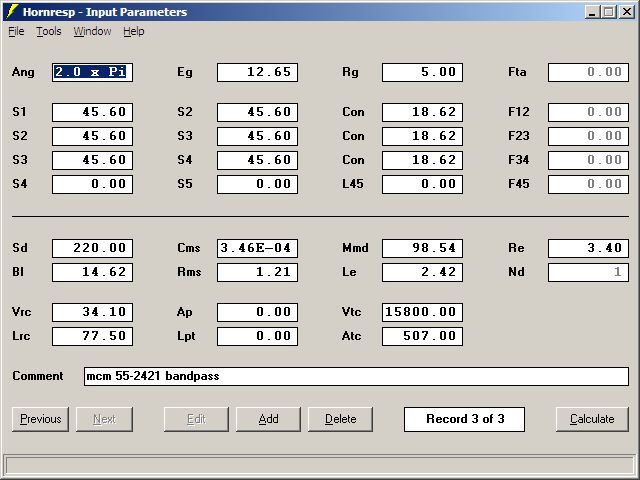
First off, the bandpass sub requires modifications to the MCM 55-2421 woofer. In a nutshell, I add mass to lower the FS and raise the QMS, then I add a resistor to raise the QES. These modifications make it work much better in a single-reflex bandpass.
The front chamber of the sub is 15.8 liters.
The rear chamber of the sub is 34.1 liters.
The front chamber has a vent which measures 22" in length and 3" in diameter. The volume of the vent is 212."
The rear chamber is sealed; the woofer is in the rear chamber, and takes up 113".
The total volume of the front chamber, including the port, is 1176" (964" + 212").
The total volume of the rear chamber is 2194".
I juggled all the numbers so that this sub needs exactly ONE sonotube 😀
The rear chamber is 31" in length; the front chamber is 17" in length. Note that you'll have to use a 180 degree turn to fit a 22" port into a chamber that's 17" long. No, I didn't factor in the volume of the front cap and the end cap, but it certainly wouldn't make more than a half DB difference 😛
I was re-reading my own thread and noticed that there are a few SPL plots posted, but they're not "authoritative" because many of them were published while the project was still in the planning phase.
To remedy that, I've modeled the sonotube bandpass sub described in the post above using horn response.
There's one little problem tho...
You guys are going to hate me for this, but I lost the measurements of the modified woofers 😛
If you recall from page three of the thread, the MCM woofers don't play very low, because the QTS is too low. To get them to dig deep, you need to get the QTS up. You can do that by adding mass to raise the QMS, adding resistance to raise the QES, or both.
I did both. When I was finished, the FS was 27hz. I know that for a fact. Using horn response I was able to predict that the "new" T/S parameters are as follows:
FS = 27hz
QMS = 14.08
QES = 0.27
VAS = 23.88
QTS = 0.27
Note that the QTS gets higher still when you add the five ohm resistor.
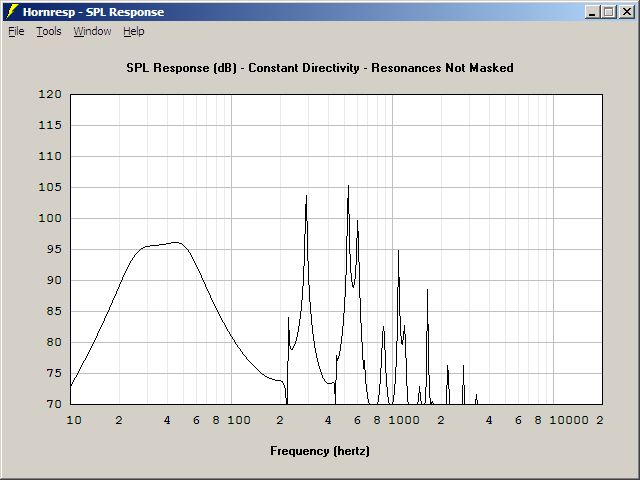
Without further ado, here's the predicted model of this bandpass sub.
Parameters:
SPL with 20 watts:
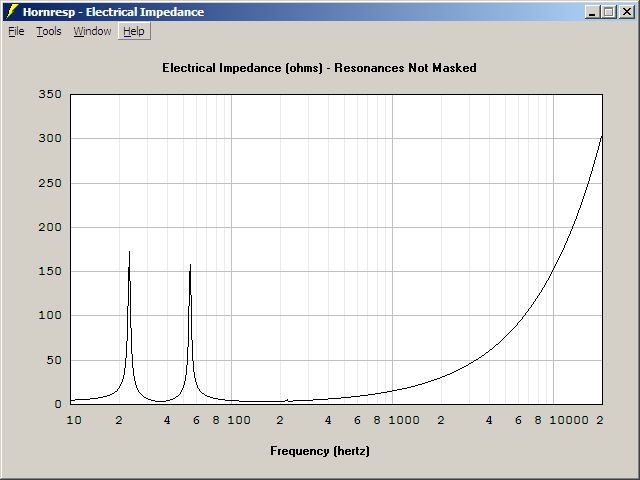
This is the most important graph of all. The impedance graph. You really need to measure the impedance curve because it's often necessary to adjust port lengths "in the real world." The impedance curve can show you if you have leaks or loose panels too.
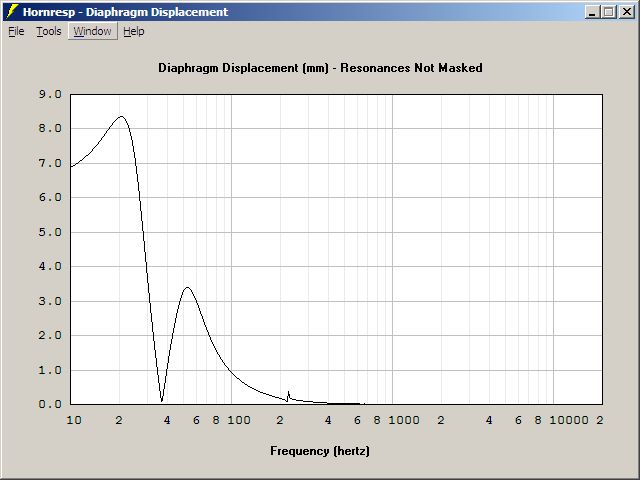
Here's the excursion at twenty watts. YES it actually runs out of excursion with 20 watts. What do you expect from an eight inch woofer making 20hz

Keep in mind that I started with three subs, and I'm in the processing of installing five more. The whole idea of this project is to create a VERY VERY small sub that can make 20hz, that's inexpensive.
Here's a quick measurement of the bandpass sub's impedance.
Note the tuning frequency has drifted lower, by about 3hz.
I think this is due to a small leak that I detected around the seal of the port. It was only noticeable when the sub was really going at it, and I fixed it a few weeks ago. (I adjusted the port length before discovering the leak - the port length specified on page 3 is based on impedance sweeps done with a slightly leaky port.)
Due to this anomaly, I should reduce the length of the port to raise the tuning frequency back up a few hz. According to horn response, this extra-low tuning reduces efficiency by almost three decibels at 40hz! That's like halving the power 😛
So this is an excellent example of what I've been harping about. Something as minor as a tiny leak can change the efficiency of these boxes dramatically!
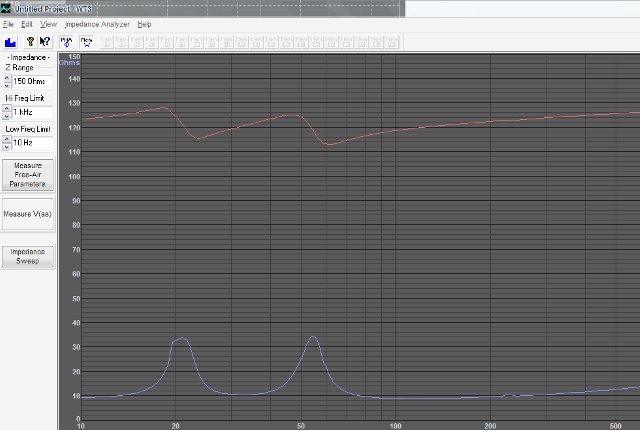
Note the tuning frequency has drifted lower, by about 3hz.
I think this is due to a small leak that I detected around the seal of the port. It was only noticeable when the sub was really going at it, and I fixed it a few weeks ago. (I adjusted the port length before discovering the leak - the port length specified on page 3 is based on impedance sweeps done with a slightly leaky port.)
Due to this anomaly, I should reduce the length of the port to raise the tuning frequency back up a few hz. According to horn response, this extra-low tuning reduces efficiency by almost three decibels at 40hz! That's like halving the power 😛
So this is an excellent example of what I've been harping about. Something as minor as a tiny leak can change the efficiency of these boxes dramatically!
John
Again, how did you support the woofer?
I'll have to check my calcs, but I usually find that low Q drivers work well in bandpass boxes.
The MCM driver did have thos excursion problem as I recall. Thats a problem I think, because typical plate amps are always greater than 20 watts, so you end up just throwing away watts. I'd rather use a driver that can take the typical 100 watt plate amp.
Again, how did you support the woofer?
I'll have to check my calcs, but I usually find that low Q drivers work well in bandpass boxes.
The MCM driver did have thos excursion problem as I recall. Thats a problem I think, because typical plate amps are always greater than 20 watts, so you end up just throwing away watts. I'd rather use a driver that can take the typical 100 watt plate amp.
gedlee said:John
Again, how did you support the woofer?
I'll have to check my calcs, but I usually find that low Q drivers work well in bandpass boxes.
The MCM driver did have thos excursion problem as I recall. Thats a problem I think, because typical plate amps are always greater than 20 watts, so you end up just throwing away watts. I'd rather use a driver that can take the typical 100 watt plate amp.
The sonotube is nested. The outer diameter of the inners sonotube is 9.75" across. The woofer itself has a diameter of 8.25". There's a plywood baffle that divides the sonotube into two chambers. The woofer is screwed into that baffle.
Also, there's a significant reduction in excursion because I've raised the QMS and the QES. This lowers the F3, but at the expense of maximum SPL and efficiency.
Though the woofer will bottom with just twenty watts, the idea is to use a BUNCH of 'em. I started with three and I'm adding five more.
The nominal impedance is 9ohms for this reason. You can run three in parallel without causing any issues for the typical plate amp, and get the advantages of multiple subs.
- Status
- Not open for further replies.
- Home
- Loudspeakers
- Subwoofers
- Tapped Horn for Dummies