
Ok, so I had a very similar thread on this a few months back that really didn't go anywhere, so I gave it some time, gathered equipment, and am trying again to get some help so I may save myself some money for a design.
I have a 12" sub (Orion HCCA proto) that will soon be making the switch from my car into my living room. I have a Buttkicker amplifier on the way to power it with 1000w @ 4ohms.
At first I was planning on a ported box, 4 cubic feet @ 20hz. I originally was only going to haveabout 350w on tap, so I figured a large box would compensate for the low wattage. Now that I have a bit more headroom for power, I'm wondering if I should try something sealed? This was kind of a last minute thought, but I don't have much experience in ht, so I figred I'd ask.
The design is what I'm having trouble with. I'd like this to be the only one I have to build, so I'd like to do it right. I'd like to downfire, and I'm not sure if I should use a loading board or not. Does downfiring into carpet affect frequency response or just output? I'm also not sure what I should use to connect the board to the actaul enclosure. It would have to be removable, so as to be able to install the driver, but sturdy enough not to vibrate. I've seen sonotubes with loading baords, but can't find any examples now. I had thought of maybe using t-nuts and bolts with large diameter dowels or maybe stained blocks.
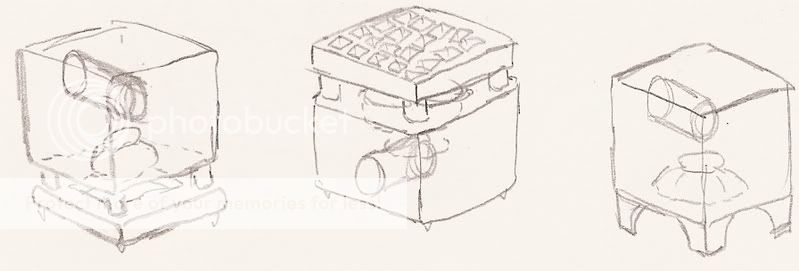
I had also sketched out a few ideas for my design and was wondering which would be best to try? The left uses a loading board, while the right side is a simple downfiring box with 90degree corner pieces. The middle was an idea I had to have a vented loading board over an upfiring box.
Any thoughts/suggestions?
I have a 12" sub (Orion HCCA proto) that will soon be making the switch from my car into my living room. I have a Buttkicker amplifier on the way to power it with 1000w @ 4ohms.
At first I was planning on a ported box, 4 cubic feet @ 20hz. I originally was only going to haveabout 350w on tap, so I figured a large box would compensate for the low wattage. Now that I have a bit more headroom for power, I'm wondering if I should try something sealed? This was kind of a last minute thought, but I don't have much experience in ht, so I figred I'd ask.
The design is what I'm having trouble with. I'd like this to be the only one I have to build, so I'd like to do it right. I'd like to downfire, and I'm not sure if I should use a loading board or not. Does downfiring into carpet affect frequency response or just output? I'm also not sure what I should use to connect the board to the actaul enclosure. It would have to be removable, so as to be able to install the driver, but sturdy enough not to vibrate. I've seen sonotubes with loading baords, but can't find any examples now. I had thought of maybe using t-nuts and bolts with large diameter dowels or maybe stained blocks.
I had also sketched out a few ideas for my design and was wondering which would be best to try? The left uses a loading board, while the right side is a simple downfiring box with 90degree corner pieces. The middle was an idea I had to have a vented loading board over an upfiring box.
Any thoughts/suggestions?
Sealed vs ported, be prepared to get a few different answers 
A ported setup with a high pass filter just below the tuning frequency is what you want for high output, sealed is what you want for very low frequencies as over excursion is less of a problem. I make every speaker I build sealed, although a ported box will have lower distortion as around the tuning point there is less excursion a sealed box's shallow roll-off is easier to integrate into a room.
Down firing doesnt really change the in-room response at all, so long as you give enough room under the box. The biggest problem with downfiring drivers is the cone sagging, which effectivly reduces xmax.
A ported setup with a high pass filter just below the tuning frequency is what you want for high output, sealed is what you want for very low frequencies as over excursion is less of a problem. I make every speaker I build sealed, although a ported box will have lower distortion as around the tuning point there is less excursion a sealed box's shallow roll-off is easier to integrate into a room.
Down firing doesnt really change the in-room response at all, so long as you give enough room under the box. The biggest problem with downfiring drivers is the cone sagging, which effectivly reduces xmax.

It's not really carpet/no carpet that's the issue, you need to look at what the floor is made of. If your floor is solid concrete or whatever then #3 will be fine. If you have floorboards that could potentially be excited then stand the sub on some slab of marble or something. Again #3 will be fine for that.
In case you hadn't guessed, I made something very similar to #3...
In case you hadn't guessed, I made something very similar to #3...

They all look fine. Of course if you put spikes on a solid floor then it can jump around at high excursion. I've seen a sub jump off its feet with excitement in a small box!
This is what doesn't make sense:
Going from a sealed box to a large vented will extend the depth you can get out of it, but the output is the same. A vented box will generally require more power, because it adds loading to the driver to limit excursion around tuning. This holds true if there is a rumble filter below tuning, otherwise moderate power will bottom the driver below tuning because it has no control there.
A vented design will give more depth, but is trickier to get right. Also with the vents, aerodynamics is important to avoid chuffing noises. A bigger box is required to fit in a vent that won't chuff. In a small box, a vent of adequate diameter must be often very long. Try putting a 4" vent in a 1 cu ft box tuned @ 20 Hz and it needs to be 2m long! Make it 3 cu ft and the vent can now be 2 ft long. Flares are needed on the ends.
Start with WinISD pro and start playing around with it. Best place to start.
This is what doesn't make sense:
At first I was planning on a ported box, 4 cubic feet @ 20hz. I originally was only going to haveabout 350w on tap, so I figured a large box would compensate for the low wattage. Now that I have a bit more headroom for power, I'm wondering if I should try something sealed? This was kind of a last minute thought, but I don't have much experience in ht, so I figred I'd ask.
Going from a sealed box to a large vented will extend the depth you can get out of it, but the output is the same. A vented box will generally require more power, because it adds loading to the driver to limit excursion around tuning. This holds true if there is a rumble filter below tuning, otherwise moderate power will bottom the driver below tuning because it has no control there.
A vented design will give more depth, but is trickier to get right. Also with the vents, aerodynamics is important to avoid chuffing noises. A bigger box is required to fit in a vent that won't chuff. In a small box, a vent of adequate diameter must be often very long. Try putting a 4" vent in a 1 cu ft box tuned @ 20 Hz and it needs to be 2m long! Make it 3 cu ft and the vent can now be 2 ft long. Flares are needed on the ends.
Start with WinISD pro and start playing around with it. Best place to start.
spudfrog said:Nothing? Am I being too vague?
No, but what you're asking is more aesthetics than performance.
Beauty is in the eye of the beholder, in room response can be modeled and measured.
I'd be asking myself what my intended goals are. Every speaker design is a collection of compromises.
What is your room size?
What are the T/S specs for the driver?
Are you mating this sub with full range or 2 way speakers?
Do you have any modeling software to experiment with trade offs in box size, freq response and cone excursion?
Regards,
Ward

There is little issue with a cubic sub-woofer box, as the possible standing wave frequencies will be well out of the passband.
I also disagree that using multiple smaller drivers automatically guarantees better sound, it's dependent on many more factors. Usually it's most cost-effective to use one better quality driver than several cheaper ones.
I also disagree that using multiple smaller drivers automatically guarantees better sound, it's dependent on many more factors. Usually it's most cost-effective to use one better quality driver than several cheaper ones.
I agree with Richie on both points, and I'll add that two smaller woofers are likely to either cost more or be of lesser quality if the total price is the same. There are quite a number of pros and cons with one vs two drivers to do the same job, and there is no clear cut winner as it depends on which aspects appeal. Often value for money is a big issue. A 15" driver will only cost say 20% more but have around 50% more SD.
Thanks for the responses.
The driver is an Orion HCCA prototype, so I'm not sure if the T/S parameters are exact, but these are the numbers for the production one.

The driver is meant more for spl applications, but it's what I have at the moment and I may swap it out or have it reconed with different softparts.
@fullthrottle: This is why I'm glad is asked about this. I've never dealt with ht and I've only seen ported commercial subwoofers. I was also under the impression that sealed enclosures allow for greater power handling as there is no chance of unloading. I went with a large box as to compensate for the low wattage I was originally planning on running.
@richie: Carpet over cement.
@paulspencer: I had run the numbers in an online calculator before buying the port and got around 17" port length for a 4"diameter port in a 4cubes box @ 20hz. It has flared ends, but I'm not usre if this is enough area to prevent chuffing.
@marzen: Front stage is a pair of Andy Graddon's 1/4wave tapered pipes.
The driver is an Orion HCCA prototype, so I'm not sure if the T/S parameters are exact, but these are the numbers for the production one.
The driver is meant more for spl applications, but it's what I have at the moment and I may swap it out or have it reconed with different softparts.
@fullthrottle: This is why I'm glad is asked about this. I've never dealt with ht and I've only seen ported commercial subwoofers. I was also under the impression that sealed enclosures allow for greater power handling as there is no chance of unloading. I went with a large box as to compensate for the low wattage I was originally planning on running.
@richie: Carpet over cement.
@paulspencer: I had run the numbers in an online calculator before buying the port and got around 17" port length for a 4"diameter port in a 4cubes box @ 20hz. It has flared ends, but I'm not usre if this is enough area to prevent chuffing.
@marzen: Front stage is a pair of Andy Graddon's 1/4wave tapered pipes.
- Status
- This old topic is closed. If you want to reopen this topic, contact a moderator using the "Report Post" button.
- Home
- Loudspeakers
- Subwoofers
- HT Sub Questions