
Hello!
It's the first time I write here, so thank you for checking this out and maybe helping a noob
The question is about the power amp of a Yamaha guitar amplifier I have. The amp is a complementary push-pull and the power transistors are running quite hot. Once I tried to play it for a while, but after five minutes it started distorting really bad. Then it blew a fuse. So I changed the power transistors and tried to measure it with an operating voltage of +30V. Normally this is 60V. It didn't blow up, but it wasn't working well either..
The first stage of the amp has a PNP silicone transistor in common emitter configuration. With the emitter resistor there's a capacitor connected in series. I was just wondering what it is doing there, since I'm having some problems with the operating points of nearly all the transistors in the power amp.
It also read somewhere that (at least in quasi-complementary design) the amp should be given something like 30 min to "settle down". Is this true? 'Cos if it is, I just might be worrying for nothing...
If someone actually has some advice for me, don't be upset if I don't answer for a while since I'll be running around in the woods for a week.
Thank you very much
-Petteri Hyvärinen
It's the first time I write here, so thank you for checking this out and maybe helping a noob
The question is about the power amp of a Yamaha guitar amplifier I have. The amp is a complementary push-pull and the power transistors are running quite hot. Once I tried to play it for a while, but after five minutes it started distorting really bad. Then it blew a fuse. So I changed the power transistors and tried to measure it with an operating voltage of +30V. Normally this is 60V. It didn't blow up, but it wasn't working well either..
The first stage of the amp has a PNP silicone transistor in common emitter configuration. With the emitter resistor there's a capacitor connected in series. I was just wondering what it is doing there, since I'm having some problems with the operating points of nearly all the transistors in the power amp.
It also read somewhere that (at least in quasi-complementary design) the amp should be given something like 30 min to "settle down". Is this true? 'Cos if it is, I just might be worrying for nothing...
If someone actually has some advice for me, don't be upset if I don't answer for a while since I'll be running around in the woods for a week.
Thank you very much
-Petteri Hyvärinen

Hi Petteri,
I used to service Yamaha guitar amps under warranty. Very few failures. They do not normally run hot while idling.
I don't have those manuals any more, but we can try to help. First thing is to tell us what the original numbers were and what you put in. You should use new insulators and heatsink grease, completely clean the old stuff off.
Normally other parts blow as well, both transistors and resistors. You need to check them all carefully while referring to the schematic diagram. Keep notes as you work.
Andrew's request for pictures is perfectly reasonable at this point also. That may give us some clues.
-Chris
I used to service Yamaha guitar amps under warranty. Very few failures. They do not normally run hot while idling.
I don't have those manuals any more, but we can try to help. First thing is to tell us what the original numbers were and what you put in. You should use new insulators and heatsink grease, completely clean the old stuff off.
Normally other parts blow as well, both transistors and resistors. You need to check them all carefully while referring to the schematic diagram. Keep notes as you work.
Andrew's request for pictures is perfectly reasonable at this point also. That may give us some clues.
-Chris

Oscillation Zobel
When transistors run hot
without some obvious reason,
it may be an oscillation going on.
This can happen if the loudspeaker you are using
is too much inductive load, for the amplifier output.
You can try with some other speaker you have
and see if that one is less inductive
= amplifier DOES NOT get hot with another load, speaker.
A zobel filter across the output of amplifier will cure,
if this is a load induced oscillation case.
From the PCB Output pin of the amplifier, +terminal, close to output transistors
to the Ground, -terminal, on the PCB
you put
100nF small film cap + 10 Ohm resistor ....... in series
Amp output junction here
|
100nF
|
|
10 Ohm
|
Ground of Amp PCB
The resistor should best be 1-2 Watt rated,
but if you have no other, you can use normal 1/4 or 1/2 Watt resistor temporary.
It is not very critical with this rating.
Hope this will help you.
It can be other things that are spooky,
but there is a certain chance it is oscillation.
lineup
When transistors run hot
without some obvious reason,
it may be an oscillation going on.
This can happen if the loudspeaker you are using
is too much inductive load, for the amplifier output.
You can try with some other speaker you have
and see if that one is less inductive
= amplifier DOES NOT get hot with another load, speaker.
A zobel filter across the output of amplifier will cure,
if this is a load induced oscillation case.
From the PCB Output pin of the amplifier, +terminal, close to output transistors
to the Ground, -terminal, on the PCB
you put
100nF small film cap + 10 Ohm resistor ....... in series
Amp output junction here
|
100nF
|
|
10 Ohm
|
Ground of Amp PCB
The resistor should best be 1-2 Watt rated,
but if you have no other, you can use normal 1/4 or 1/2 Watt resistor temporary.
It is not very critical with this rating.
Hope this will help you.
It can be other things that are spooky,
but there is a certain chance it is oscillation.
lineup
Hi Petteri
Sounds like your amp is a conventional capacitor coupled design. Does the speaker output go via a capacitor?
I think we might guess that the PNP operates at half supply voltage and the capacitor decouples the feedback signal to set the gain in conjunction with the feedback and gain ratio resistors.
This would go to an NPN VAS and from there to the output stage - you mentioned complementary, so a guess would be that there are TO-5 or TO-126 case devices and TO-3 outputs. I'm not familiar with the Yamaha but is this close?
Possibly if there is a bias setting the bias pot is wrong. Normally these designs should work at lower than normal voltages, so I would check the quiescent current. First, it might be worth checking that the emitter resistors are still in one piece, and if they're OK check the voltage across them at low voltage.
Any info you can provide regarding the amp will help to locate the problem. As Chris mentioned.
Cheers
John
Sounds like your amp is a conventional capacitor coupled design. Does the speaker output go via a capacitor?
I think we might guess that the PNP operates at half supply voltage and the capacitor decouples the feedback signal to set the gain in conjunction with the feedback and gain ratio resistors.
This would go to an NPN VAS and from there to the output stage - you mentioned complementary, so a guess would be that there are TO-5 or TO-126 case devices and TO-3 outputs. I'm not familiar with the Yamaha but is this close?
Possibly if there is a bias setting the bias pot is wrong. Normally these designs should work at lower than normal voltages, so I would check the quiescent current. First, it might be worth checking that the emitter resistors are still in one piece, and if they're OK check the voltage across them at low voltage.
Any info you can provide regarding the amp will help to locate the problem. As Chris mentioned.
Cheers
John
Thank you all very much for your posts!
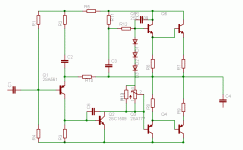
I actually already have a paper schem of the amp, but I seem to have forgotten it to the barracks. In the attachment there's the schematic as far as I remember. I will check all the values out and post it here later.
The model is Yamaha G112-25 "Twentyfive".
john_ellis: there are no TO-3 or TO-5 cases. I think the output transistors are TO-126 and TO-220 since they didn't have the other original part in the store, they replaced it with the TO-220 (with metal back, so does it make TO-220AB?).
I really have to check those parts out before giving any more info to avoid confusion, since I probably remember them just the wrong way around.
-Petteri Hyvärinen
I actually already have a paper schem of the amp, but I seem to have forgotten it to the barracks. In the attachment there's the schematic as far as I remember. I will check all the values out and post it here later.
The model is Yamaha G112-25 "Twentyfive".
john_ellis: there are no TO-3 or TO-5 cases. I think the output transistors are TO-126 and TO-220 since they didn't have the other original part in the store, they replaced it with the TO-220 (with metal back, so does it make TO-220AB?).
I really have to check those parts out before giving any more info to avoid confusion, since I probably remember them just the wrong way around.
-Petteri Hyvärinen
Attachments

hyvärinen said:
john_ellis: there are no TO-3 or TO-5 cases. I think the output transistors are TO-126 and TO-220 since they didn't have the other original part in the store, they replaced it with the TO-220 (with metal back, so does it make TO-220AB?).

Kidding ?
Mike
Hi Petteri
Looks like a standard quasi-comp. Normally, would expect to see R2 tied to ground (assuming bottom rail is ground) and decoupling capacitor between R1 and R5 to ground also.
COuld be that the pot. has gone open circuit and sets the quiescent current to max. (i.e. too much)
Check the voltage across R7, R9. Replace pot. if quiescent current is say over 50 mA, and adjust to about 50 mA
Alternatively it might be oscillation. If you can borrow a scope check the output. Usually a 2.2k resistor in series with input capacitor C1 would suppress this.
Hi MikeB
- all right, the design isn't that old!!
Cheers
John
Looks like a standard quasi-comp. Normally, would expect to see R2 tied to ground (assuming bottom rail is ground) and decoupling capacitor between R1 and R5 to ground also.
COuld be that the pot. has gone open circuit and sets the quiescent current to max. (i.e. too much)
Check the voltage across R7, R9. Replace pot. if quiescent current is say over 50 mA, and adjust to about 50 mA
Alternatively it might be oscillation. If you can borrow a scope check the output. Usually a 2.2k resistor in series with input capacitor C1 would suppress this.
Hi MikeB
- all right, the design isn't that old!!
Cheers
John
yes,
I agree.
If the potentiometer still is okay,
you can adjust, LOWER the resistance, and so get lower idle current.
Too high idle current in output will make HEAT.
Too low idle current will give 'bad sound' because of crossover dist.
If potentiometer is bad, you should replace it,
but you still need to adjust to a correct idle current level.
These small trim potentiometers should not be worn out, by used many times.
Because they are only used a very few times.
It is not like volume controls, which often are among the first things
you will need to replace in an old amplifier.
But this trim pot can have been damaged mechanically
or by getting overheated once, when was some failure in amp.
I agree.
If the potentiometer still is okay,
you can adjust, LOWER the resistance, and so get lower idle current.
Too high idle current in output will make HEAT.
Too low idle current will give 'bad sound' because of crossover dist.
If potentiometer is bad, you should replace it,
but you still need to adjust to a correct idle current level.
These small trim potentiometers should not be worn out, by used many times.
Because they are only used a very few times.
It is not like volume controls, which often are among the first things
you will need to replace in an old amplifier.
But this trim pot can have been damaged mechanically
or by getting overheated once, when was some failure in amp.
Thaks again for your advice!
I'll change the pot and see what comes out...
But first I think I have to make a new PCB, because the original one started falling into pieces.
When I do get to the point of testing it again, will it do any harm if I remove the output transistors to check the voltages? Or should I just run it with half (or even less) the voltage applied?
And some more questions..
How much difference does it make if the driving transistors (Q3, Q5) have different hfe's? Because at the moment I have the 2SC1509 NPN, which is complemetary to 2SA777, in use, but the PNP one (Q3) I have changed to 2SA965. And Q1 is now BC327. So should I be looking for a complementary transistor for the 2SA965?
It's father's day in Finland, so happy father's day to all you dads out there!
-Petteri Hyvärinen
I'll change the pot and see what comes out...
But first I think I have to make a new PCB, because the original one started falling into pieces.
When I do get to the point of testing it again, will it do any harm if I remove the output transistors to check the voltages? Or should I just run it with half (or even less) the voltage applied?
And some more questions..
How much difference does it make if the driving transistors (Q3, Q5) have different hfe's? Because at the moment I have the 2SC1509 NPN, which is complemetary to 2SA777, in use, but the PNP one (Q3) I have changed to 2SA965. And Q1 is now BC327. So should I be looking for a complementary transistor for the 2SA965?
It's father's day in Finland, so happy father's day to all you dads out there!
-Petteri Hyvärinen
- Status
- This old topic is closed. If you want to reopen this topic, contact a moderator using the "Report Post" button.
- Home
- Amplifiers
- Solid State
- Some help needed with a power amp