


Nice interview. As ever, Bob succeeds to get his points across coolly and convincingly (if you know just enough engineering).
Ahh, those TIM wars in the 70-ies! Cordell vs Otala/Curl etc....
Jan Didden
Ahh, those TIM wars in the 70-ies! Cordell vs Otala/Curl etc....
Jan Didden


I agree.
Excellent interview. Very grounded in reality and science with subtle pokes at the psychology of subjectivism.
Thanks for the posting.
Excellent interview. Very grounded in reality and science with subtle pokes at the psychology of subjectivism.
Thanks for the posting.

I had a chance to meet Bob last weekend at the Rocky Mountain Audio Fest in Denver. They had an amplifier design Q&A, so I was able to pick his brain about his error correction amplifier AES journal article. He is a nice guy. He has a web site here You can download his papers there.
One interesting thing I learned from the discussion. In his amplifier, you'll see series R-C networks from the power MOSFET gates to ground. These networks allow a smaller gate resistor while still preventing RF oscillations in the MOSFETs (400 MHz!). He gets away with 47 Ohms, giving a larger bandwidth than what you get with the more typical 200 Ohms or so. The series R-C doesn't seem to impact the bandwidth at all. But it does terminate the gate with a resistance at RF frequencies.
22 years after the publication of the article, and he is still a fan of error correction. The amps in his active speaker don't use error correction though. I think this was in the interest of simplicity and being able to have them be small enough to cram into a pretty small speaker enclosure.
One interesting thing I learned from the discussion. In his amplifier, you'll see series R-C networks from the power MOSFET gates to ground. These networks allow a smaller gate resistor while still preventing RF oscillations in the MOSFETs (400 MHz!). He gets away with 47 Ohms, giving a larger bandwidth than what you get with the more typical 200 Ohms or so. The series R-C doesn't seem to impact the bandwidth at all. But it does terminate the gate with a resistance at RF frequencies.
22 years after the publication of the article, and he is still a fan of error correction. The amps in his active speaker don't use error correction though. I think this was in the interest of simplicity and being able to have them be small enough to cram into a pretty small speaker enclosure.

I just had a look at Bob's AES paper. Mosfets on the output, distortion around .005% at 20KHz. Has Doug Self read this?

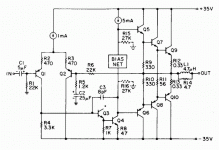
In one of the PDF's in Bob's site, there is an amp. The amp is attached below.
The output stage looks like triple darlington, Q5+Q6, Q7+Q8, Q9+Q10.
Why is that Q5+Q6 and Q9+Q10 's emitors are attached to the output node, while Q7+Q8 are not attached to output? What is the reason to make Q7+Q8 have different connection than Q5+Q6 and Q9+Q10?
The output stage looks like triple darlington, Q5+Q6, Q7+Q8, Q9+Q10.
Why is that Q5+Q6 and Q9+Q10 's emitors are attached to the output node, while Q7+Q8 are not attached to output? What is the reason to make Q7+Q8 have different connection than Q5+Q6 and Q9+Q10?
Attachments

Just checking the pp file from Mr. Cordell. It seems that I have invented a "super gainclone" 🙂 Didn't know the name was "super". I named it "high performance"....
Interesting to see that a such a famous person wants to even mention the LM3886
Interesting to see that a such a famous person wants to even mention the LM3886
peranders said:Just checking the pp file from Mr. Cordell. It seems that I have invented a "super gainclone" 🙂 Didn't know the name was "super". I named it "high performance"....
Interesting to see that a such a famous person wants to even mention the LM3886
Wow! YOU invented the gainclone? Or just the name? This is an interesting question. If you clone something (as in 'rip off') can you then claim to have it invented? This puts a whole new light on the term 'intellectual property' (on both of the words).
Jeez....
Jan Didden
http://www.cordellaudio.com/papers/another_view_of_tim.shtmlWhere?
fig.7
Mikeks,
Why is that Q7+Q8's emitors are not connected to output like Q5+Q6 and Q9+Q10? I saw this also in Fostexlab600 amp, Alesis RA500 amp, these amps also has the same connection, in triple darlington, the 1st and 3rd pair is connected to output, while the 2nd is not. What is the reason of such connection, do you know the reason why?
This connection of Q7/Q8 makes for more rapid extraction of charge from the output device that's being turned off.
This cross-coupling should be extended to Q5/Q6 so as to cause them to operate in Class-A, regardless of output load.
This cross-coupling should be extended to Q5/Q6 so as to cause them to operate in Class-A, regardless of output load.
mikeks said:This connection of Q7/Q8 makes for more rapid extraction of charge from the output device that's being turned off.
This cross-coupling should be extended to Q5/Q6 so as to cause them to operate in Class-A, regardless of output load.
It is right, but who will diswcarge the cable and the speaker?

Though I like his interview, ... 😎


This cross-coupling should be extended to Q5/Q6 so as to cause them to operate in Class-A, regardless of output load.
it may interest you to know that leach amps have both predrivers and drivers connected so...
I was a little bit surprised that he didn't make more of the different types of high frequency compensation in the factors that effected sound quality. Around the time that the AES paper was pubilshed there was a small but renowned group that all used the same method. And they all flew in the face of current, majority opinion and in JLH's case a lot of flack from the minimal THD group. From memory they were, Nelson Pass, Bob Cordell, John Linsely Hood and Edward Cherry in Aust. I think from the JAES biogs Ed Cherry and Bob Cordell may have been at Bell Lab at one stage.
I mean I was the first here using a DC-servo but I didn't call it "Super Gainclone". 😀 I settled for "High Performance Gainclone".janneman said:Wow! YOU invented the gainclone? Or just the name?

I can't read the interview. Can you upload them to another host ?
Mikeks! Do you have a account at www.box.net ?
Mikeks! Do you have a account at www.box.net ?
Re: I agree.
???! Never mind.
Regards, Mike.
DCPreamp said:Excellent interview. Very grounded in reality and science with subtle pokes at the psychology of subjectivism.
???! Never mind.
Regards, Mike.
- Home
- Amplifiers
- Solid State
- Bob Cordell Interview: Error Correction