
Hi DIY fans,
I am a newbie on this forum (but not to DIY audio) and have been looking through various threads and links on moving coil preamps, and I have not really found one yet that I like.
I have a low output Ortofon MC20 MkII - around 90uV @ 5cm/s.
Needs around 32dB of gain (like the Ortofon transformers or ancient MCA76 preamp)
From an engineering perspective, I would think the following criteria are important:
1) Minimal DC current in the cartridge coils. If we think of the normal output of 90uV into 10 ohm (the minimum load specified by Ortofon) this equates to approx 13uA peak. How much DC can the cartridge tolerate, maybe 1,000th of this , say 13nA? This rules out any single supply circuit with a large electrolytic cap on its input (leakage easily larger than the signal!)
2) No shunt resistors across the input. With the tiny signal current, why would we want to waste it in a resistor? This is the premise of the phono clone, itself an old idea used, I believe, 30 years ago in the Lentek moving coil preamp. Requirement in 1) above would need care to meet though. The virtual ground is also very sensitive to RFI and noise (as found by Phonoclone builders)
3) Transformers seem attractive, in that they avoid 1) and 2) above, but you have little control of the input impedance, since it is a reflection of the following stage.
4) Equivalent Input noise for a reasonable 60dB down on normal listening level needs to be 90nV or less (I hate hiss). This equates to a device noise of approx 0.7nV/rtHz. OP27 is not going to be good enough (Phonoclone). Seems to favor the multiple parallel fets used in the Pass phono amp and others.
5) No input capacitor. With signals this tiny, I would expect capacitor imperfections could dwarf low level detail.
I appreciate any feedback (no pun intended) on these ramblings.
Paul J
I am a newbie on this forum (but not to DIY audio) and have been looking through various threads and links on moving coil preamps, and I have not really found one yet that I like.
I have a low output Ortofon MC20 MkII - around 90uV @ 5cm/s.
Needs around 32dB of gain (like the Ortofon transformers or ancient MCA76 preamp)
From an engineering perspective, I would think the following criteria are important:
1) Minimal DC current in the cartridge coils. If we think of the normal output of 90uV into 10 ohm (the minimum load specified by Ortofon) this equates to approx 13uA peak. How much DC can the cartridge tolerate, maybe 1,000th of this , say 13nA? This rules out any single supply circuit with a large electrolytic cap on its input (leakage easily larger than the signal!)
2) No shunt resistors across the input. With the tiny signal current, why would we want to waste it in a resistor? This is the premise of the phono clone, itself an old idea used, I believe, 30 years ago in the Lentek moving coil preamp. Requirement in 1) above would need care to meet though. The virtual ground is also very sensitive to RFI and noise (as found by Phonoclone builders)
3) Transformers seem attractive, in that they avoid 1) and 2) above, but you have little control of the input impedance, since it is a reflection of the following stage.
4) Equivalent Input noise for a reasonable 60dB down on normal listening level needs to be 90nV or less (I hate hiss). This equates to a device noise of approx 0.7nV/rtHz. OP27 is not going to be good enough (Phonoclone). Seems to favor the multiple parallel fets used in the Pass phono amp and others.
5) No input capacitor. With signals this tiny, I would expect capacitor imperfections could dwarf low level detail.
I appreciate any feedback (no pun intended) on these ramblings.
Paul J

Hi Paul,
You raise pivotal issues.
This output is the lowest I've seen; not even 0.1mV. Further, consider the optimum active device for this job; a JFET. Bias currents are around 3000 times less than a bipolar, so we might assume around 300K times less than the stage current. If this is, say, 10mA, we are talking of 0.03uA, which is around 400 times less than the cartridge output. It is unlikely a bias current of 30nA would appreciably disturb the cartridge output integrity, and in fact it would be dwarfed by the second harmonic created by asymmetric mechanical action.
Note that Ortofon specify a 10R load; they do this presumably for a reason, and while it may sound different, even better, to use a higher value than 10R, I don't believe it's best to have no loading at all. I'd be tempted to offer a choice; 10R, 100R, 500R and 1K would seem a reasonable range.
Transformers are very expensive, and a potential source of hum intrusion. I've heard it said by many they could never achieve high resolution with trafos, but I cannot say I necessarily agree. The chief criticism would appear to be cost.
Yes, I agree conclusively. However, much of the noise comes from the Vcc of the active device; normally, the load for this device is referred to the rail, and that could be a major point of noise intrusion. If the load is referred directly to earth, and the power supply completely decoupled from the load, this might be reduced.
Yes, you need several hundred uF, and this means either very large film caps - with resulting noise intrusion through large antenna surfaces - or electrolytics, with all the implications of poor resolution you mention. If you use a JFET, there are some nA bias issues, but by and large direct coupling to the gate can be effectively used.
Cheers,
Hugh
You raise pivotal issues.
1) Minimal DC current in the cartridge coils. If we think of the normal output of 90uV into 10 ohm (the minimum load specified by Ortofon) this equates to approx 13uA peak. How much DC can the cartridge tolerate, maybe 1,000th of this , say 13nA? This rules out any single supply circuit with a large electrolytic cap on its input (leakage easily larger than the signal!)
This output is the lowest I've seen; not even 0.1mV. Further, consider the optimum active device for this job; a JFET. Bias currents are around 3000 times less than a bipolar, so we might assume around 300K times less than the stage current. If this is, say, 10mA, we are talking of 0.03uA, which is around 400 times less than the cartridge output. It is unlikely a bias current of 30nA would appreciably disturb the cartridge output integrity, and in fact it would be dwarfed by the second harmonic created by asymmetric mechanical action.
2) No shunt resistors across the input. With the tiny signal current, why would we want to waste it in a resistor? This is the premise of the phono clone, itself an old idea used, I believe, 30 years ago in the Lentek moving coil preamp. Requirement in 1) above would need care to meet though. The virtual ground is also very sensitive to RFI and noise (as found by Phonoclone builders)
Note that Ortofon specify a 10R load; they do this presumably for a reason, and while it may sound different, even better, to use a higher value than 10R, I don't believe it's best to have no loading at all. I'd be tempted to offer a choice; 10R, 100R, 500R and 1K would seem a reasonable range.
3) Transformers seem attractive, in that they avoid 1) and 2) above, but you have little control of the input impedance, since it is a reflection of the following stage.
Transformers are very expensive, and a potential source of hum intrusion. I've heard it said by many they could never achieve high resolution with trafos, but I cannot say I necessarily agree. The chief criticism would appear to be cost.
4) Equivalent Input noise for a reasonable 60dB down on normal listening level needs to be 90nV or less (I hate hiss). This equates to a device noise of approx 0.7nV/rtHz. OP27 is not going to be good enough (Phonoclone). Seems to favor the multiple parallel fets used in the Pass phono amp and others.
Yes, I agree conclusively. However, much of the noise comes from the Vcc of the active device; normally, the load for this device is referred to the rail, and that could be a major point of noise intrusion. If the load is referred directly to earth, and the power supply completely decoupled from the load, this might be reduced.
5) No input capacitor. With signals this tiny, I would expect capacitor imperfections could dwarf low level detail.
Yes, you need several hundred uF, and this means either very large film caps - with resulting noise intrusion through large antenna surfaces - or electrolytics, with all the implications of poor resolution you mention. If you use a JFET, there are some nA bias issues, but by and large direct coupling to the gate can be effectively used.
Cheers,
Hugh

Transformers are very expensive, and a potential source of hum intrusion. I've heard it said by many they could never achieve high resolution with trafos, but I cannot say I necessarily agree. The chief criticism would appear to be cost.
Hum can be a problem, but can always be solved.
Transformers are used in high-bandwidth apps like routers. Audio is an ultra low-bandwidth world. The DVD-A is only "hi-rez" compared to the CD. The DVD-A is absolutely nothing in the real world.
Virtually every European record cut between 1966 and 1975 was cut on the Tab U 73 limiter. None of those albums can have higher resolution than those Telefunken input balancing trafos, albeit the best step-up transformers ever made.

Hi Paul, Hugh and phn,
I’m in the process of improving the phonoclone, so I’m asking the same questions for some time.
First, 2)
I’m taking the following viewpoint, knowing only few sharing it:
The cart produces current, that is changed into voltage over the ‘shunt’ resistor (yes, it’s a simplification, you have to take into account the source resistance and all those parasitic L,C,R of the whole assembly. Has anybody a model of the DL103 with all those parameters for me? ;-)
So you indeed loose some of the real stuff over that resistor, no wonder it should have the highest quality available/affordable.
Using an inverting topology as an I/V circumvents that (at last in my theory…)
I exchanged the op27 with an AD811 (cf-opamp, consequently) which gives you much more resolution but leads us to
1)
Apart from that resolution, it sounded quite dull and damped. You guess it, my cheap DVM read 0.2mV input offset. A quick check with a huge foilcap, and everything clears up. If you can cope with the offset in another way, you make a big step forward. So far, I’m fiddling with a pot, but: how much I and V are tolerable both soundwise and cartridge-lifetimewise? I don’t know…
Noise and RFI: yes, I’m playing with layout since days because of that…
Maybe one should go balanced in a later stage, having two inputs here…
3) Transformers? I’m biased, because the best (to me) phonostages I’ve heard until today didn’t have those…
4) So far, noise is not the biggest issue: it’s for more quiet if you disconnect the cartridge (I have unshielded wire, which worked well with a balanced circuit) I would tolerate this if anything else were perfect. But, ugh, it gets in the way with those tiny currents the cart delivers…
5) The big Jensen input trannies might be cheaper than the huge high quality caps one would need, I guess.
Rüdiger
I’m in the process of improving the phonoclone, so I’m asking the same questions for some time.
First, 2)
I’m taking the following viewpoint, knowing only few sharing it:
The cart produces current, that is changed into voltage over the ‘shunt’ resistor (yes, it’s a simplification, you have to take into account the source resistance and all those parasitic L,C,R of the whole assembly. Has anybody a model of the DL103 with all those parameters for me? ;-)
So you indeed loose some of the real stuff over that resistor, no wonder it should have the highest quality available/affordable.
Using an inverting topology as an I/V circumvents that (at last in my theory…)
I exchanged the op27 with an AD811 (cf-opamp, consequently) which gives you much more resolution but leads us to
1)
Apart from that resolution, it sounded quite dull and damped. You guess it, my cheap DVM read 0.2mV input offset. A quick check with a huge foilcap, and everything clears up. If you can cope with the offset in another way, you make a big step forward. So far, I’m fiddling with a pot, but: how much I and V are tolerable both soundwise and cartridge-lifetimewise? I don’t know…
Noise and RFI: yes, I’m playing with layout since days because of that…
Maybe one should go balanced in a later stage, having two inputs here…
3) Transformers? I’m biased, because the best (to me) phonostages I’ve heard until today didn’t have those…
4) So far, noise is not the biggest issue: it’s for more quiet if you disconnect the cartridge (I have unshielded wire, which worked well with a balanced circuit) I would tolerate this if anything else were perfect. But, ugh, it gets in the way with those tiny currents the cart delivers…
5) The big Jensen input trannies might be cheaper than the huge high quality caps one would need, I guess.
Rüdiger
For a THD-analyzer project, I build a 0.350nV/srqtHz preamplifier from 4 parrallel JFET, powered by 9Volt battery. I think gain was about 30dB.. I would be good solution for your problem I guess.
By lowering the drain-to-source voltage on the JFETs, you can lower the tiny input current to a minimum, and if that's not enough, use a cap in series for the input to lower it even further.
Anyway, I would think that JFETs are the way to go.
regards,
Thijs
By lowering the drain-to-source voltage on the JFETs, you can lower the tiny input current to a minimum, and if that's not enough, use a cap in series for the input to lower it even further.
Anyway, I would think that JFETs are the way to go.
regards,
Thijs
moving coils are not current sources
with any reasonable permanent magnet& practical pole structure the mag field in the air gap is virtually unaffected by coil current short of meltdown - so the better model is a Voltage generator (Faraday's Law anyone?) in series with a really miniscule R and L
in general phono carts are electromechanical transformers and electrical load is reflected as mechanical damping - a reason to use specified load R
but they are probably inefficient electromechanical transformers so the load R may not be of mechanical significance, but the electrical damping of LC resonance is important too- so still use the recommended Rload
since mc coils are full of nice magnetically linear air, not iron, they are much less sensitive to bias current than mm/var reluctance types - I think you are being pointlessly obsessive by focusing on sub-uA bias current for mc amplifiers
Low noise Bipolar op amps like AD797, LT1028 are the easiest approach but discrete single ended front ends achieve the lowest noise in active amplifiers - bjt LM394, MAT-02 or very large area jfets ( http://www.linearsystems.com/index.html )
parametric amps are reputed to have the lowest possible noise but I haven't seen a phono pre - or any modern implementation for that matter
with any reasonable permanent magnet& practical pole structure the mag field in the air gap is virtually unaffected by coil current short of meltdown - so the better model is a Voltage generator (Faraday's Law anyone?) in series with a really miniscule R and L
in general phono carts are electromechanical transformers and electrical load is reflected as mechanical damping - a reason to use specified load R
but they are probably inefficient electromechanical transformers so the load R may not be of mechanical significance, but the electrical damping of LC resonance is important too- so still use the recommended Rload
since mc coils are full of nice magnetically linear air, not iron, they are much less sensitive to bias current than mm/var reluctance types - I think you are being pointlessly obsessive by focusing on sub-uA bias current for mc amplifiers
Low noise Bipolar op amps like AD797, LT1028 are the easiest approach but discrete single ended front ends achieve the lowest noise in active amplifiers - bjt LM394, MAT-02 or very large area jfets ( http://www.linearsystems.com/index.html )
parametric amps are reputed to have the lowest possible noise but I haven't seen a phono pre - or any modern implementation for that matter
Hi jcx,
what I don't get in your argument is:
If a voltage is present, then a current has to be present, otherwise there couldn't be a form of electrical energy (I'm no engineer, did you guess that? )
)
So, wether one deals with current or voltage depends on the device the measures that 'energy'. My basic understanding is, that a current-to-voltage-amplifier does sense the 'current portion' of that energy.
But maybe what you say is, that this approach is not optimal, due to the lack of a load resistor?
My final goal then is not to claim the chicken/egg-thing solved, but to 1) understand why the phonoclon topo works (so good), and, in order to improve further, 2) to understand why. One clue might be the absence of that initial 'load' resistor, which was a clue of Paul's initial post as well and made me post my thoughts.
At the end of the day, one feels better should practical observations and theorie fall together, so I'm open to learn and eager to try further experiments...
Rüdiger
what I don't get in your argument is:
If a voltage is present, then a current has to be present, otherwise there couldn't be a form of electrical energy (I'm no engineer, did you guess that?
)So, wether one deals with current or voltage depends on the device the measures that 'energy'. My basic understanding is, that a current-to-voltage-amplifier does sense the 'current portion' of that energy.
But maybe what you say is, that this approach is not optimal, due to the lack of a load resistor?
My final goal then is not to claim the chicken/egg-thing solved, but to 1) understand why the phonoclon topo works (so good), and, in order to improve further, 2) to understand why. One clue might be the absence of that initial 'load' resistor, which was a clue of Paul's initial post as well and made me post my thoughts.
At the end of the day, one feels better should practical observations and theorie fall together, so I'm open to learn and eager to try further experiments...
Rüdiger
you can use the Norton equivalent to calculate with, in a virtual gnd input amp this can be handy
but the physics of the mc transducer are preferably described in terms of a voltage source from the E field caused by Faraday's dB/dt * A, alternatively the Lorentz? B x qv law [edit: i'll get the name right eventually] gives the force on the electrons in the moving coil, the integral over the length of the coil gives the work done moving a electron from one end to the other which is again a V - Stokes theorem show the equivalence of the 2 views but both give a V source in series with the coil - not a current
this can be seen with a "thought experiment": same coil geometry, mag feild, velocity but different resistance wire in the coil - the open circuit Vout is unchanged
If you adopt a Norton equivalent explanation you have to hypothesize that the current generator changes with wire resistance in order to explain the constant open circuit Vout at a given constant dB/dt ~= coil velocity
we can guess that the coil is a very linear low value resistor at audio frequencies so the short circuit current is a good measurement of the induced V - as long as the short circuit doesn't upset the electromechanical damping
a way 2nd order effect is that the extra current in a shorted coil does increase the mag field generated by the coil and could be expected to cause more interaction with any magnetic circuit nonlinearity – which should be vanishingly small with the large air gap of a mc cart (eddy current "drag" from coil field induced currents in pole pieces?)
but the physics of the mc transducer are preferably described in terms of a voltage source from the E field caused by Faraday's dB/dt * A, alternatively the Lorentz? B x qv law [edit: i'll get the name right eventually] gives the force on the electrons in the moving coil, the integral over the length of the coil gives the work done moving a electron from one end to the other which is again a V - Stokes theorem show the equivalence of the 2 views but both give a V source in series with the coil - not a current
this can be seen with a "thought experiment": same coil geometry, mag feild, velocity but different resistance wire in the coil - the open circuit Vout is unchanged
If you adopt a Norton equivalent explanation you have to hypothesize that the current generator changes with wire resistance in order to explain the constant open circuit Vout at a given constant dB/dt ~= coil velocity
we can guess that the coil is a very linear low value resistor at audio frequencies so the short circuit current is a good measurement of the induced V - as long as the short circuit doesn't upset the electromechanical damping
a way 2nd order effect is that the extra current in a shorted coil does increase the mag field generated by the coil and could be expected to cause more interaction with any magnetic circuit nonlinearity – which should be vanishingly small with the large air gap of a mc cart (eddy current "drag" from coil field induced currents in pole pieces?)
Marshall Leach´s 3 circuits
Hi paul joyce
Could one of these circuits be a winner???
Marshall Leach three circuits for head-amps
http://users.ece.gatech.edu/~mleach/headamp/
Personally I have tried and uses this circuit with great success: The Common-Base Circuit
It is extremely silent (with 2N4401+4403) and there is no interference's due to switching the battery on and of. I uses Tantalum caps for this circuits (100µF/10V).
Regards 😎
Hi paul joyce
Could one of these circuits be a winner???
Marshall Leach three circuits for head-amps
http://users.ece.gatech.edu/~mleach/headamp/
Personally I have tried and uses this circuit with great success: The Common-Base Circuit
It is extremely silent (with 2N4401+4403) and there is no interference's due to switching the battery on and of. I uses Tantalum caps for this circuits (100µF/10V).
Regards 😎
I have also used the Common-base amplifier for many years with a Dynavector MC pickup. Mine was powered by a single AA cell for each channel. No hum and very pleasing sound
a single AA cell? is that all the voltage that is needed! whoa..! i was studying the circuit and it seems each channel would require its own voltage source? is replacing R2 with a pot something sensible?
thanks!
thanks!
Re: Marshall Leach´s 3 circuits
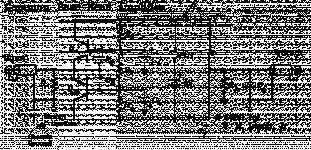
Thanks everyone for your responses so far. I did look at Leach's circuits, and I have attached the first one for comment. It certainly is simple!
I do have some issues with it:
1) Although Mr. Leach claims there can be no bias current in the cartridge, he's assuming all the leakage in the electroytic caps is equal. Difference in C6 and C7 leakage will flow through cartridge.
2) It does meet my requirement of having minimal shunt resistance, however, the internal re of the transistors is in series with the source, degrading noise figure. This is why many circuits use several transistors in parallel.
3) The circuit as it stands needs more gain for me (6dB) This could be achieved by doubling the transistor current, which would also reduce the series resistance due to Re of the transistors.
4) Although on first look it has no coupling capacitor on the input, C4 and C5 are essentially in series with the cartridge. I think the circuit would work with lower value high quality non electrolytics. If the load resistor were 4k instead of 2k (another way of getting 6dB extra gain), 10uF polypropylenes could be used for C6/C7 for a -3dB point of 4Hz or so. This would also alleviate the electrolytic leakage problem.
Paul J
Flodstroem said:Hi paul joyce
Could one of these circuits be a winner???
Marshall Leach three circuits for head-amps
http://users.ece.gatech.edu/~mleach/headamp/
Personally I have tried and uses this circuit with great success: The Common-Base Circuit
It is extremely silent (with 2N4401+4403) and there is no interference's due to switching the battery on and of. I uses Tantalum caps for this circuits (100µF/10V).
Regards 😎
Thanks everyone for your responses so far. I did look at Leach's circuits, and I have attached the first one for comment. It certainly is simple!
I do have some issues with it:
1) Although Mr. Leach claims there can be no bias current in the cartridge, he's assuming all the leakage in the electroytic caps is equal. Difference in C6 and C7 leakage will flow through cartridge.
2) It does meet my requirement of having minimal shunt resistance, however, the internal re of the transistors is in series with the source, degrading noise figure. This is why many circuits use several transistors in parallel.
3) The circuit as it stands needs more gain for me (6dB) This could be achieved by doubling the transistor current, which would also reduce the series resistance due to Re of the transistors.
4) Although on first look it has no coupling capacitor on the input, C4 and C5 are essentially in series with the cartridge. I think the circuit would work with lower value high quality non electrolytics. If the load resistor were 4k instead of 2k (another way of getting 6dB extra gain), 10uF polypropylenes could be used for C6/C7 for a -3dB point of 4Hz or so. This would also alleviate the electrolytic leakage problem.
Paul J
Attachments

Paul J
If the CB circuits are in any way superior to a CS 2sk170 it is certainly not obvious. IME the Fet sounds at least as good and you simply add more in parallel if needed. Ok, not so simple as the sound of parallel devices is different.
I have lived with similar FET/Tube based, battery powered step-ups for many years until i heard a cheap Lundahl 9206. This and a Tribute are my only step-ups these days. The transformers may have some very slight limitations but they effectively cure audiophile neurosis related to caps, batteries, regulators etc. An active step-up built with premium components will cost pretty much the same anyway.
If the CB circuits are in any way superior to a CS 2sk170 it is certainly not obvious. IME the Fet sounds at least as good and you simply add more in parallel if needed. Ok, not so simple as the sound of parallel devices is different.
I have lived with similar FET/Tube based, battery powered step-ups for many years until i heard a cheap Lundahl 9206. This and a Tribute are my only step-ups these days. The transformers may have some very slight limitations but they effectively cure audiophile neurosis related to caps, batteries, regulators etc. An active step-up built with premium components will cost pretty much the same anyway.
Hi paul
paul joyce wrote:
Yea! thats why we used the tantalum caps. But I have thought about the caps you are thinking of to. How about to rise the battery voltage ? For example to 2 x 9V = 18V or use a 12-14V Li-Ione/polymer battery to get more amplification?
Note: you must have one battery per channel. We arrange it though the batteries was switched on and off by a relay (STDP) fed by the pre/RIAA-amplifiers power source. Then you never got the problem with a separate battery-switch to forget. The 9V battery had a lifetime of over half a year and when the batteries got low (got decharged) only the signal-level vent down.
MichaelK wrote
Hi MichaelK, did you build it by your self or did you bought a finished circuit? (just asking because I have sold some of these circuits in Stockholm many years ago)
Regards 😎
paul joyce wrote:
4) Although on first look it has no coupling capacitor on the input, C4 and C5 are essentially in series with the cartridge. I think the circuit would work with lower value high quality non electrolytics. If the load resistor were 4k instead of 2k (another way of getting 6dB extra gain), 10uF polypropylenes could be used for C6/C7 for a -3dB point of 4Hz or so. This would also alleviate the electrolytic leakage problem.
Yea! thats why we used the tantalum caps. But I have thought about the caps you are thinking of to. How about to rise the battery voltage ? For example to 2 x 9V = 18V or use a 12-14V Li-Ione/polymer battery to get more amplification?
Note: you must have one battery per channel. We arrange it though the batteries was switched on and off by a relay (STDP) fed by the pre/RIAA-amplifiers power source. Then you never got the problem with a separate battery-switch to forget. The 9V battery had a lifetime of over half a year and when the batteries got low (got decharged) only the signal-level vent down.
MichaelK wrote
I have also used the Common-base amplifier for many years with a Dynavector MC pickup. Mine was powered by a single AA cell for each channel. No hum and very pleasing sound
Hi MichaelK, did you build it by your self or did you bought a finished circuit? (just asking because I have sold some of these circuits in Stockholm many years ago)
Regards 😎
Hi,
one additional option I will try someday is to place a headamp on the arm right above the cart. One will need a suitable arm for that, I have a scheu cantus here waiting. Biggest problem: weight of batterie or heavy losses through the arm wiring. You also have to ensure to stay in the arms' weight limit, of course.
JCarr posted an example a while ago here showing a tricky circuit with one half of a diff-pair on the headshell, the other in the phono amp nearby (if I'm not mistaken); just searched but didn't find it yet
With smd parts, many other solutions might be realistic.
Rüidger
one additional option I will try someday is to place a headamp on the arm right above the cart. One will need a suitable arm for that, I have a scheu cantus here waiting. Biggest problem: weight of batterie or heavy losses through the arm wiring. You also have to ensure to stay in the arms' weight limit, of course.
JCarr posted an example a while ago here showing a tricky circuit with one half of a diff-pair on the headshell, the other in the phono amp nearby (if I'm not mistaken); just searched but didn't find it yet
With smd parts, many other solutions might be realistic.
Rüidger
Hi Onvinyl
Onvinyl wrote:
This can be done if using this circuit. If you look at the battery you can see the battery poles/connections is a sort of a balanced circuit and any hum/noice picking up by the battery will cancels in the circuit. Thus you can place the battery outside the tone-arm (e.g. inside the chassis of turntable)
The electronics can be build on a PCB with the dimension of 1 x 2 cm and if using SMD parts: 1x1cm (depending on the caps used). But as you mention, there is some weights added by the 4 Tantalum 47 to 100µF-caps.
Regards 😎
Onvinyl wrote:
one additional option I will try someday is to place a headamp on the arm right above the cart. One will need a suitable arm for that, I have a scheu cantus here waiting. Biggest problem: weight of batterie or heavy losses through the arm wiring.
This can be done if using this circuit. If you look at the battery you can see the battery poles/connections is a sort of a balanced circuit and any hum/noice picking up by the battery will cancels in the circuit. Thus you can place the battery outside the tone-arm (e.g. inside the chassis of turntable)
The electronics can be build on a PCB with the dimension of 1 x 2 cm and if using SMD parts: 1x1cm (depending on the caps used). But as you mention, there is some weights added by the 4 Tantalum 47 to 100µF-caps.
Regards 😎
analog_sa said:Paul J
If the CB circuits are in any way superior to a CS 2sk170 it is certainly not obvious. IME the Fet sounds at least as good and you simply add more in parallel if needed. Ok, not so simple as the sound of parallel devices is different.
I have lived with similar FET/Tube based, battery powered step-ups for many years until i heard a cheap Lundahl 9206. This and a Tribute are my only step-ups these days. The transformers may have some very slight limitations but they effectively cure audiophile neurosis related to caps, batteries, regulators etc. An active step-up built with premium components will cost pretty much the same anyway.
I tend to agree. The 2N4403 solution is old hat. John Curl, in the (huge) Blowtorch preamp thread, was indicating that FET's are now the preferred solution, and other well respected designers like Erno Borbely and Wayne Colburn (PassDIY) are using them. However, I do like the simplicity of Prof. Leach's circuit, although the 32dB I need is a stretch for a one stage amp. I think I will make one up with the bipolars, and then another with similar topology, but using parallel Fet's, and non electrolytic caps. I suspect the current consumption will be need to be much higher to optimise noise performance, so it will probably need a rechargeable battery. I can then compare these two to the Ortofon transformer I have which is designed for the cartridge.
Paul J
paul joyce, a good idea
paul joyce wrote
You must use Tantalum caps for the bipolar circuit (low leakage compared to electrolytics)
Yes, 2N4401-03 is old hat bur there is hardly no other bipolar with such a low noise figure. They are a very special transistor (constructed in a special process). The benefit to use fets is that their noise figure spectrum is more "pleasant" for the human ear than is from the bipolars (if comparing fet and bipolar with same noise figure/dB)
There is a lot of rechargeable batteries for sale at eBay (all kinds of battery technologies). I would like to recommend the Li-Polymer 11-14V (3-4 cells, 1-2Ah) and also a suitable charger for the Li-P (Li-P. has a very low self-decharge and is lighter than other types).
Do you have any information about a circuit for the fet topology ? Maybe a link?
Paul, your idea to compare the different topology also including a transformer topology looks to be very interesting. Keep us informed.
Regards 😎
paul joyce wrote
However, I do like the simplicity of Prof. Leach's circuit, although the 32dB I need is a stretch for a one stage amp. I think I will make one up with the bipolars, and then another with similar topology, but using parallel Fet's, and non electrolytic caps. I suspect the current consumption will be need to be much higher to optimise noise performance, so it will probably need a rechargeable battery. I can then compare these two to the Ortofon transformer I have which is designed for the cartridge.
You must use Tantalum caps for the bipolar circuit (low leakage compared to electrolytics)
Yes, 2N4401-03 is old hat bur there is hardly no other bipolar with such a low noise figure. They are a very special transistor (constructed in a special process). The benefit to use fets is that their noise figure spectrum is more "pleasant" for the human ear than is from the bipolars (if comparing fet and bipolar with same noise figure/dB)
There is a lot of rechargeable batteries for sale at eBay (all kinds of battery technologies). I would like to recommend the Li-Polymer 11-14V (3-4 cells, 1-2Ah) and also a suitable charger for the Li-P (Li-P. has a very low self-decharge and is lighter than other types).
Do you have any information about a circuit for the fet topology ? Maybe a link?
Paul, your idea to compare the different topology also including a transformer topology looks to be very interesting. Keep us informed.
Regards 😎

Is the low input impedance of common base circuits sufficient to correctly load a moving coil cartridge ? Is it not a current input rather than a voltage input ? I think such circuits have been used for microphones and then abandonned because they provided too much damping.
~~~~~ Forr
§§§
~~~~~ Forr
§§§
The idea is to set the current to get the impedance that you want, modern cartridges do not recommend virtual earth inputs.
The attached pdf is a 3V version of the Marshall Leach common base design with an attempt to run the transistors (actually 2n4401/3) running at constant power and 25 dB gain.
This version has much better current stability with battery voltage than the original.
2x AA batteries will last a long time so no need for a switch, unlike the original which would eat p3 batteries.
Simulation shows that reducing the ecap values can cause a strange bass resonance
The attached pdf is a 3V version of the Marshall Leach common base design with an attempt to run the transistors (actually 2n4401/3) running at constant power and 25 dB gain.
This version has much better current stability with battery voltage than the original.
2x AA batteries will last a long time so no need for a switch, unlike the original which would eat p3 batteries.
Simulation shows that reducing the ecap values can cause a strange bass resonance
Attachments
- Status
- Not open for further replies.
- Home
- Amplifiers
- Solid State
- Moving Coil preamp design