
Hi, as I'm pretty new to audio equipment and power supply building, I thought I would ask you a couple questions about how you do it regarding safety and certifications.
Regarding power supplies:
For you without formal electronics education, how do you do it?
While I'm pretty confident I coud get it right (the first time ), I also have quite a bit of respect for high power applications, having seen some (non-audio) faulty equipment.
My other question is regarding grounding. Most (all?) the amp designs I have looked at connects to the mains ground. As I am in the unfortunate situation of not having grounded outlets, I was wondering if anyone have any comments on that ?(Considering that the amps was designed with grounded mains
in mind)
As I said, I am confident enough in my skills (haveing built some low-power equipment) to know I can make it work, but I still want a second opinion.
Regards,
Stein
Regarding power supplies:
For you without formal electronics education, how do you do it?
- Do you take your chances, knowing you did a good job?
- Do you build it, then get it checked by someone with formal education (engineer)?
- Do you leave it to someone with formal education, detailing parts and layout?
While I'm pretty confident I coud get it right (the first time
), I also have quite a bit of respect for high power applications, having seen some (non-audio) faulty equipment.My other question is regarding grounding. Most (all?) the amp designs I have looked at connects to the mains ground. As I am in the unfortunate situation of not having grounded outlets, I was wondering if anyone have any comments on that ?(Considering that the amps was designed with grounded mains
in mind)
As I said, I am confident enough in my skills (haveing built some low-power equipment) to know I can make it work, but I still want a second opinion.
Regards,
Stein


Good question
One place to start (I did anyway) is with G.Randy Slone's book on electricity and electronics (those words are in the title). The first few chapters includes step-by-step directions on building a power supply for testing amps and other projects. Part of the step-by-step is information on how to do this safely. I recomend actually building the project because you can actually use the PS later as a practical piece of test equipment and because when you are done you will have a pretty good idea of how to construct a PS for an amplifier project.
I also suggest something I added. I made a check list of each test described by Slone. I print out a fresh copy and follow it exactly for every PS I have constructed. If you do this and follow Slones safety recomendations religiously you should be ok.
One more thing to add. Choose a place to do the work and have a qualified electrician check out the mains service you will be using. DO NOT ASSUME your house has been wired correctly. Hot may be neutral and visa versa -- and just because there is socket with three holes does not mean you have a ground connection. You may infer I have had an unpleasent personal experience in this reguard! It's your butt- trust no one! KNOW!!
One place to start (I did anyway) is with G.Randy Slone's book on electricity and electronics (those words are in the title). The first few chapters includes step-by-step directions on building a power supply for testing amps and other projects. Part of the step-by-step is information on how to do this safely. I recomend actually building the project because you can actually use the PS later as a practical piece of test equipment and because when you are done you will have a pretty good idea of how to construct a PS for an amplifier project.
I also suggest something I added. I made a check list of each test described by Slone. I print out a fresh copy and follow it exactly for every PS I have constructed. If you do this and follow Slones safety recomendations religiously you should be ok.
One more thing to add. Choose a place to do the work and have a qualified electrician check out the mains service you will be using. DO NOT ASSUME your house has been wired correctly. Hot may be neutral and visa versa -- and just because there is socket with three holes does not mean you have a ground connection. You may infer I have had an unpleasent personal experience in this reguard! It's your butt- trust no one! KNOW!!
From someone who works with very high powered equipment every day, the most important thing you can remember is do NOT ground yourself!
There's something called the "one hand rule" where you always keep one hand behind your back. It's not always practical, but safe. It keeps you from leaning on something that will ground. If you do get shocked, you don't want the power going from arm to arm, arm to leg is much better (if you think about it, arm to arm crosses right past your organs, mainly your heart).
Electricity is dangerous, but almost every time I see someone get shocked (or have to read an accident report about it the next morning when I get to work), it's because of carelessness. If you're careful, and smart about it, you'll probably be fine.
There's something called the "one hand rule" where you always keep one hand behind your back. It's not always practical, but safe. It keeps you from leaning on something that will ground. If you do get shocked, you don't want the power going from arm to arm, arm to leg is much better (if you think about it, arm to arm crosses right past your organs, mainly your heart).
Electricity is dangerous, but almost every time I see someone get shocked (or have to read an accident report about it the next morning when I get to work), it's because of carelessness. If you're careful, and smart about it, you'll probably be fine.
sam9:
I'll have a look at that book. Thanks for the reference. About the mains wireing, you are twice right. It's a bit different here in Norway (Yes, your geograpics knowledge is pretty good), and no, the wireing in this house has not been done properly.
Mr. Pass:
Yes, I'll probably have to do that. You say standing in water is bad, but holding a can of beer would be ok, wouldn't it?
Regards,
Stein
I'll have a look at that book. Thanks for the reference. About the mains wireing, you are twice right. It's a bit different here in Norway (Yes, your geograpics knowledge is pretty good), and no, the wireing in this house has not been done properly.
Mr. Pass:
Yes, I'll probably have to do that. You say standing in water is bad, but holding a can of beer would be ok, wouldn't it?
Regards,
Stein

Grounds and safety
It's probably a good idea to repeat the obvious. The following come from a couple decades in ham radio, audio and the odd job fixing o'scopes and electronics while a physics student:
The "one hand" rule is imperative. I know it's impractical, but it is a good idea to work with another person.
Grounds -- make sure that the ground lead connecting your service panel is at least connected to the "street side" of the water mains. Make sure that both the water meter and water filter (if you have one) are bridged with a #4 copper braid.
High voltages will jump, longer than you think too!
Clean circuit boards of flux, solder balls, dirt etc.
It's not a bad idea to stand on a rubber mat (although if you work with CMOS you will want to get one from Allied or Newark.)
Furthermore, stop when you get tired. I have seen this repeated on rec.radio.amateur.homebrew, on the PIC list and elsewhere -- a guy can't figure out what's wrong with his circuit at 3:00 a.m. -- he has the DVM probes on the schematic, not the circuit board!
It's probably a good idea to repeat the obvious. The following come from a couple decades in ham radio, audio and the odd job fixing o'scopes and electronics while a physics student:
The "one hand" rule is imperative. I know it's impractical, but it is a good idea to work with another person.
Grounds -- make sure that the ground lead connecting your service panel is at least connected to the "street side" of the water mains. Make sure that both the water meter and water filter (if you have one) are bridged with a #4 copper braid.
High voltages will jump, longer than you think too!
Clean circuit boards of flux, solder balls, dirt etc.
It's not a bad idea to stand on a rubber mat (although if you work with CMOS you will want to get one from Allied or Newark.)
Furthermore, stop when you get tired. I have seen this repeated on rec.radio.amateur.homebrew, on the PIC list and elsewhere -- a guy can't figure out what's wrong with his circuit at 3:00 a.m. -- he has the DVM probes on the schematic, not the circuit board!

I´m a swede living in Norway and I know from personal experience that the mains wiring in this country is different from back home in Sweden. It´s a 240V system alright, but it´s 120V in one lead and 120 in the other and the fusebox have two fuses for each cirquit fused. So when I fex. turn the lightswitch off to hang a roof lamp or something one lead is still 120V. Finding this out standing on the top of a ladder, holding a heavy lamp, is not a nice experience! On top of all things, I´ve managed to repeat this more than once.
BTW, alcohol would be a pretty crappy electrolyte wouldn´t it? Suppose beer would make a greater hazard than aquavit in this respect.
BTW, alcohol would be a pretty crappy electrolyte wouldn´t it? Suppose beer would make a greater hazard than aquavit in this respect.
On the Akavit again?
I wonder how they do "ground fault interrupt" receptacles in Norway or Sweden. Pretty much standard gear on this side of the pond.
Seem to be quite a few Scandinavians on this board. I wonder if they appreciate how much Norwegians and Swedes are discussed on the National Public Radio in the US. Of course, I am thinking of Garrison Keilor from whom we learn of the sour herring and stinky cheese and the interesting relationships between the Lutheran and Catholic flock in Lake Wobegone, Minnesota.<p>and of course, the <em> lingua franca</em> in Minnesota is peppered with, what best could be called "Skandineglish"!
I wonder how they do "ground fault interrupt" receptacles in Norway or Sweden. Pretty much standard gear on this side of the pond.
Seem to be quite a few Scandinavians on this board. I wonder if they appreciate how much Norwegians and Swedes are discussed on the National Public Radio in the US. Of course, I am thinking of Garrison Keilor from whom we learn of the sour herring and stinky cheese and the interesting relationships between the Lutheran and Catholic flock in Lake Wobegone, Minnesota.<p>and of course, the <em> lingua franca</em> in Minnesota is peppered with, what best could be called "Skandineglish"!
So, to sum up all the advices, use common sense, drink akevitt (That's how it is spelled in norwegian) and use a grounded plug.
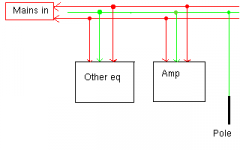
Now, as I said I don't have a grounded outlet in my room. Running a wire frm the kitchen is possible, but only a short-term solution (and not a good one for me).
Now, I have a perhaps unorthodox solution to the problem:
I run pretty much everything electric from extension cords with muliple outlets, and they are all with grund plugs. If make an extension cord with only ground connected, plug it into one of these, and run it out the window to an iron pole driven deep (say 1m/3ft)m into the ground. Wouldn't this be sufficient?
As a side note, what would using a dedicated ground like this do to hum loops?
Now, as I said I don't have a grounded outlet in my room. Running a wire frm the kitchen is possible, but only a short-term solution (and not a good one for me).
Now, I have a perhaps unorthodox solution to the problem:
I run pretty much everything electric from extension cords with muliple outlets, and they are all with grund plugs. If make an extension cord with only ground connected, plug it into one of these, and run it out the window to an iron pole driven deep (say 1m/3ft)m into the ground. Wouldn't this be sufficient?
As a side note, what would using a dedicated ground like this do to hum loops?
- Status
- This old topic is closed. If you want to reopen this topic, contact a moderator using the "Report Post" button.
- Home
- Amplifiers
- Solid State
- Power supplies and safety